compost bin shadows
The weather’s not very different from last month, but the light has changed. You can tell, even in the face of coronavirus time-fuzz, that summer is sliding gently into fall. The blueberry bushes sit leafy but fruitless inside their net cages. Soon I will take the nets off; there’s nothing left for the birds to loot. Tomatoes are rolling in, and every morning brings an armload of cosmos and zinnias to  bundle into the house for bouquets. The flowers mostly grow in their raised beds, but a few volunteers decorate random spots and edges of the garden. Volunteer cosmos: a lovely phrase.
In addition to Charlie, I’ve had a crew of bunnies trimming my lawn. I’m happy to see them eating clover instead of the flowers edging my deck. In early June there were three bunnies; now there’s just one. What has the summer done with them? Are they eating greener clover somewhere else? Bunnies are a prey species, making them a sort of clover for hawk, owl, and eagle. Everyone has to eat.
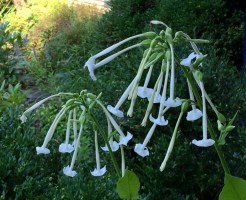
scented jasmine tobacco
I always thought animals knew what to eat by instinct, but the fawns have changed my mind. They wander through with their mamas and you’d think they would eat what their mamas are eating. Not exactly. I’ve seen them nibble my foxgloves and jasmine tobacco, both of which are poisonous, and neither of which a smart mama deer will touch. But lately they’ve been leaving the foxgloves and tobacco unmolested. This, I suppose, means they’ve learned something in their first summer on earth. Telling the good from the bad is a skill that comes with experience. I hope they didn’t get too sick learning it.
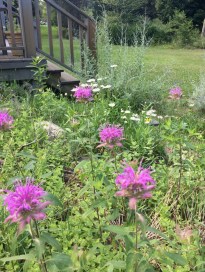 Charlie came with his ride-on mower and cut my lawn yesterday. During the ban on yardwork my laissez-faire lawn got terribly uneven and lumpy looking, but Charlie has now smoothed it back into a semblance of suburban lawn. This is typically a contact-free event anyway – Charlie drives up in his truck, powers the mower across the yard, runs the trimmer, runs the blower, and off he goes. We like to chat if I’m outside, but in the interest of Social Distancing I’ll just wave for now.
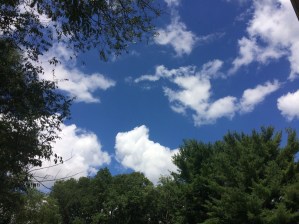 browsing, lunches with friends, and visits with far-flung family are cancelled. But when I walk outside and see the lawn, the flowers, the garden, the trees, the sky, I feel the calm and satisfaction they have always brought me, huge, deep, and familiar, and other considerations fall away. Deep breaths. Yes, the world is still here. What a relief.
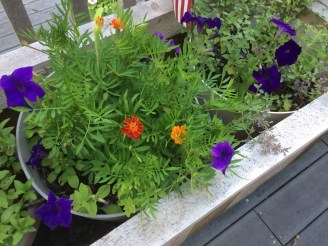 themselves before, but this had been a generous spring for horticulture, if not for human health.
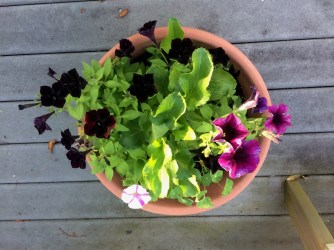 And time did. Petunias happened spontaneously among the marigolds, with no input from the gardener. Last year’s petunias were one group of black and one group of very pale yellow. The photos show how they organized themselves for their comeback. According to Burpee, “petunias are sensitive to high temperatures and may change color or produce a stripe when they too warm.” The next surprise will be to see if they change to last year’s colors when the weather cools.
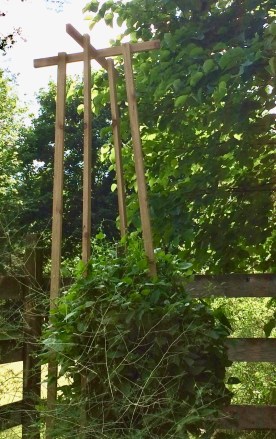 somewhere else to go. It found the innocently growing ferns of the asparagus patch, and swamped them.
 It had thin spots, jagged edges way up high, rambly bare twigs, but still managed to produce a bumper crop of fruit suitable only for chipmunks, a thin scrim of flesh over a fat seed.
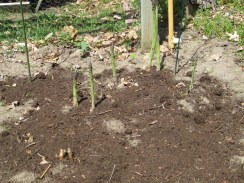 The fenced garden has already been producing asparagus. This is another of many fine things I enjoy as the fruit of someone else’s labor: I moved into the house one summer, and the next spring all this asparagus appeared with no effort on my part. I had never seen asparagus in its neonatal condition, and it made me laugh. It looks for all the world like someone snuck out into the garden when nobody was looking, and stood a lot of asparagus spears up in the dirt as a joke.
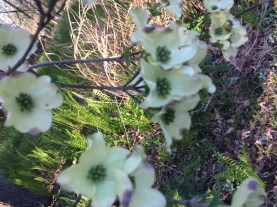 And then there’s the dogwood tree: another example of something wonderful that just showed up that first spring. Wanting to add my contribution to all this largesse, it pleases me no end to think of the future householders looking out the window to what was once my yard on a fine spring day – and may it be many years from now – to be greeted by the daffodils I planted and the redbud trees I have placed as understory in the woods, and see that someone loved this place, and worked to make it more beautiful.
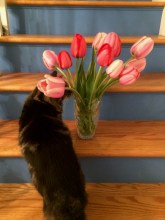
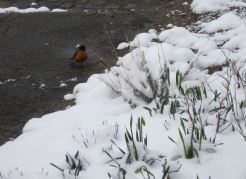 businesses deemed inessential. Including garden stores. While I’m as outraged as the next gardener that she doesn’t consider seeds and plants for warm weather crops essential, I, apparently unlike some others, have looked out the window. This is what I see.
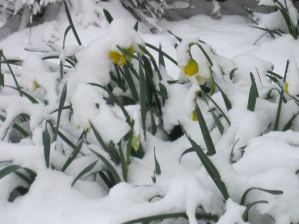 proof: snow on my daffodils, and the fact that snow does not bother my daffodils. They expect it. People ought to, but they say things like, “Late Season Storm Barreling Down,” instead of “Still Cold In Michigan But You Knew That, It’s Why You’re Not Out There Planting Your Tomatoes.”
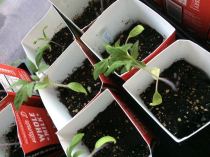 Upstairs in my front window, the tomato seedlings I started weeks ago are staying cozy, unfurling themselves a leaf or two at a time. Change is coming, slowly. When it gets here, my seedlings and I will be ready.


 Robin Richstone