Our power was out for five days, but like birds in spring it did come back at last. We cleaned out the fridge, and my thoughts turned to starting tomato seeds.
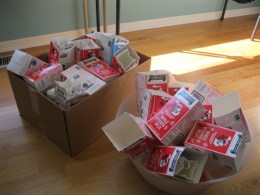 First step was to set up long folding tables in front of the big, sunny windows in my upstairs guest room, with trays on them to catch water. Next, I rounded up my collection of milk cartons. We began collecting the empty half gallon paper cartons in late summer, slicing off the tops, washing them out, and tossing them into a tub and a box in the garage, along with a few smaller
 containers. I carted these upstairs, and sat down to make drainage holes by sticking in a paring knife and twisting it, four holes per carton.
I filled the now-empty collection tub with a bag of potting soil. I’ve experimented with various types of potting soils and seed-starting mixes, and for me regular potting soil gets the best result. Seed-starting soil is very fine, and I have trouble keeping it around the roots of the seedlings when I plant them out in the garden. You should, however, test this with your own style of gardening, because you might easily have different results.
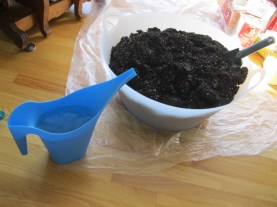 Any bag of potting soil that’s been sitting around a Michigan warehouse in winter will be pretty dry, so once it was in the tub I added a potful of water, and stirred it with my trusty trowel. I went down to the kitchen and fixed a cup of tea, to give it time to soak in.
Next, since this session was strictly for tomatoes, I filled the milk cartons only
about a third of the way up with dirt. Which is the same as soil, but once  I’m getting my hands in it I think of it as dirt. Soiling yourself is what babies do in their diapers. Getting dirty means you’re having fun.
Now at last, time to plant the tomato seeds. I set the cartons in the trays on the tables and planted two or three seeds in each. Ten milk cartons fit in a tray, and I like to have each tray seeded with one variety of tomato. Unfortunately, we were late starting on our carton collecting this year and I ran out before I could start the cherry tomatoes, but I’ll find something else for them. If you’ve ever had tomato vines in your garden that flopped over and sat there for a while before you tried to tie them up, you will have discovered that tomato stems put out roots wherever they touch the ground. As the seedlings grow I will fill in around their stems with more dirt. By the time they are out the top of the carton they will have nice big sturdy root systems underneath.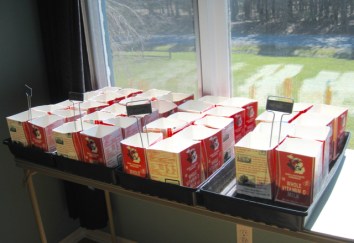
Last step: watering them, then standing back to admire my work. The cartons look very cheerful peering out the window, and they look cheerful from outside, too. My neighbor says she knows its spring when she sees them up there. I know it’s spring when they start to grow.

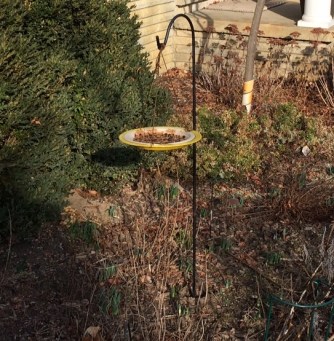 made of a paper plate in a plastic holder, smeared with peanut butter, sprinkled with birdseed, and suspended with three pieces of cord from whatever likely spot there was to hang it from.
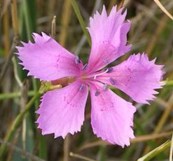 merrily on my way to a dissertation on garden flowers, the pinks I know best, when I was brought up short: the word “pink” originally meant a small coastal fishing vessel. Even the most stalwart scholars have had trouble figuring out how we got here from there – “derivation unclear,” they say – but in broad outlines it is, or might be, something like this: the boat was small;
 the word began to stand in for any of the smallest things in a group, for instance your pinkie finger, or the smallest flowers in the garden; then to one specific small flower; then the color of that flower (and the shape of that flower’s ragged edge, “pinked”). It became the canonical female color when a little girl whose grandmother called her Pinky – smallest member of the family – commissioned a portrait of the girl wearing the color.
 But why not reclaim the color for its assertiveness, its kinship to the powerful red, and the way it matches the inside of my cat’s mouth when she shows her fangs. She kills things with those fangs. Let’s reclaim the fighting side of pink for womanhood. Warning: do not mistake pointy ears and pinkness for submissiveness. I have never met a submissive cat.
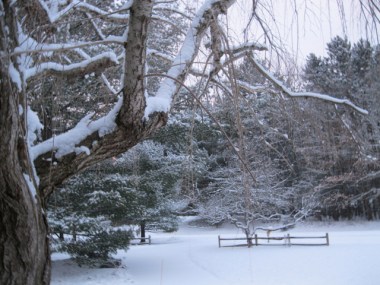 Something like that is going on outside right now – hard to say whether what’s falling is rain or snow. I saw footprints that looked suspiciously like the woodchuck, who should be asleep in her burrow until next month. She would not have seen her shadow this morning, but there’s nothing for her to eat so she’d be wise to go back to sleep. I wonder if she knows about Punxsutawney Phil. How did he end up getting all the woodchuck glory? Do you have to be a male woodchuck to get the job, and if so, how do we know Punxsutawney Phil qualifies? Did some foreign agency help him out? Are the deer behind this? I wouldn’t put anything past the deer.
 This name is most agreeable to a writer; and maybe that’s what makes me put so many of them into saucers full of pebbles or pots of dirt, set them near my desk, water them, and hope. Other narcissi – big yellow jonquils, white, yellow, and even pink daffodils – are waiting patiently in their beds in the yard and garden, for spring. Because I nudge the paperwhites into bloom in January, they represent winter to me, not spring: winter as pure beauty. Winter to be appreciated for itself, not as a way-station to somewhere else. This is how I look at them, as a kind of indoor snow, but the paperwhites themselves lean against the window glass. They grow toward the slowly increasing hours of light.

