Sooner than usual this year, the ground is thawing out and spring plants are taking advantage. This includes a lot of Michigan weeds I still haven’t learned to recognize, a fair amount of incipient garlic mustard which I do, sadly, recognize, and, happily, lots of narcissus. The yellow ones that were first up have been joined by many friends. I see the lavender I planted between batches of them, though not in new growth yet, will need to be pruned back. Lamium, sturdiest of groundcovers, reasserts itself; nubs begin to swell on the forsythia (Spring’s Yellow Telegram – how does the rest of that poem go?); fingers of peony leaf, red instead of green, reach out of the bare dirt and scratch the air.
There’s a lot of deadfall to clear from the small wooded area out back, including the better part of a tree hacked down by Edison as it dangled, mid-air, across a cable, threatening more damage when we’d barely escaped from the Big Power Outage. It’s still in large chunks, but will make good firewood if Doug’s chainsaw is up to the task.
I patrol the yard and garden, thinking of different schemes for all those seedlings soon to sprout in my upstairs window. I am learning to landscape with herbs, since they seem to repel the deer, the squirrels, and even the woodchuck. Miraculous basil, worthy of its royal name.
Speaking of squirrels, I have an update on my peanut-butter-and-hot-spiced-birdseed feeder. Among the squirrels there’s one that’s very, very fat even for a Michigan Gigunda Squirrel, by which I assume he has advanced food-gathering techniques. I noticed him lurking near the feeder at various times during the day, but never saw him on it until near dinnertime one day. By that hour the birds had eaten most of the seeds, but a lot of the peanut butter was still in place; and Mr. Gigunda climbed boldly up, reached out his little gray hands, and scraped all the remaining peanut butter into his mouth. I didn’t see the days in between when he figured this out, but it seems when the seeds are gone, the hot pepper goes with them. Once he was down to the peanut butter he was in the clear. And that’s okay with me. I’m happy to let Mr. Gigunda have the peanut butter as long as he lets the birds have the seeds.
For an interesting look at what your weeds can tell you about your soil, try this: Weeds as Indicator Plants . Although they could also be telling you what kinds of seeds spilled out of your birdfeeder.
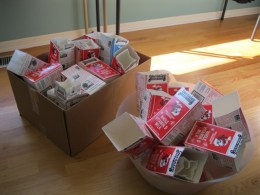 First step was to set up long folding tables in front of the big, sunny windows in my upstairs guest room, with trays on them to catch water. Next, I rounded up my collection of milk cartons. We began collecting the empty half gallon paper cartons in late summer, slicing off the tops, washing them out, and tossing them into a tub and a box in the garage, along with a few smaller
  containers. I carted these upstairs, and sat down to make drainage holes by sticking in a paring knife and twisting it, four holes per carton.
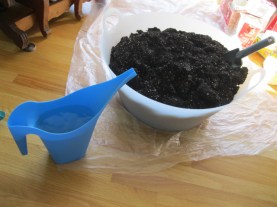 Any bag of potting soil that’s been sitting around a Michigan warehouse in winter will be pretty dry, so once it was in the tub I added a potful of water, and stirred it with my trusty trowel. I went down to the kitchen and fixed a cup of tea, to give it time to soak in.
 I’m getting my hands in it I think of it as dirt. Soiling yourself is what babies do in their diapers. Getting dirty means you’re having fun.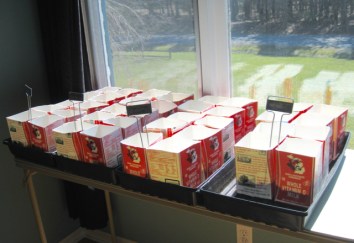

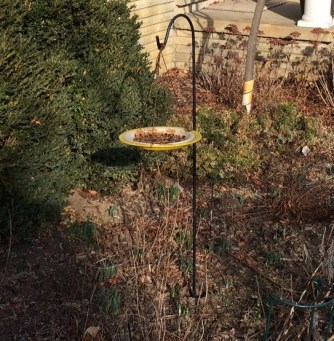 made of a paper plate in a plastic holder, smeared with peanut butter, sprinkled with birdseed, and suspended with three pieces of cord from whatever likely spot there was to hang it from.
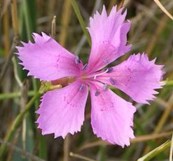 merrily on my way to a dissertation on garden flowers, the pinks I know best, when I was brought up short: the word “pink” originally meant a small coastal fishing vessel. Even the most stalwart scholars have had trouble figuring out how we got here from there – “derivation unclear,” they say – but in broad outlines it is, or might be, something like this: the boat was small;
 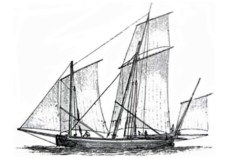 the word began to stand in for any of the smallest things in a group, for instance your pinkie finger, or the smallest flowers in the garden; then to one specific small flower; then the color of that flower (and the shape of that flower’s ragged edge, “pinked”). It became the canonical female color when a little girl whose grandmother called her Pinky – smallest member of the family – commissioned a portrait of the girl wearing the color.
 But why not reclaim the color for its assertiveness, its kinship to the powerful red, and the way it matches the inside of my cat’s mouth when she shows her fangs. She kills things with those fangs. Let’s reclaim the fighting side of pink for womanhood. Warning: do not mistake pointy ears and pinkness for submissiveness. I have never met a submissive cat.
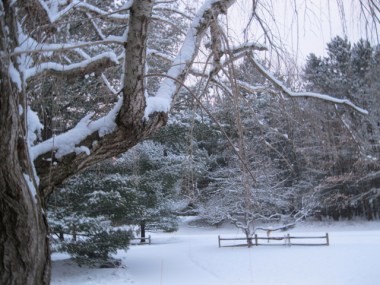 Something like that is going on outside right now – hard to say whether what’s falling is rain or snow. I saw footprints that looked suspiciously like the woodchuck, who should be asleep in her burrow until next month. She would not have seen her shadow this morning, but there’s nothing for her to eat so she’d be wise to go back to sleep. I wonder if she knows about Punxsutawney Phil. How did he end up getting all the woodchuck glory? Do you have to be a male woodchuck to get the job, and if so, how do we know Punxsutawney Phil qualifies? Did some foreign agency help him out? Are the deer behind this? I wouldn’t put anything past the deer.
 This name is most agreeable to a writer; and maybe that’s what makes me put so many of them into saucers full of pebbles or pots of dirt, set them near my desk, water them, and hope. Other narcissi – big yellow jonquils, white, yellow, and even pink daffodils – are waiting patiently in their beds in the yard and garden, for spring. Because I nudge the paperwhites into bloom in January, they represent winter to me, not spring: winter as pure beauty. Winter to be appreciated for itself, not as a way-station to somewhere else. This is how I look at them, as a kind of indoor snow, but the paperwhites themselves lean against the window glass. They grow toward the slowly increasing hours of light.
 Robin Richstone