January Flowers

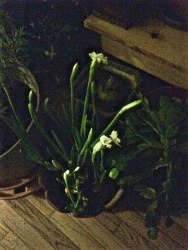
One of my New Year traditions is potting up dozens of amaryllis and paperwhite narcissus bulbs. They respond enthusiastically to emerging from my chilly, dark closet into the brightly lit studio. I know how they feel. Some will sit regally on elegant glass pebbles; some will stand like linemen with their hands in the specially prepared dirt. The paperwhites aren’t particular about this, but the amaryllis like to be up to their round middles in storebought soil, top halves exposed.IMG_3095

Catalogs will tell you they need four to six weeks from potting to blooming, but their enthusiasm leads them on to precociousness. The first narcissus buds swell at about two weeks and they bloom in waves, from those nearest the windows on across the room. The amaryllis are right behind them.

This process is called forcing. Forcing the bulbs. Have I forced them to bloom indoors? Would they rather be outside right IMG_3093now? Their daffodil cousins are happy enough living outdoors, sleeping under a nice blanket of snow at the moment; but the paperwhites would die in the wilds of a Michigan winter. They are being coddled in here, with heat, and warm storebought soil, and water in its liquid state. They stretch luxuriantly toward the window. I may be waking them up, but no more than that. The force is theirs, not mine.
New Year’s Eve

I’m superstitious about resolutions. I always make one for New Year’s and keep it, but I am deeply certain that if I told anyone what it was, or even wrote it down, I would break it right away. So I can’t tell you what mine are, but I will tell you what they are not: they are not about diet or exercise. Ever. The obvious trick to making a resolution you will keep, is to make one you will enjoy keeping. Tedious and unpleasant subjects impose themselves on a new year without any help; no need to encourage them.

Sometimes I leverage a resolution with my annual urge to clean and organize. I get this urge every year, so it’s strange that I continue to find things I can’t believe I didn’t already throw out. Apparently uselessness takes a few cycles to register.

New Year’s Eve was very big in the Pasadena area, where I used to live. There was no post-Christmas let-down, because everyone was busy all week sticking roses into tiny vials, gluing chrysanthemums onto faux cartwheels, and giving directions to lost visitors.

On New Year’s morning we often went out to watch the parade live, but sometimes we were too tired. One of those New Years led me to write this poem.


January First, From Pasadena

On New Year’s morning we wake
to the sound of airplanes over the house.
The children run outdoors
and read the sky for us: Happy New Year
From 31 Flavors. We yawn and stretch.
They watch the parade on television.
Network coverage ends in time
for us to hear the groan of real drums
muffling up the canyon from the park,
where sixty flower-covered fantasies
of a thousand high-school girls
who couldn’t babysit for me last night
are pulling into numbered spots,
the end of the line, to lose their flowers
slowly to the crowd.
The logo of a finance company
tangles in our trees;
lost messages smudge the sky
like last year’s resolutions.
I feel my yearly impulse to clean house.
Raising all the windowshades,
I start with the sky.

(first published in Seneca Review)


Snowfall

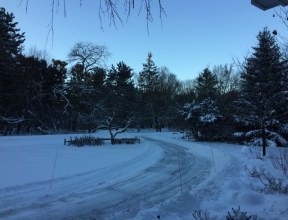
Yesterday we had a long snowfall, hours of it floating peacefully by the window as I finished making Christmas presents and packed them up to mail. I have no idea whether indigenous Alaskans have hundreds of different words for snow or not, but judging by what fell past my window, they should have. It varied from almost gritty fineness to fat puffs; from white to grey; from sparse to heavy. It varied in how fast it built up, how much it blew around, and how much in glittered in reflected light.

It did not vary in how deeply happy it made me. Sitting in this chair, at this window,

view

blue morning snow

I have seen the hundreds of narcissus I planted blooming in April; the progression of flowers from foxgloves in May to asters in September; the bright leaves of October and the elegant bare branches of November. And now there is the snow, decorating the last standing seedheads and smoothing all things low and rough into voluptuous cushions. I put on my big coat full of feathers and took a little walk in it, leaving the packages to be mailed in the morning.

It is that morning now, the snow no longer falling and the roads all plowed.

deer tracks

deer tracks

The sun’s not over the pinetrees yet, the light soft and blue. Looking out the window I can see where the deer have foraged among those standing seedheads. Much as I complain about the deer, I hope they found something to eat.

A Memorial

Shortly after I moved to Ann Arbor, still puzzling over how to garden in this very different place, I went to a quilting session at the home of Kathy French. One look at her front yard and I knew this was the person whose Michigan gardening advice I wanted. A gentle slope down from house to street bore an elegant tumble of gorgeous perennials, varied in color, shape, and contrast, but always companionable with each other. She told me the front lawn had been dug up to connect to the city sewers, and when they said ok, now we’ll put the sod back, she said, please don’t. She did this instead: compost, mulch, more soil, and perennials galore.

It was from Kathy that I learned I could plant perennials in October here; that sage kathy's peoniesand thyme would stay green all winter; that deer didn’t eat fragrant herbs; and that it’s true, as they say, that the best thing for the garden is the shadow of the gardener. Not only did she give me advice, she also divided her peonies and gave me the divisions.
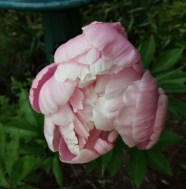
Kathy was very keen in her observations of the natural as well as the constructed world. She brought a level of portraiture to her quilts whether the design was scenic or geometric, working with very small pieces of fabric to bring out light and depth that made the whole greater than the sum of its parts. It was exactly the way she did her garden: with care and attention to detail, but with freedom of spirit. She got all the pieces not just to work together, but to be happy in each other’s company.

kathy's peony 2Kathy moved away from Ann Arbor to another place she loved, but she kept in touch with us. I saw her for the last time in the spring; this fall she died after an illness of a few months. But the world still holds her beautiful quilts; and the peonies she gave me are doing well, growing, and in their proper times still blooming, in my front yard.
 

Rain, Snow, Rain

Fall is getting ready to shift into winter. There’s some color left in the trees, but a little snow sifted in with the rain the other day and clung to the north-shadowed parts of the yard for a while. Like any premonition it soon passed.

IMG_2770

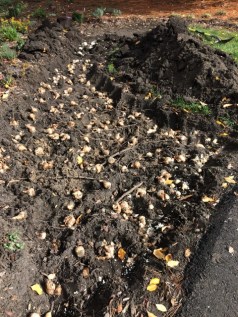
last bed of bulbs going in

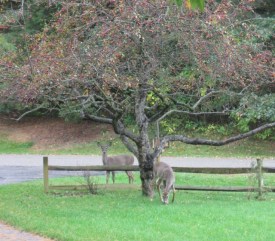
A few last chores stood ready for me: planting the rest of the bulbs; cutting the tops from the asparagus patch which I’d left because they were still green; raking up more leaves for the compost pile; sweeping up pine needles to mulch the blueberries; checking that the dogwood trunks are well wrapped against the deer. The buck that has moseyed through my yard for a few years now is up to eight points, and I’m sure is one of the destroyers of bark on my dogwoods, but has yet to leave any antlers in the woods for me, the ungrateful wretch.

I also had to bring in the ceramic birdbath, which is not winter-proof. It had a skim of ice this morning, and the birds did not seem to be bathing in it any more, though they were still enjoying the seedheads left standing a short distance away. Zerlina watched from the window, wearing an expression of slight alarm. She has always preferred the inanimate objects in her life to stay put unless she moves them herself.

IMG_1995

Deer respectful of a crabapple tree

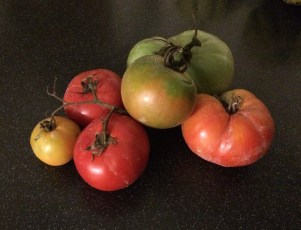
And then Sunday morning Doug and I ate the very last of the tomato crop. These were the ones I brought in green on a first-frost warning, and they have ripened nicely indoors. Even ripened this way they are much tastier than supermarket tomatoes, not being varieties bred for shipping carton survival. I cut them up and scrambled them into some eggs, and we had one last bright burst of harvest before the seasons move on to their next thing.

Frost

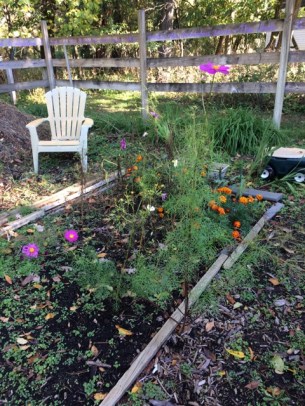
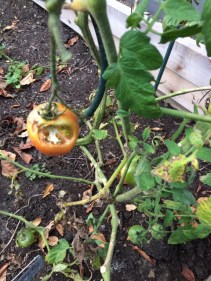
Our very late first frost came in the early morning hours of last harvestOctober 26th.  A frost advisory can lead to much agonizing – what to cut and bring in, what to cover and leave out – but this time it was clear. Harvest everything that was left, which wasn’t much. In the shortened hours of late October daylight very little was ripening anyway. I brought in my last armload of green and part-green tomatoes, and a few last cosmos and cornflowers, which looked oddly like William Morris wallpaper as they stood in their vase.

On the chilly weekend that followed, I pulled deceased plants, collected tomato stakes, and Doug brought out boards cut to length and fitted with corner pieces, to set up one more raised bed in last flowersthe last remaining spot in the garden. He had offered to do this last spring, but I’d already planted the area in its unraised state so it had to stay as it was. Setting the bed up now would avoid timing issues next spring.
I had a warm jacket on, and a scarf, and gloves. Doug was in shirtsleeves. He did have gloves, but they were work gloves to keep splinters out of his hands. I’m not sure if he was always a polar bear, or if he became one after some number of years living in Michigan.

“This is great,” he said, “I’m not sweating.”

I like to avoid sweating as much as the next person, but we could have had another twenty degrees out there before it became a problem. Still, I was glad he wasn’t suffering as he built another garden improvement for me.

When we finished and went inside, Zerlina came over and nudged my leg. I reached down to pet her, and though she didn’t scream, she did jump and run away, only to come back and sniff my hand suspiciously. No way she was going to let me warm my hands up on her. I would have to warm them up on Doug, instead.

Quieting Down

The roar of tomatoes in the garden is dialing down to a low rumble. They ripen very slowly now, but on the positive side the squirrel has stopped eating them. I’m guessing cooler weather has inspired him to gather more walnuts and acorns, things he can stash for the winter. Mucking around in my tomatoes is all very well in late summer, but it’s October, and time to get real.

The squirrels need things to eat all winter because they’re up, out, and running around. They have this deal with the trees, where the trees give them all the nuts they can haul away, and in return the squirrels plant them in ridiculous places the trees could never have come up with on their own. The squirrels plan to dig them all up and eat them as winter proceeds, but as you’d expect from their louche and scatterbrained behavior, they lose track; thus establishing the next generation of trees.

Woodchucks, on the other hand, hibernate. I can hardly wait. Once there’s a frost, ours will tuck into her burrow and stay there, offering me relief for a few months. Until then, she is havoc incarnated. I caught her in full wallow yesterday, lazing in

IMG_2638

tired October garden

my plumbago groundcover, scarfing down all its pretty blue flowers that she scorned just a couple of weeks ago, when there were tastier options. Would that she would scorn them now, but she is dedicated to padding out her waddly flesh so that there will be something left of it when she wakes up after her long fast.

There are still cosmos in the garden, and some zinnias, but everyone looks so tired. It’s time to take down the berry nets. It’s time to bring in the cushions. But the end of one cycle is the beginning of another. It’s time to plant bulbs.

Harvest

They are slowing down as the hours of daylight decrease, but the tomatoes are still rolling in. And the squirrel, having acquired a taste for hot peppers, is still eating

damage

bonus tomato

them. Sometimes when I stand at my kitchen window I see him out there, making free with the fruits of my labor. At first I would rush out in a rage to run him off, but eventually I realized this was useless. True, as soon as the screen door creaked he was gone in a flash; but screen door, rage, or not, once he had his three bites out of the tomato he looped off anyway. I could think of only two ways to keep him out of the garden: stay out there all the time; or put a roof over it. Not very practical.

In some years there would have been a frost by now, so I try to look at the abundance side of this situation: the tomatoes the Perp eats are bonus tomatoes; those

tomatoes of grace

tomatoes of grace

he leaves behind are tomatoes of pure grace. Even the ones I pick half green and ripen in the house in an attempt to defeat him, are way tastier than common supermarket tomatoes. Supermarket tomatoes are not bred for flavor – they are bred to withstand the shipping and handling necessary to sell them in supermarkets, as they have to be, since no one would buy them in the bruised and leaking condition a garden tomato would demonstrate when so shipped and so handled. We need to keep this in mind before we scold supermarkets. Until someone invents a tomato transporter to beam them into supermarkets directly from farms, supermarket tomatoes will continue to be bred for sturdiness.

My squirrel, who seems almost able to beam himself into the garden, appears to have been bred for persistence. Did that first tomato burn your tongue? Try another. That one too? Keep going. How can I argue with desire that will fight through the pain of fire on the tomato skin, to get to the luscious heart inside it? I’m not sure if it’s fear that motivates him to flee at the threat of my approach, or something more like taunting. He is a Siegfried of squirrels. Unless I am wrong about his gender, in which case she’s a Valkyrie.

A Squirrel in the Tomatoes

It started, I believe, as an error on the squirrel’s part. He looped himself up over the fence and out of the garden, in his mouth a green tomato the same size, shape, and color as a walnut in its husk. If he tries to stash that for the winter, I thought, he’ll be disappointed.

the perp

the perp

But either he was indeed disappointed and kept coming back hoping for a different result, or he bit into it and found it as delicious as I do, because he has been in the garden regularly since then, conducting what seems to be a very thorough taste test: a bite here, a bite there, green, red, small, large. He never finishes any of them, but he ruins a great many.

So here’s the really odd thing – this doesn’t happen every year. I’m pretty sure I have the same squirrels, or mostly the same squirrels, every year. Do they forget about tomatoes over the winter? Do they only eat tomatoes when other food is scarce? If I threw a lot of walnuts into another part of the yard, would that keep the squirrels away from the garden, or reaffirm them in the notion that my yard has the best eats in town, or increase the local squirrel population?red and green

Meanwhile I spray hot sauce and critter repellent, which are resolutely washed off by rainstorms, and bring at least some of the tomatoes in before they’re ripe, for protection. And think up original imprecations against squirrels.

Dinosaurs of Bozeman

Before the eclipse, we detoured to see some dinosaurs. Montana apparently once teemed with them, and the Museum of the Rockies at Montana State University in Bozeman has more T. Rex fossils than anywhere else in the world.

dinosaurs

Hall of Horns and Teeth, Museum of the Rockies

They have fossils of loads of other dinosaurs, too, and every one of them was found in Montana, predator and prey, large and small, even babies and eggs, all the bones and shells turned to stone.

Dinosaurs have always seemed to me to explain a lot of legends. Imagine you are walking along an eroded cliffside or washed out streambed, and you stumble on one of these: the head of a giant monster, turned to stone, half in and half out of the ground. Even to us today, knowing what it is, dino headthe remains of a T. Rex look terrifying. This creature is powerful, but trapped. Is it dead, or sleeping? Was it turned to stone by some protective force, or by an evil one? The dragon sleeping on its hoard, the monster to be battled by the hero, the trolls turned to stone by the rising sun – here they all are, real as can be, if misinterpreted. And here is the fatal flaw and crowning glory of humankind: our inextinguishable desire to understand things, no matter how badly.

Behind a glass wall, paleontologists and grad students were working to free more fossils from their millions of years of hardened dust, while answering questions posed to them by small children. The museum was full of small children, who seem to have an affinity for dinosaurs, as they do for science museums generally. Children are used to asking questions about things, as opposed to being embarrassed not to already know the answer. Then they become teenagers, self-conscious, sensitive to criticism real or imagined, sulking in the family car while their little sisters and brothers leap with joy among the science exhibits. But eventually curiosity wins over the teenagers, and some even grow up to become the staff behind the glass wall.

Because this is us. Stories of trolls and dragons don’t hold up against the questions we ask. It’s enough to give me hope when I read the comments section in the average news article, roiled with conspiracy theories and trembling with classic debating errors. Keep poking at that layer of petrified dust, people. If there’s a fragment of truth down deep, it may look nothing like what you expect.