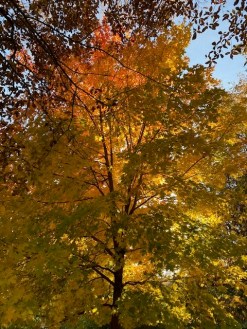
 Fall has always been my favorite season, which was frustrating when I lived in California. We had fall from about Christmas to New Year’s (after that, spring). Now that I am in the gorgeous country of blazing maples, golden hickory, and the self-explanatory burning bush, my October cup runneth over.
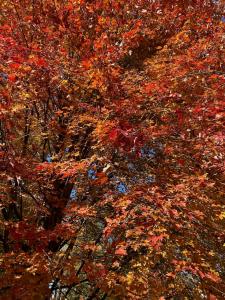 Seized with desire not to lose all these beauties, I take their photographs. Over and over again, and then they are mine. Taken; captured; the words used for photographs imply that I’m not alone in this irrational feeling that the image is the thing.
 But what we possess in a photograph doesn’t come only from what’s physically in it. The colors and shading give the illusion of heft and contour, but a photo is a flat surface. The third dimension comes from us, from what we know about leaves and trees, and fill in – just physically, not even counting the feelings we have about trees, about autumn, about color, about light, about darkness. Those come into it too.
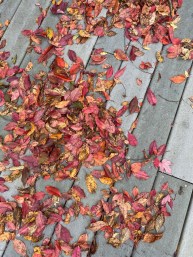
 I take a photo of leaves on the ground, and I can feel my feet scuffling through heaps of them on trails and sidewalks.
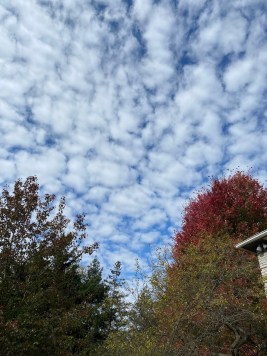
I take a photo of a tree against a skyful of amazing clouds, and I think of my mother, and what she called a “buttermilk sky.”
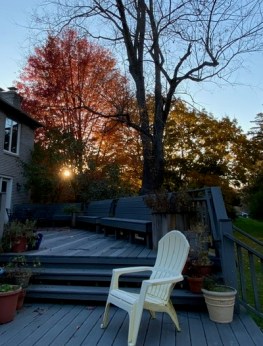 And this late afternoon sun speaks autumn strongly to me, because I know that three months ago the sun set on the righthand edge of this picture, far north of where it is setting now. It’s not just the color in the trees – summer’s heading south. Your particular associations may be different from mine, but you have them. That’s the part that’s the same.
Every fall I write about the leaves and most winters I cross most of it out. Here are two surviving bits.
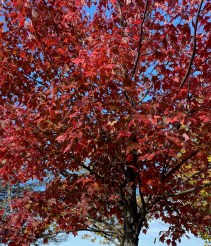 Maple: vermilion
Signs of the season,
lamps against grey skies,
flame to the blue,
they build into quick haystacks
on the ground.
The deep end of autumn,
leap in feet-first; it closes
over your head.
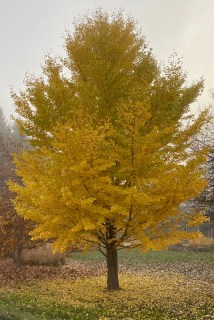 Gingko: cadmium yellow
Ancient tree, eons of
synchronized passion
make the leaves fall
all together when they fall,
a chorus line dancing
to the ground, one,
two, three, kick.
 One place I’d heard of but not yet seen since moving to Michigan, was Sleeping Bear Dunes. People told me how big, tall, steep, and impressive the dunes were, but having seen what passes for mountains around here my expectations were low. Doug and I drove up the hand-shaped Michigan lower peninsula, heading for the pinky/ring finger. Michigan is two peninsulas surrounded by a whole bunch of big lakes and, in an unusual display of common sense, has a name from the Anishinaabe that means – Big Lake. Michigami.
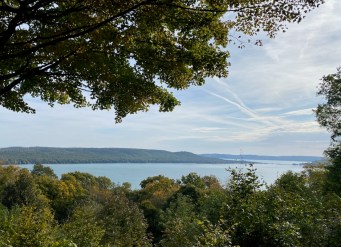 Another well-named place was this view of Alligator Point. Compared to other Alligator Points I’ve seen, this one looks much more like an alligator. Since alligators are not native to Michigan, I wonder who named it and what name it had originally.
 And then we came to the dunes. Having lived on both the Atlantic and Pacific coasts I’d seen plenty of charming, modest dunes. Well, forget that! These dunes were huge, steep, amazing, and nothing like any dunelets I ever saw before. At the top of the Lake Michigan Overlook, on the scenic drive in the national park, we were 450 feet above the lake. It sloped down at a 33 degree angle. A large warning sign advised the public that there was no way back up but to climb, and a helicopter rescue cost $3,000. The Park Service is very good on information like that. Since I’m a writer, not a hiker, I stayed up top and took notes.
 Working with words as I do, my next question was: what about the name Sleeping Bear Dunes? This one has a sweet, sad story, also from the Anishinaabe, about a mother bear and her two cubs. They lived on the Wisconsin shore, and due to famine in one version, or fire in another, had to flee for their lives into the lake. They swam and swam, but only the mother bear made it across. She climbed the bluff and sat there, watching for the cubs, but alas they drowned. She still sits there, watching for them. Some say the Manitou islands (see them in the blue haze) are the cubs, still in the water. The small dark knoll atop the dune in this photo was originally larger and more ursamorphic, but has been much eroded by heavy storms over the last two or three hundred years.
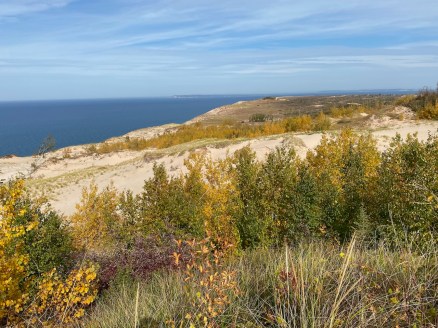 Sand dunes erode, shift, and move (slowly) about. For some decades now, people have been planting cottonwood trees to help stabilize the dunes. Most trees give up when buried in sand, but a cottonwood will send up a whole new tree from its roots. They also turn a lovely, bright golden yellow in the fall.
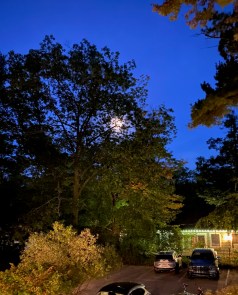 It was a gorgeous day. I believe I took 200 pictures – it wasn’t easy picking just six to show you. We returned to our motel tired and happy, greeted by a nearly full moon rising artistically through the trees.
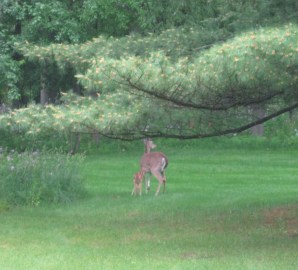 Though deer are generally a source of torment to me as a gardener, today one pair of them was really funny: a fawn standing halfway under a doe, trying to nurse while she tried to get away. She’d take a few steps and Junior would keep up, staying tucked under; she’d put on a little burst and shake him off, and he’d catch up and glom on again. I don’t know if she was trying to wean him, or just trying to get herself a snack, but it looked like a vaudeville routine. They both seemed very determined.
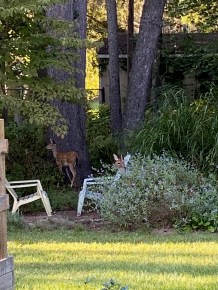 I could definitely relate to mama, but on the other hand realized if she succeeded he’d move on to eating my flowers. As I’ve said before, there’s nothing more clueless about what to eat than a fawn. I’ve seen fawns eating foxgloves and nicotiana, a bad idea not just for my landscaping but because those plants are poisonous. I used to wonder how deer knew to steer clear of poisonous plants, but it seems they don’t. They just eat whatever looks good to them, and the ones attracted to poisonous plants don’t survive. It’s brutal out there.
 The weather’s not brutal yet, but the deer have begun grouping up for winter. This is another deer fact that has confused me. Food sources are so scant in winter, you’d think the deer would spread out to get enough to eat. All summer the deer come through by twos, threes, or fours – a doe or two at a time, with her fawns. Then the leaves start to fall and the nights start to cool, and the deer start to bunch up. For warmth together overnight? For safety from predators under those leafless trees? What predators? Their only predators in this area today are people, and we’re not very good at it. It’s certainly easier for us to spot a herd of deer than a pair of them. Guess they know that, as deer predators go, we’re pretty lame. That’s comforting, isn’t it? To know we’re not a source of terror to all nature.
 In other mysteries, my tomatoes are petering out early this year. Who knows why, but it was a weird year for weather – some things did amazingly better, some things surprisingly worse. The tomato plants are looking ragged, but they still have fruit and it’s still ripening. This is when I start watching the weather forecast carefully, for frost warnings. I could give up and bring them all in now, but that’s not very sporting.
 Among the happy campers in my yard are the mountain mint, zinnias, asters, and Russian sage, plants that keep blooming as summer winds down. Trying to stay on nature’s good side, I put in more of these plants that bloom into fall, providing food for bees and butterflies. For some reason I have millions of Cabbage Whites this year – I grow none of the vegetables they prefer, but they’re good with mountain mint – and I also have a lot of Fritillaries.
 I love Robert Graves’
  No sign of the woodchuck the whole last month. Was it the repellent spray? The tunnel flood? The vinegar? Maybe all of them? There’s no more havoc in the garden, and damage outside it is clearly the work of deer, who leave a ragged edge on anything they chomp. Woodchuck and rabbit teeth cut cleanly.
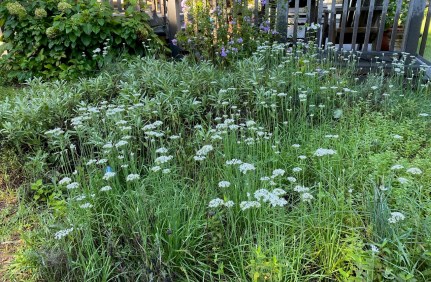 The harvest, unmolested, continues to roll in, but there’s at least one change I’m making for next year. The garlic chives have been pretty effective at keeping deer from eating the phlox, but have spread so much they seem to have choked out the shastas. And they are currently going to seed. I need to pull some of those. Soon.
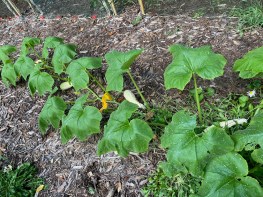 The mini pumpkins and gourds are fun, because after their slow start they leap out of the raised beds and travel in a most amusing fashion. The blueberries are all gone by the time random gourds barricade the nets, so no conflict there.
 One of the things I loved about marigolds as a child was harvesting their seeds. This is a task especially suited to small children’s hands.
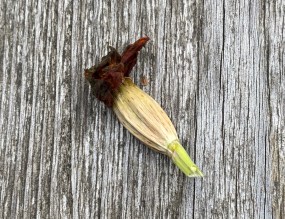 Once the flower has dried on the stem, the whole seedhead breaks off cleanly with a satisfying snap.
 Pull off the bits of dried orangey brown petals, and the fluff that comes with them leaves a nice clump of feathered seeds. I used to just put them in a paper envelope, but now I use an empty spice jar, since I usually have some around. But the envelope worked fine.
 Gardeners in Ann Arbor used to bring their tender plants indoors over the Labor Day weekend and some still do out of habit, but average first frost here is now October 15, with a spread from 10% on September 30 to 10% on October 30. My poinsettia plants, moribund indoors by last May, have flourished once again on my deck this summer; the geraniums and jasmine, too. All of them need to come in before a frost, which means I need to clear out a lot of floorspace indoors, in front of windows for them. I’m working on it.
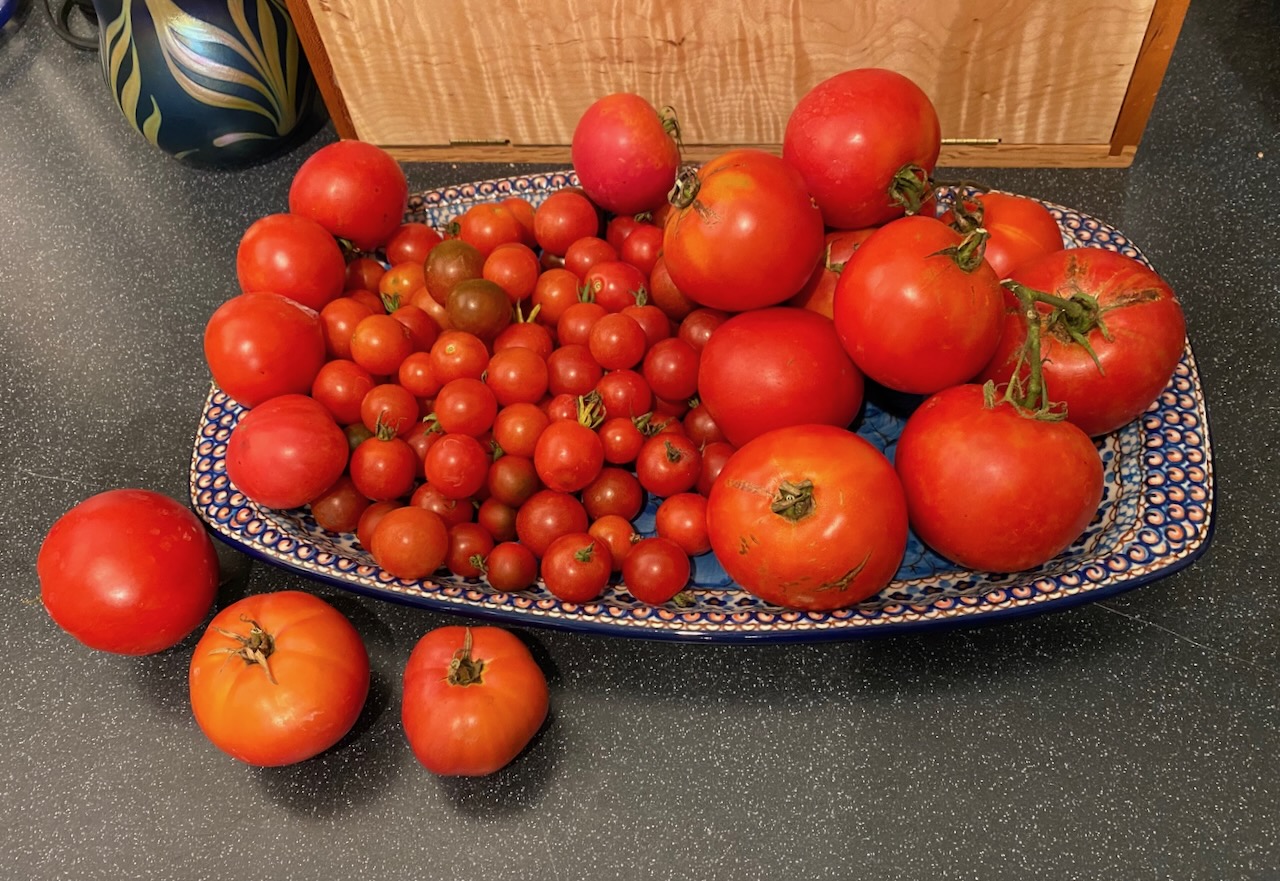 August is a very rewarding time in my garden. The tomatoes, yellow squash, cosmos, and zinnias are rolling in, the weeds have slowed down, and the little pumpkins that seemed so reluctant to emerge are finally showing themselves.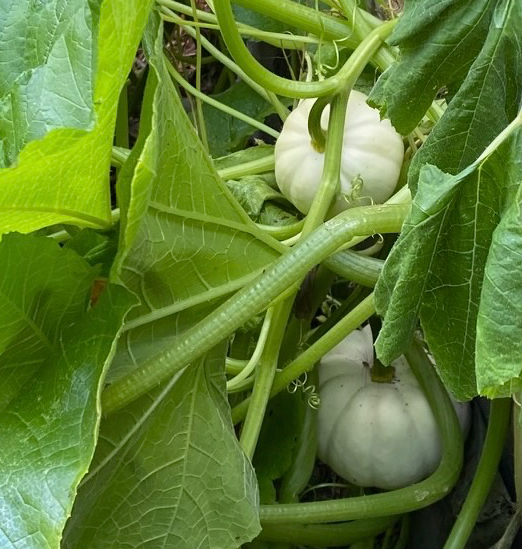
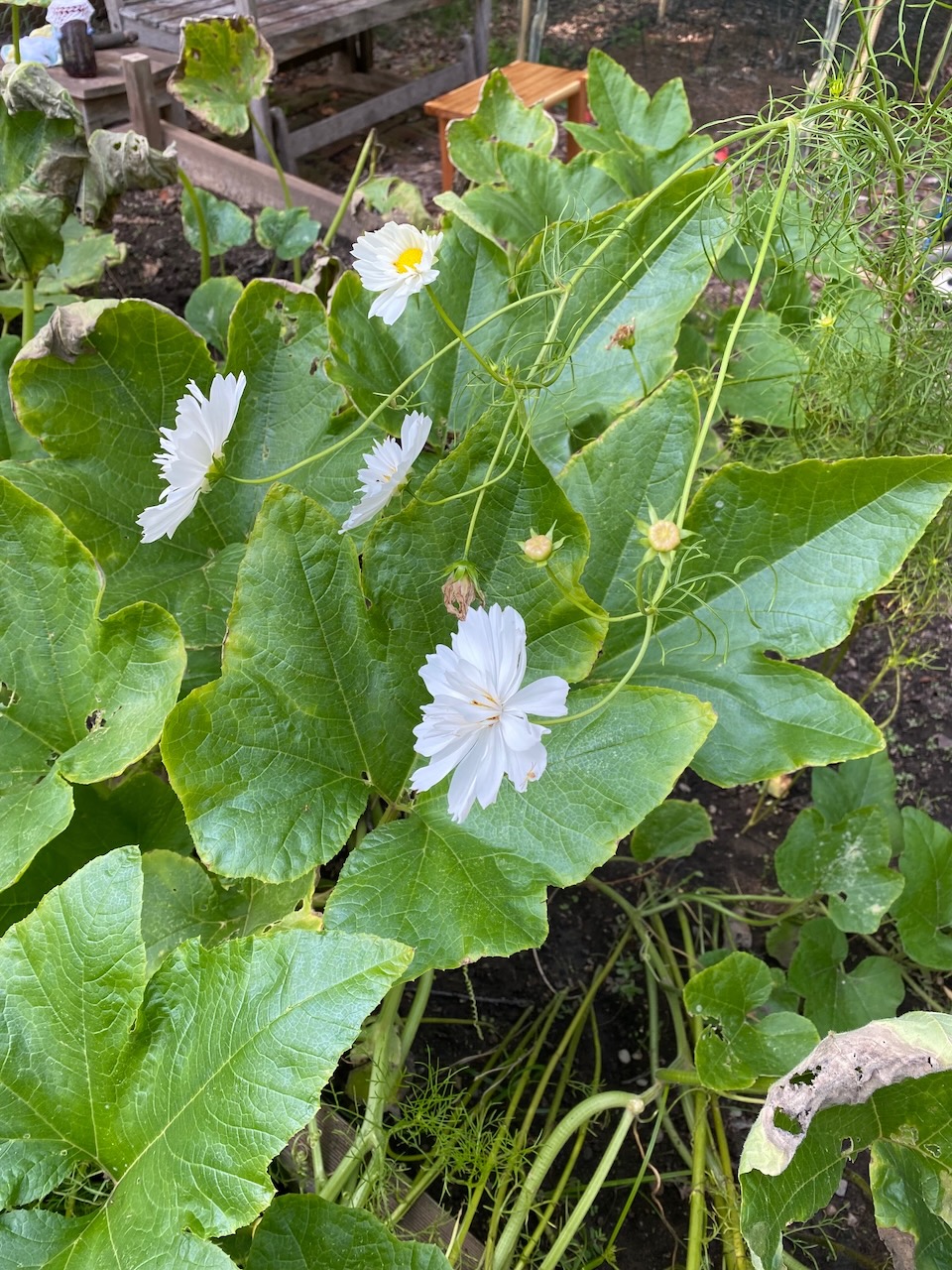 We had a big, windy storm a few days ago, which knocked my tall flowers over. Sunny days followed, and the cosmos needed only one day’s sunshine to right themselves to a jaunty angle. They nod gracefully in my flower arrangements.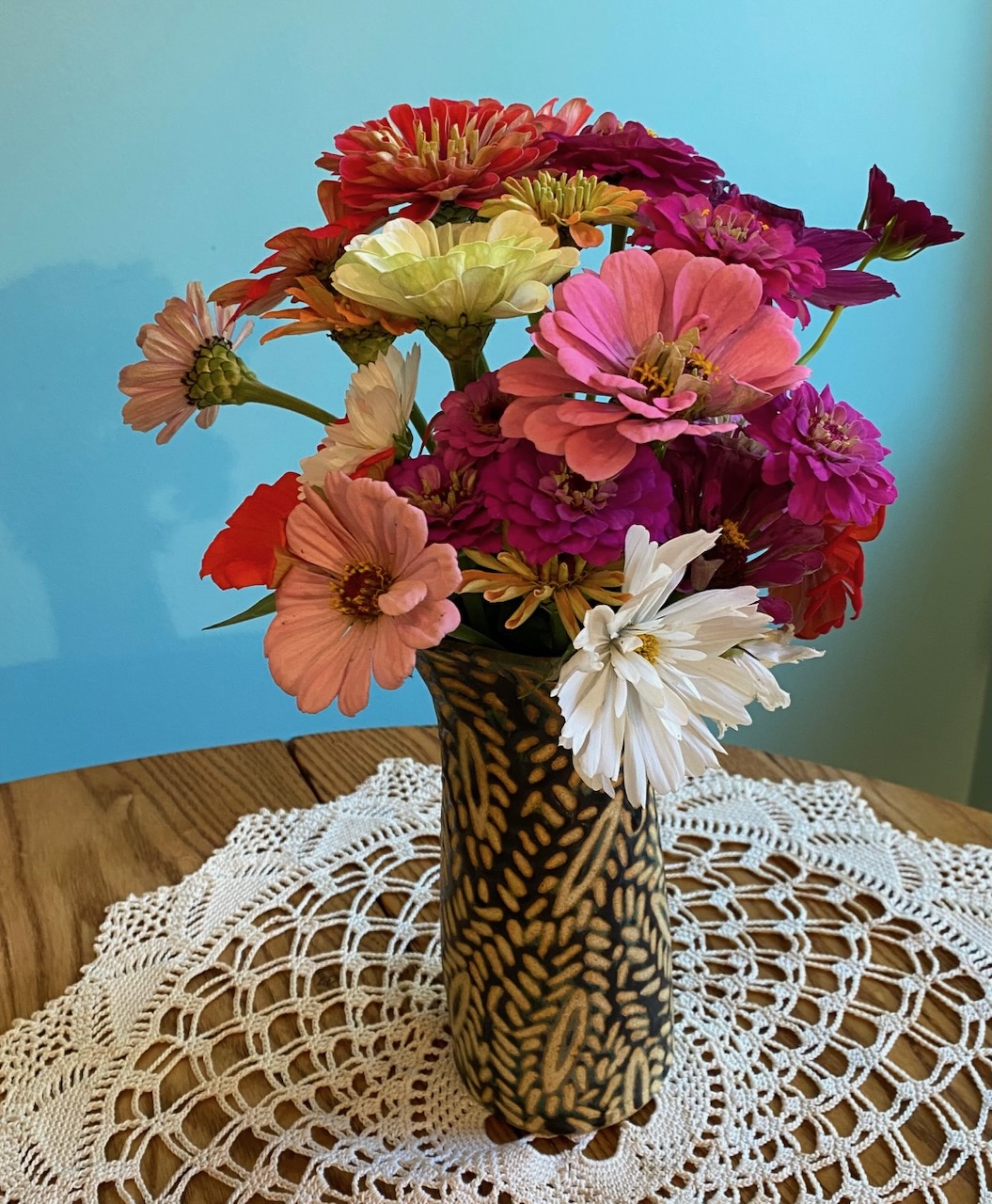
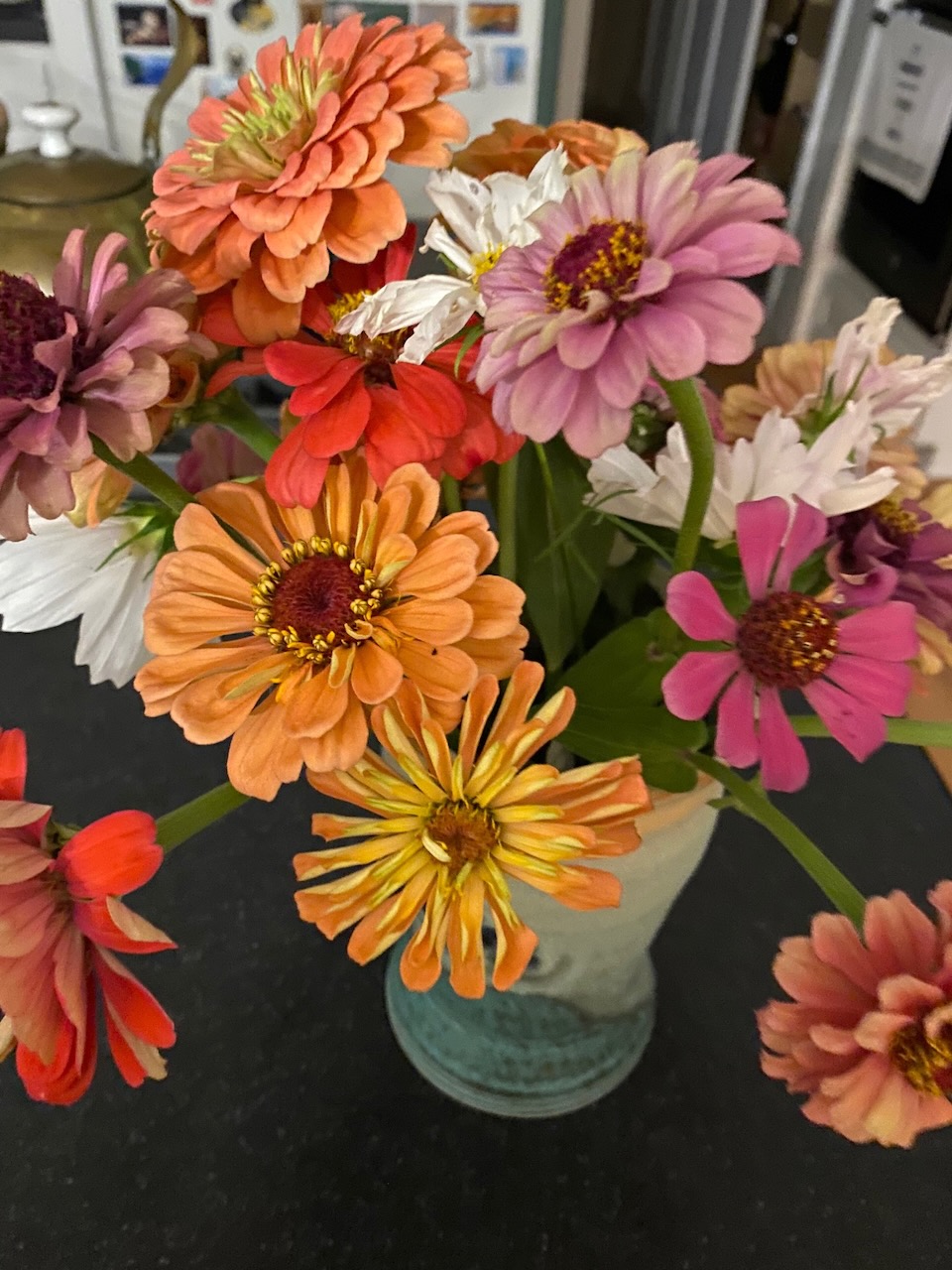
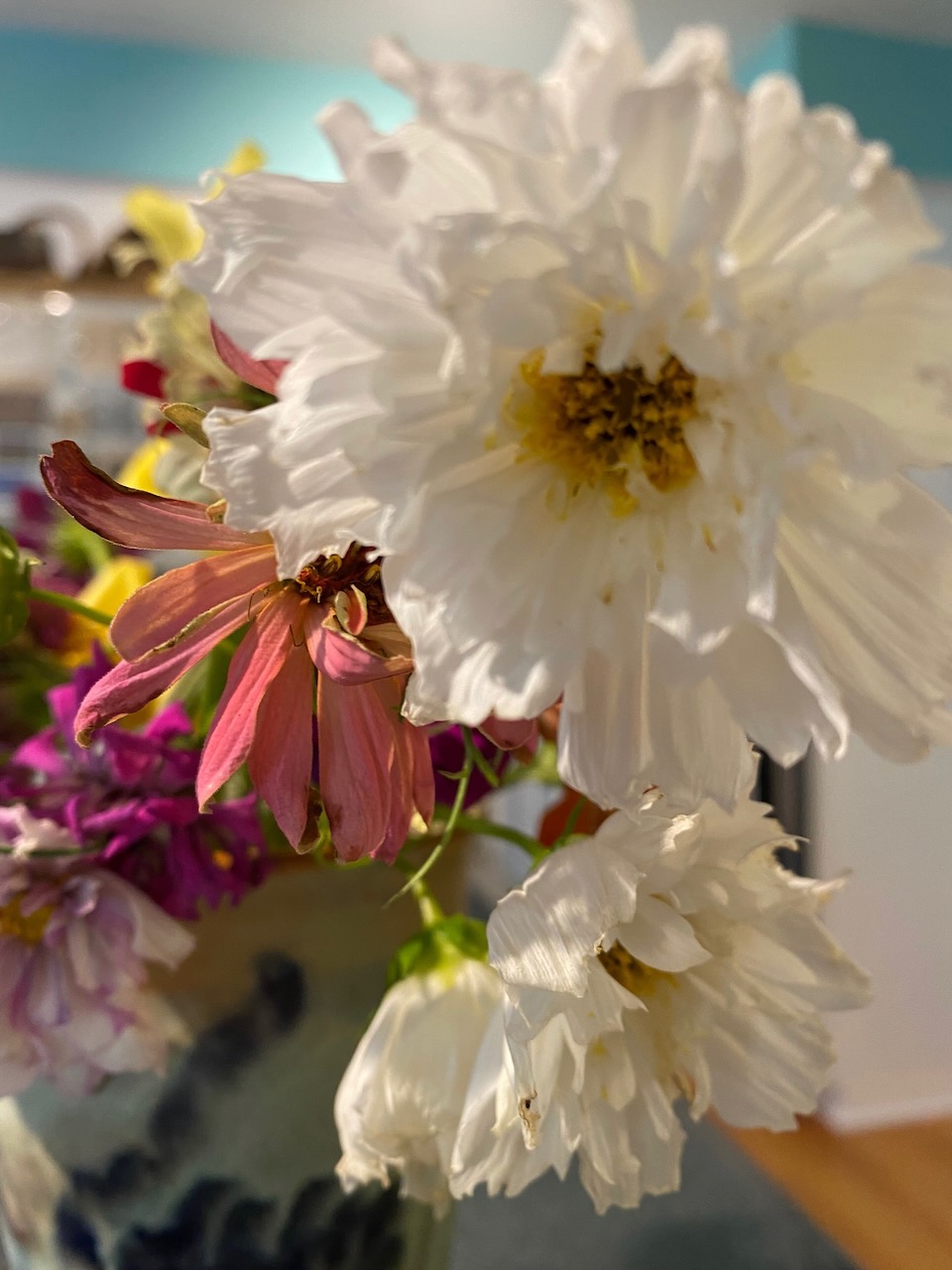 But to me zinnias and cosmos in September, budding even to the last morning before frost, are signposts of strength and beauty persisting into age. Fear not, and persevere.
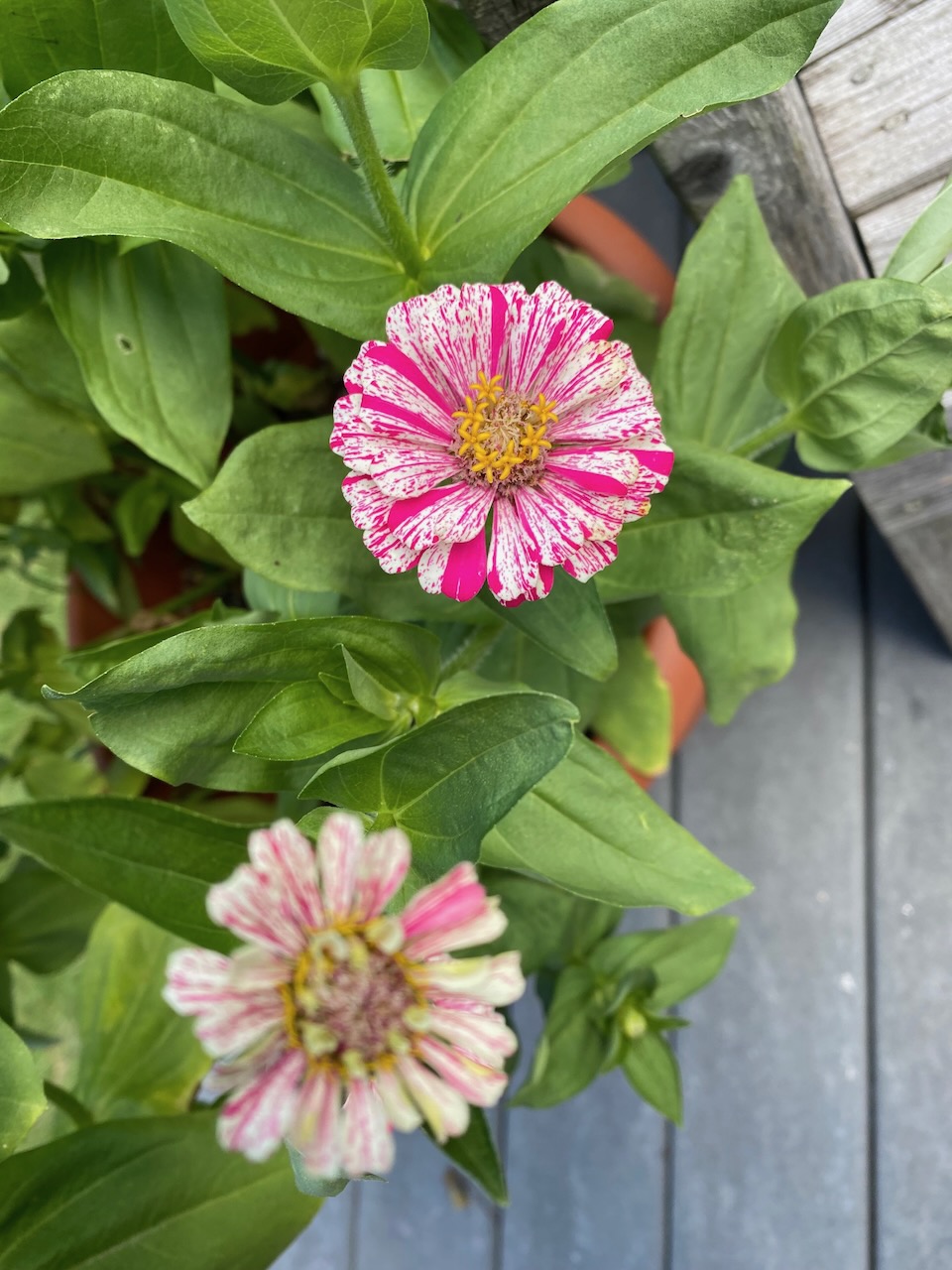 One of the best bloomers for late summer is the zinnia. Beloved by bees and hummingbirds, it blooms right up to frost, and the more flowers you cut the more new flowers it grows. Also – so far – it is not eaten by any of the visiting varmints in my garden. Excuse me while I knock on wood.
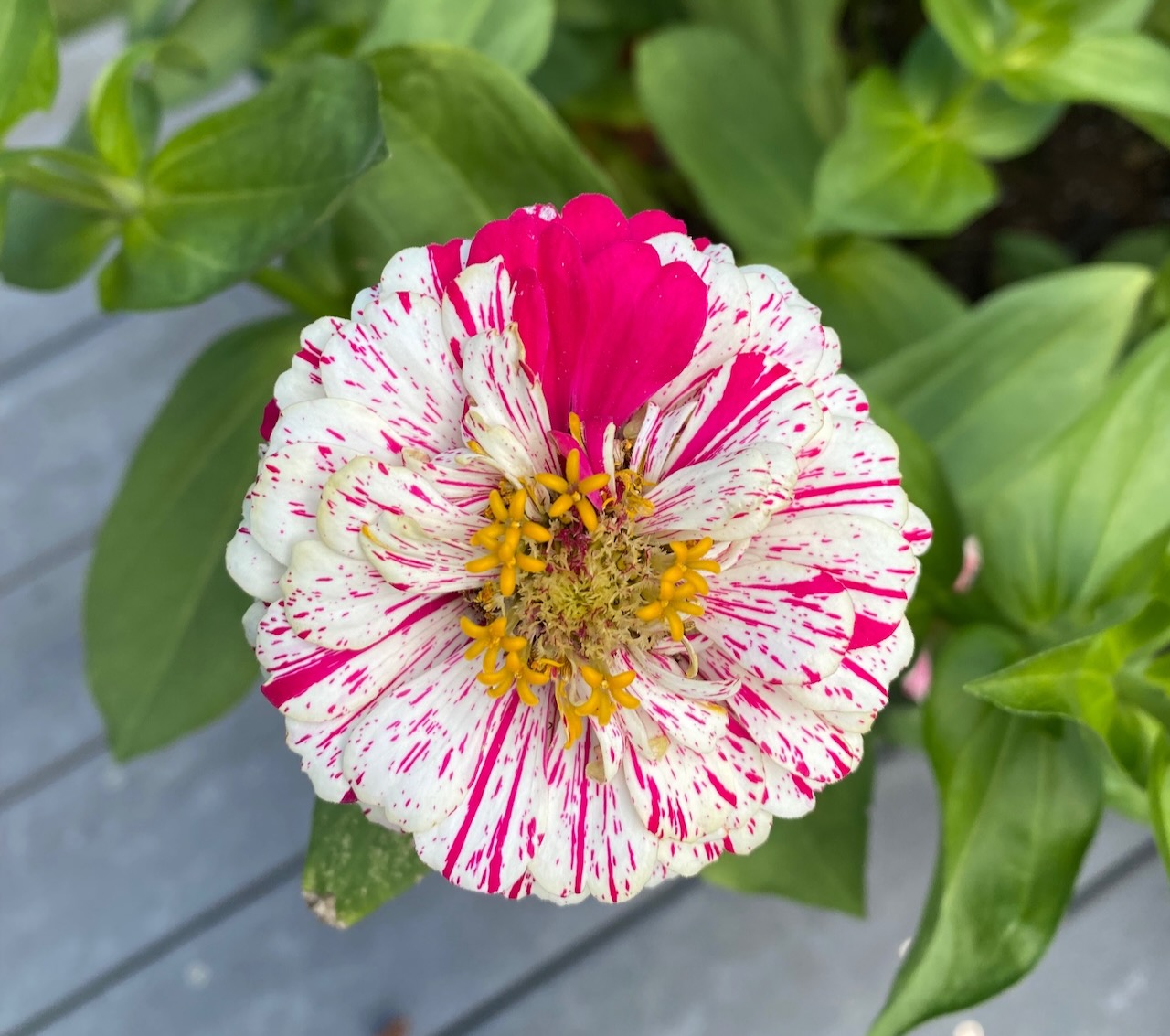 Zinnias come in many colors (everything but blue – what is it about blue?) and sizes, but one of the most interesting to grow is the Peppermint Stripe. It’s of medium height for a zinnia – about two feet tall – and looks hand painted. Stripes can be regular or eccentric,
 balanced or unbalanced
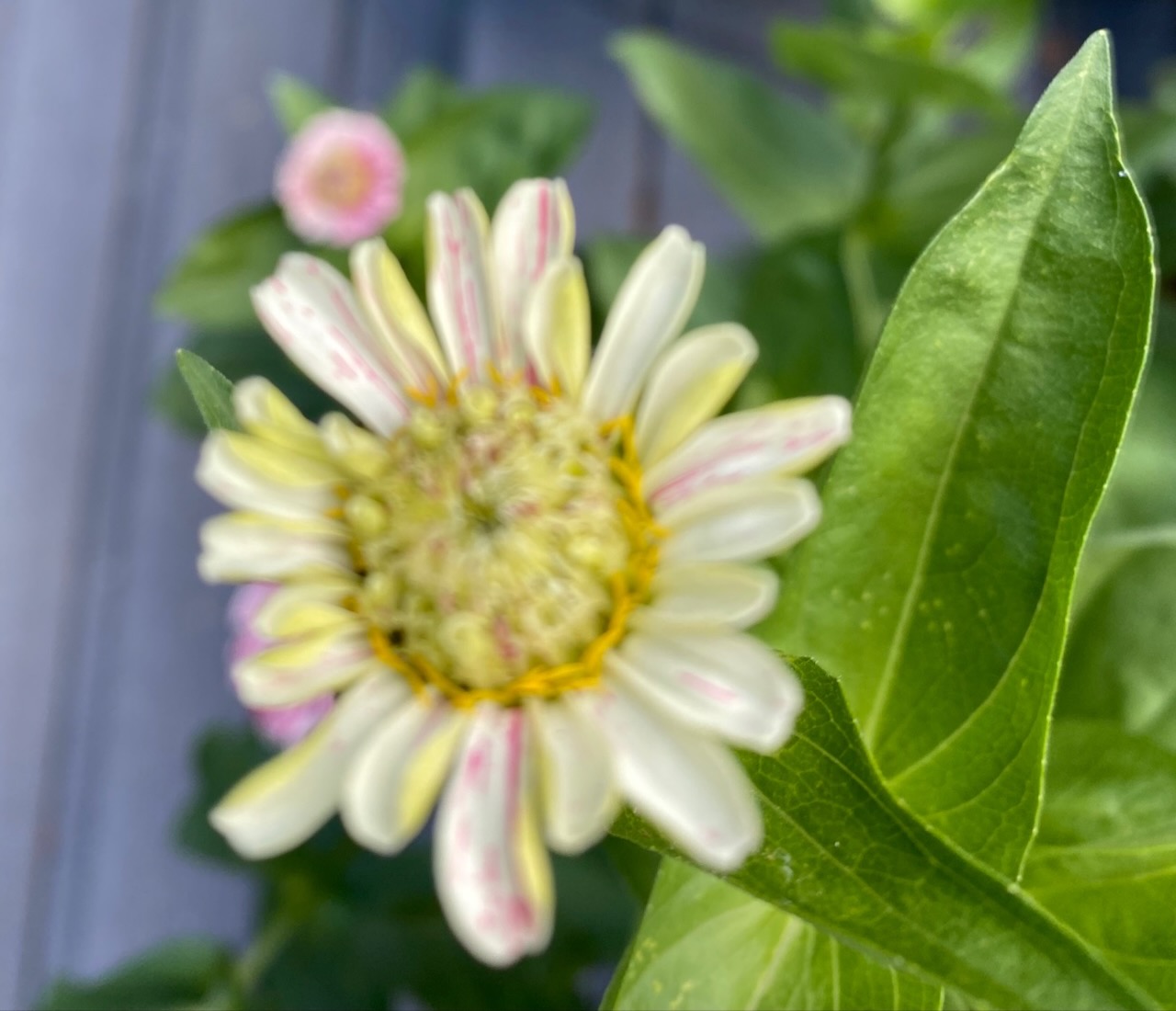 evenly pale
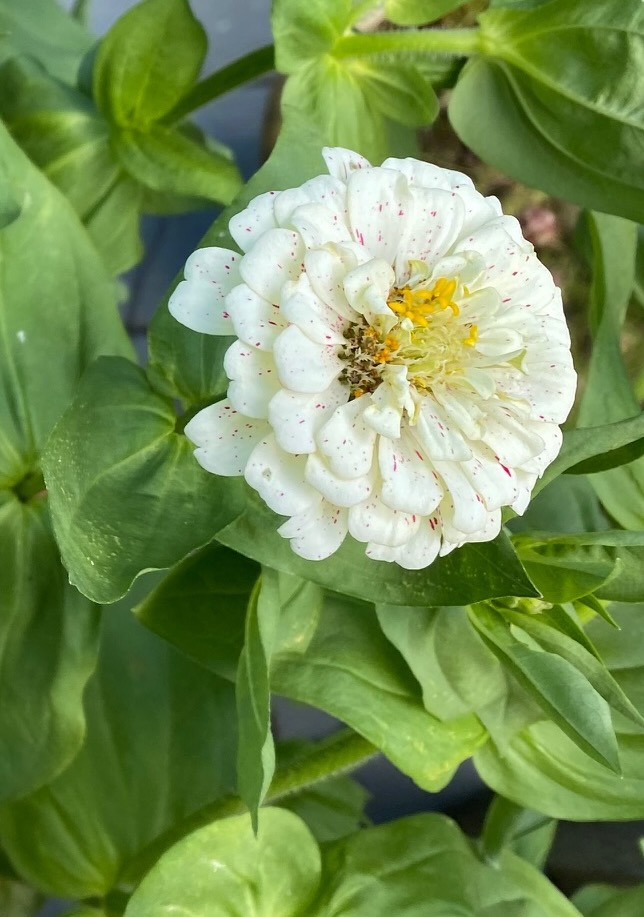 lightly marked with sprinkles
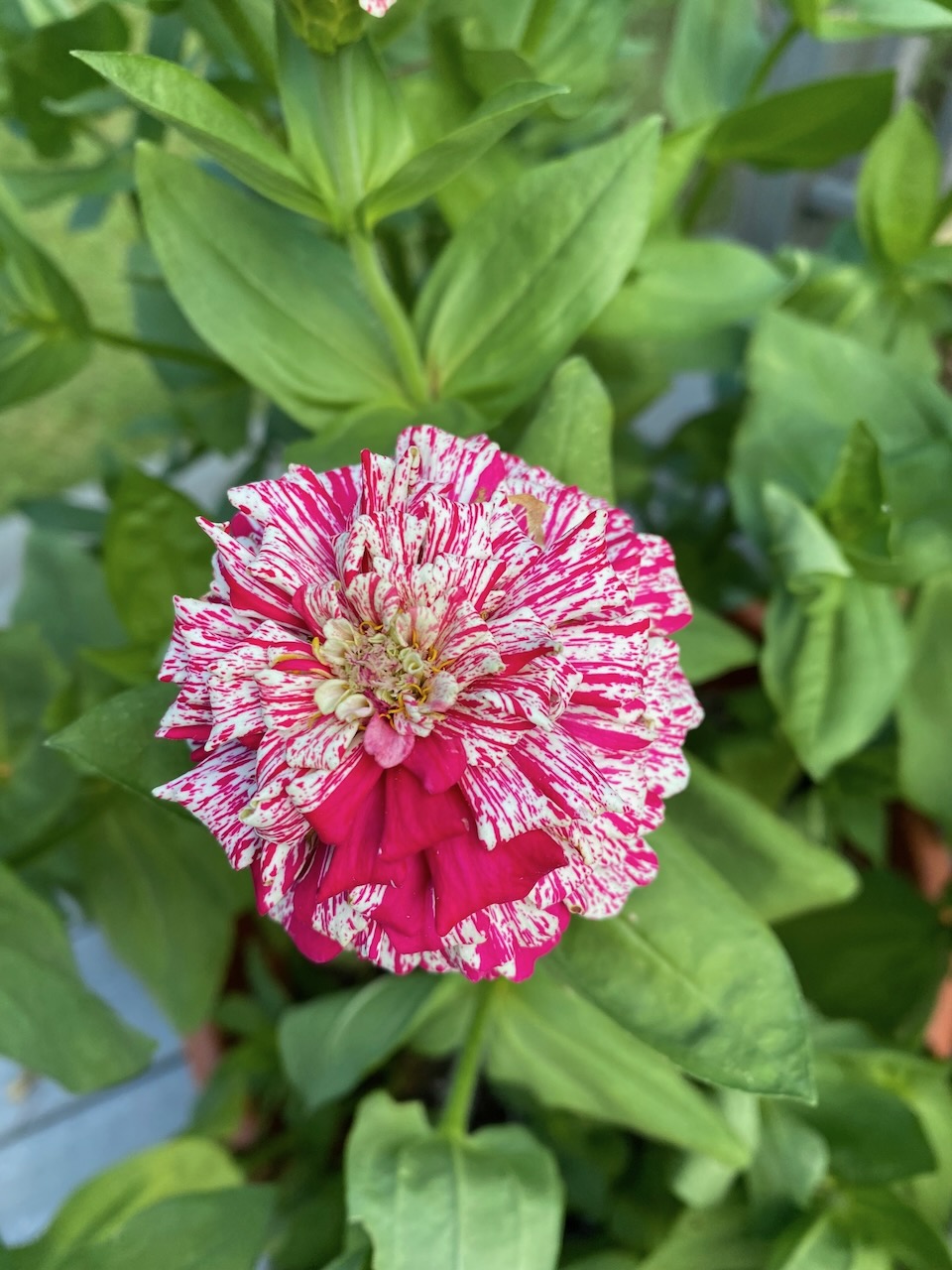 or wild and crazy.
 These are all from one packet of seeds planted together in the same pot where, as they grew, each one opened into its own design. They coexist in glory, the pot made gorgeous by all those different ideas of zinnia beauty. Clearly, it wouldn’t be nearly so interesting if they were all the same.
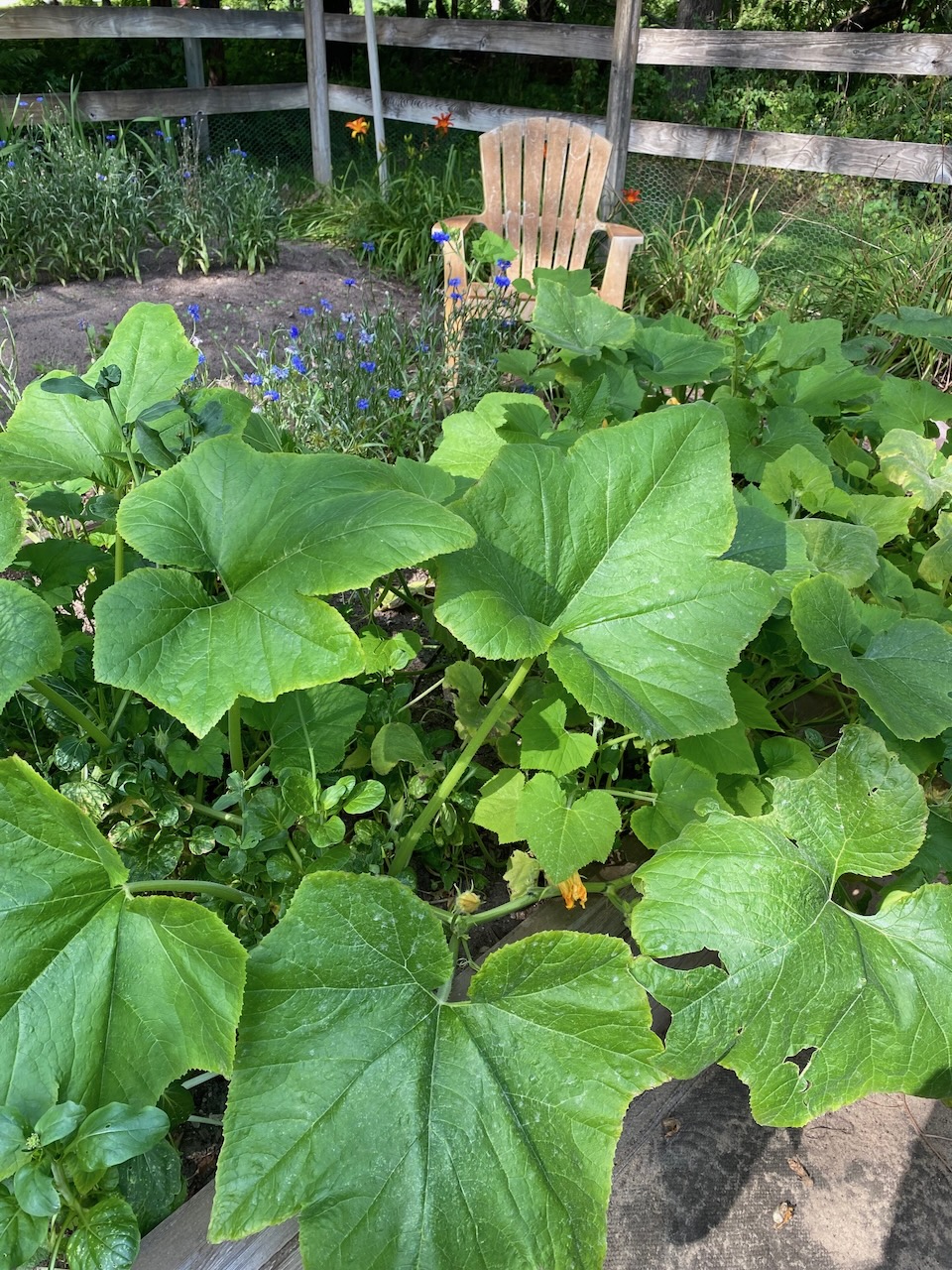 I have taken various measures against the woodchuck’s break-in, and so far they are working. I sprayed all the plants inside the garden with animal repellent. I ran a hose out and flooded the tunnel. A woodchuck tunnel usually connects to other woodchuck tunnels, so my hope was to make a mess in there and precipitate a woodchuck crisis. I imagined Mama Woodchuck furiously walling off Junior’s unauthorized expansion unit, scolding him as water poured into her previously tidy home: “You opened it where?? Are you crazy?? Go to your room!” When the water level went down I poured vinegar in after it. I sprinkled mole repellent around the garden perimeter. I smoothed the dirt at the tunnel exit so it would show footprints, and watched for two days. No footprints, and no more damaged plants. I shovelled the dirt back into the tunnel.
 Since I wasn’t patient enough to try these one at a time I can’t be sure which ones were effective, but so far the tunnel hasn’t been dug out again, and the squash plants are flourishing. I like to grow yellow squash so I have a fighting chance to spot them under the leaves before they get too big, the way zucchini does.
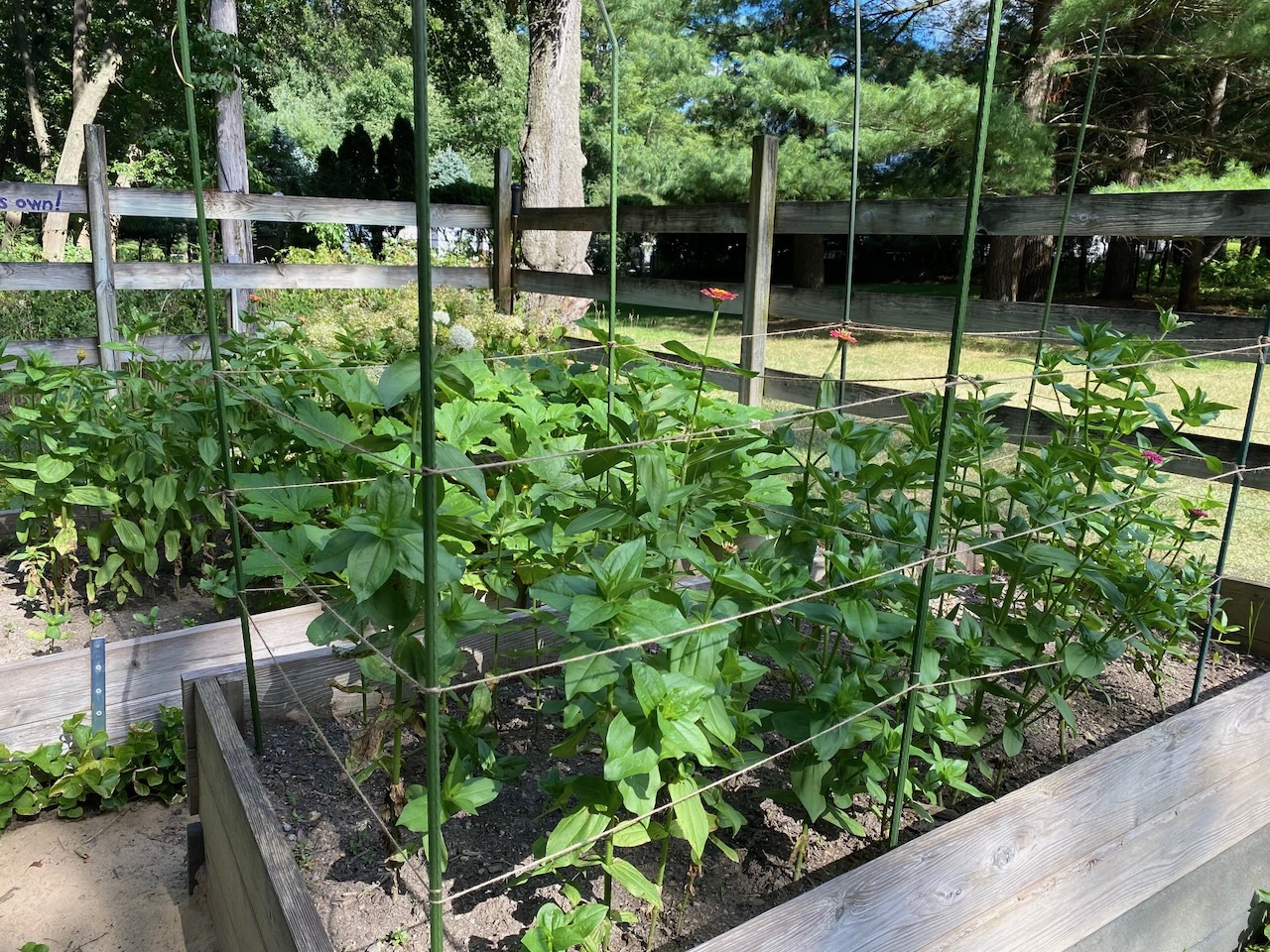 The zinnias, while blooming, keep getting taller. I strung twine between stakes – it’s in there crosswise as well as on the perimeter – to keep them from flopping over.
 These are for cutting, for bouquets, so I want straight stems. I like to mix salmon, rose, and pink zinnias with white cosmos, like this.
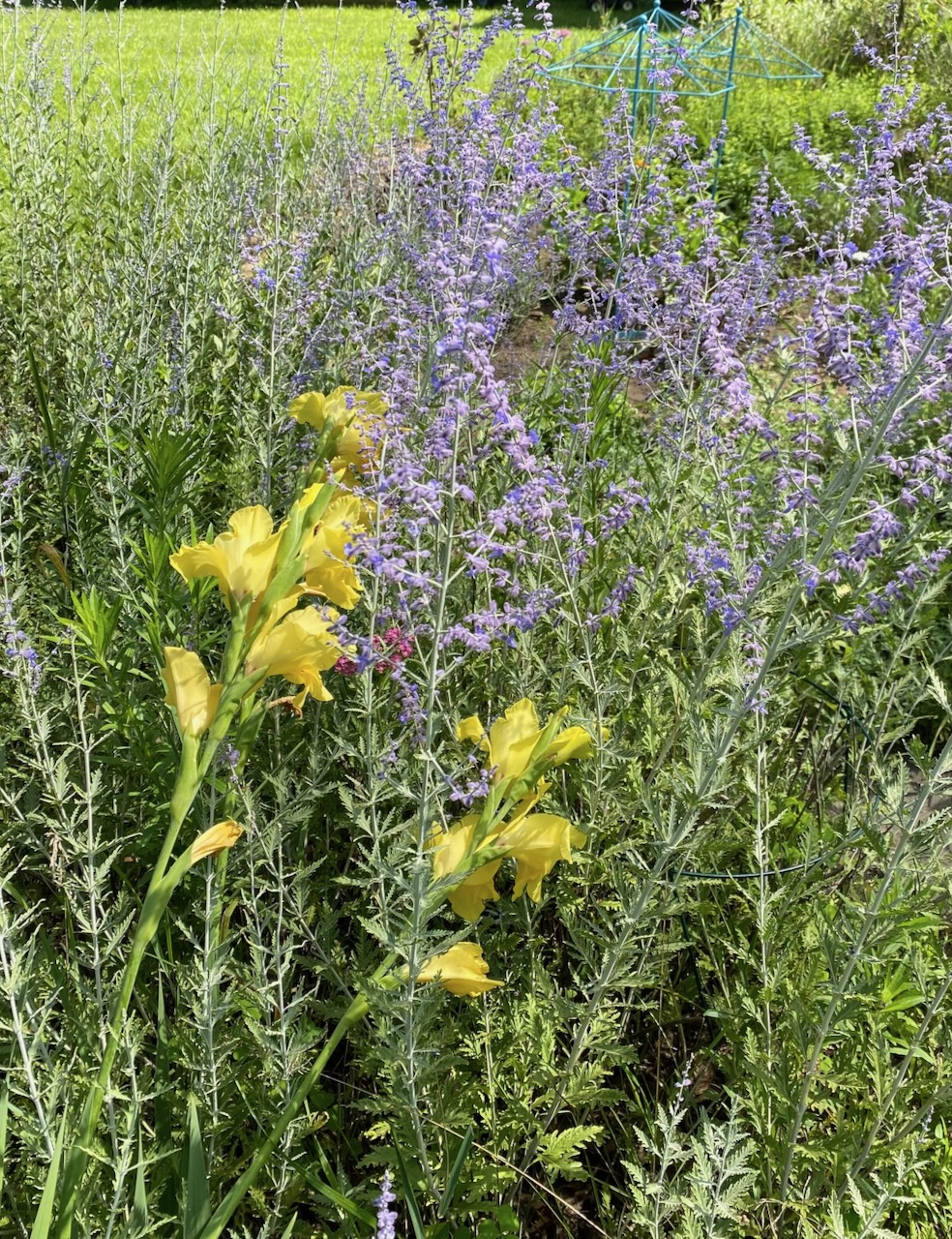 My yellow gladiolus were flourishing outside the fenced area, looking gorgeous against the purple of Russian sage, and I was just about to tell you they were deer proof. Then I went out and found the yellow blooms in the backyard all nipped off with the telltale ragged edges of deer munching. Why? The deer ignored the purple glads as they bloomed and faded, and the yellow ones in the front yard are still intact. Was it the work of one of those foolish fawns? Did it give him a bellyache? Am I wrong to hope so?
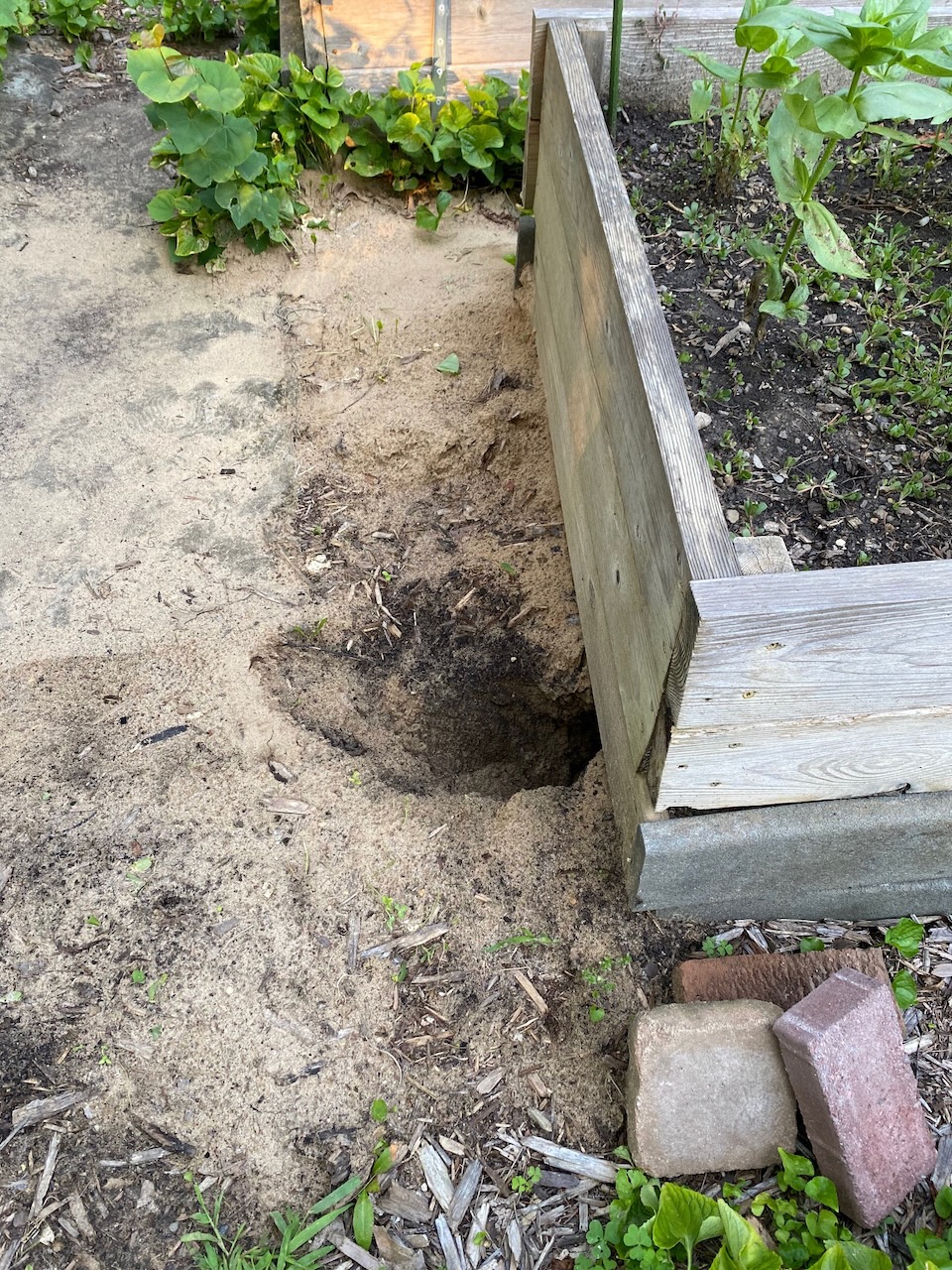 Well, look at this. For ten years the fence has protected the garden, with the occasional bunny break-ins where the chicken wire let go or rusted through. Then last week after a short absence, I walked out to enjoy communion with nature and found this. Aaaaaah! The woodchuck! I heard a rustling in the squash bed and saw him – one of this year’s babies, maybe half size but clearly prodigious in digging. We had the chicken wire six inches deep, thinking of bunnies. Clearly not enough for a woodchuck. When he saw me he ran up and back along the fence in panic, till he finally found the place where he could dive under and out the other side. So – he had both a tunnel and an underpass. I don’t know if he came in that way and dug the tunnel to get out, or tunneled in and dug the underpass to get out.
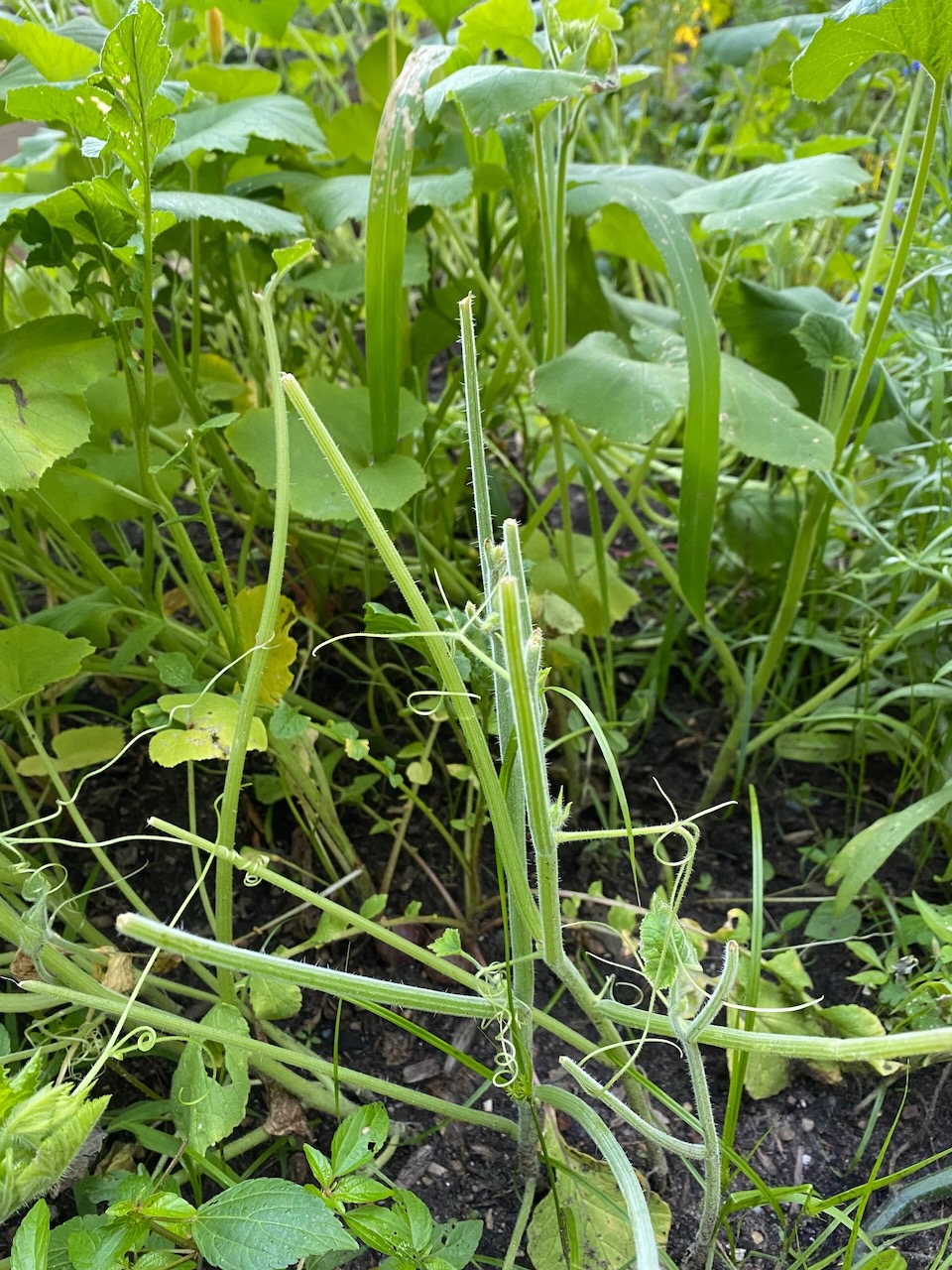 In the two days when I wasn’t looking he had removed an impressive amount of dirt. My yard has good soil where I’ve enriched it, but a few inches down, and under the raised beds, it’s all sand. Which was now piled on top of my pathway and strewn heedlessly about. The other damage was to my squash plants, the biggest leaves in the garden. This guy put the hog in groundhog. I put some repellent in the hole and filled it back in, but he dug it right out again the next day. I wasn’t expecting this level of industry from the local furry brigands. I am currently trying a variety of repellents, both on the plants and around the tunnel. Will let you know what, if anything, works.
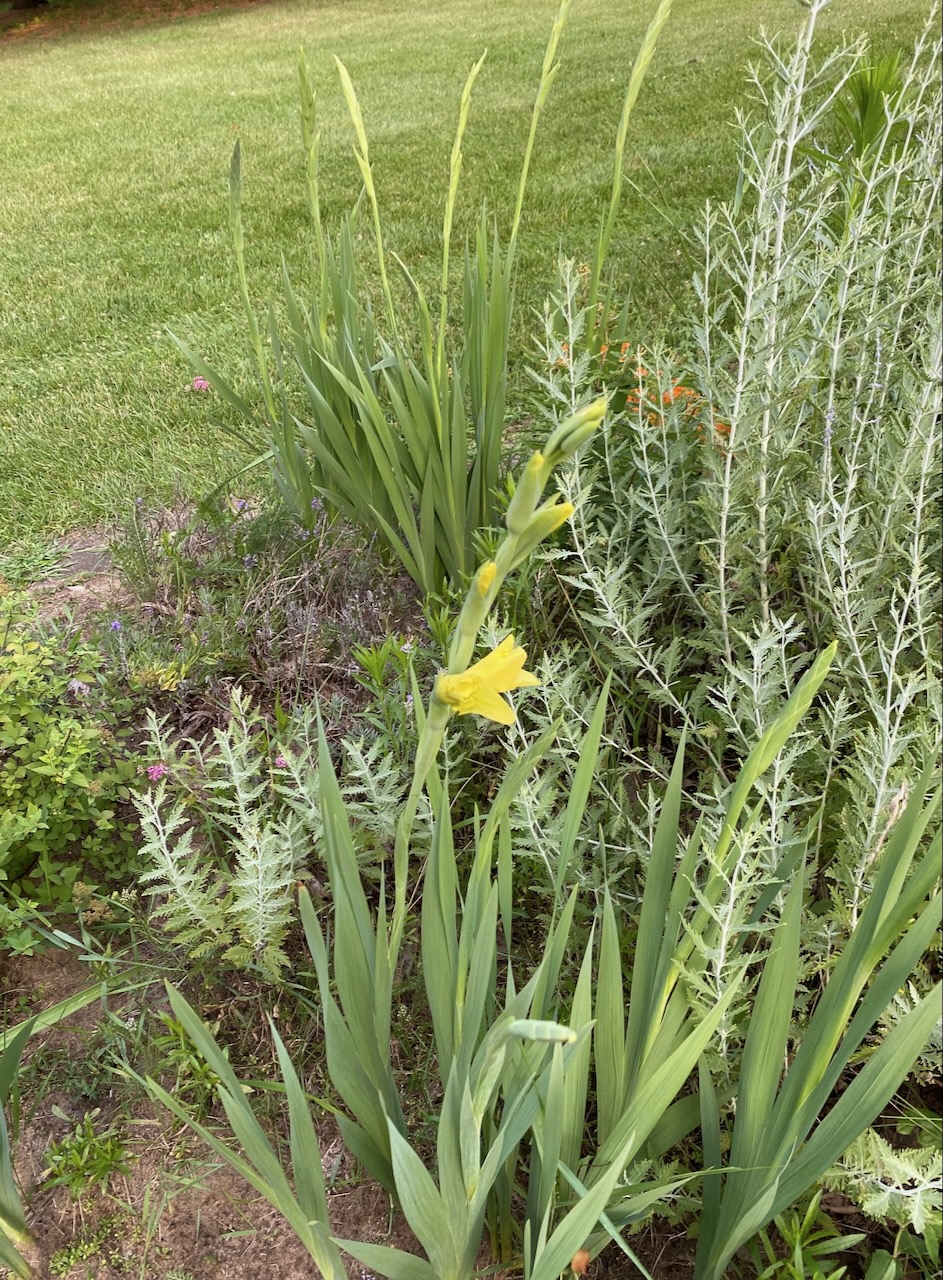 I am, though, getting a lot better at understanding what I can plant outside the garden, where woodchucks, deer, and rabbits maraud daily. They don’t eat gladiolus or Russian sage. They don’t eat culinary sage or any of my other herbs – mint, basil, oregano, marjoram, or lavender. The garlic chives will impede – but not totally prevent – their wading through to munch on the phlox.
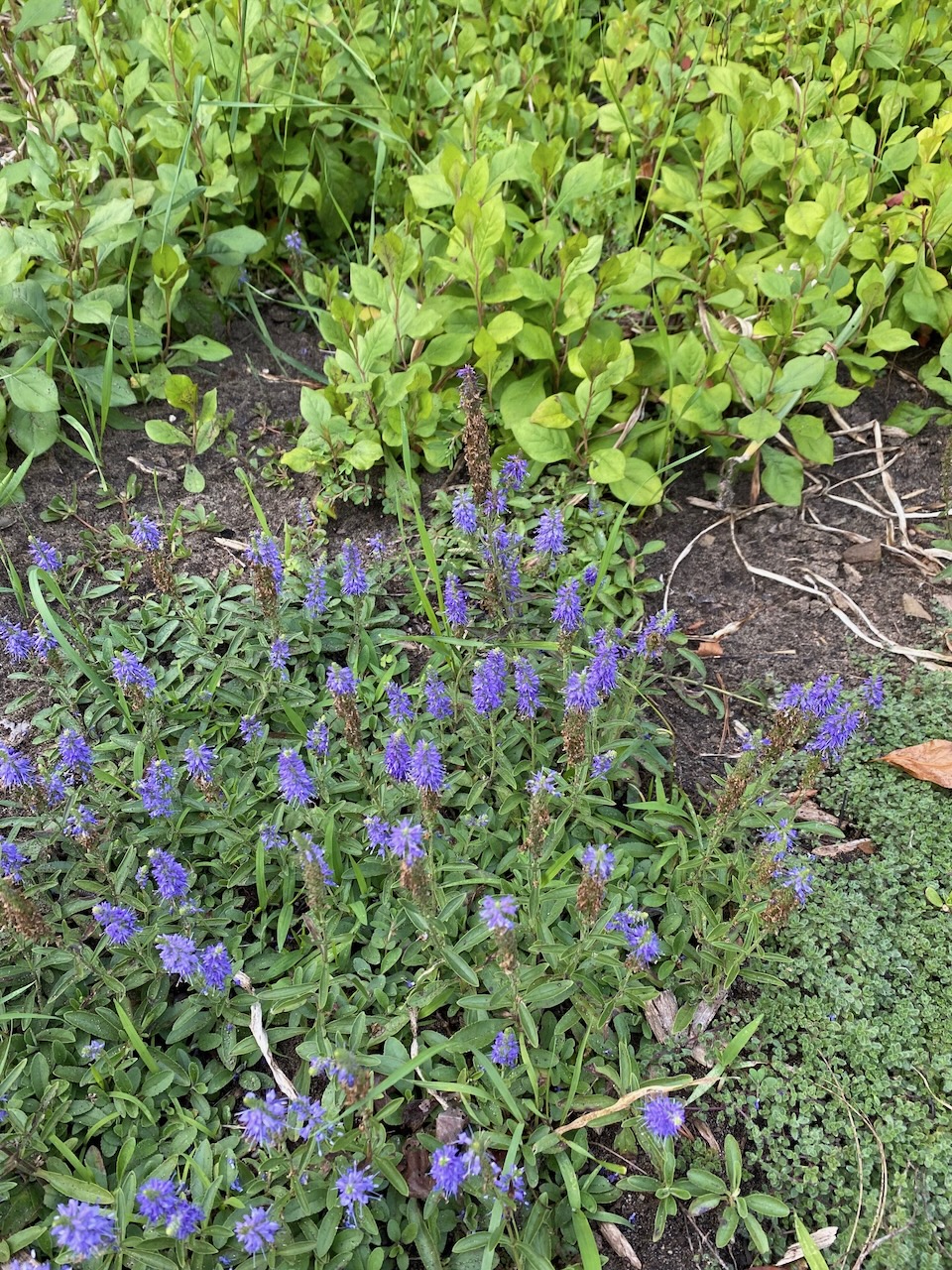 They don’t eat Veronica or ceratostigma, two useful groundcovers. Veronica has the nice purple flowers; ceratostigma is really useful for covering the wilting leaves of spent daffodils. It will have a blue flower later in the summer, and red leaves in the fall.
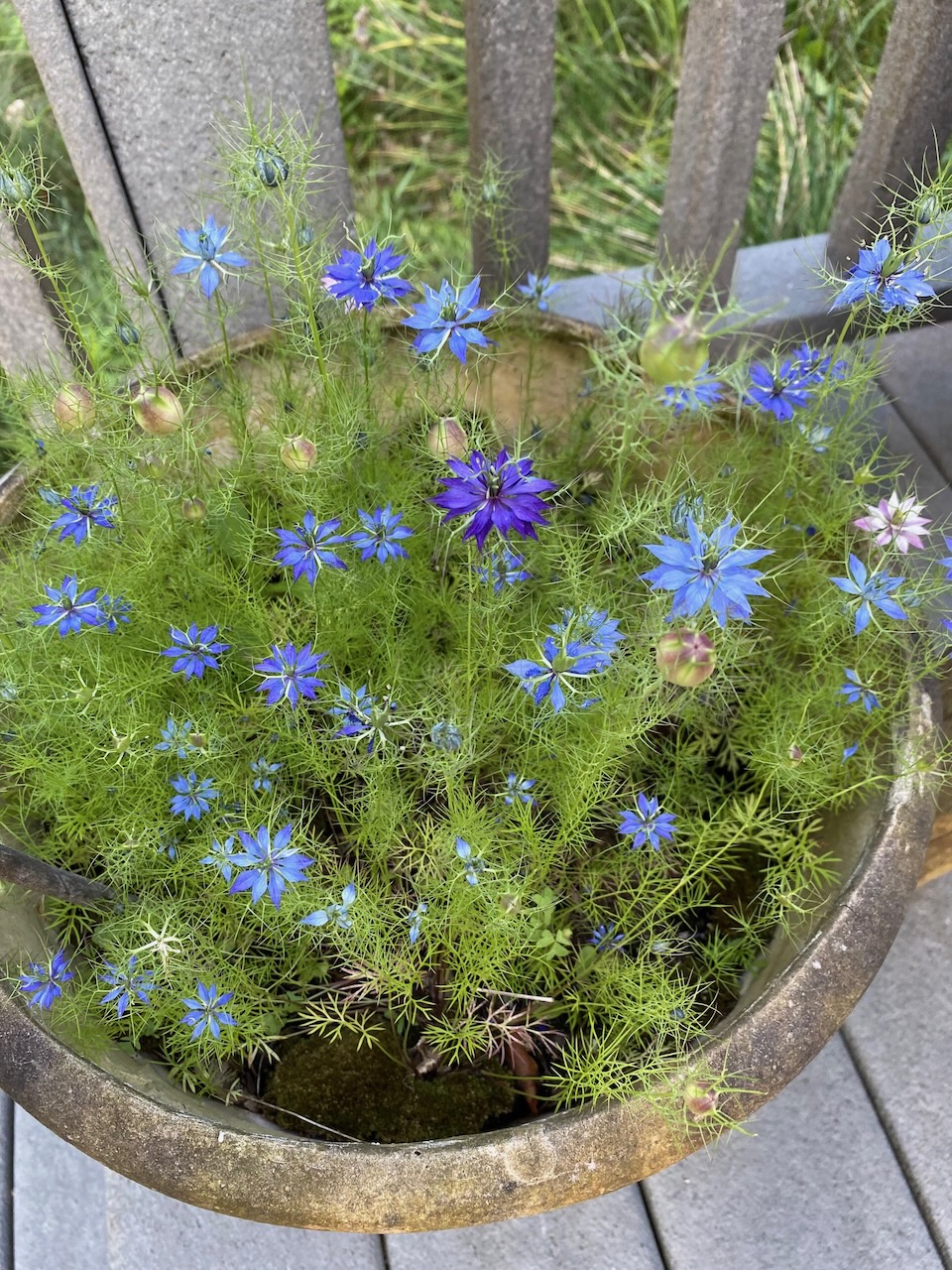 They shun the nigella, which self-seeds itself every year, even in pots. Nigella is also known as love-in-a-mist. In the upper lefthand area you can see its seed pods developing – as they dry they make great Halloween decorations.
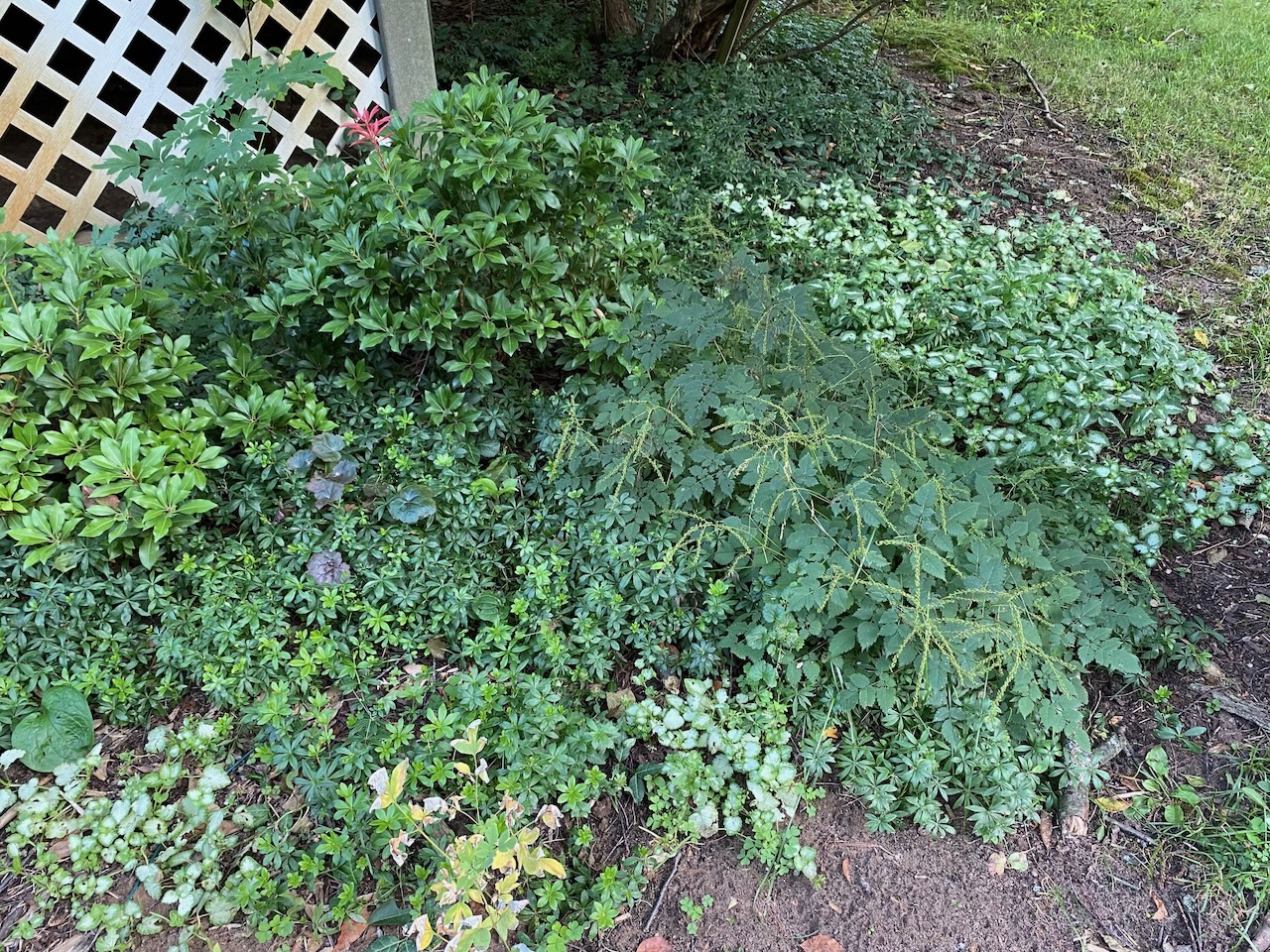 Contrary to what I’ve been told, something out there does eat rudbeckias and shasta daisies. This sadly impacts my ability to cut them off myself and carry them into the house for vases. Nature, however, provides a pretty good substitute in the ox-eyed daisies that self-sow vigorously every year. A weed, so called by those with a pejorative bent; invasive, a foreigner, and therefore unknown to the menu choices of northamerican deer, rabbits, and marmots of all kinds. Smaller than shastas, but profuse. Persevering. I’ve written a poem about them (first published in Potomac Review).
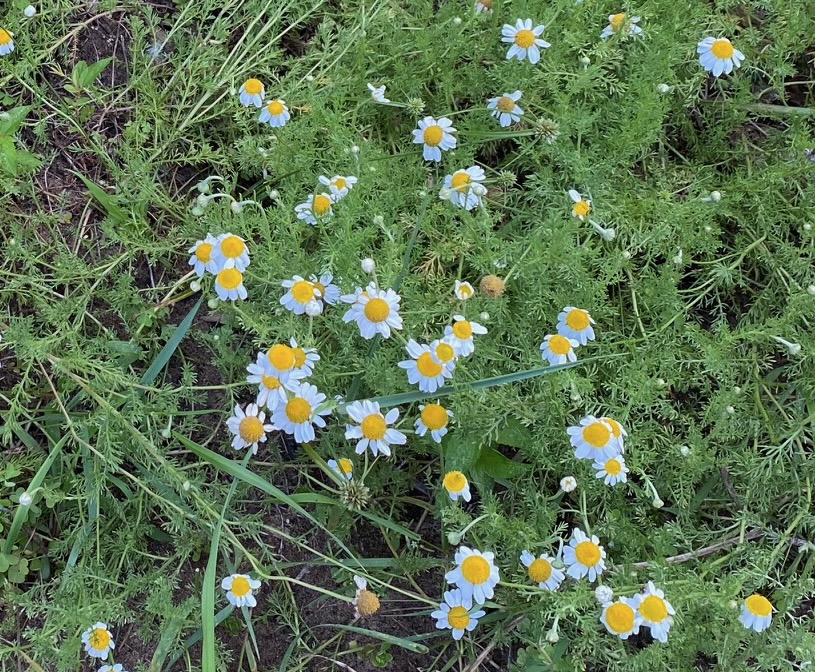 Ox-Eyed Daisy
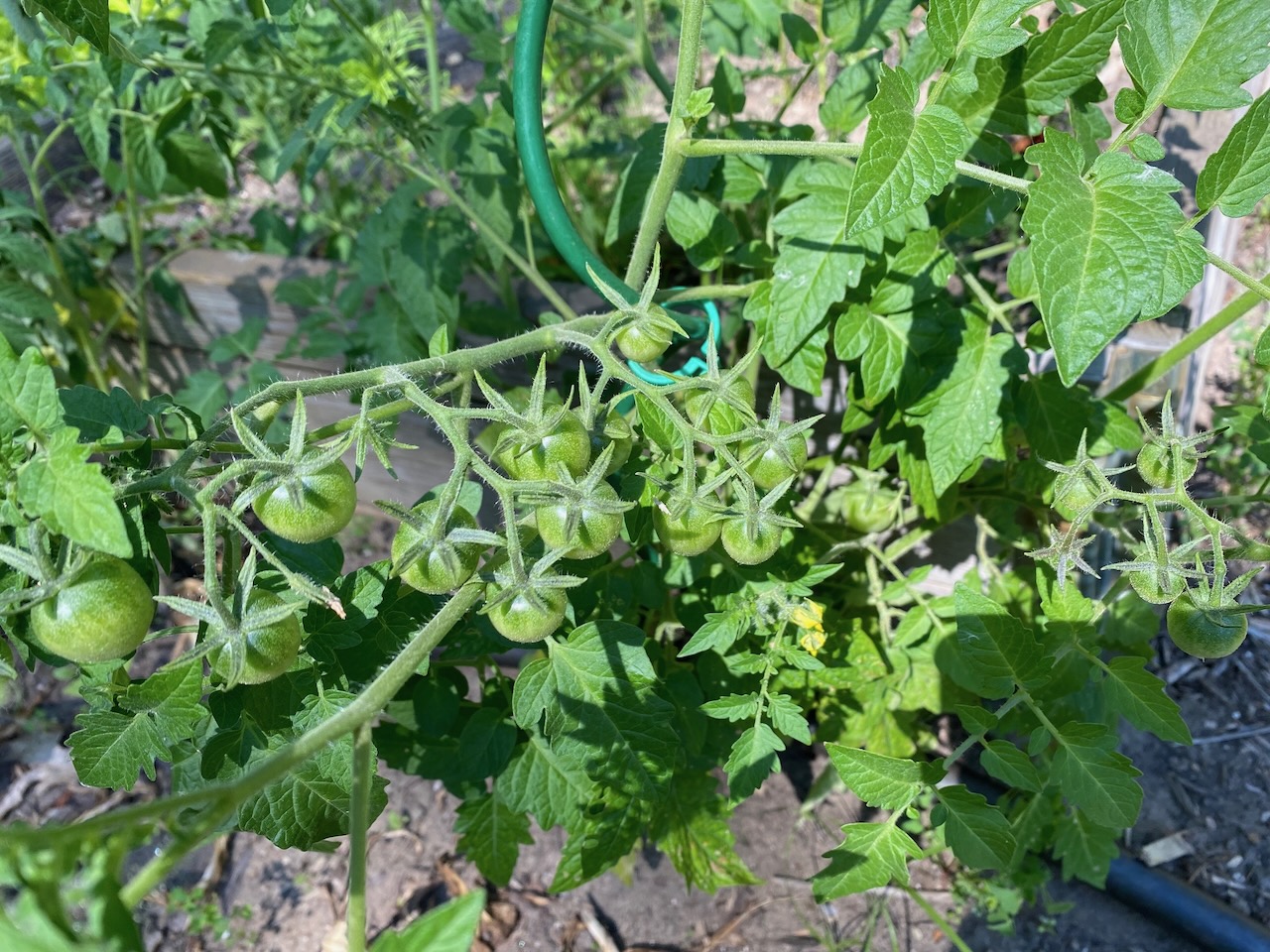 It’s lucky the weather has been beautiful, because the news has been so disheartening. I have great need of the garden, to recharge my ability to deal with my fellow humans. Pure summer has arrived, blue skied, clear, and breezy, so I stepped away from websites and media feeds, took my kneeling pad, my weeder, and my tubtrug and went out to the garden. Hello tomatoes. Let me help you out by getting these iniquitous weeds out from under your feet.
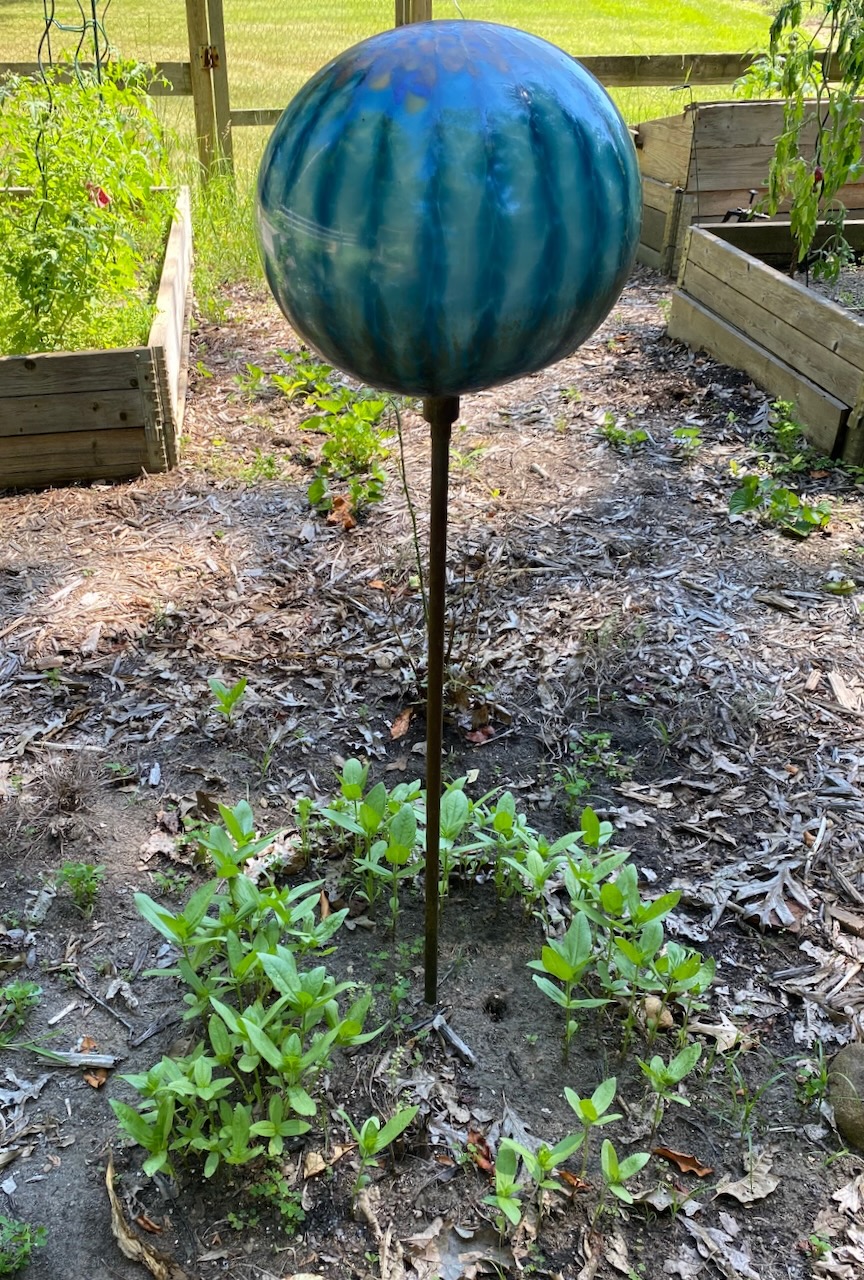 It was satisfying. I liberated the tomatoes and went on to the cosmos and zinnias. You can never have too many flowers, so when the available raised beds were full I found a place for more: a circle of zinnia seeds around my garden globe. In my garden I can grow what I want, where I want, in as many raised beds as I like, or in low dirt where I think that’s a better idea, No one argues with me about it. Other people grow other things, but gardeners don’t go around forcing their beans and watermelon seeds on those with other plans.
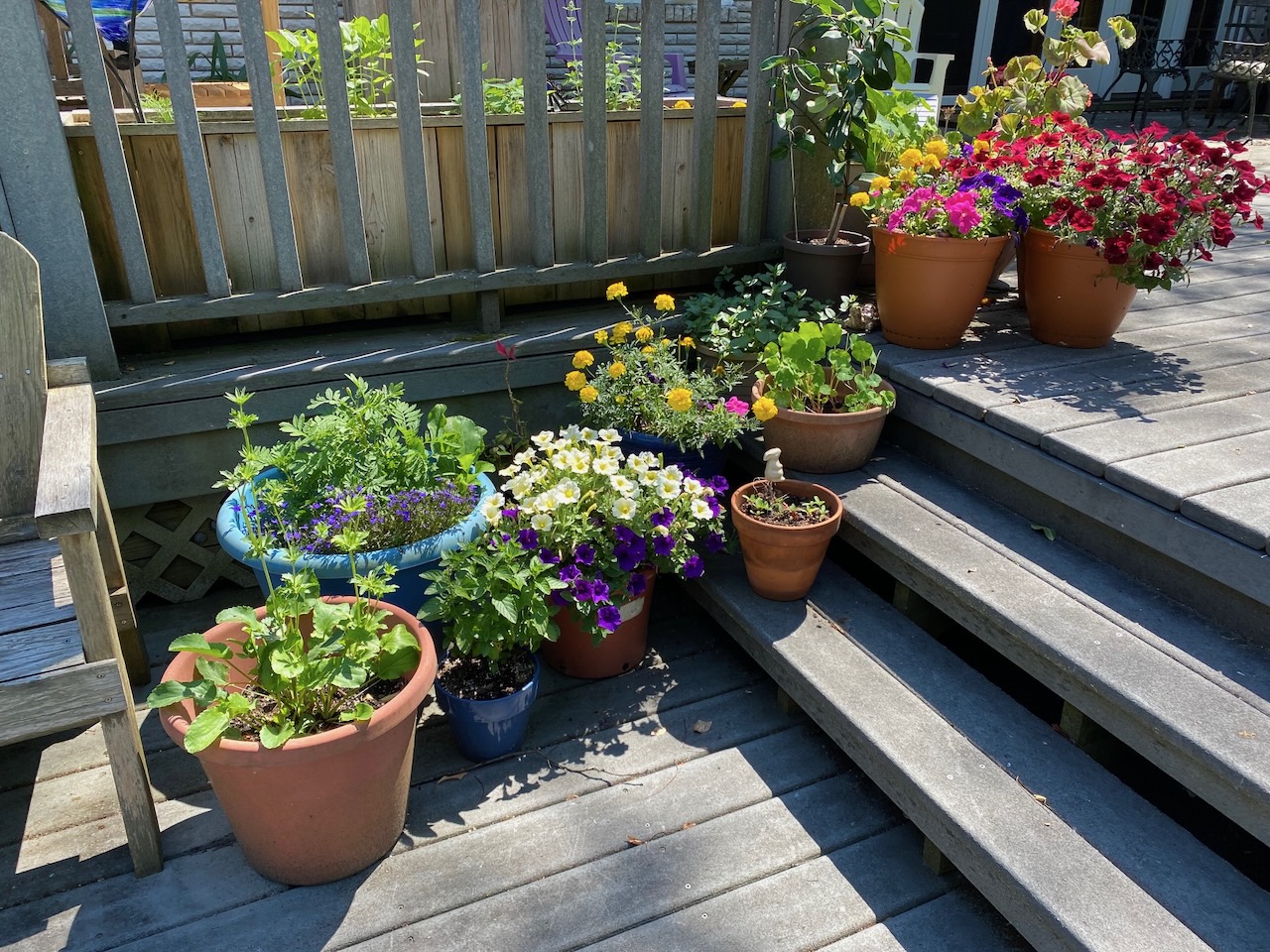 I added a row of pots down the deck steps – more flowers, and then some chocolate mint. Mint grows fast and will take over the world if not confined to pots. Someone once argued with me that mint couldn’t possibly taste like chocolate, because they didn’t believe chocolate came from a plant. They became very invested in this position, causing a force field to rise around their ears, blocking facts. I like to think this happens more outside of gardens than in them, but our first recorded instance of it was in a garden, long ago.
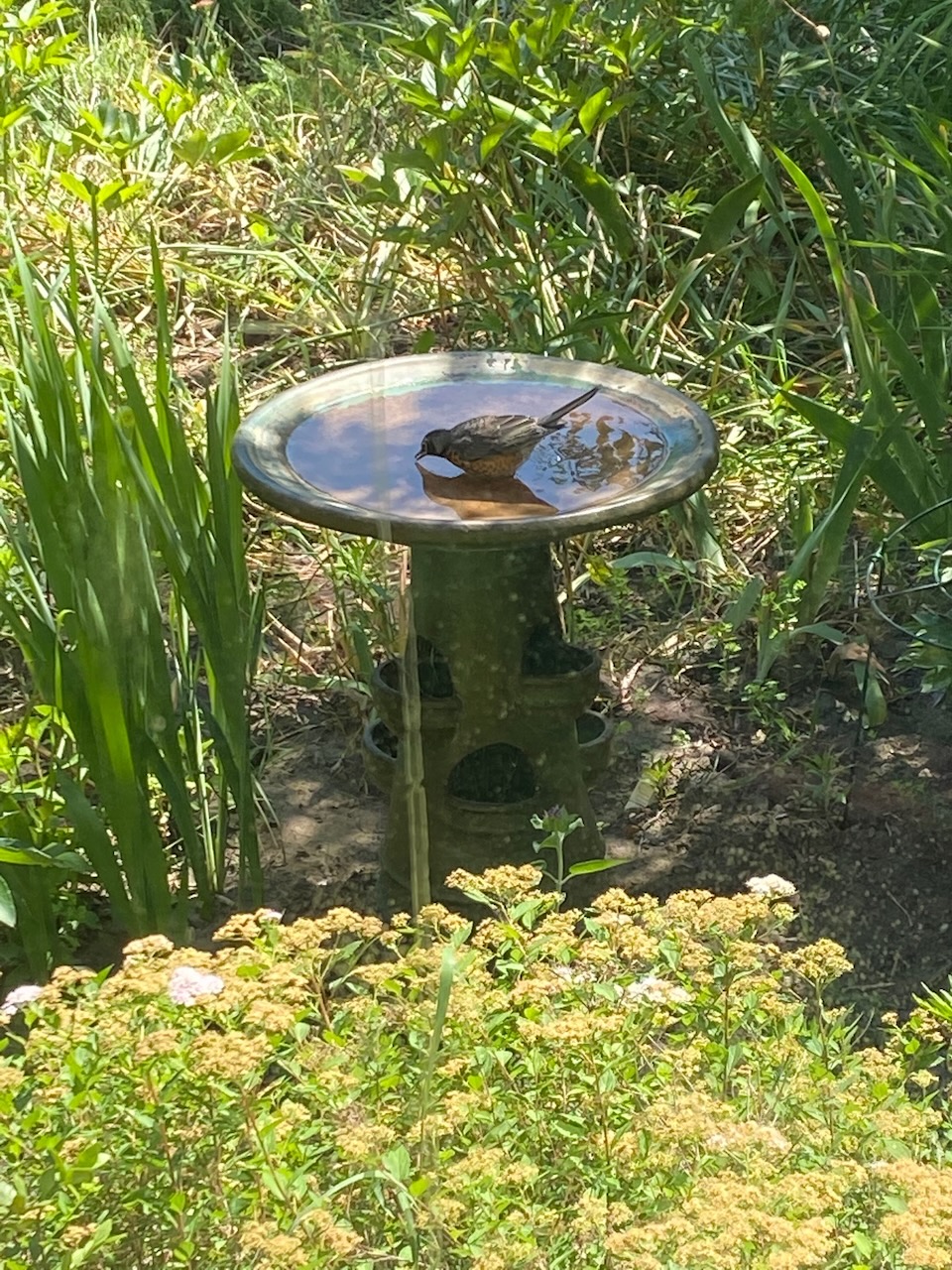 Once I had the pots on the deck I continued around the house to the front yard, where I checked the water in the birdbath. There was water. There was also a bird. Robins are my totem bird, of course, so when they hang out around my house it feels like a kind word from the cosmos, and makes me happy.
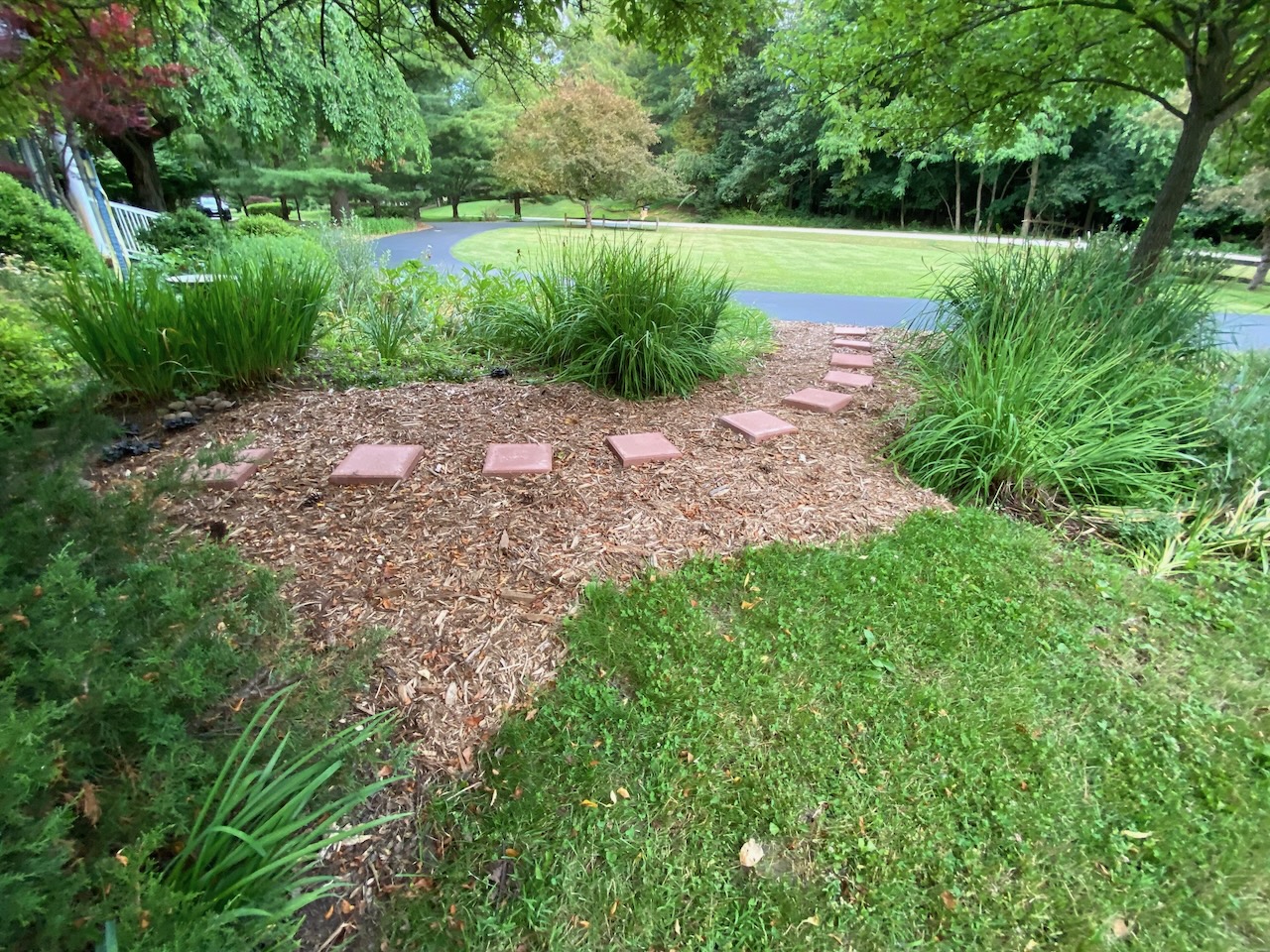 I fill the birdbath from a hose at the end of the house. I’ve been wanting a nice clear path to it, so I cut up some cardboard boxes, laid them out across the grass, layered mulch over them, and lined up stepping stones on top. When I turn on the water, my thumb on the end of the hose sends a strong enough spray to the birdbath to clean out any fallen leaves, dirt, stray feathers, whatever muck the has been left behind. A slight change of pressure makes the spray gentler, filling the birdbath up again, clean, sparkling, ready for the future. It takes the right effort in the right place, repeated often, to keep the situation from getting out of hand.
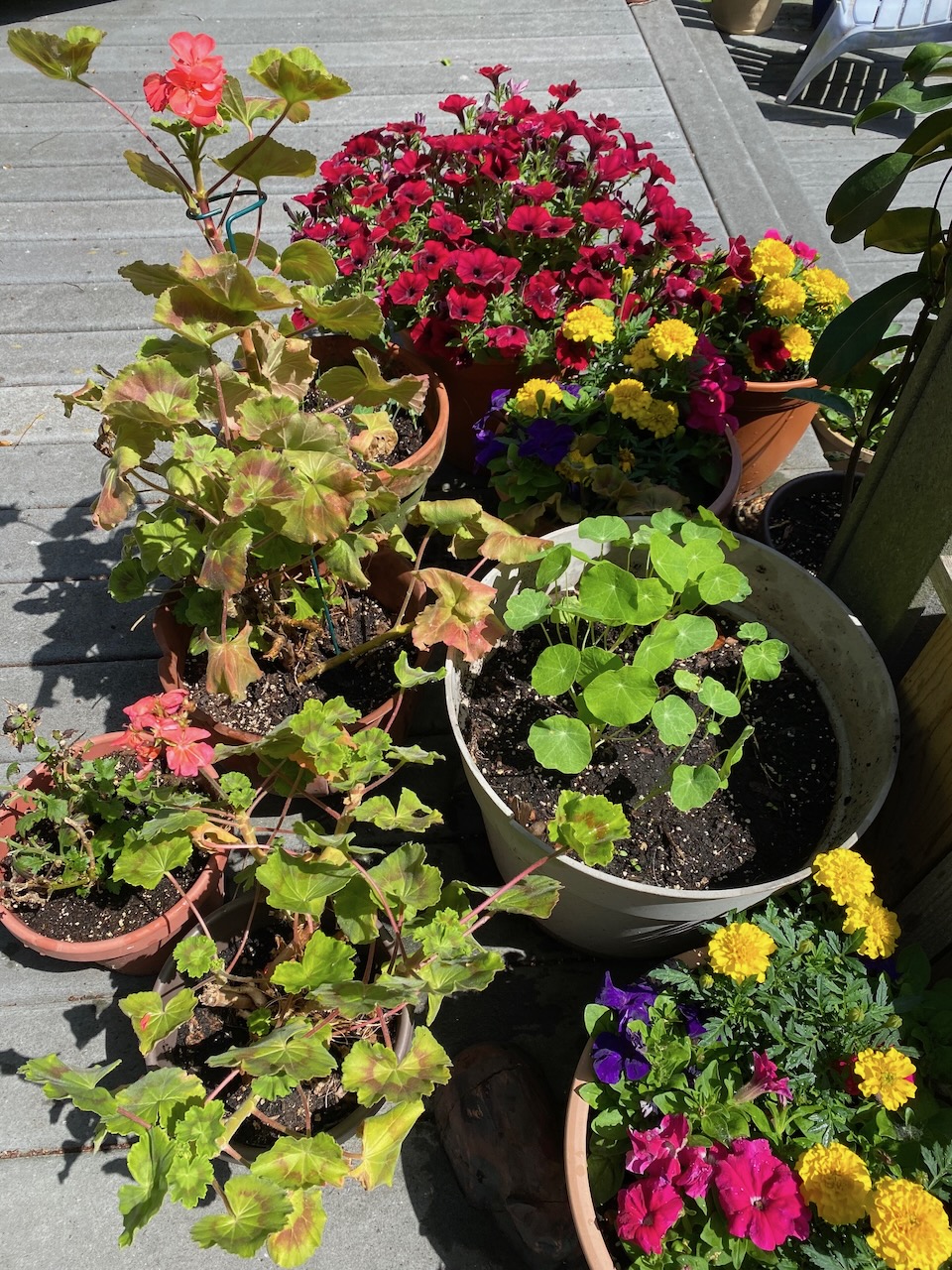 They say it’s really going to be hot today in Michigan. This weather forecast made me excited. Hot! Languid, delightful, relaxing heat, soother of achy muscles, consoler of tiny infants. Yay! That’s me talking. Unfortunately, it makes Doug cranky. He will want to turn on the air conditioner, and I will want to sit by an open window. I won’t do yardwork in the sun, but I will happily wander outside with my iced tea in hand, checking on the plants. They are well watered from the huge downpour we had two days ago, but pots do dry out. A thumb in the dirt of these told me they’re doing fine, but at some point Doug will bring a bucket of water up from the dehumidifier, and I’ll give them another drink.
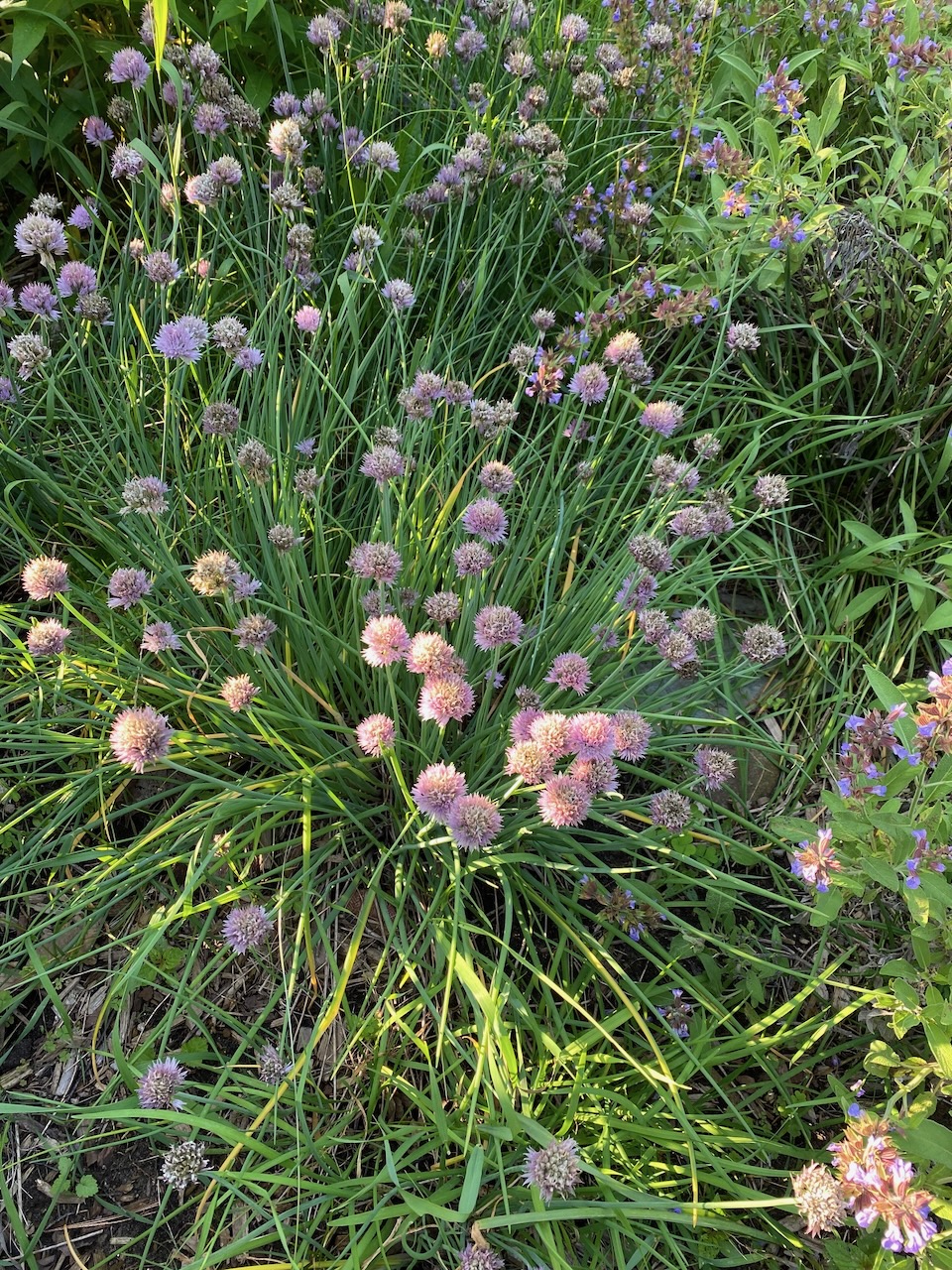 The plants in the ground won’t need extra help. Here are the chives in my herb garden, along with some of the sage, looking happy. Their friends the thyme and oregano are happy too, but the chives get the photo op while they’re in bloom.
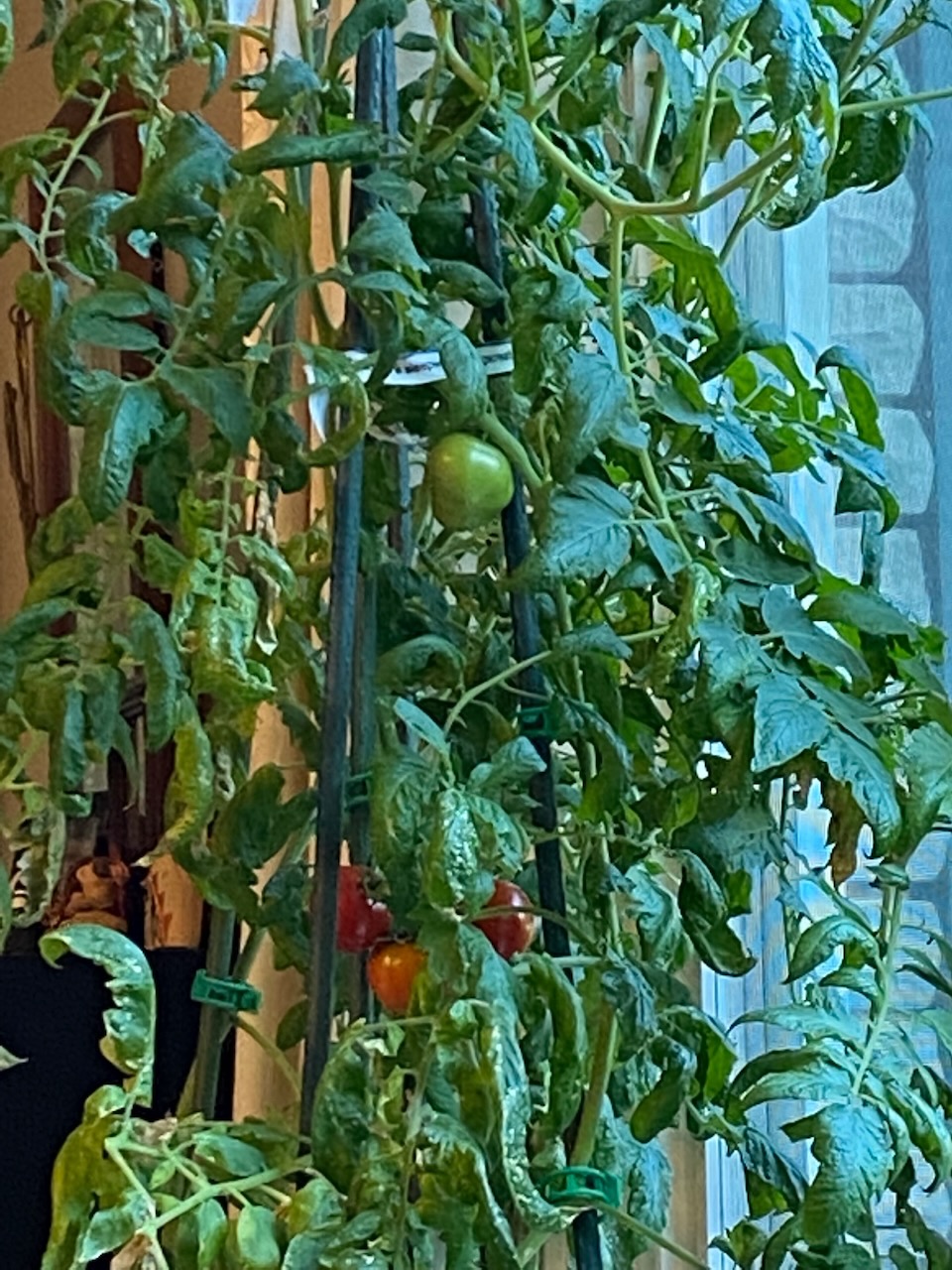 The outdoor tomatoes are blooming now, too, and a few fruits have set. Tomatoes like it fairly hot, but if it goes over 90 degrees for a couple of days, they won’t set fruit. Meanwhile the indoor tomatoes, which have been producing since Memorial Day, are rolling right along. They have a sunny window, but they’re also downstairs in a two story house, so they’ll stay cool enough.
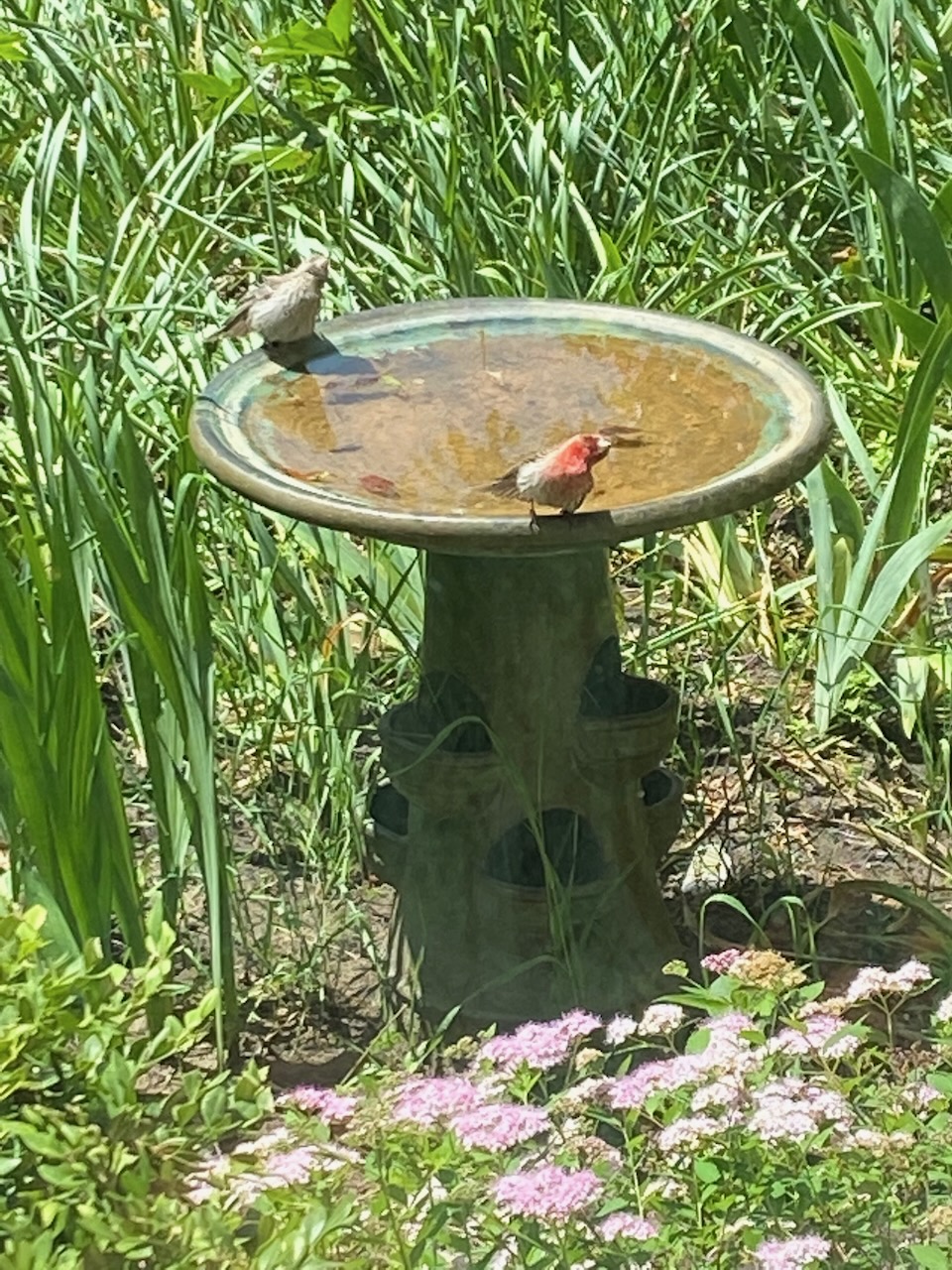 Sitting by that window, writing this, I was thinking of the birdbath and scrolling through my phone for a recent photo, when I glanced out the window and saw this. They hopped out, of course, as soon as I picked up my phone. I also saw that the level of water has decreased since this morning. It’s 1:30 clock time now, which is our Solar Noon (one hour for the clocks being on Daylight Savings Time, and half an hour for our location within our time zone). I will monitor the water level, and fill it back up when needed.
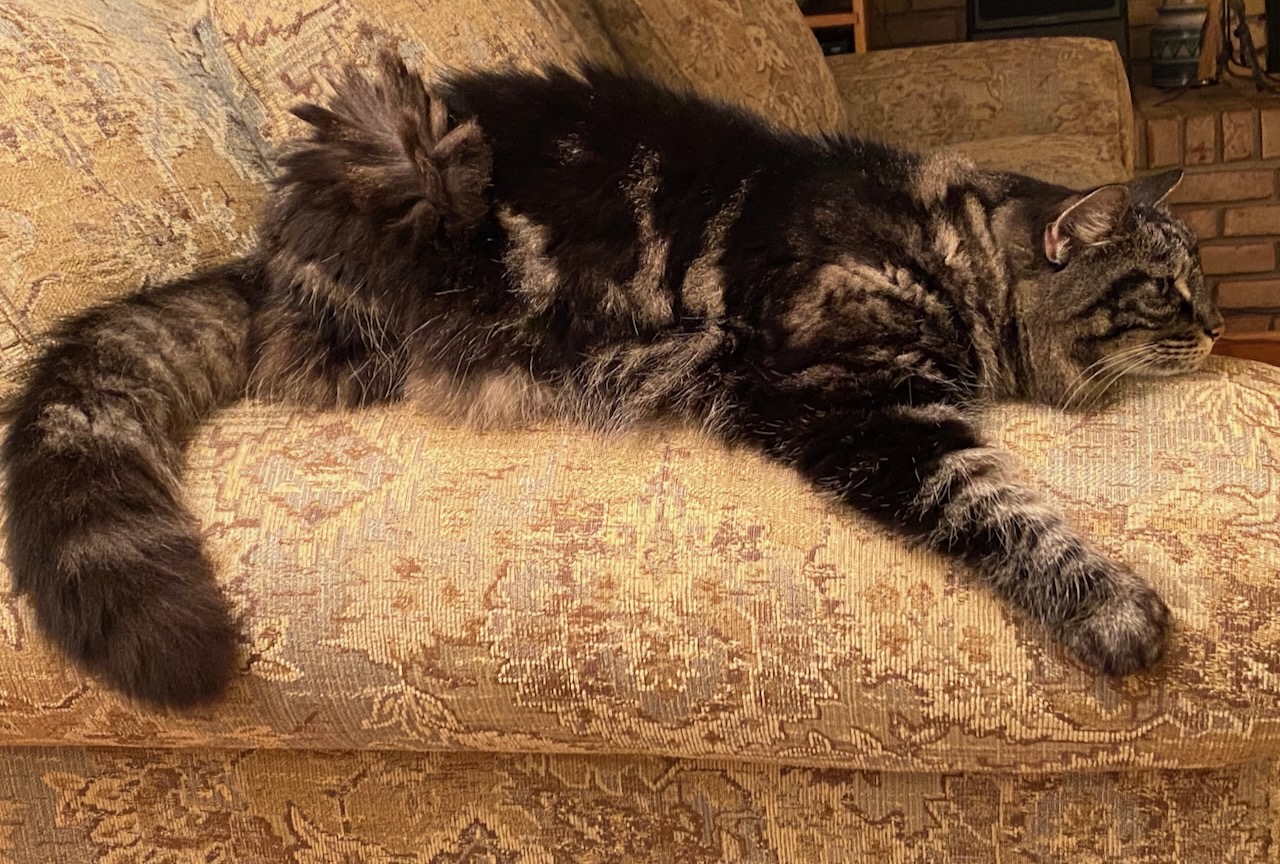 Zerlina is often very interested in birdbath activity, but not today. We’re officially at 92 degrees, so she’s with the garden tomatoes on the question of temperature limits. I think Doug is taking a nap. I promised him I wouldn’t go out in the noonday sun, but in a couple of hours I will make the rounds, slowly, with iced tea and bare feet, amazed again at the warmth welling up from the same place where, just weeks ago, I walked in the snow.
 Robin Richstone