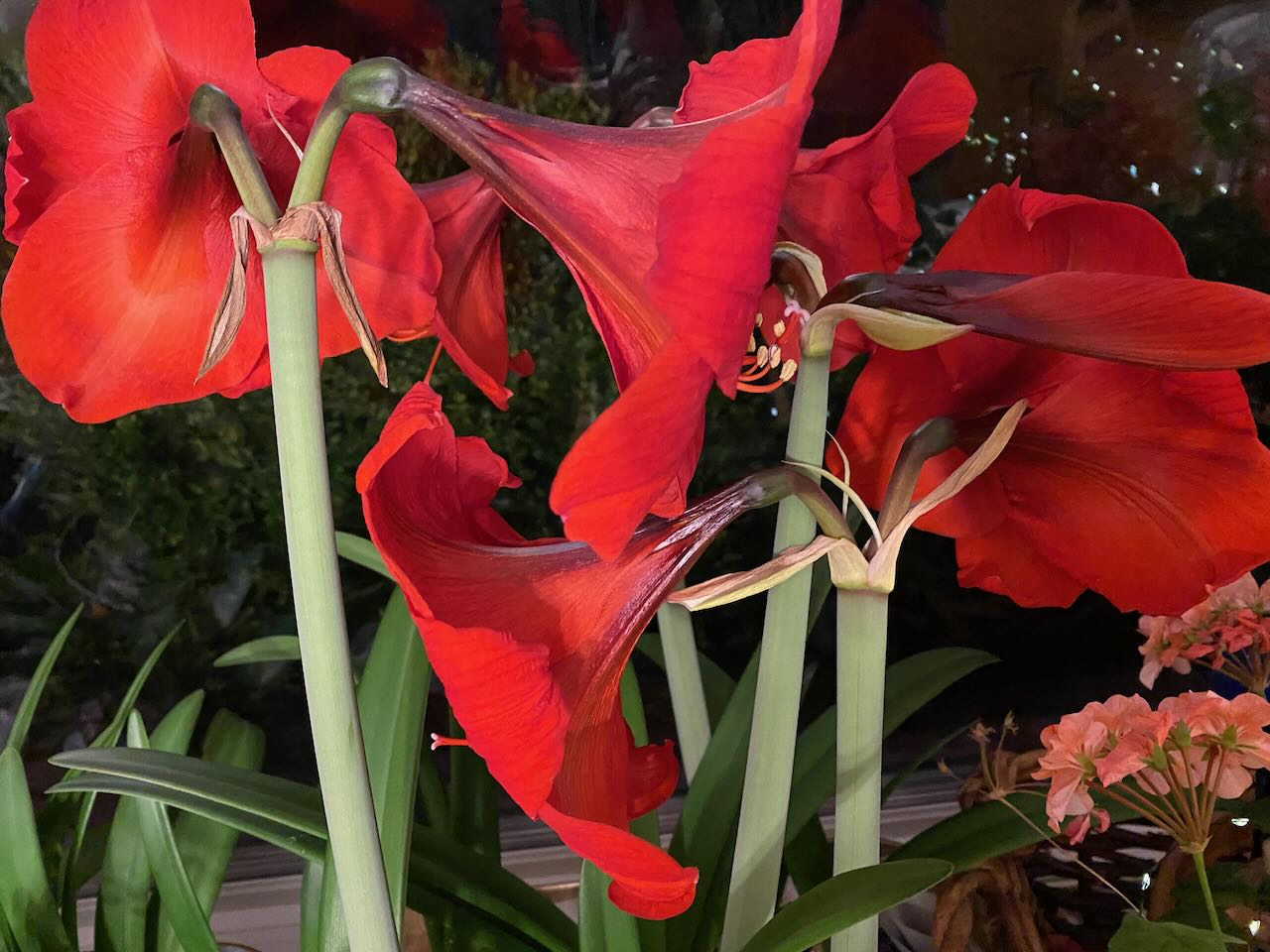
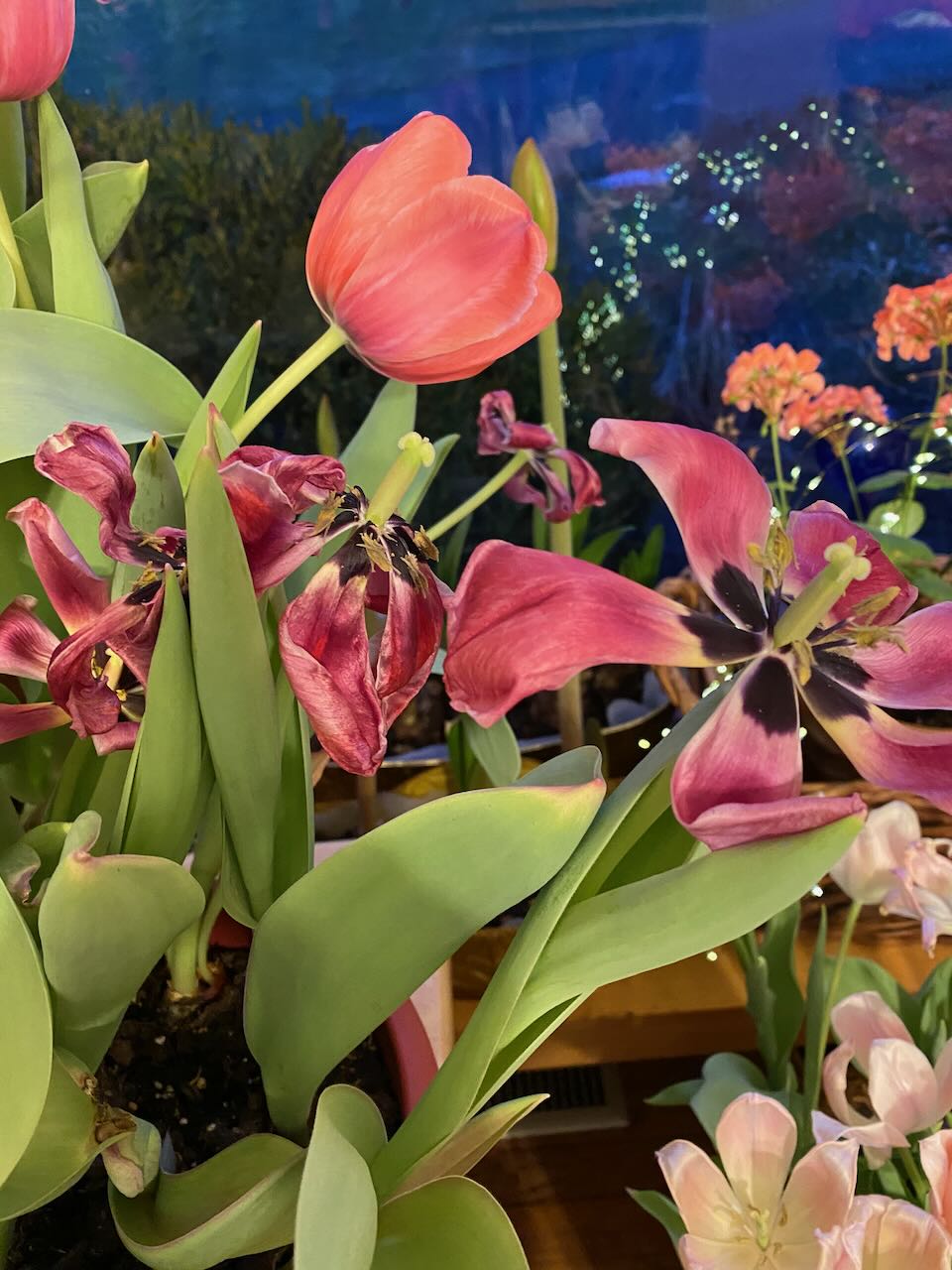
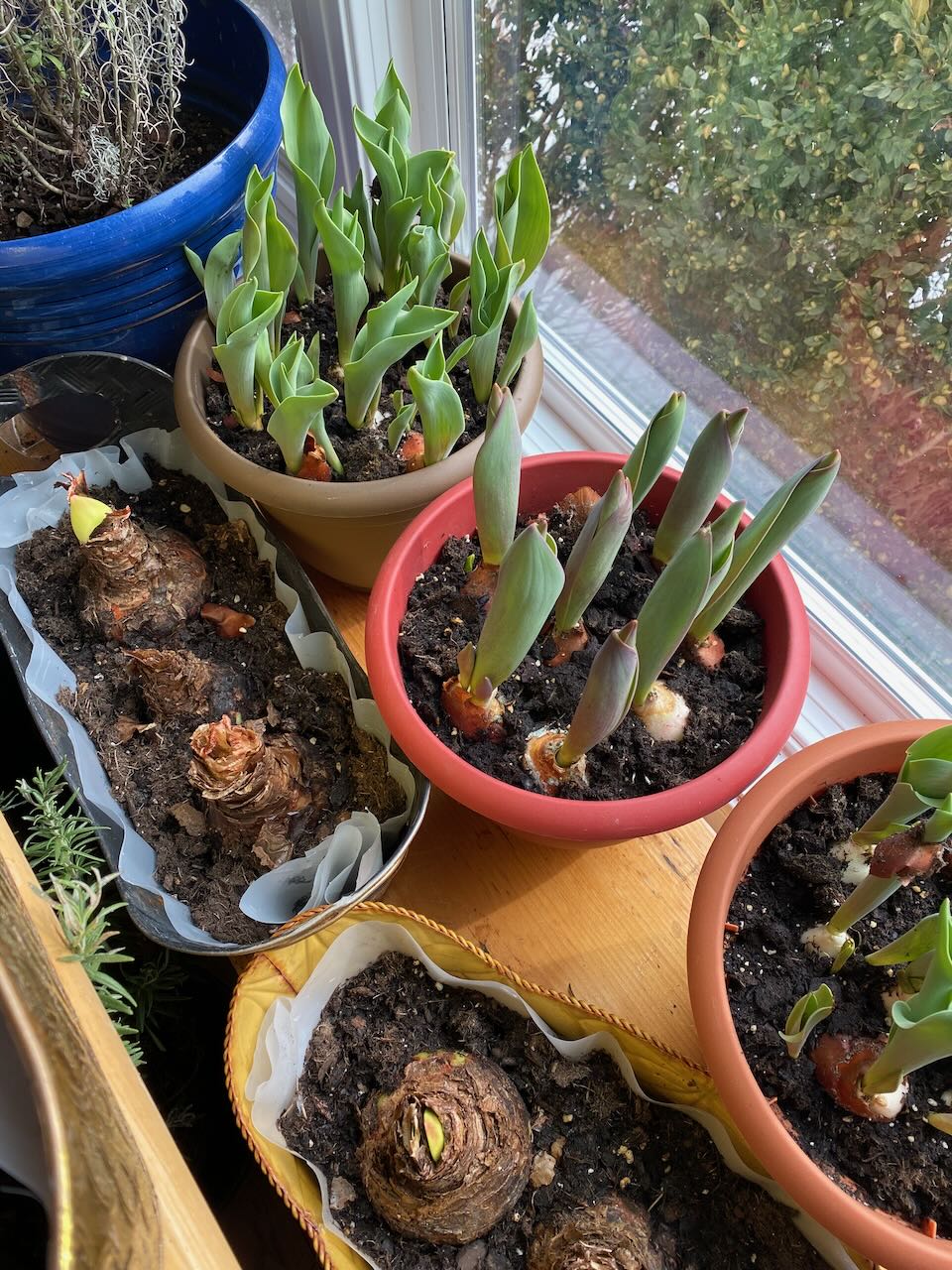
The tulips at my windowsill are done now and the amaryllis have come into glory, turning their backs to me because the sun is so much more compelling. Birds that were here all winter but mostly hiding in the shrubbery, are now flaunting themselves in song – certainly song from the cardinals and robins. I’m not sure I’d call it that from the bluejays. Still, it serves their purpose, claiming a territory, finding a mate, the tasks of approaching spring.
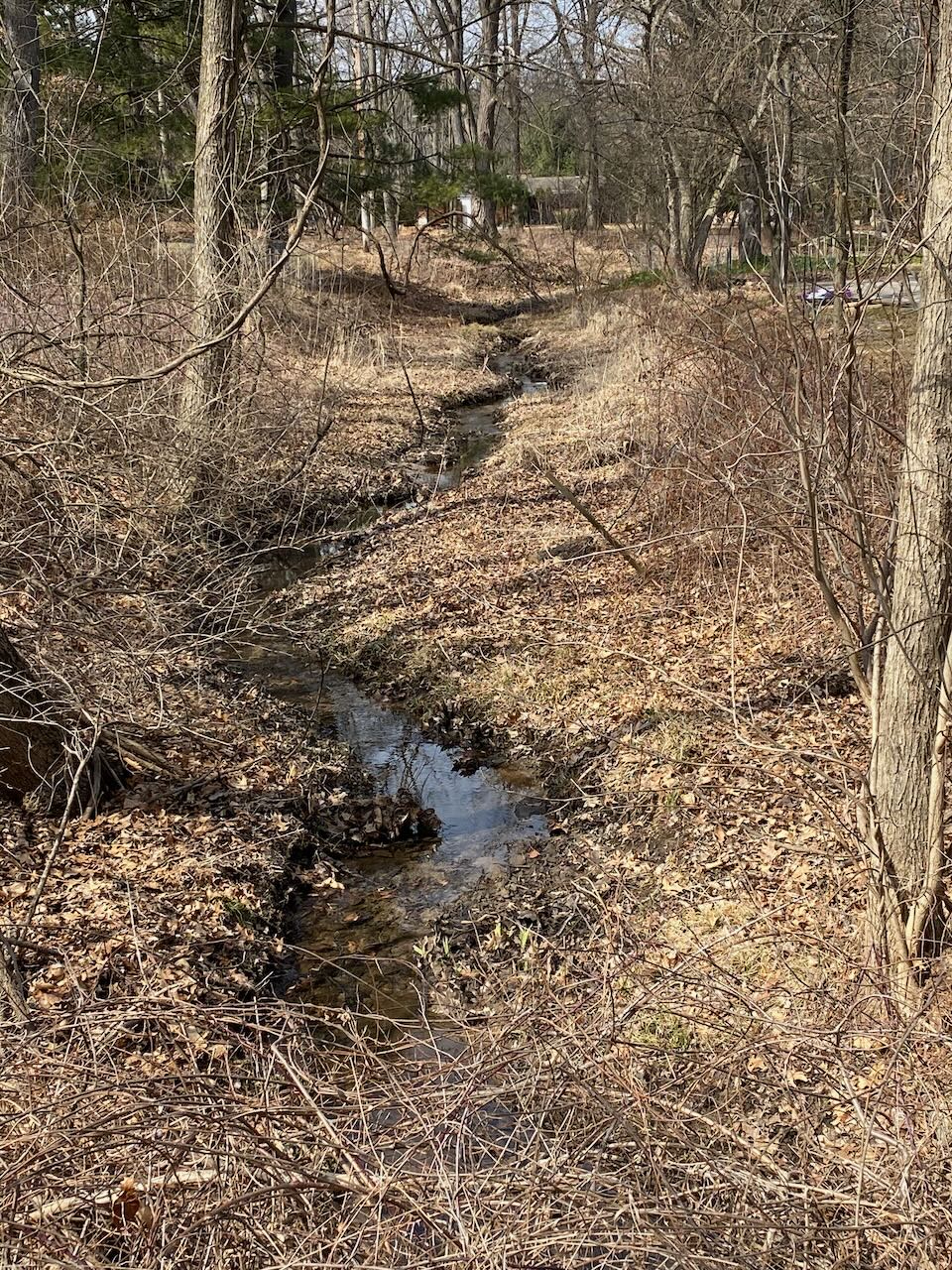
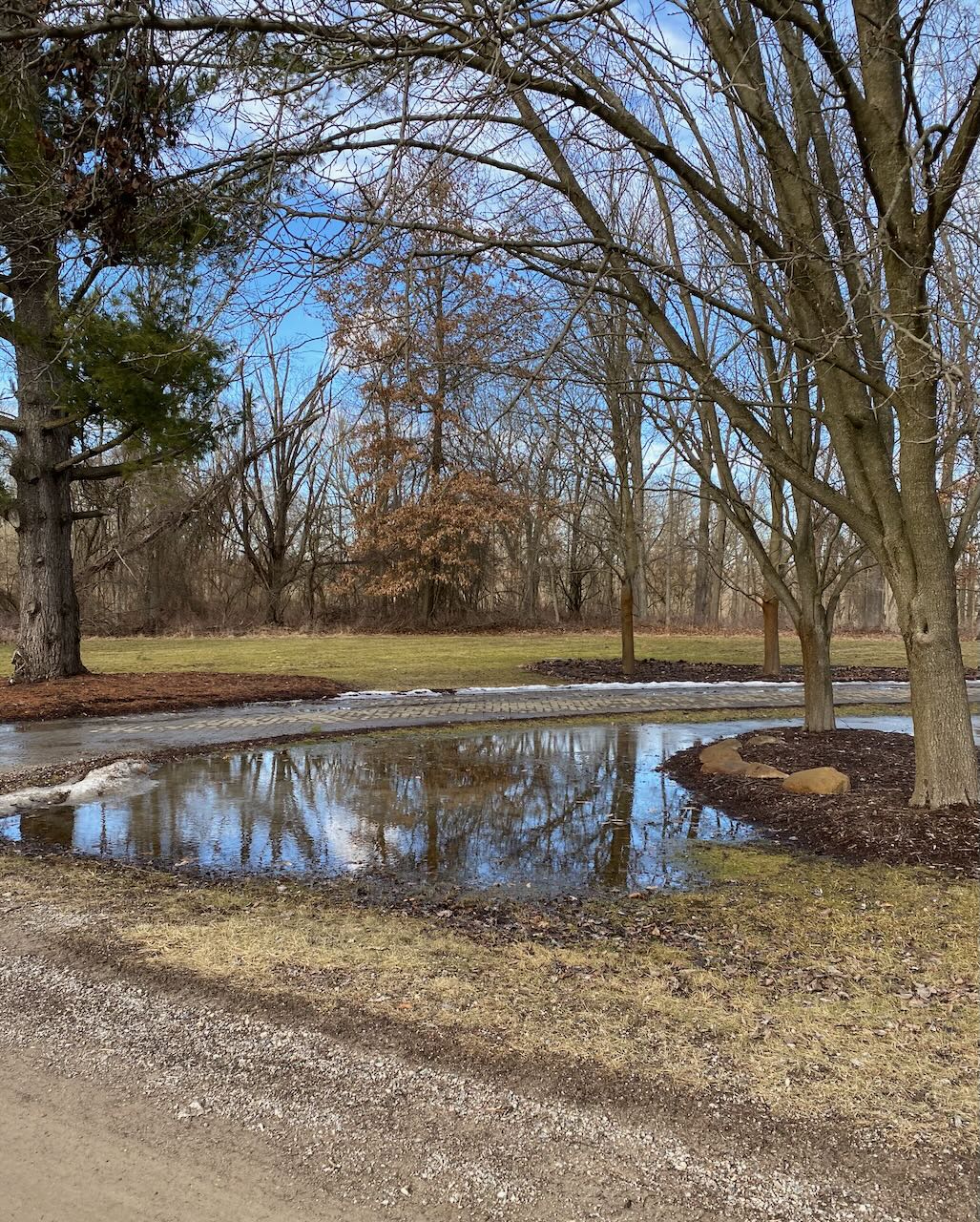
The snow has turned to rain, sometimes as it falls. The ice is gone from our small neighborhood creek, where bare branches and flattened grass give us a longer view than usual of the path it provides for deer on their way to the river. That’s one of my favorite things about winter – how it changes the way we see things.

There’s a song about changing viewpoints, starting with clouds, that I always think of when I’m on an airplane. I like to sit in the window seat and watch the familiar, detailed ground turn into vast maps, and clouds become veils and carpets. I take photos and make sketches but nothing’s gelled into a painting yet.

The sky is a rich source of painterly inspiration from below as well as above. Walking up my street yesterday I saw this. How would I paint clouds so they came out like that? Painted ultra-realistically, wouldn’t they look fake? These particular trees are evergreens so the view is seasonless, but if I painted in bare branches, or hung them with snow, or flowers, or red leaves, the same sky would tell a different story every time.

This is one of my favorite early-spring photos, taken a few years ago. I love how the tree seems to grow out of the barn, entirely because of where I stood to take the picture. The trees are bare; the sky looks like it might want to snow but will have to settle for rain. Once the tree leafs out, the barn, from this angle, will disappear. With all the development happening in our area, it may already be gone.






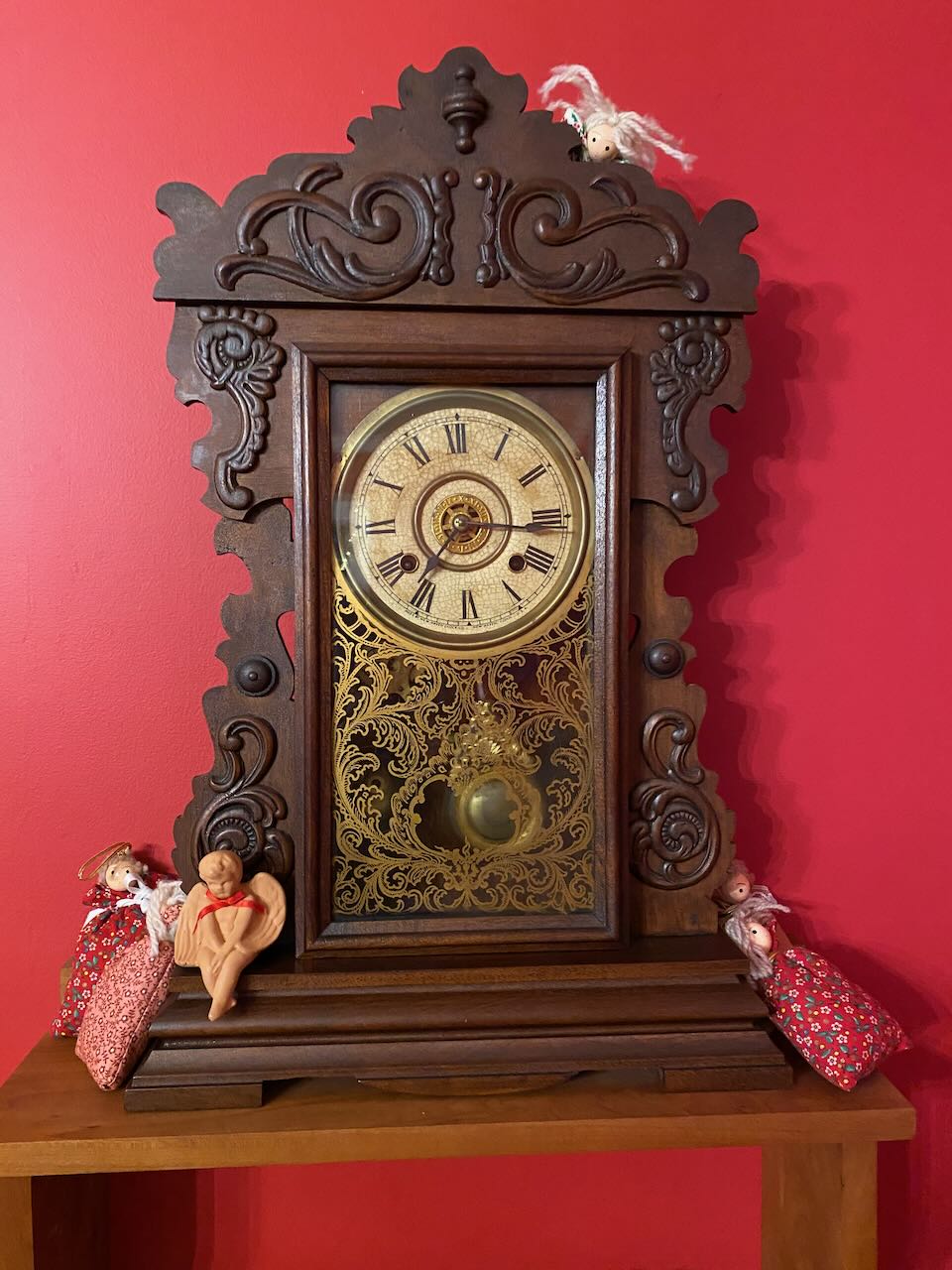 Happy New Year, the day that looks both forward and back. This is my antique clock, that rang in the New Year last night as it did through my childhood, when it sat on our living room mantelpiece and it was my job to wind it. I was the one among my siblings who’d wind it slowly enough not to break the mainspring. The little angels visit the clock when I decorate for Christmas, and they will fly back up to heaven, or somewhere, after January 6th when the decorations come down.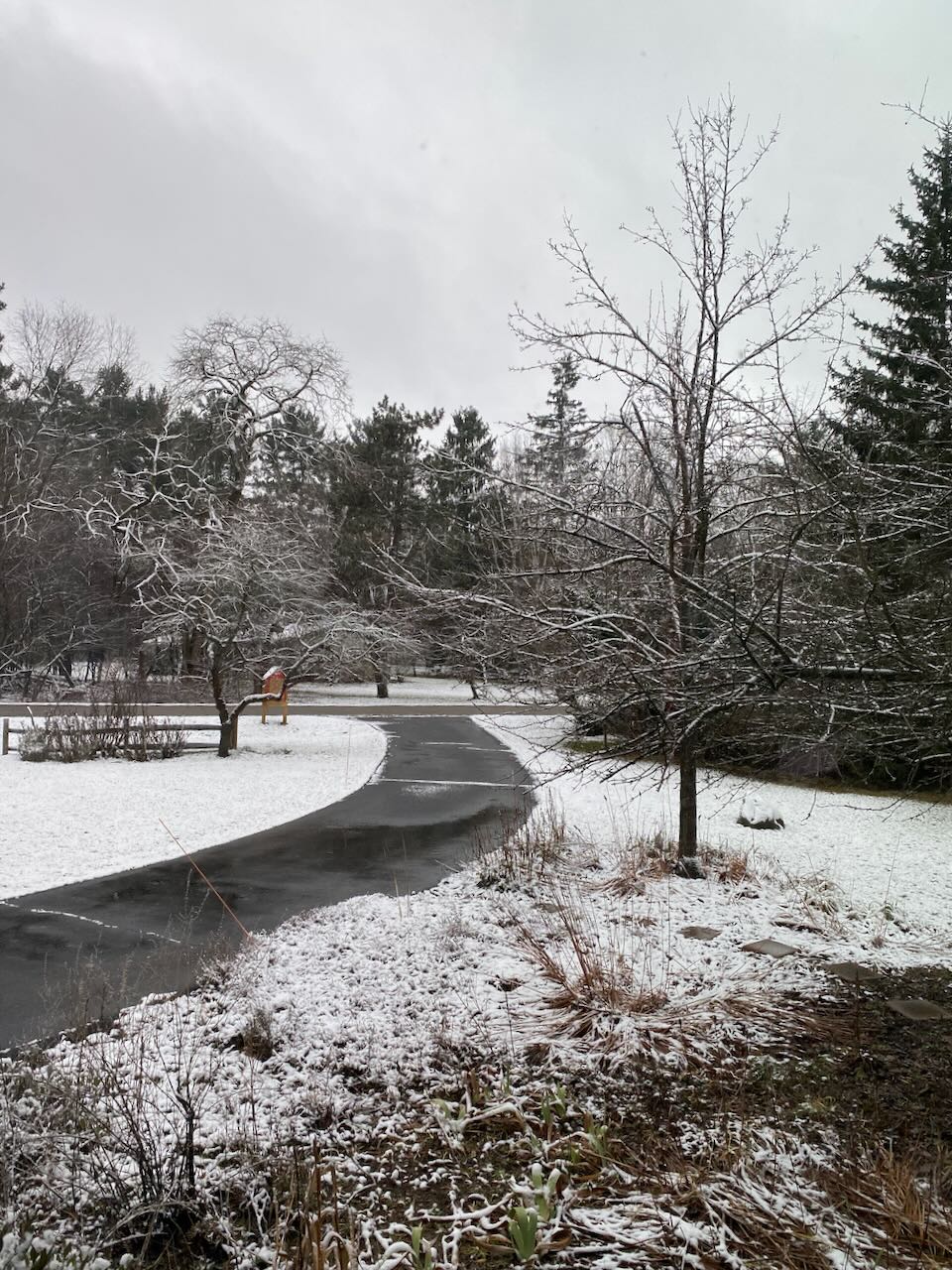
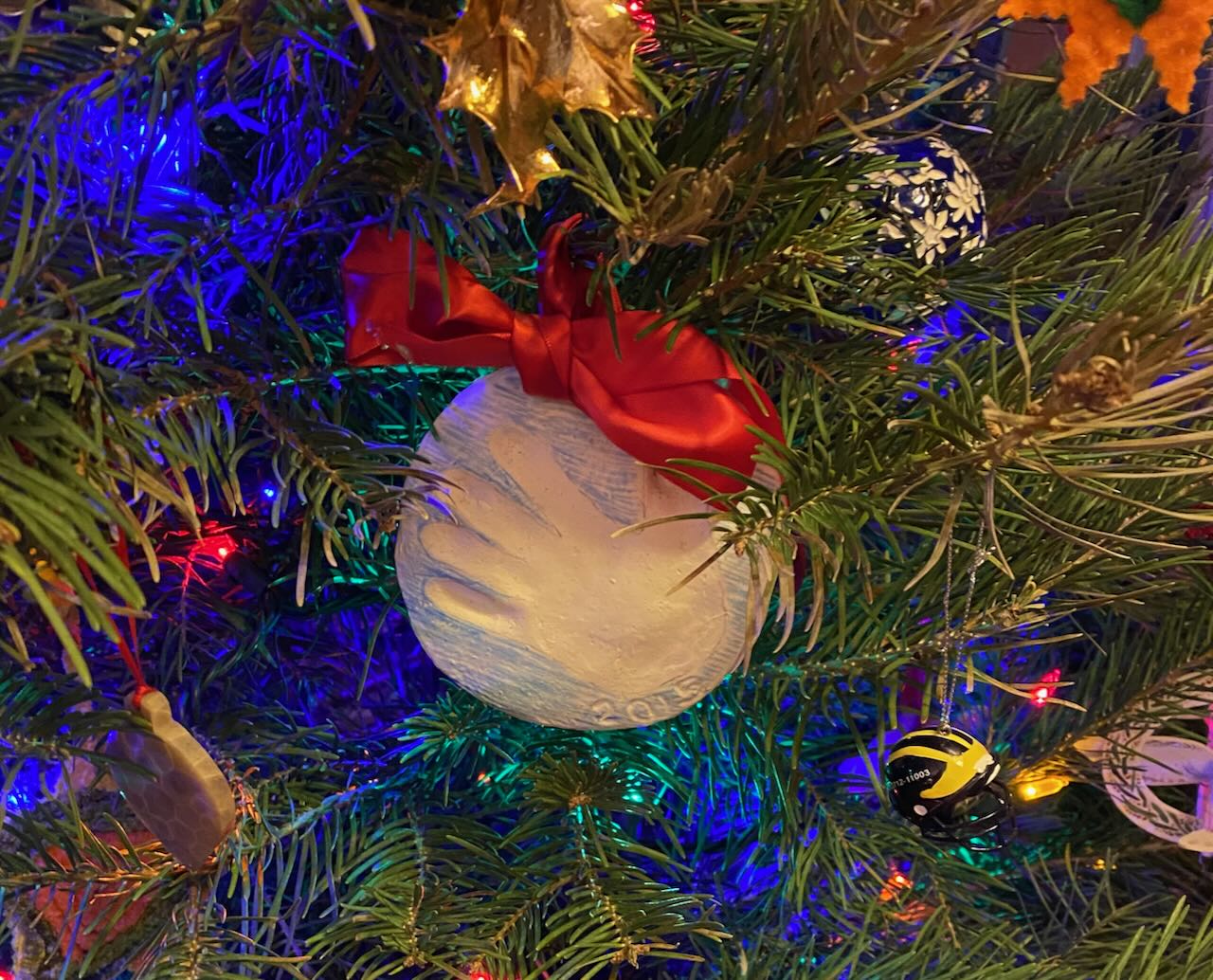
 The best thing about decorating the house for the holidays is unpacking my ornaments and distributing them through as many rooms as possible. Doug helps me carry all the boxes up from the basement, and as I open them I lift out every Christmases I ever had. Which at this point is a lot of Christmases. It’s true I don’t possess actual pieces from my childhood any more, but those from my children’s childhood recall my own to me. The stars made of bread-dough clay, flowers of cornstarch clay, and god’s eyes of yarn, emerge from their careful tissue wrappings as though in a sparkling blaze, and light up the winter day. I put on Christmas music, sing along, pour myself some eggnog, and restore the ornaments to the season they were made for.
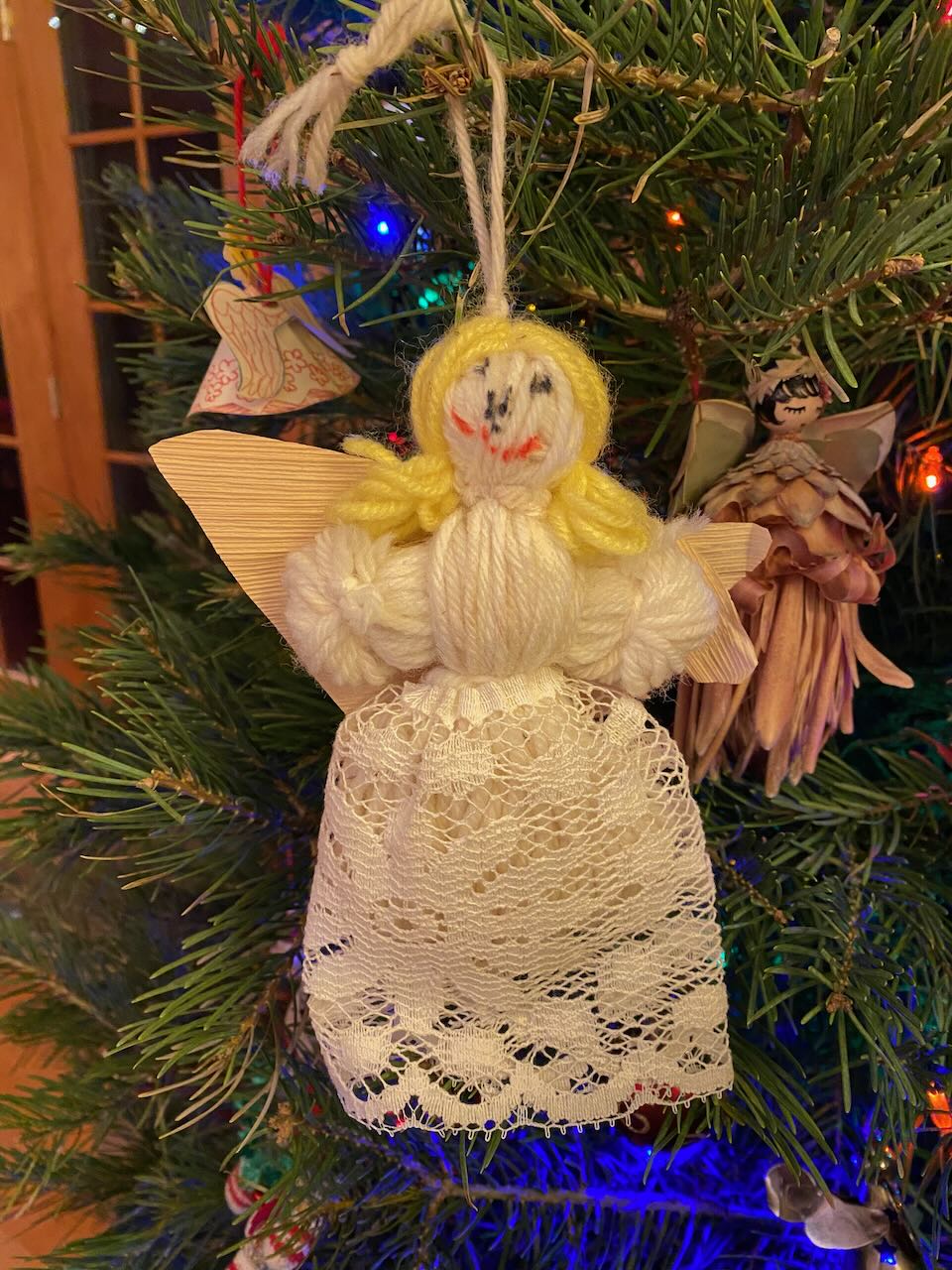 I used to make these yarn angels – it’s why I taught my daughter to make them. My children, grown now, refer to these ornaments as my Holy Relics. I hang them alongside store-bought travel souvenirs and gifts from a lifetime of friends. Every year an ornament or two breaks, or falls, or in some other way meets the end of its useful life, and every year I make something new and add it to the tree.
 Recently a friend gave me a stack of books she cleaned out of her house. There was a whole set of encyclopedias and an array of books she had once used teaching English in Poland, including dictionaries and songbooks. The pages of the songbooks were large and inspiring, meant as they were for lifting voices out of paper and ink. Pretty miraculous. I couldn’t read them, but I thought they made a glorious wreath.
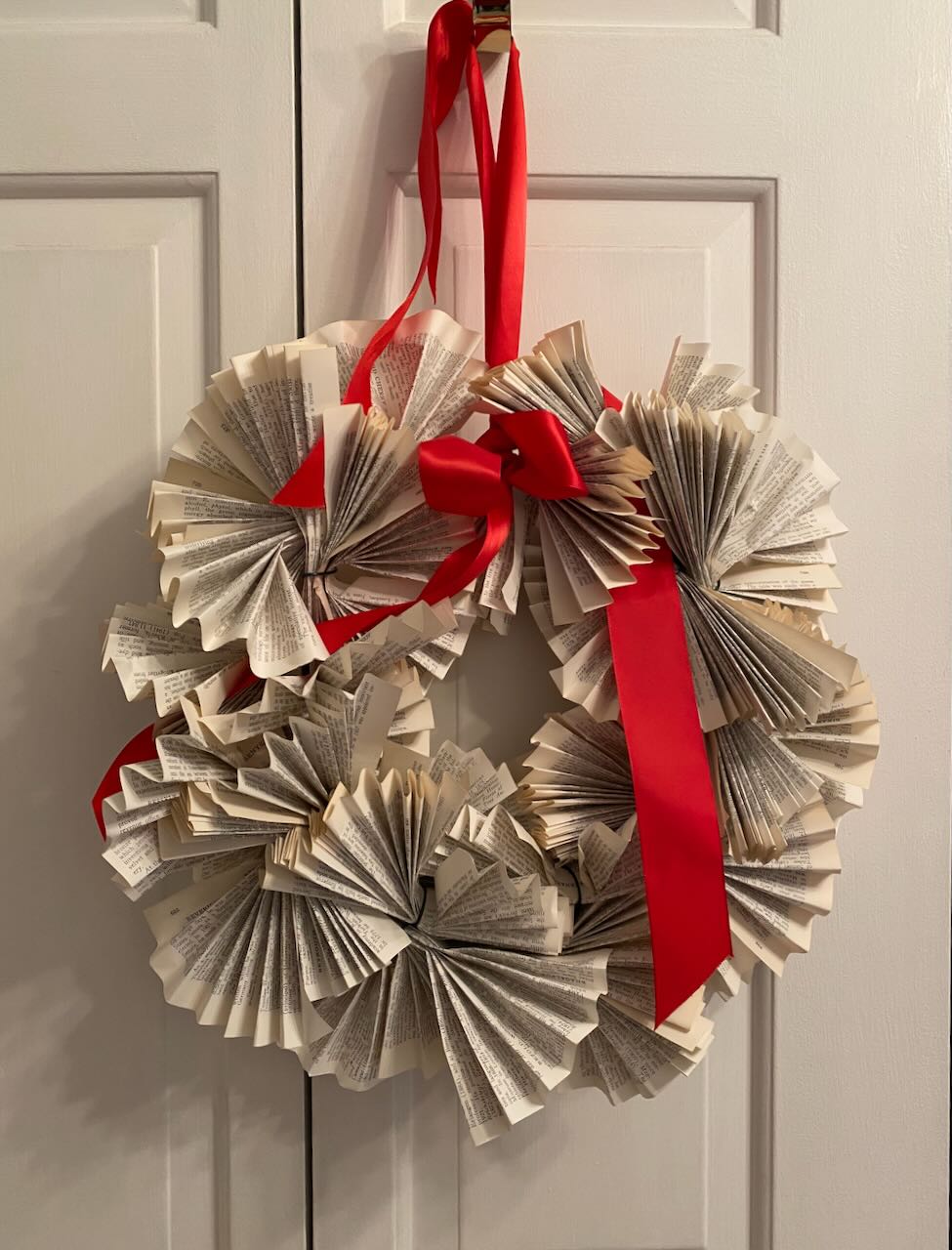 The encyclopedia was in English, so I can tell you the pages that made this wreath were full of Billiards and Bergamot, among other Volume Two subjects.
 My new tree ornaments this year were also made of paper, this time Japanese origami paper. Another friend showed me how to fold it into pairs of flower petals, which were then glued together to make a circle. To hold the pieces together while the glue dried, I used the miniature clothespins my Dad used as clamps when he made ship models. My children, my parents, countries I have learned from, countries I have traveled to, all these cultures and all these generations fill the branches of my tree. Multiculturalism is out of fashion these days, but it’s beautiful and memorable in my living room, here at the time of year when the light prepares to come back.
 Thanksgiving marks the pivot point between fall and winter. The leaves are all down, Christmas lights have begun going up, and a bit of snow has joined in the decorating trend. One of my surprises moving to Michigan from California, was still having fresh sage in the garden for the Thanksgiving turkey platter. I did have to brush the snow off of it, but it looked great and smelled wonderful.
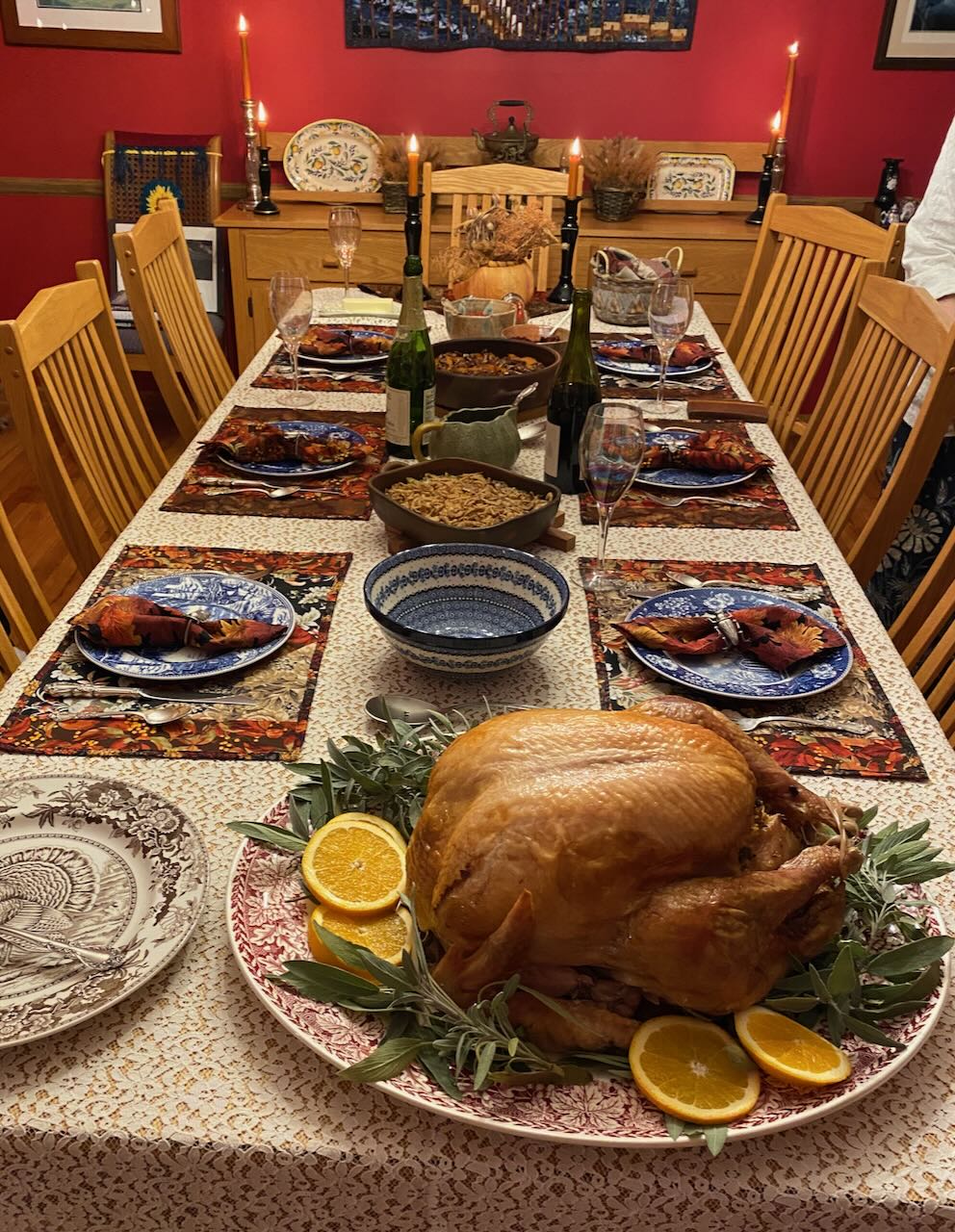 The turkey platter is a family heirloom. I didn’t have the best relationship with my mother growing up, but as I set the table it meant a lot to me to have her silver, her black glass candlesticks, her blue Staffordshire souvenir plates, her turkey platter. I lifted and placed these things and thought about what her life was like, what she might have wanted to do with it and what she did. She used to tell me stories that changed as she told them, that differed from time to time. That was how it seemed to me then. Now I think it was all the same story, just seen from different perspectives.
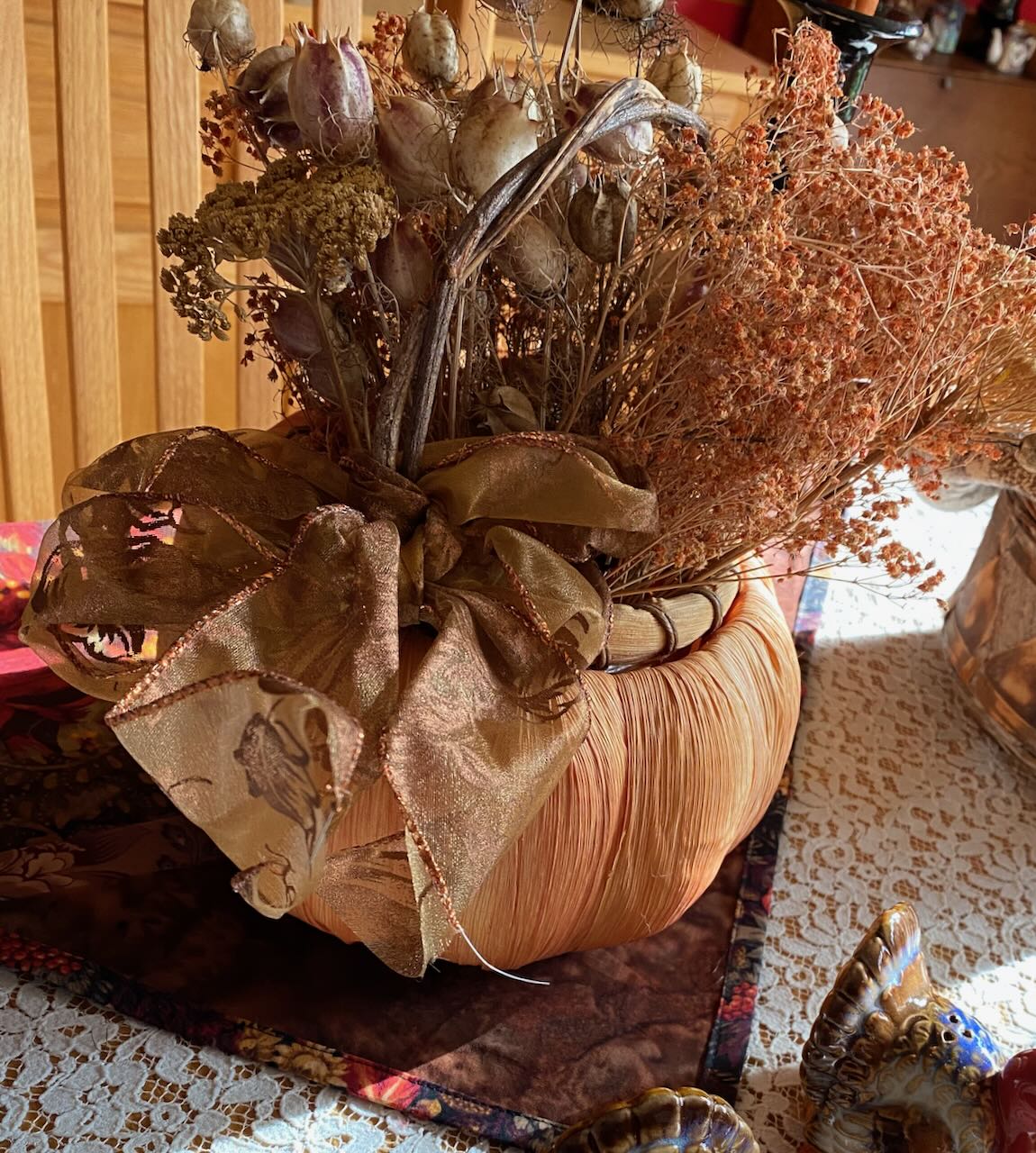 Thanksgiving is a good time for appreciating what you have. No more zinnias or cosmos in the garden, but the nigella and goldenrod, standing tall and dry outside in the cold, make a lovely arrangement.
 There’s leftover pumpkin pie for breakfast, while on the front porch the frost is definitely on the pumpkin.
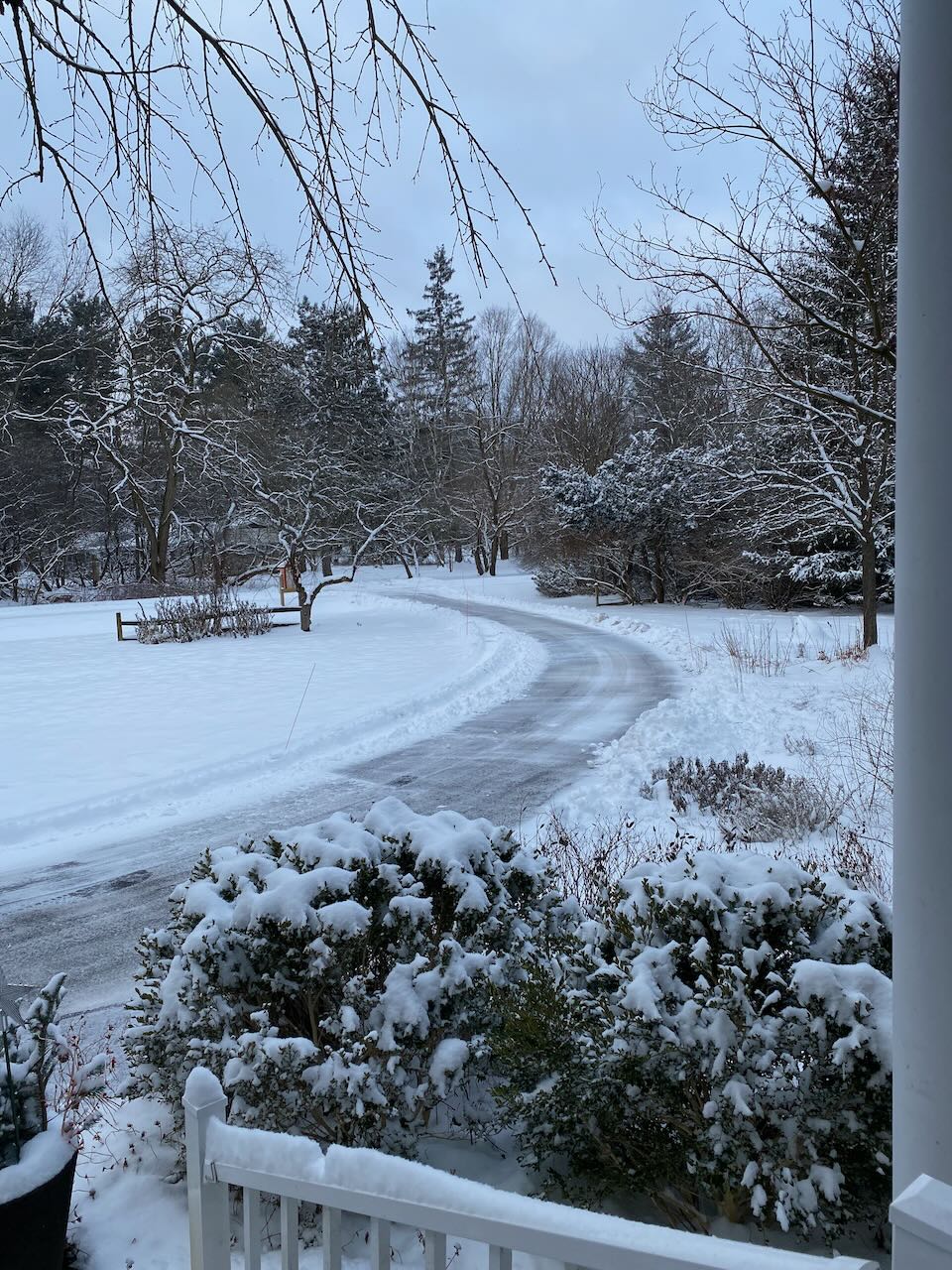
 Snow outlines the trees, blows off, comes back, blows off. The sky’s not the same twice in ten minutes.
 On my windowsill another transition is happening: the poinsettias, so lush and green when I brought them in form the deck, are starting to turn red. The next season is coming along.
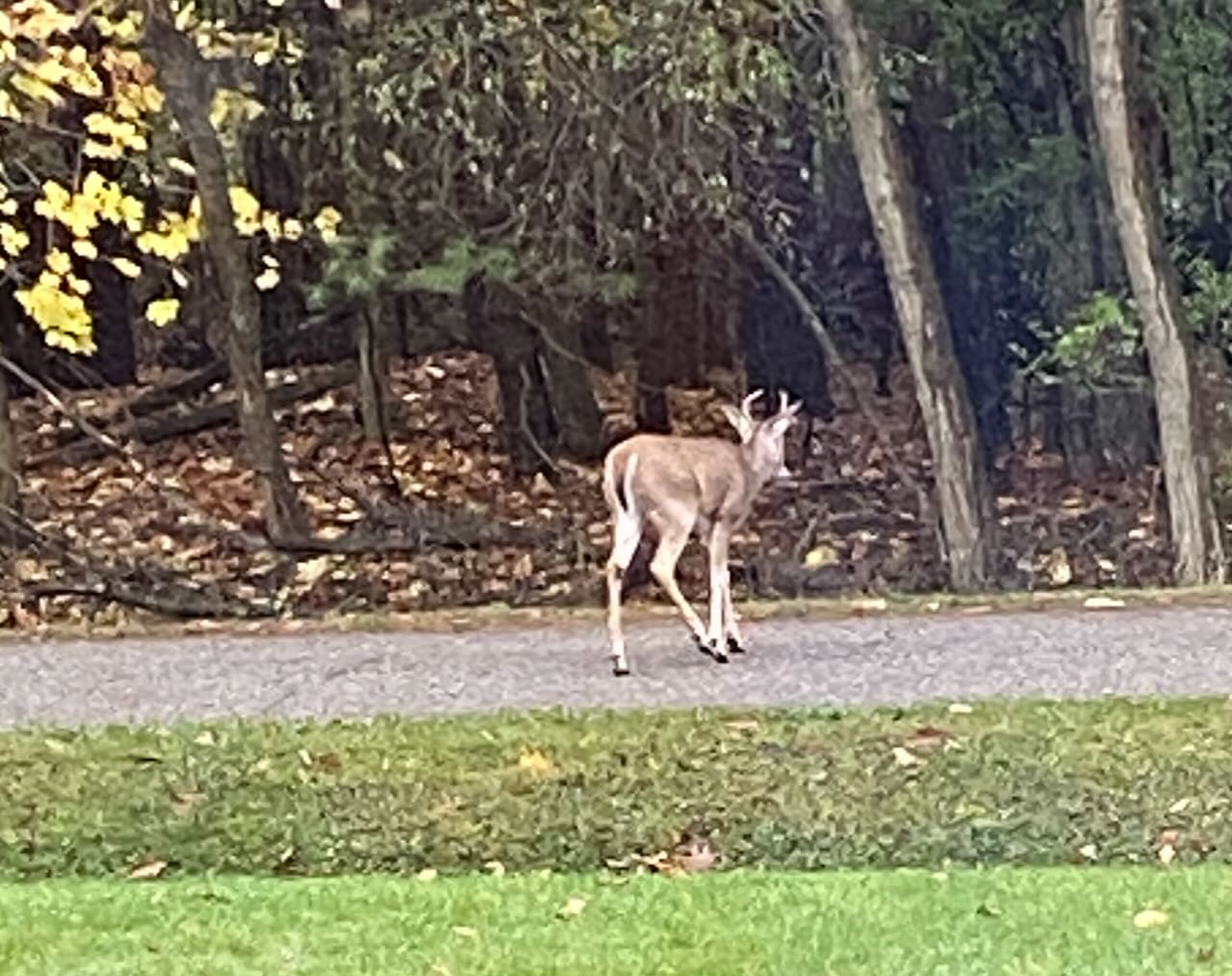 After weeks of summer and fall bumping into each other in a jumble, fall seems to be emerging triumphant at last. The stags are about done destroying small trees by using them to rub the velvet off their antlers. I’m still waiting for one of them to graciously leave his shed antlers in exchange – seems like the least he could do. Maybe this will be the year.
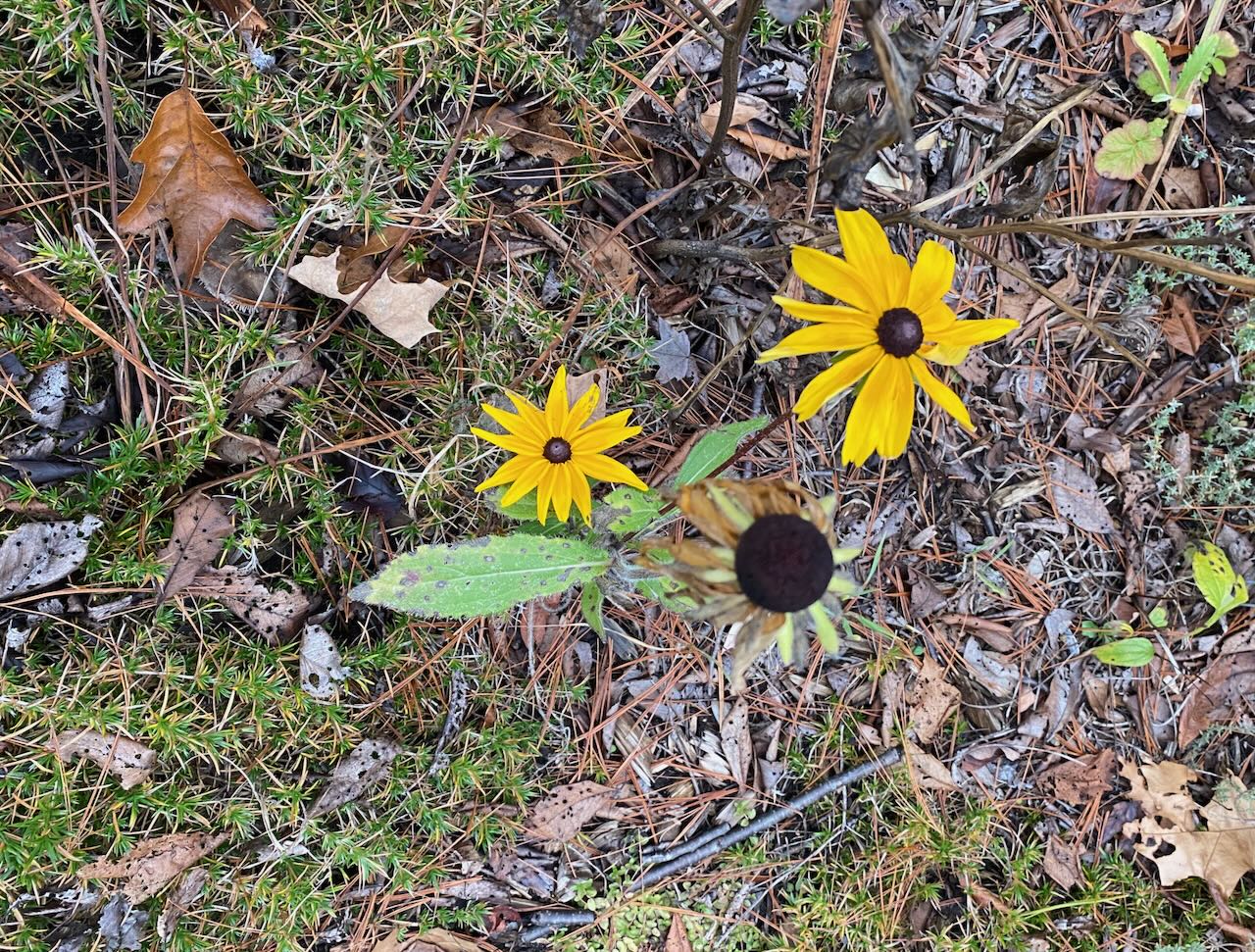 Between the light frosts and the subsiding hours of sunlight most of my flowers and tomatoes are gone, but out in front, facing south, one rudbeckia plant persists. It’s not the only rudbeckia out there, but it’s the only one still blooming. A mystery of nature.
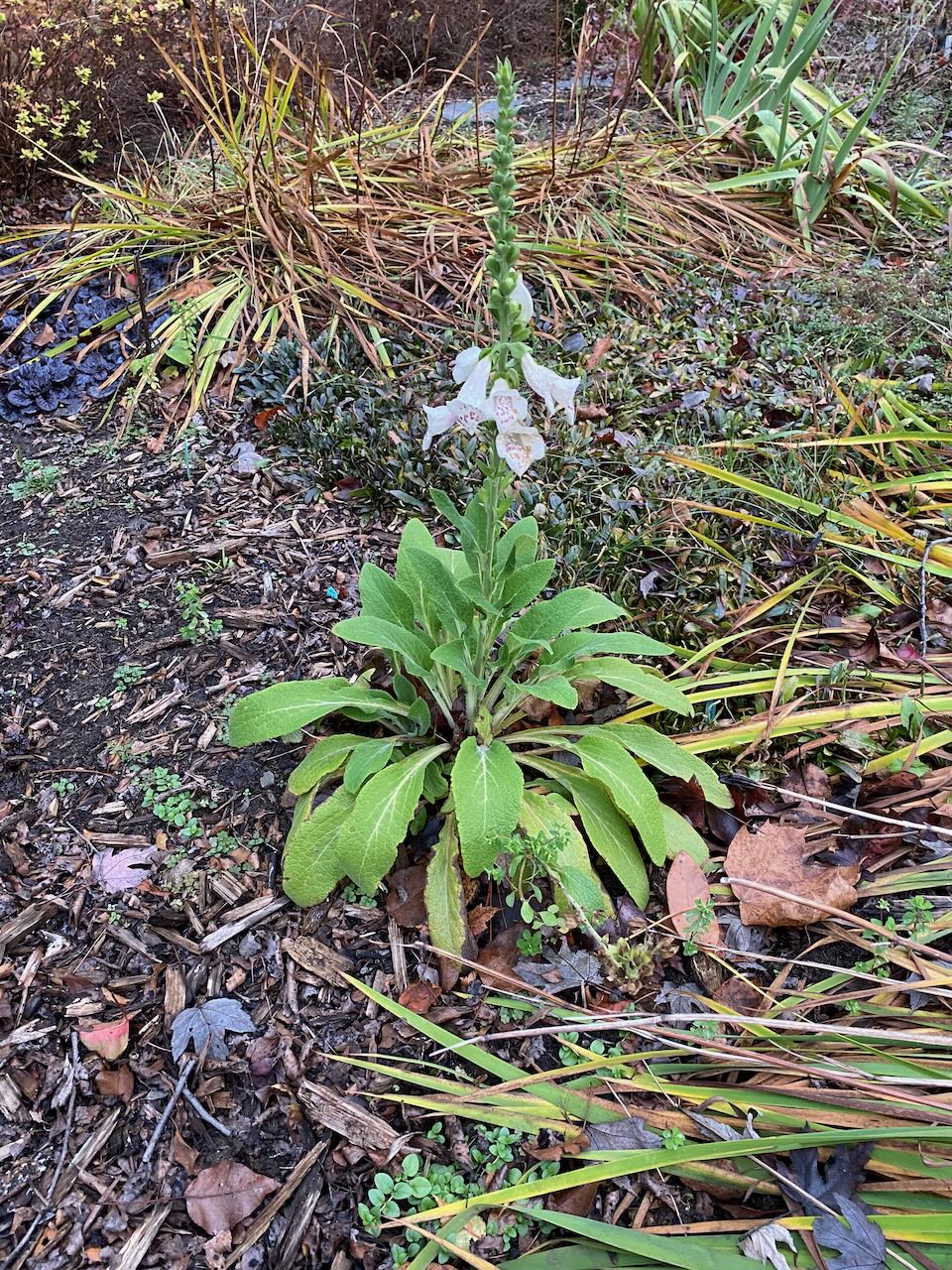 Over in the shady section, a single foxglove has re-bloomed. It was pink the first time, but has paled in the shortened hours of daylight. The foxgloves are spaced widely, so in their case it’s understandable that individuals may have different amounts of light, or shelter, or competition from other plants. Less mysterious.
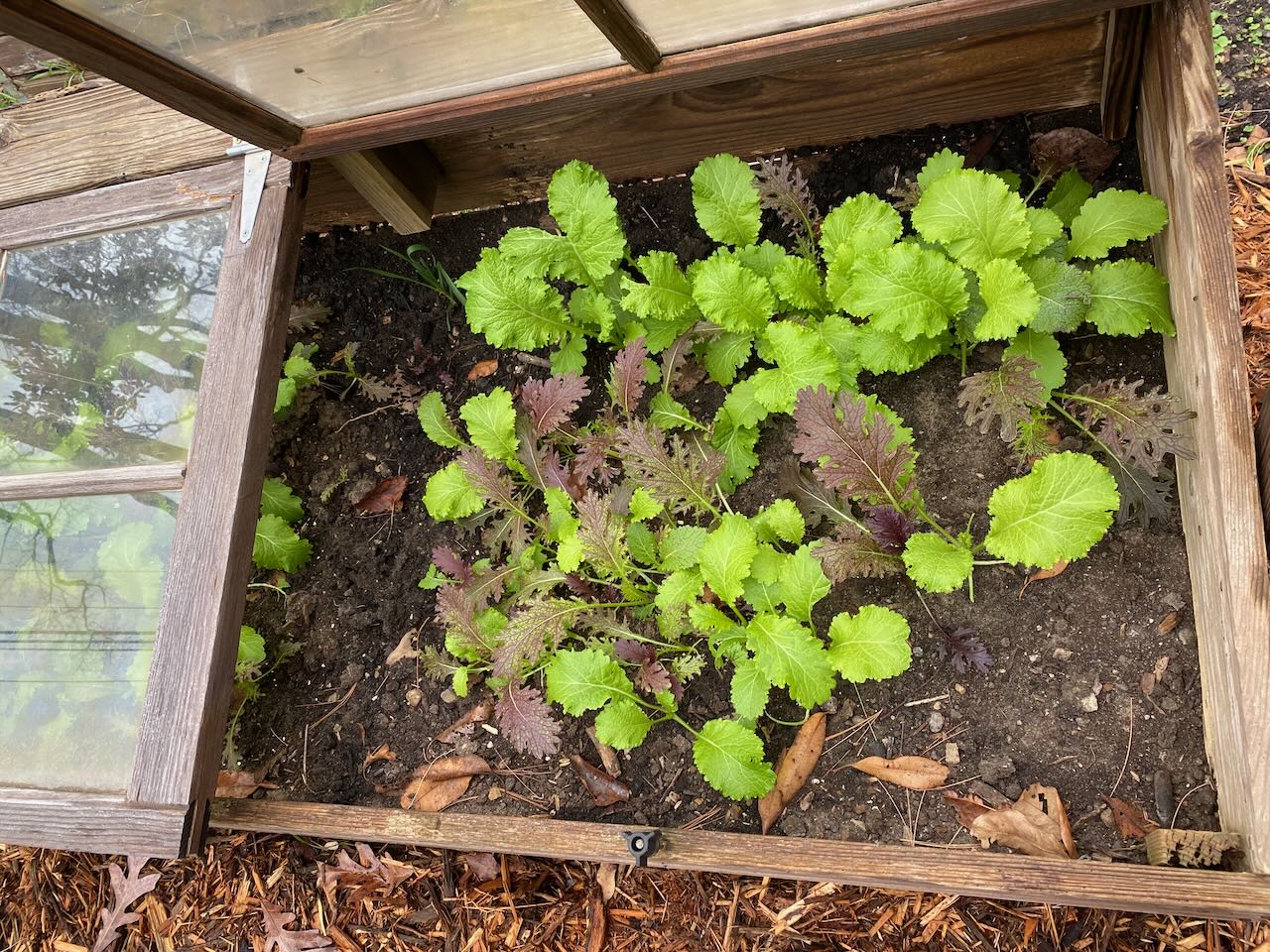 Out in the fenced garden, once the tomatoes were gone, I planted lettuces in the cold frame. They’re flourishing. This is very satisfying to me as a gardener, but the flaw in the plan is that I really don’t eat much salad in cold weather.
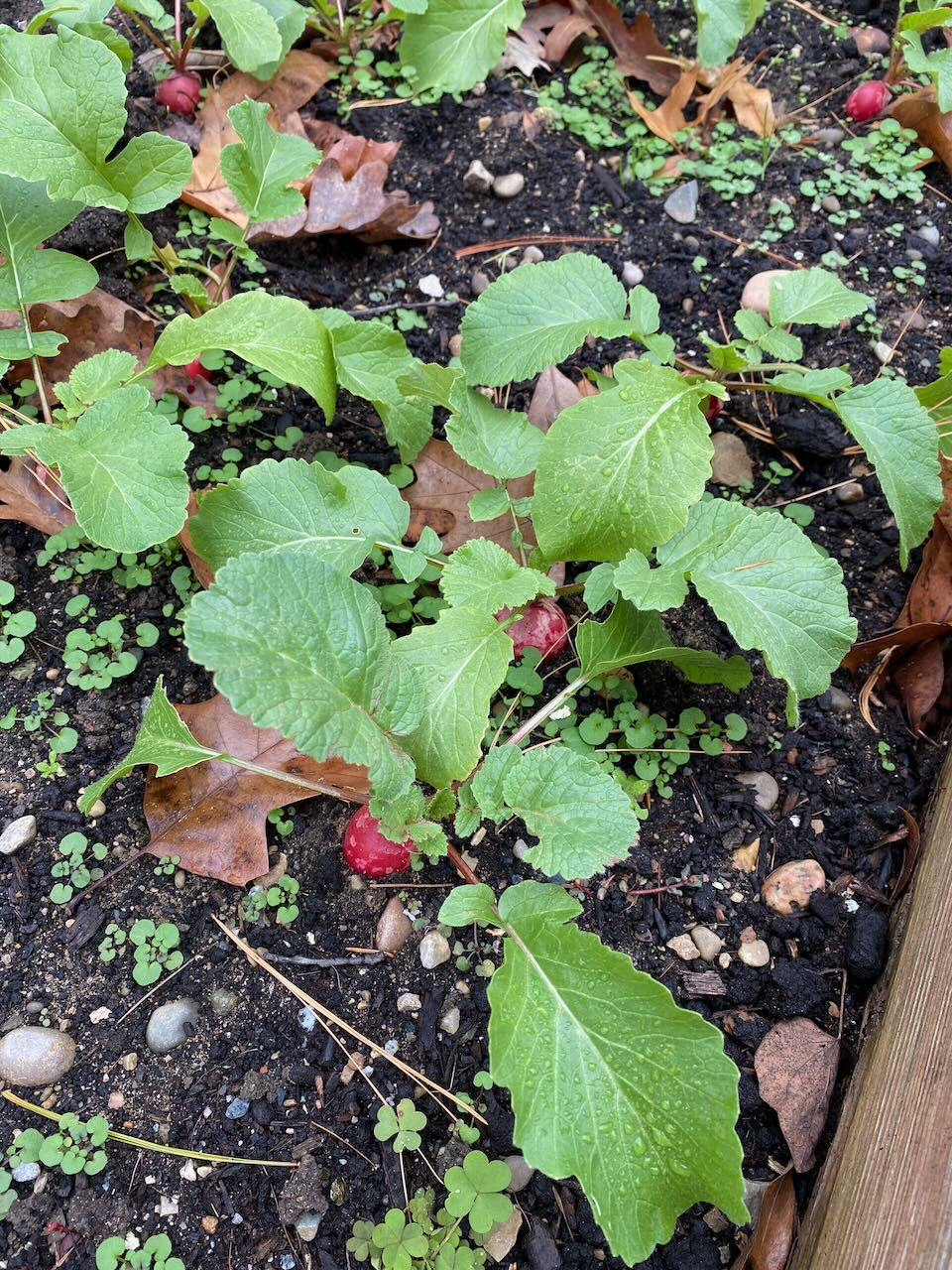 That was the trouble with radishes too, until I learned that they can be cooked. How did I get to be as old as I am, and never knew this? They’re so cute out in the garden, with their little round, red shoulders peeking out of the dirt, and they demand so little in the way of warmth and sunlight, I can’t resist planting them when random space becomes available. I’m still working out the best recipes for them.
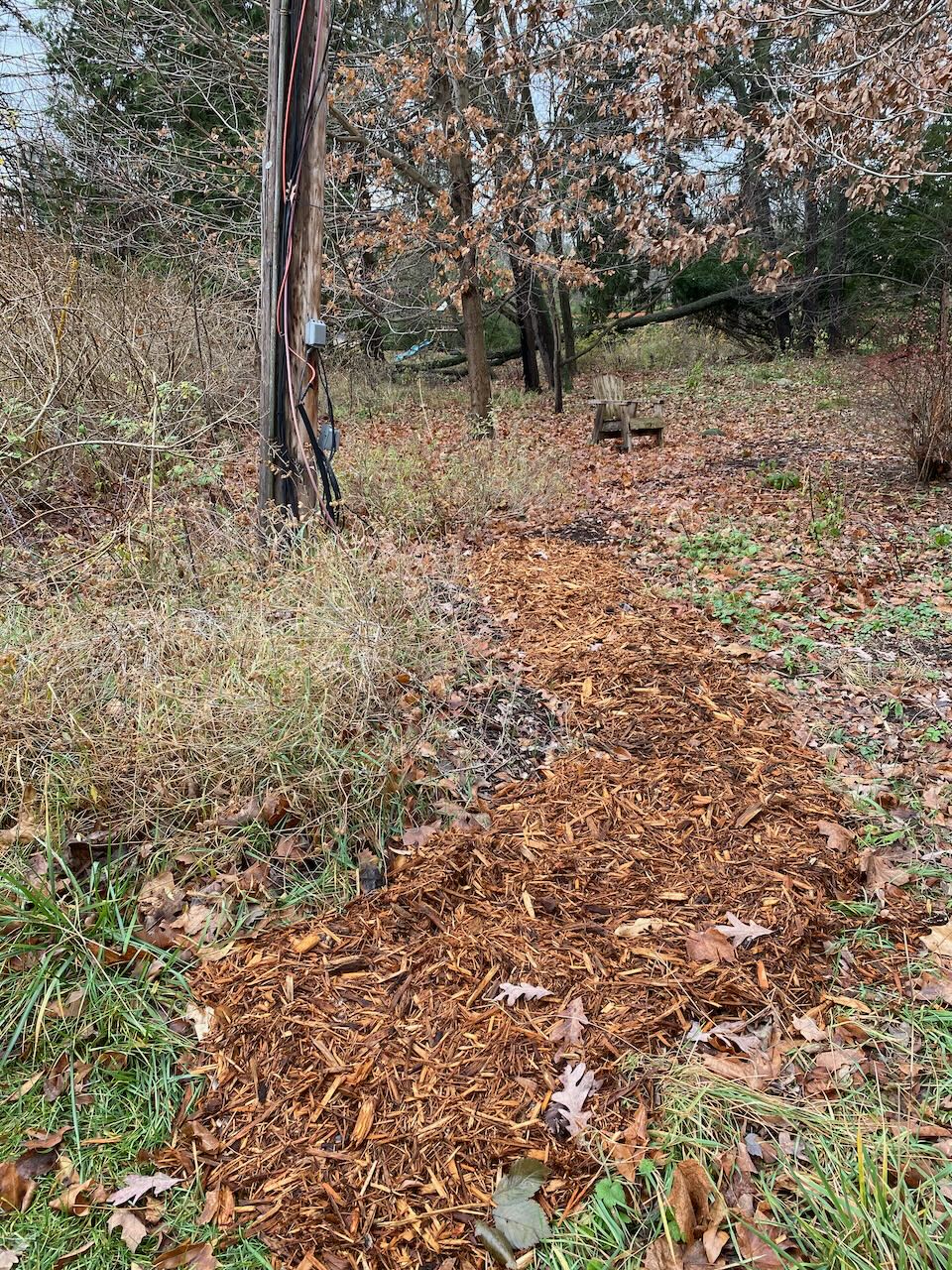 Meanwhile, the main path into my woods needed help. I spread several layers of the Sunday New York Times over the old path, poured a bucket of water over that so it wouldn’t blow around as I worked, and topped it with mulch. That will be one less thing to do come spring, when things to do are plentiful. As much as I love gardening, there comes a time when I really need a break. If spring is the reward for winter and harvest is the reward for spring, winter is the reward for three seasons of hard work. Just curl up with a good book and eat all those quarts of tomato sauce.
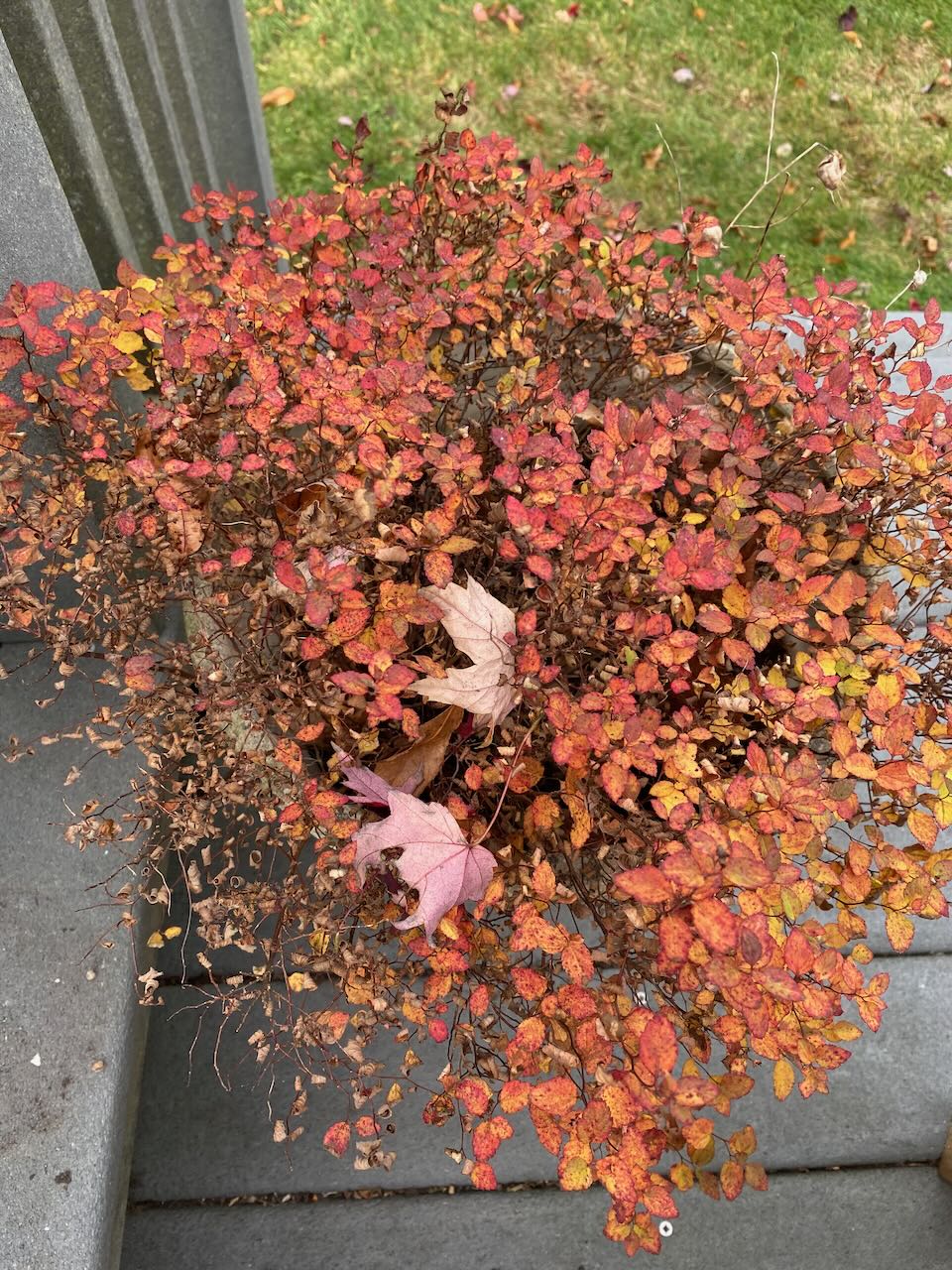 The late warm season continues. Most of the flowers are gone, but there’s still a lot of autumn color. The spirea planted in front is mostly down to bare branches, but this one in a pot on the deck is still in glory. This is odd, first because the front yard gets more sunshine, facing south, and the deck faces north; but also because roots in the ground get more protection from weather than roots in pots do. Nature surprises us whenever she wishes. The potted spirea is a volunteer – a pot of nigella was colonized by free-range spirea seed, and quickly became too lovely to remove. Here it is garnished by a couple of immigrant maple leaves, likely carried by whatever forces brought the spirea seed.
 Here’s the donor tree for those maple leaves, with just a little left in its branches to continue decorating the yard.
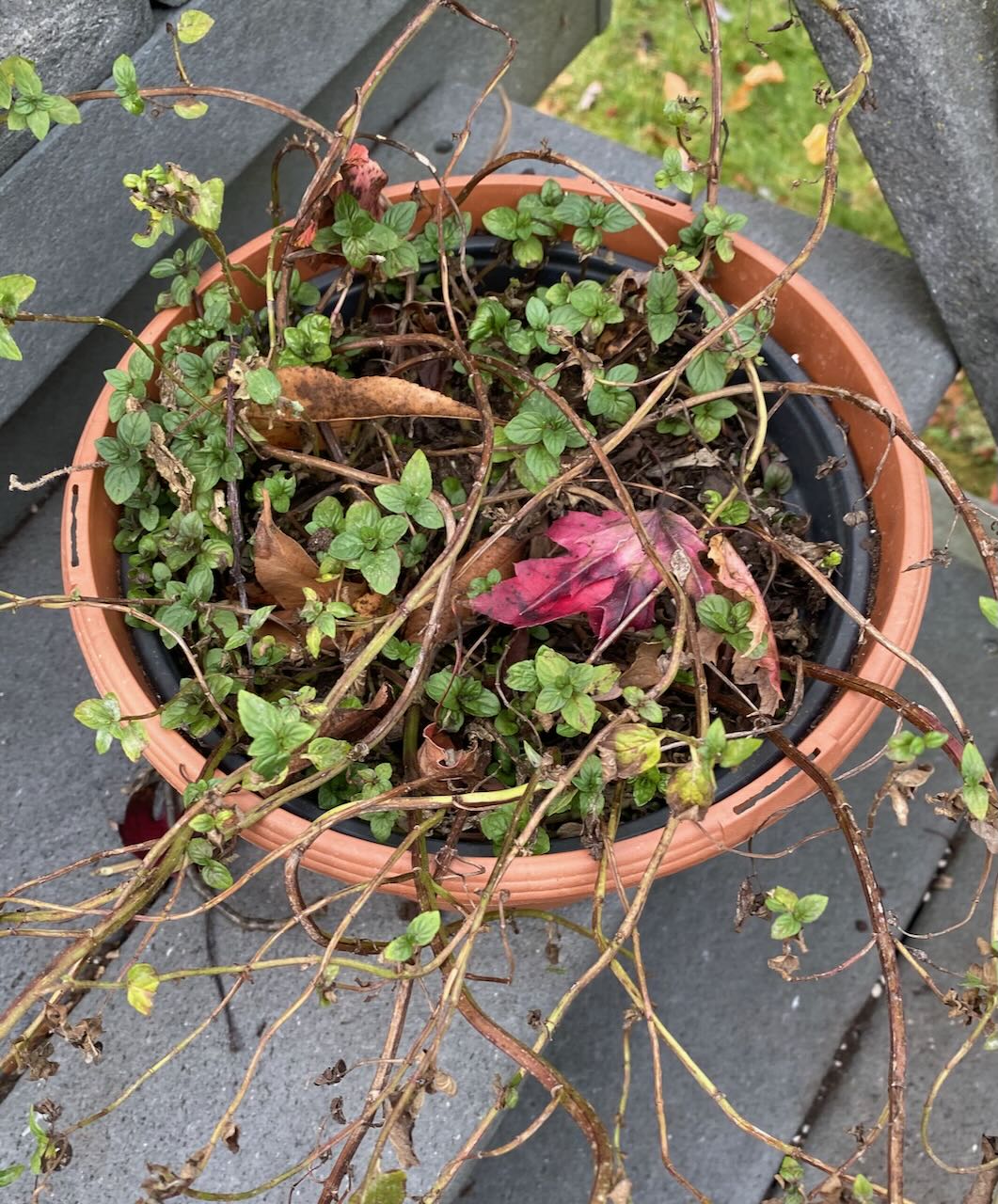 My herb collection has a mixed response to autumn. I had to bring the basil indoors, but thyme and sage will persevere outside all the way to Thanksgiving. The pot of mint may not last quite so long, but meanwhile has collected its own leaf embellishment.
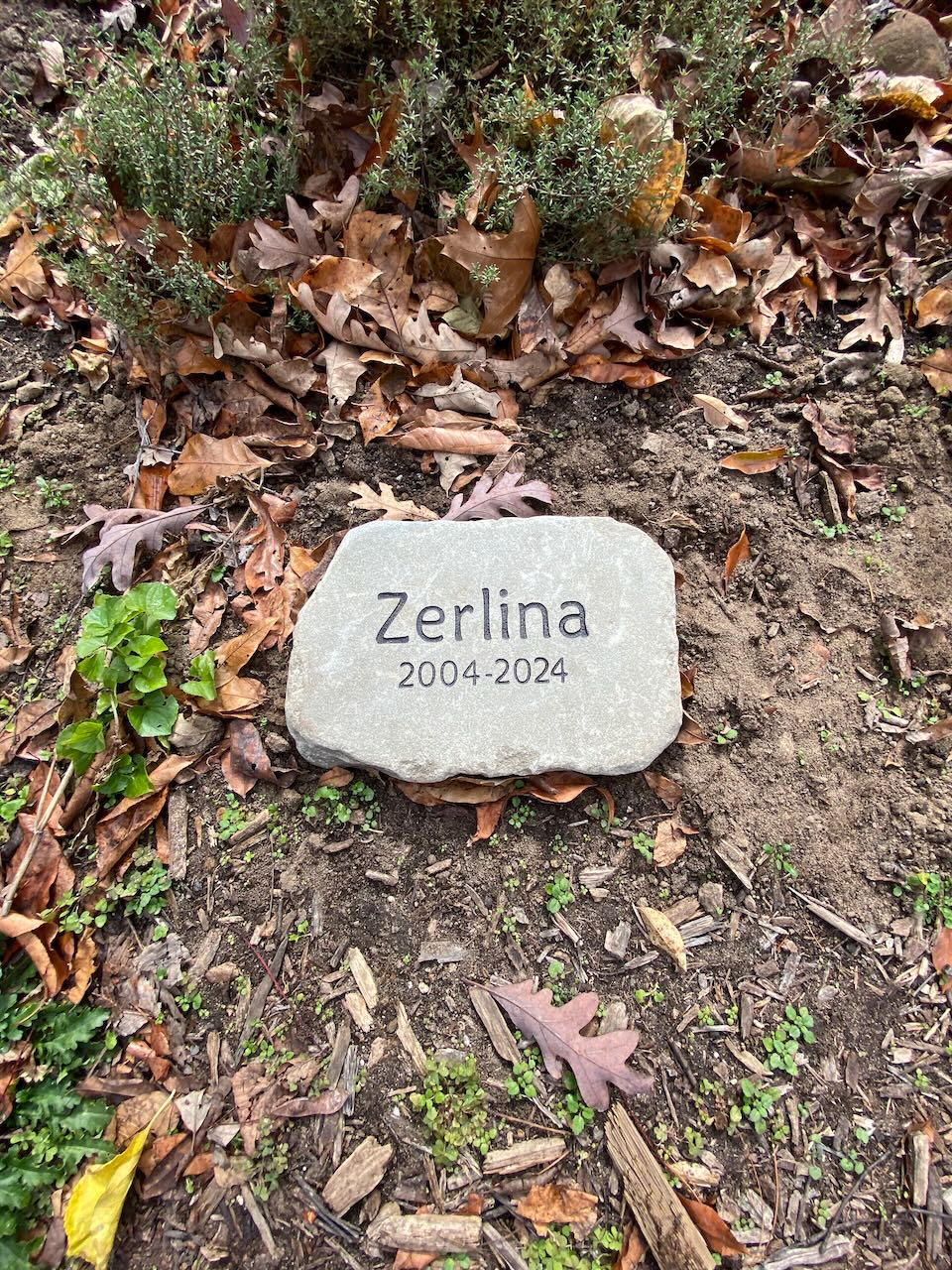 Meanwhile, after much inspection via the internet, I ordered a memorial stone for my wonderful cat, Zerlina. Many of those offered had elaborate decorations and extensive text, but none came up to Zerlina’s level of elegance. I chose one in her colors, with a soft shape. Not that a stone will be puffy, but hard angled edges seemed wrong. Doug came out to the garden with me while I buried her ashes in the center of the garden next to the thyme, and placed the stone on top. I needed the hugs. Then I sat for a while on my glider bench, thinking about her. The thyme will spread, and maybe I’ll encourage it to surround the whole stone. I haven’t decided yet, but thyme sounds like it belongs with memorials.
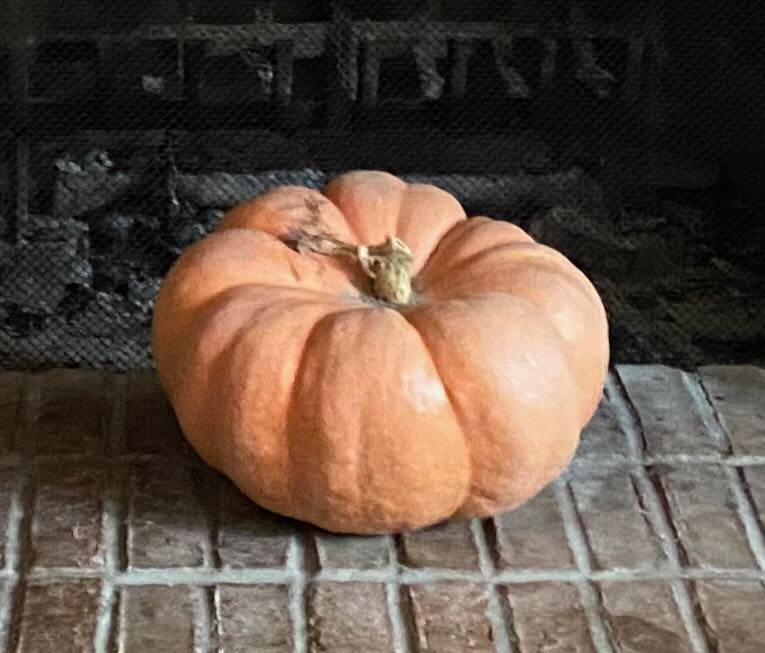 Then I went back into the house, where I picked up all the pumpkins and put them back in different places. I had to remember that things can change. And I found a sort of puffy one for the hearth.
 Robin Richstone