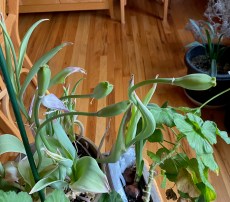
 Well, the tulip pods are fattening up nicely. As instructed, I am waiting until they turn brown to take the seeds out. This isn’t the most practical experiment, considering the seven years they say it could take for a tulip seed to produce a flowering plant, but it just sounds so totally improbable I have to give it a try.
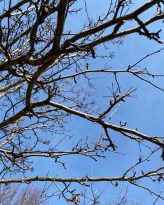 The weather got warm and the weather got cold again, but the snow’s all melted, even from the deck on the shadowy north side of the house. Buds are showing up on the tips of branches against a bright, bright sky, and the buzzards are back, our official harbinger of spring. I always wonder if there’s less road kill in winter, or why they leave. Do their featherless heads get too cold in a Michigan? Does the roadkill freeze? Buzzards would seem to be better equipped for winter than the deer are, but the deer hang around. The bald eagles are back, too, nesting in their usual spot up the street.
 Down on the ground, the hellebores continue to increase. Don’t they look pretty, blooming among last year’s dead leaves that no one has gone out there and hacked off? My excuse is, it’s hard to do that without stepping on the noses of the daffodils just coming up. Like Archimedes, I need a place to stand.
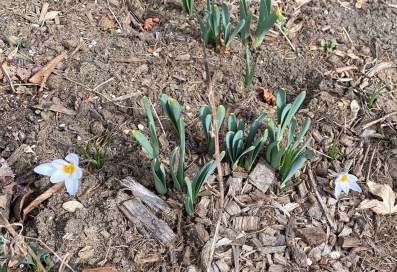 I didn’t make that any easier for myself when I decided to add more kinds of bulbs to the mix. Last fall I found some crocus said to lack appeal to rabbits, and read that snowdrops have the same alkaloids narcissus do, which have successfully repelled both deer and rabbits in my yard. The sparse look is because I planted very few, since they’re my test group. I’ll get more if these survive. So far so good.
 And now it’s Daylight Savings Time, though up here in Michigan there’s not much daylight to save this time of year. We pay for the late sunset by getting up in the dark. Why does no one ever mention that? According to the very authoritative Sunday NY Times acrostic, Ben Franklin suggested Daylight Savings Time as a joke. Sounds about right to me. I’d put a photo of dawn in here for you, but when I have the misfortune to be up so early there’s no way I can push the right button on my phone. So here’s a nice artistic photo of my latest amaryllis instead.
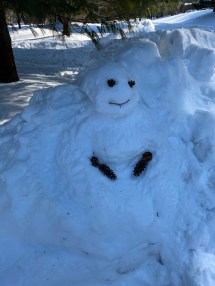 Where my driveway meets the street, a spectacular amount of snow piles up from multiple directions of plowing. I took advantage of the heap to build a Snow Woman. She was much appreciated by the determined Michiganders who take their walks down my street in any kind of weather. How could winter be a problem in a state shaped like a mitten?
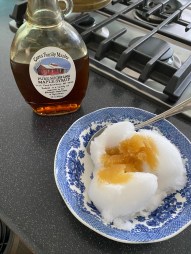 When it warmed up a few days ago, I realized I’d better move fast if I wanted to make any snow ice cream. The snow has to be deep enough that you can brush off the top layer and get a good bowlful without touching underlying dirt. My deck is on the north side of the house, so snow on the table there perseveres in glory, even after grass is peeking through on the south-facing lawn. I spooned up three scoops of snow, took it inside, and added a nice pour of Michigan maple syrup. In New England the syrup would be boiled down so when it hit the snow, it would solidify into candy. But straight from the bottle, syrup on snow yields ice cream, or at least a maple sno-cone. That’s what I like.
 And I was not a moment too soon doing it, because the snow continues to recede, and now the hellebores, living up to their other name – Lenten Rose – are nosing up to bridge the winter-spring gap. Seeds I ordered keep arriving in the mail. My amaryllis, potted up and beginning to bloom, lean into the window with its view of melting snow.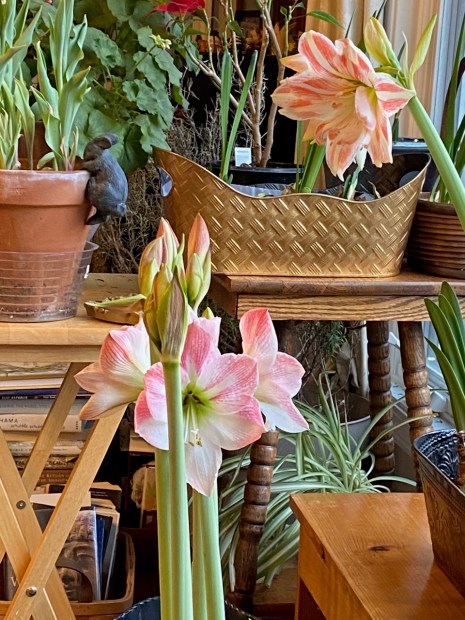
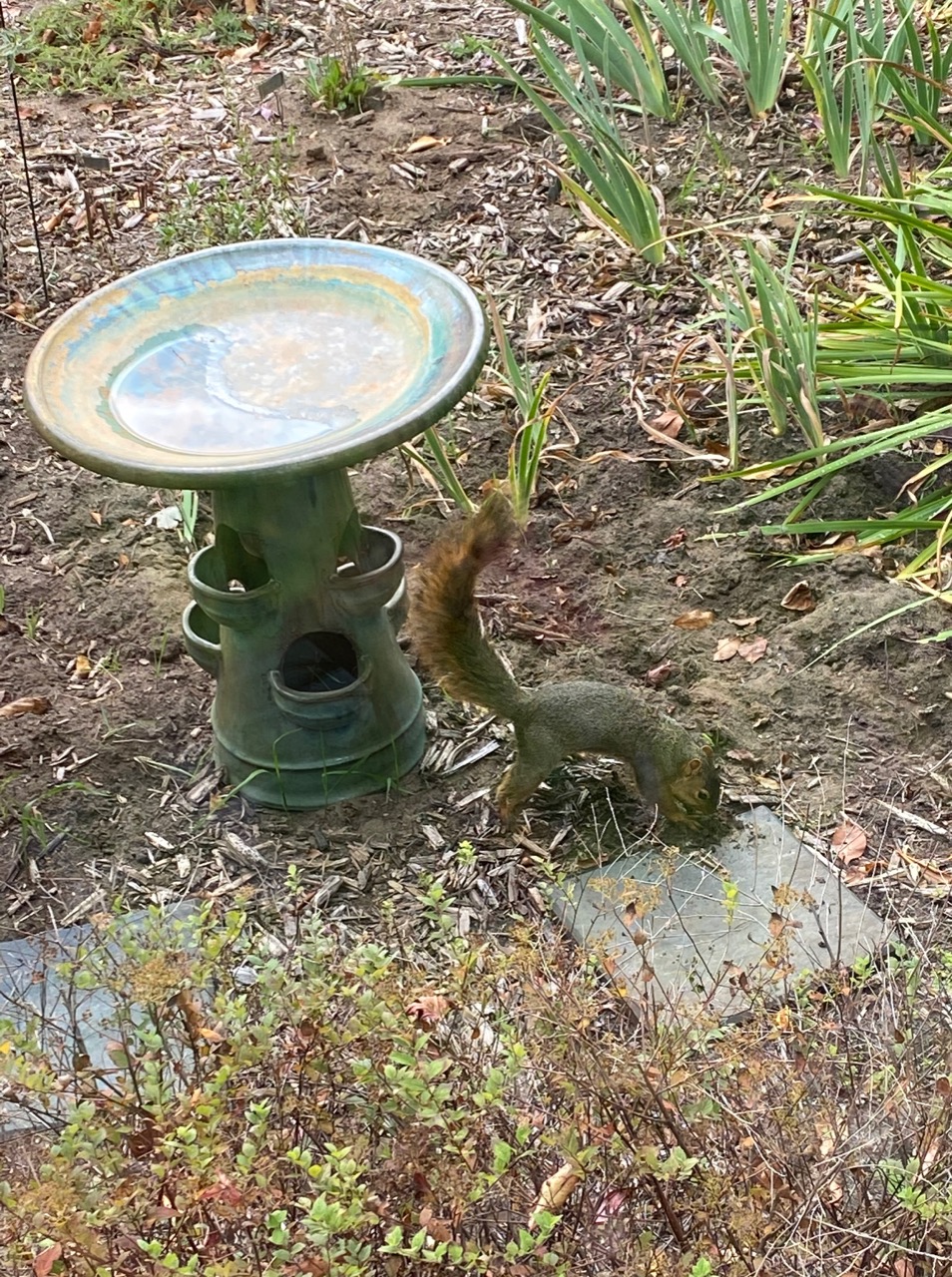
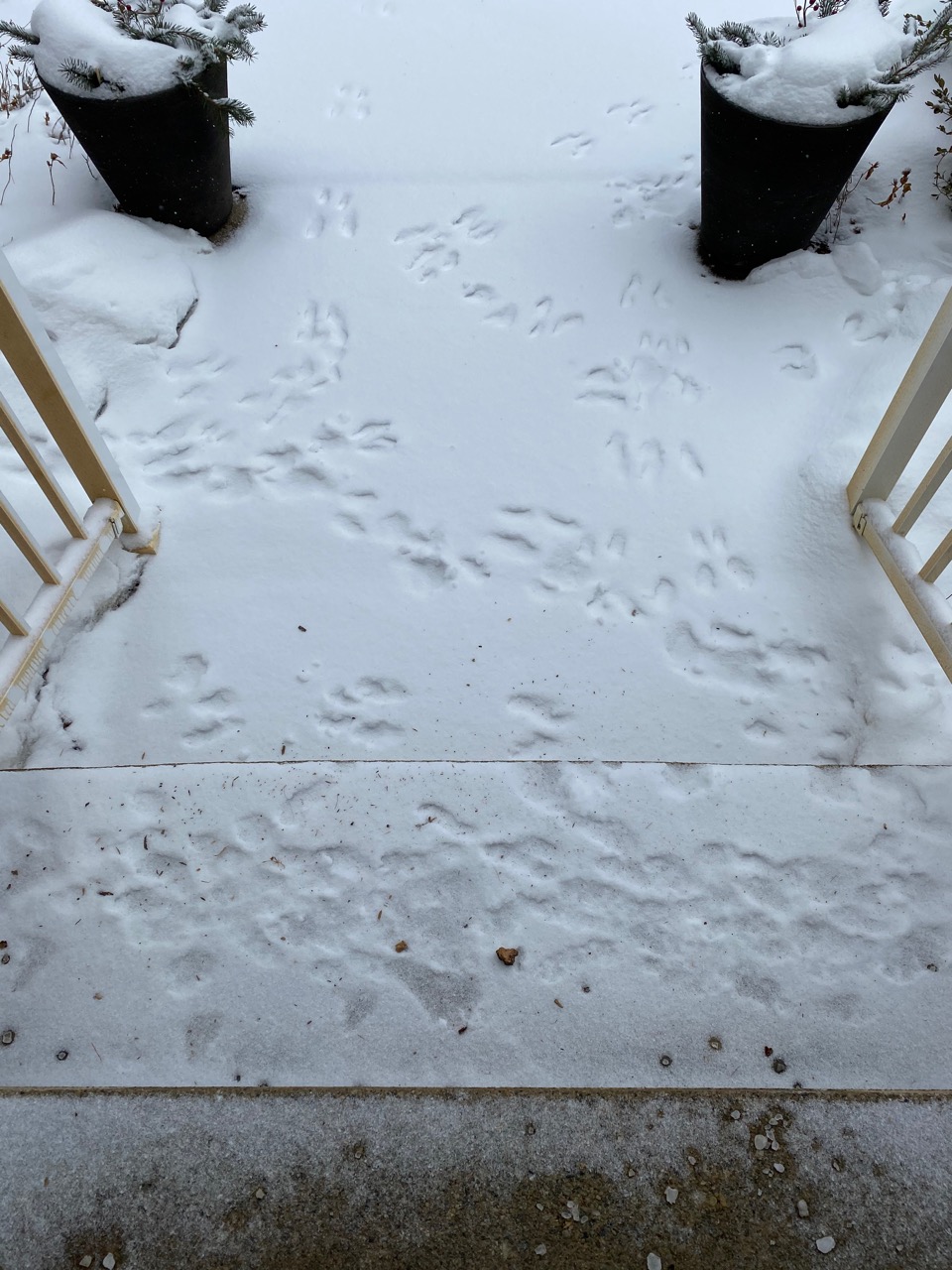 This morning I opened the front door to this. That was one busy squirrel, and I have no idea what he was after. No nuts, no berries, no breadcrumbs or birdseed. Was it warm, being near the house? But it doesn’t look like he rested, or even stopped. Was that two busy squirrels, chasing each other? I’d opened the door in order to sweep the snow off the steps, but this was too amusing to mess with and I didn’t plan to go out right then, so I left it.
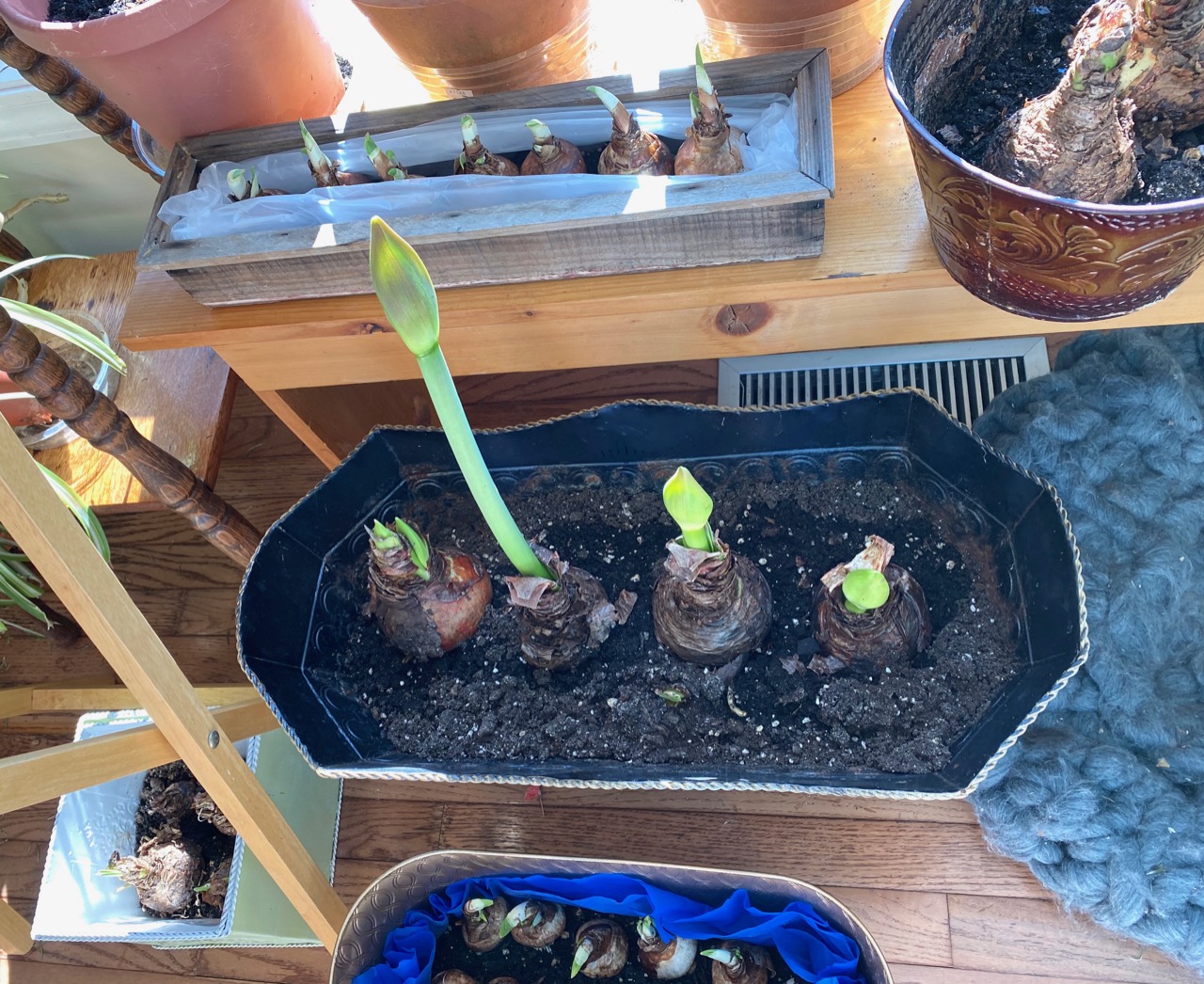 snowstorm moved in this afternoon, predicted to pile up deep and opulent by morning, delicate enough to make humble objects ethereal, powerful enough to stop traffic. What a lovely background for my array of potted bulbs on the windowsill.
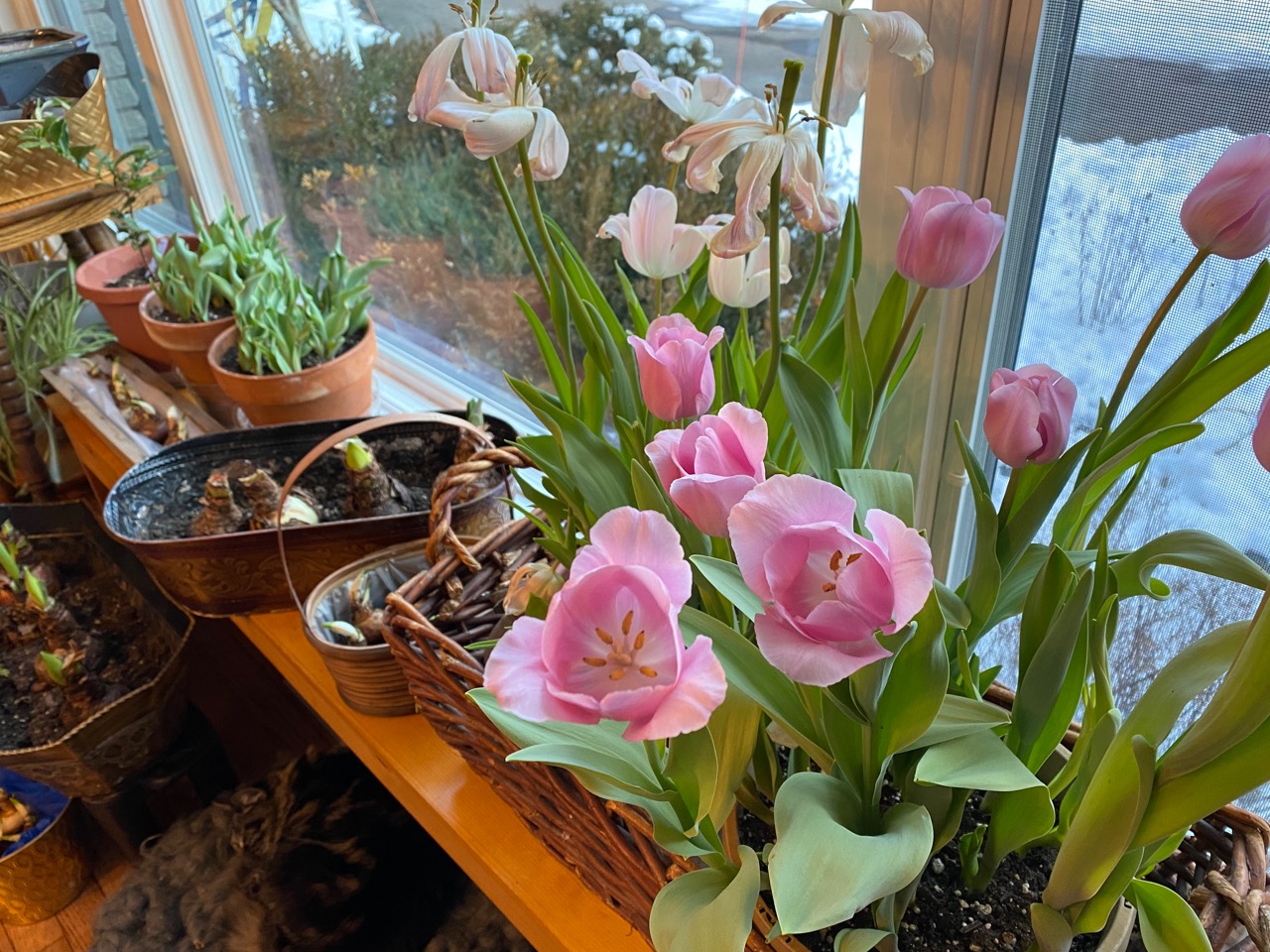 The first round of tulips has already bloomed and faded, the second pot is going strong, and a little further down the shelf the Apricot Beauties prepare for their star turn. The paperwhites stick their small green snouts up, testing the air, and the amaryllis stick their necks out, some a little more, some a little less.
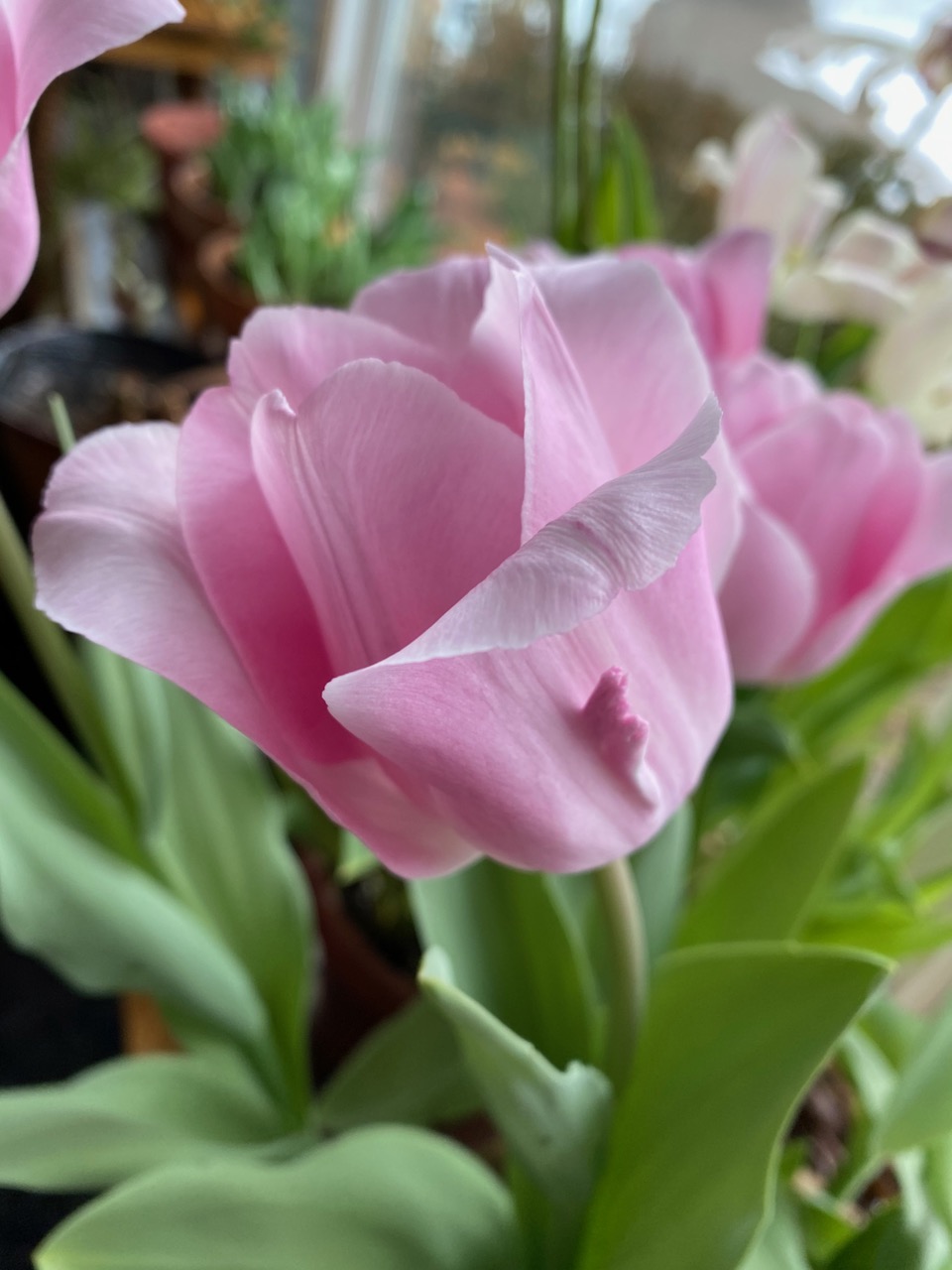 Dutch tulip breeder edging into the tulipmania of 1636. Might you cross this with a fringed tulip, or a ruffly one, for an even more elaborate effect? Would you make a fortune (quick, before the market collapsed) with a new variety? This made me realize I don’t know anyone who ever raised a tulip from seed. This, naturally, led me to the googly discovery that growing tulips from seed is “laborious and won’t yield a flower for at least seven years” (Thank you Jann Seal on SFGate). Also, tulips bear their seeds in pods. Why have I never noticed a tulip pod? Probably because I cut the stems back once the flower is clearly falling apart. So, here’s a new project. I will let at least some of those spent blooms stand, and maybe next month I can show you a tulip seed pod. And if the snowstorm lives up to its billing, maybe I’ll have a nice snowman for you, too.
 Michigan snow continues to amaze me. It’s fluffy. You can sweep it off the doorstep. Where I grew up on Long Island, snow had to be removed with an ice axe. I exaggerate, but not by much. I take my broom to the snow here and whoosh it lightly, like fairy dust, off the steps, onto the flowerbeds on either side. Here you go, lamium; here’s some for you, ceratostigma. More blanket. Sleep well.
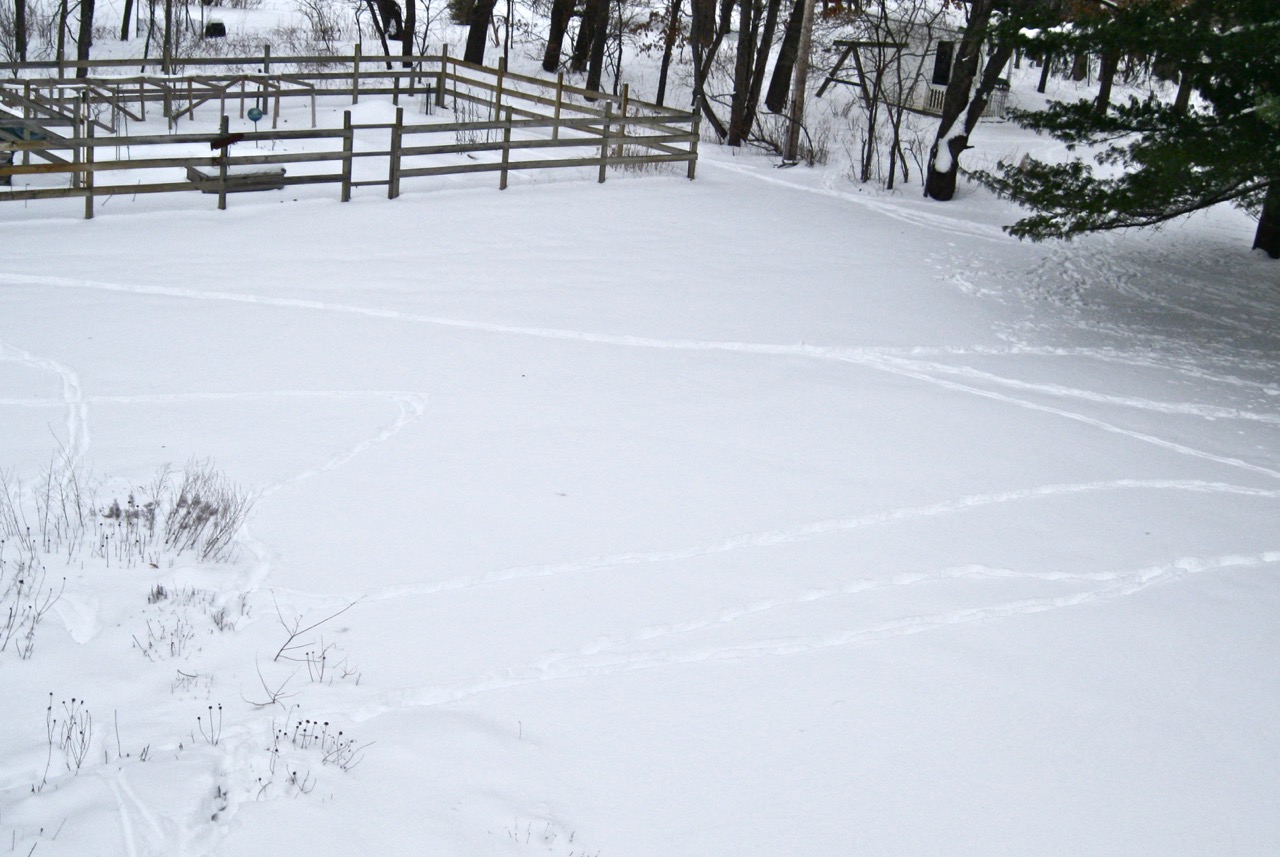 deer, but they leave a record for me: the allure of standing seedheads in the herb garden; the shelter they found under pine trees. The woodchuck, heavy and low to the ground, hasn’t waited for her official day but has waddled a wake into the snow, emerging from under the deck and steering for the woods, or vice versa. I can’t read her signs well enough, yet, to tell the direction.
 And what kind of critter do you think made this deep, purposeful, extremely straight-lined track from the road to my front door? Too early for my garden orders to be delivered. Must have been something for Doug.
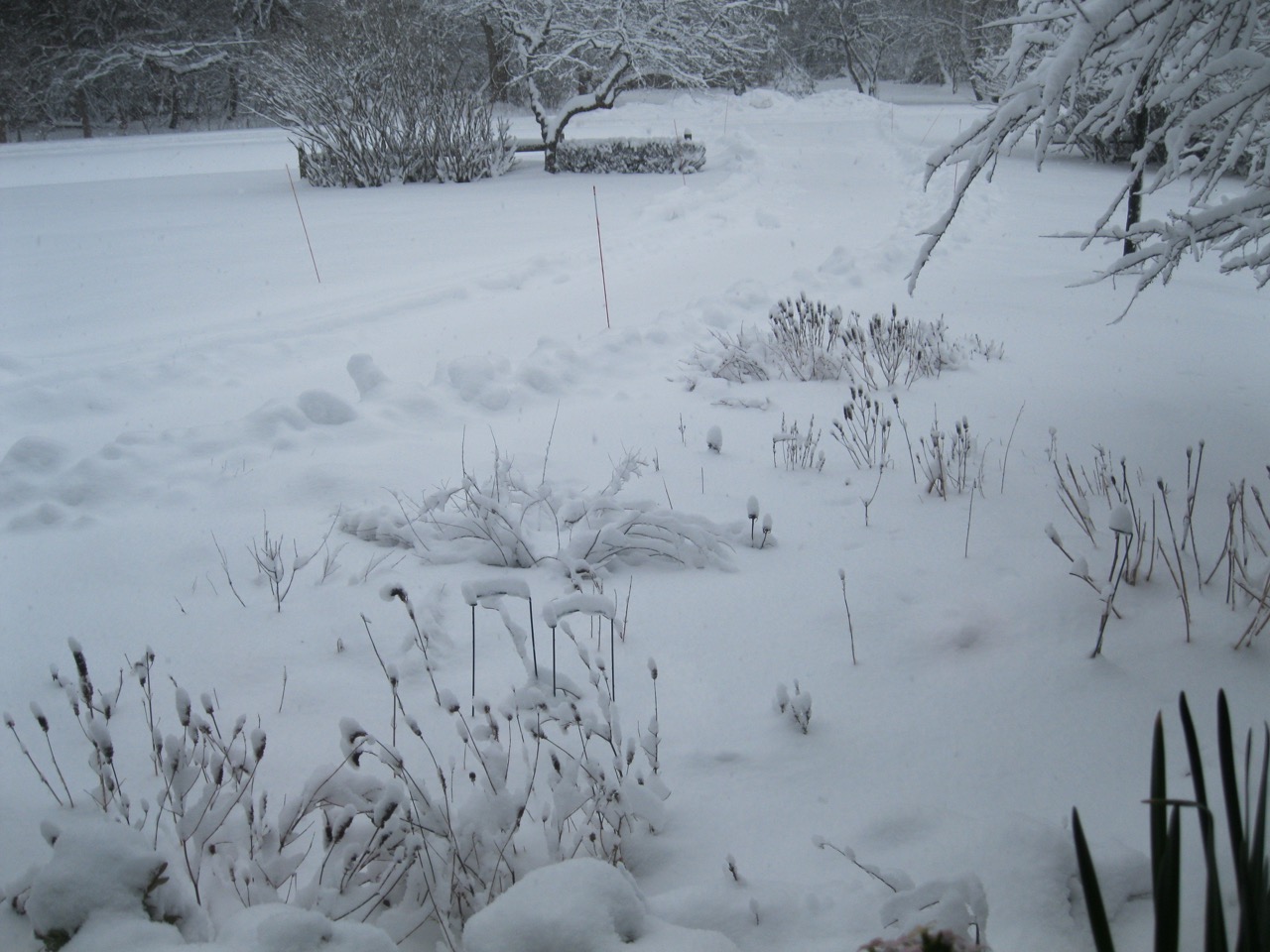 It’s a word often used at the head of a year. As with many interesting words, it has meanings that overlap and inform each other.
 resolutions. We use it for fineness of detail in an image, as in the resolving power of a telescope, a microscope, a camera. We use it for the passing of discord into harmony in music. We use it for turning disputes and contention into peace. The word contains all this. Can we use our firmness of purpose to look not at the surface of our situation, but deep into its substance to see what it’s made of? Will what it’s made of help us turn its discord and contention into harmony and peace? That’s hard to see, and hard to do. It’s much easier to see the meaningless structures that stand in the way, obscuring the heart of the thing. It took thousands of years of the sun appearing to rise and set – as we still say it does – before we recognized that wasn’t the truth at all. We say that we hold to our beliefs, when often it’s the beliefs that have a grip on us.
 2020 was a year very much in need of resolution, in all the facets of that word. We didn’t get there. Let’s try again for 2021.
 In 2020, all three classical music stations I listen to started playing Christmas music before Thanksgiving – usually anathema – and they all gave the same apology for it: wasn’t it a year well worth hurrying on its way out? True, but it was a whole year of our lives. Wasn’t it good for something?
 Several writers have noted that this plague was a demonstration of how, all across the planet, we are irrevocably interdependent. I think this was what motivated the outrage of those who protested being required to wear masks. They said it violated their liberty, but what it really violated was their wish that they, their communities, maybe all the U.S., were and could remain separate from that whole rest of the world, whose influence they saw as something pernicious that could, should, and would be kept at bay. An old, deep strain of American thought, tapped by recent politicians but not invented by them.
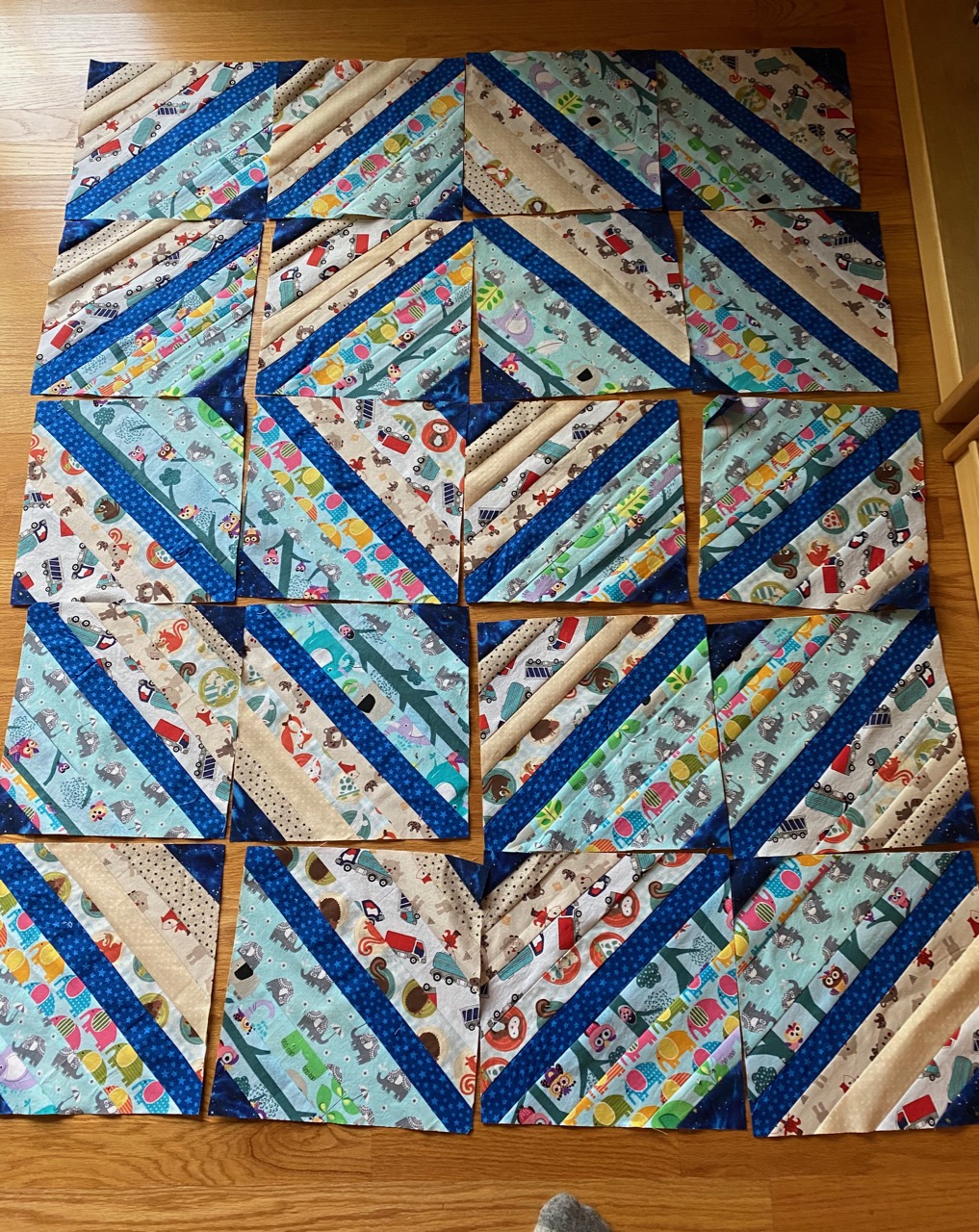 If adversity builds character, what a lot of character we all must have now. Let’s hope we can use it to muster the strength to give up ideas that have outlived their relevance. For gardeners, the return of seed catalogs reaffirms that a new season is approaching, filled with possibility. Old favorites and new varieties, the tried-and-true and the experimental, it’s all there to choose from. I greet my seed catalogs with a smile, looking forward. Happy New Year!
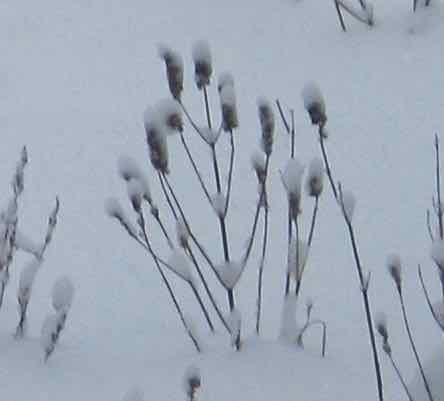
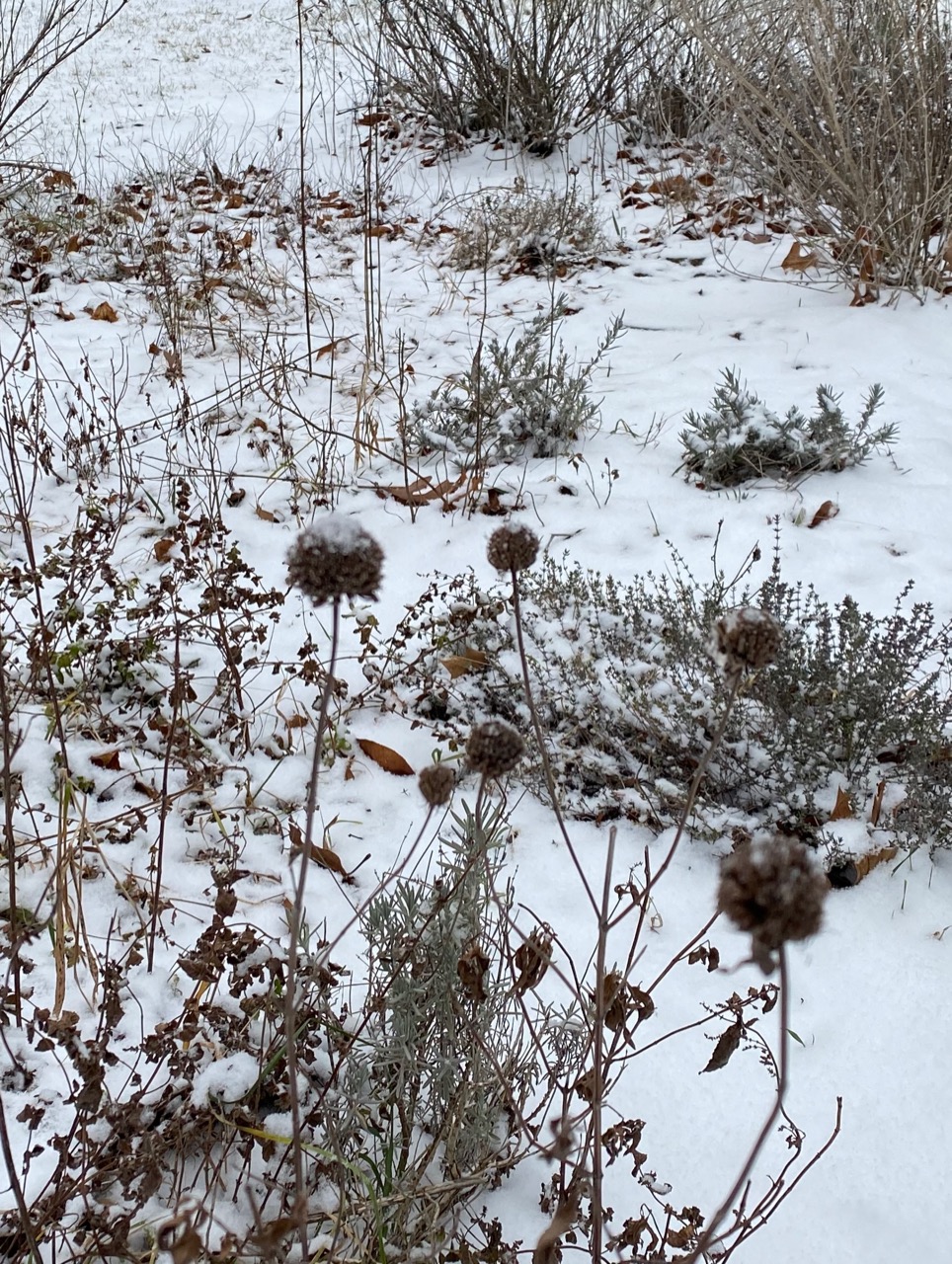 I was happy to oblige. As I wrote up some notes for her, I thought also about the nature of advice. It’s a lot like literary criticism. You have to distinguish between your personal taste and eternal truth. Maybe that’s overstating it, but haven’t we all put in some “easy care” plants that were, in fact, total divas? Some supposedly prolific tomato plants that turned strangely reticent in our care? Groundcovers apparently determined to become planetcovers? How much time and maintenance do you enjoy, or tolerate? I say if there’s a plant that gives you trouble, rip it out and never let it cross your garden path again. A weed is anything growing where you don’t want it. I like to recommend leaving old stalks and seedheads standing over the winter, both to provide shelter for wildlife and because I love how they look in the snow. Some gardeners – and some neighbors – think this looks like a big mess.
 So advice based on another’s experience can be a shortcut, but the best way to find what works for you, is to try things. Keep trying them. If a plant fails in one place, move it somewhere else. Pay attention to how the garden responds, and draw new conclusions from it.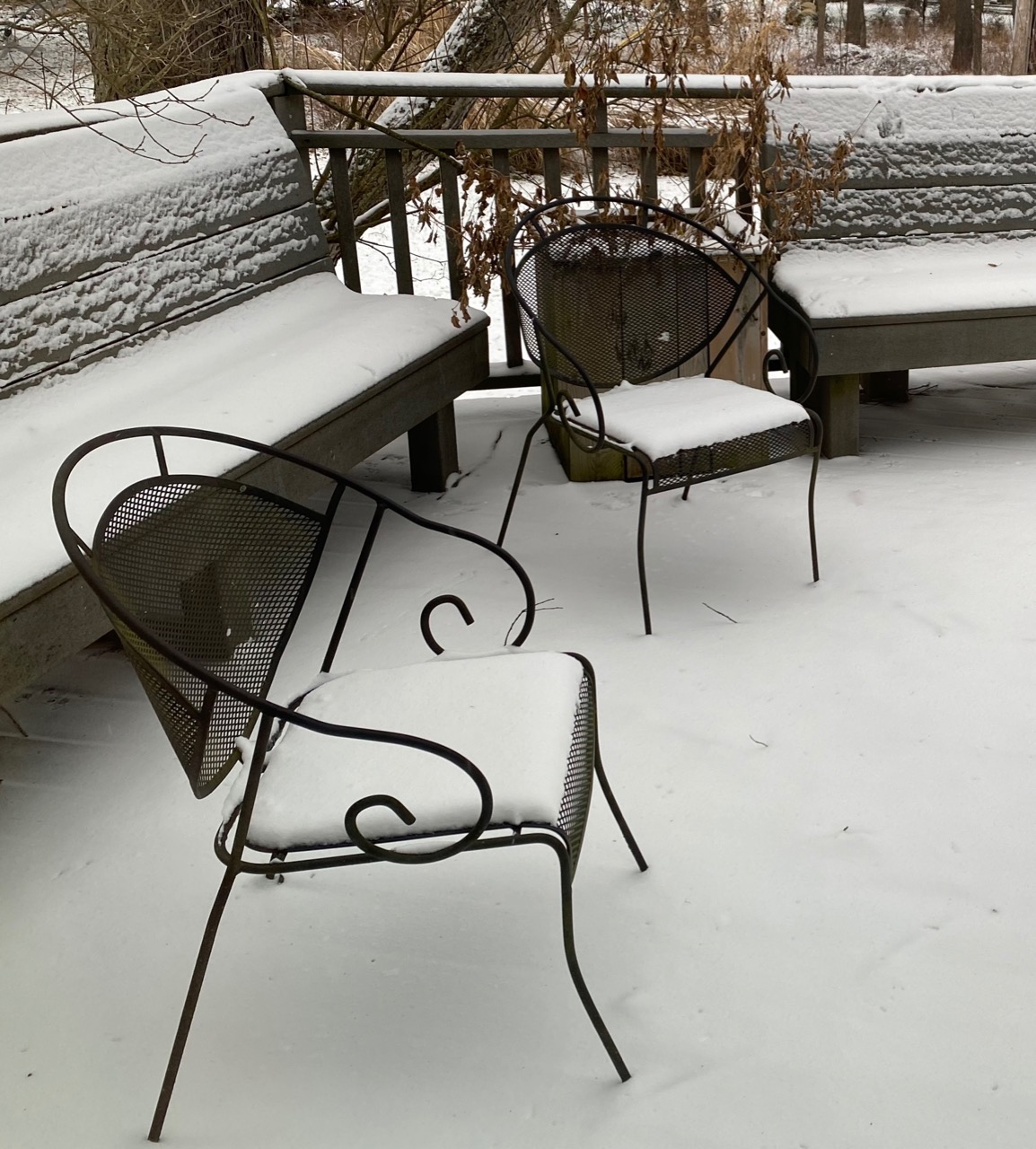
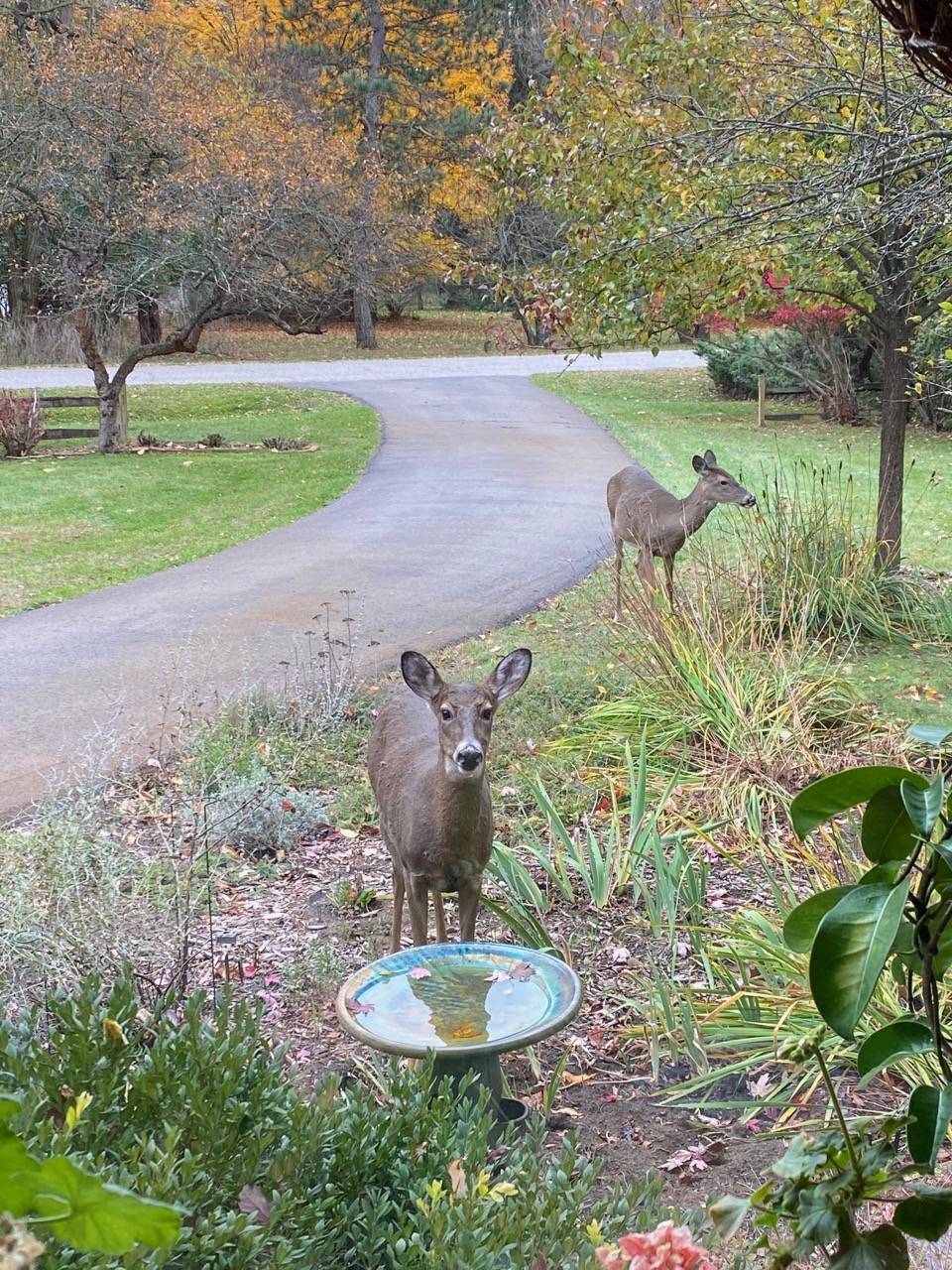
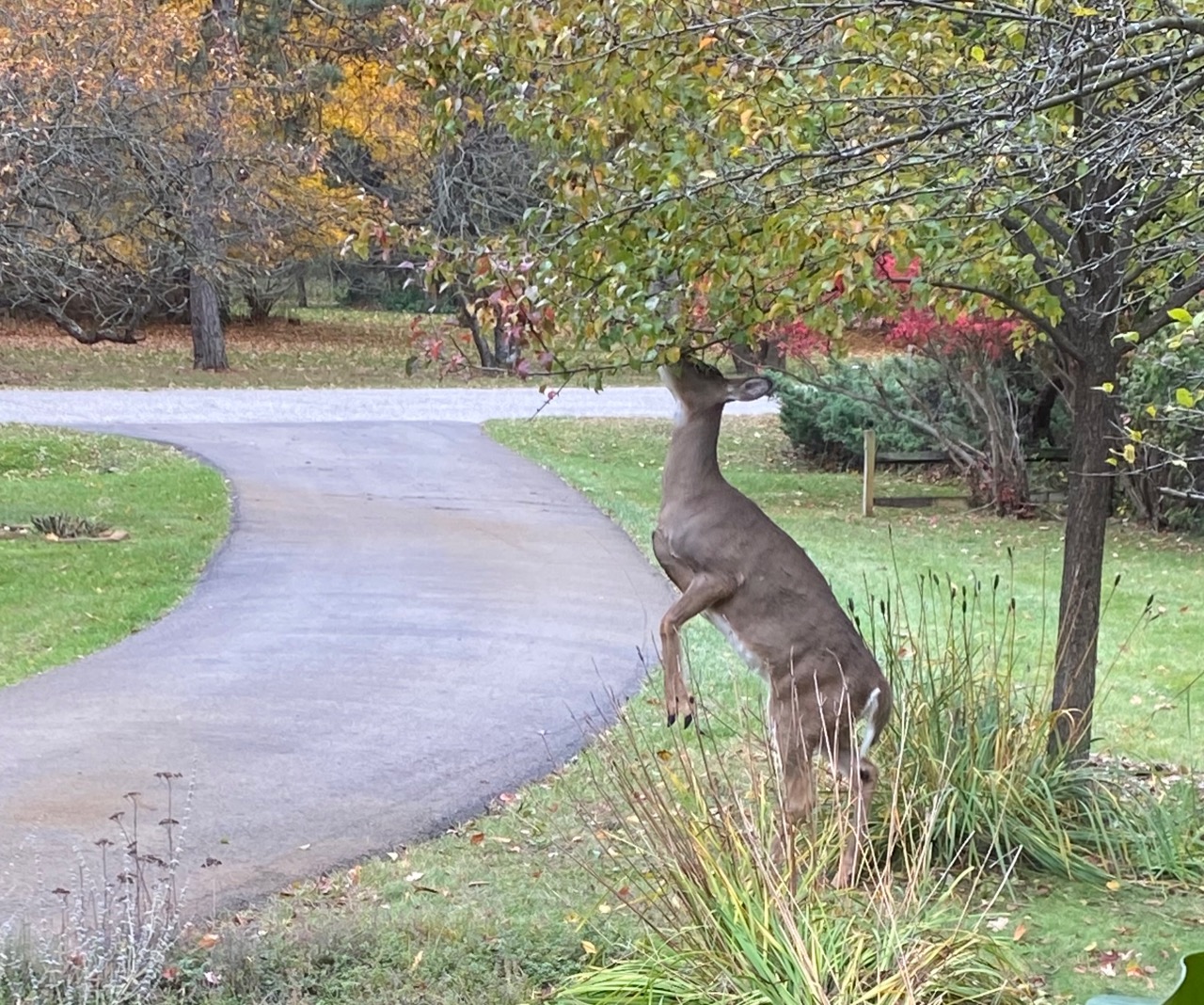 One of the late sources of food for the critters in my yard is the ornamental pear tree. It makes tiny, hard pears about the size of the end of my thumb, inedible for people but irresistible to deer and squirrels. First they eat the ones that fall to the ground, then they indulge in a little topiary.
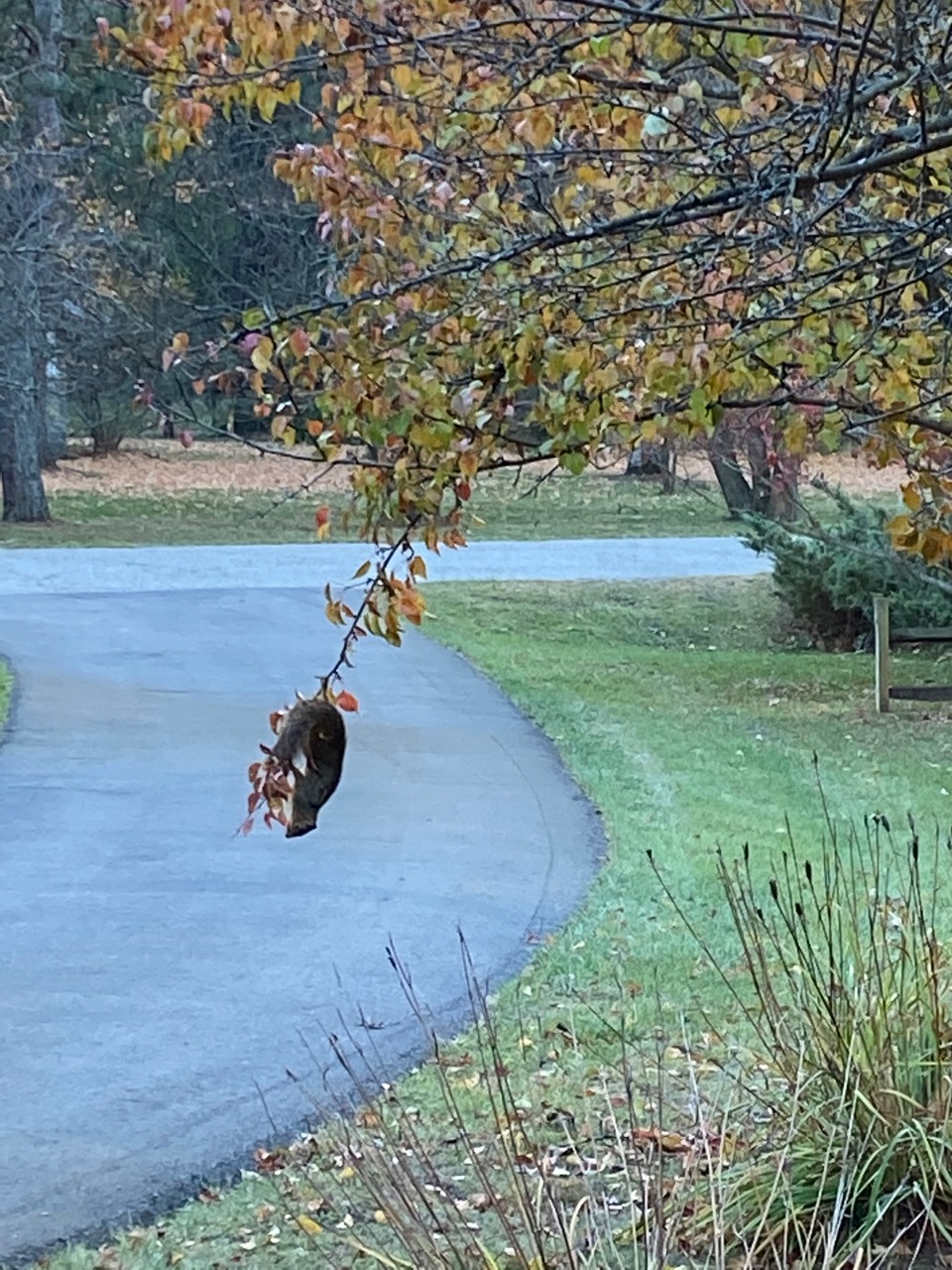 The tall stalks you can see standing under the tree are the stems of my Siberian Iris. There was a time when I’d have cut them all down, tidying up, but I have seen the error of my ways. I learned that the hollow stems become shelters in which Michigan’s solitary bees can hibernate. This was news to me because I used to live in Southern California, where bees have no need to hibernate. How lovely to discover that I could ditch a chore and be ecologically correct at the same time.
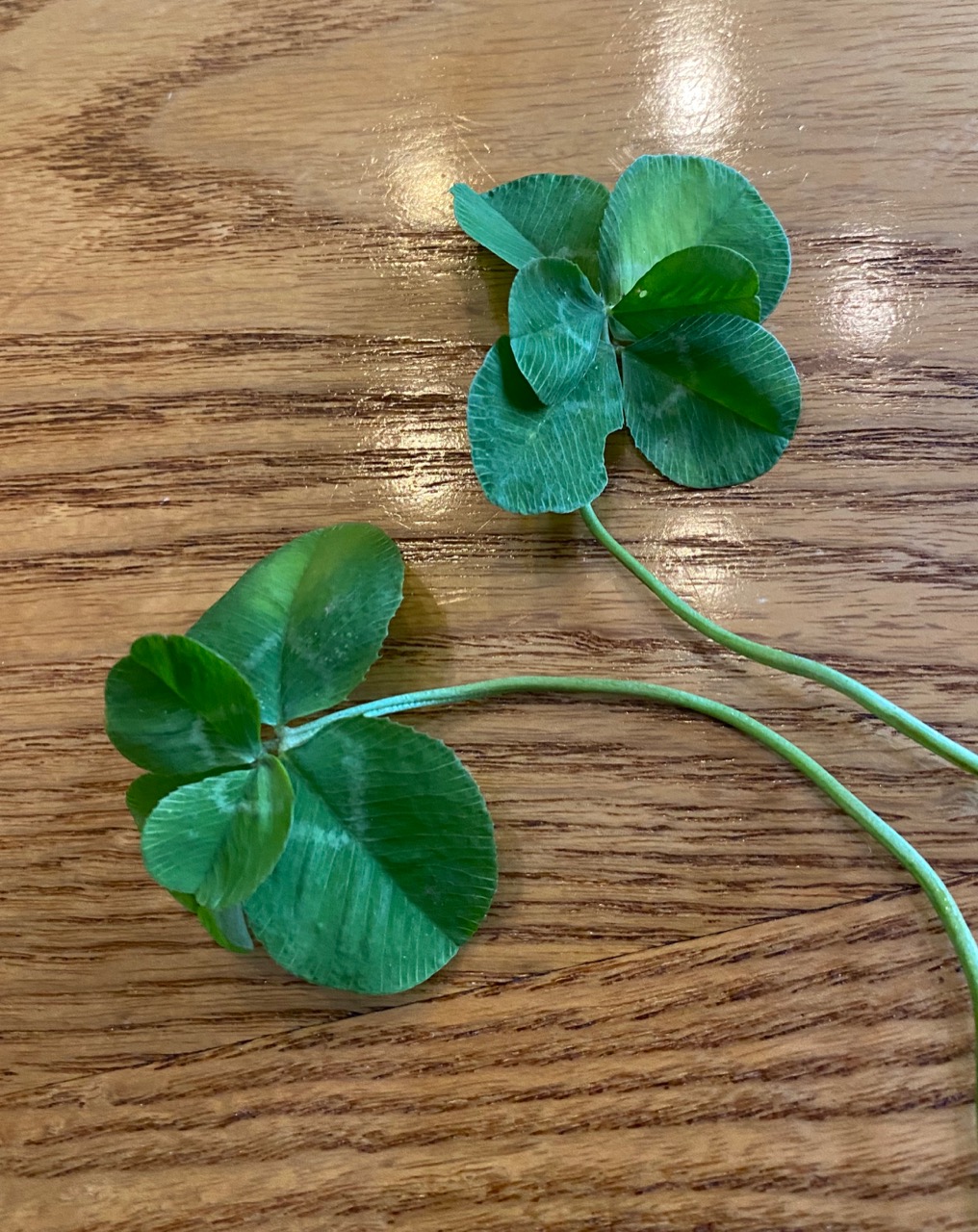 We now have serious, white, twinkling frosts most nights, but the clover persists in several raised beds in the garden. There is one corner in particular that has continually generated good luck tokens since October: not only four-leafed clovers, but five-leafed and six-leafed ones! I have been up to my eyebrows in wishes. A friend says that five-leafed clovers must be given away for the wish to come true, but that’s not in my folktale culture. I was raised to believe that giving away good luck like that was a sign of ingratitude. I am cherishing these clovers, exuberant in their late lives, extravagant of leaf in defiance of the lessening daylight. Inspiring. Just to look at them is good luck – though when I wish on them I do close my eyes.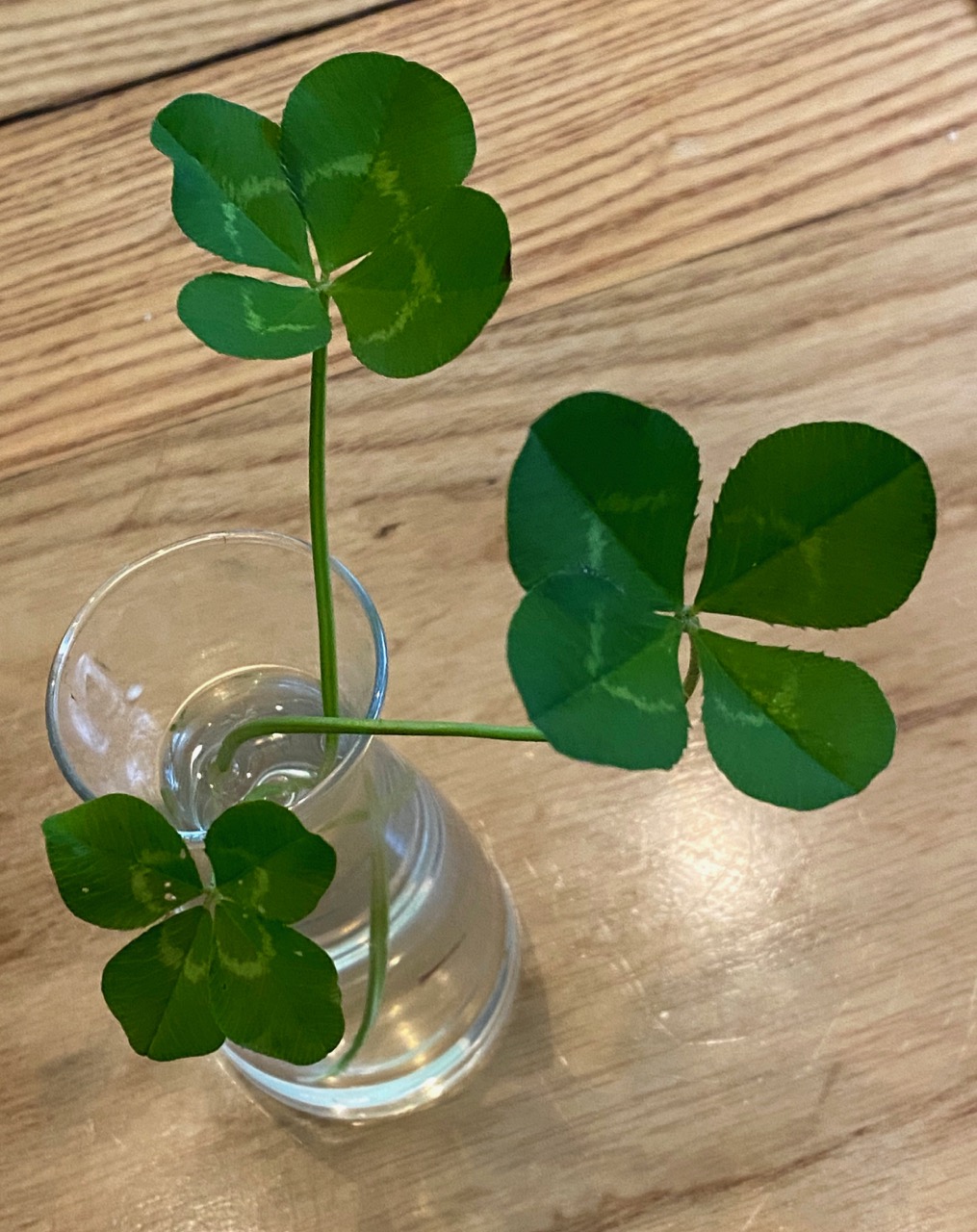
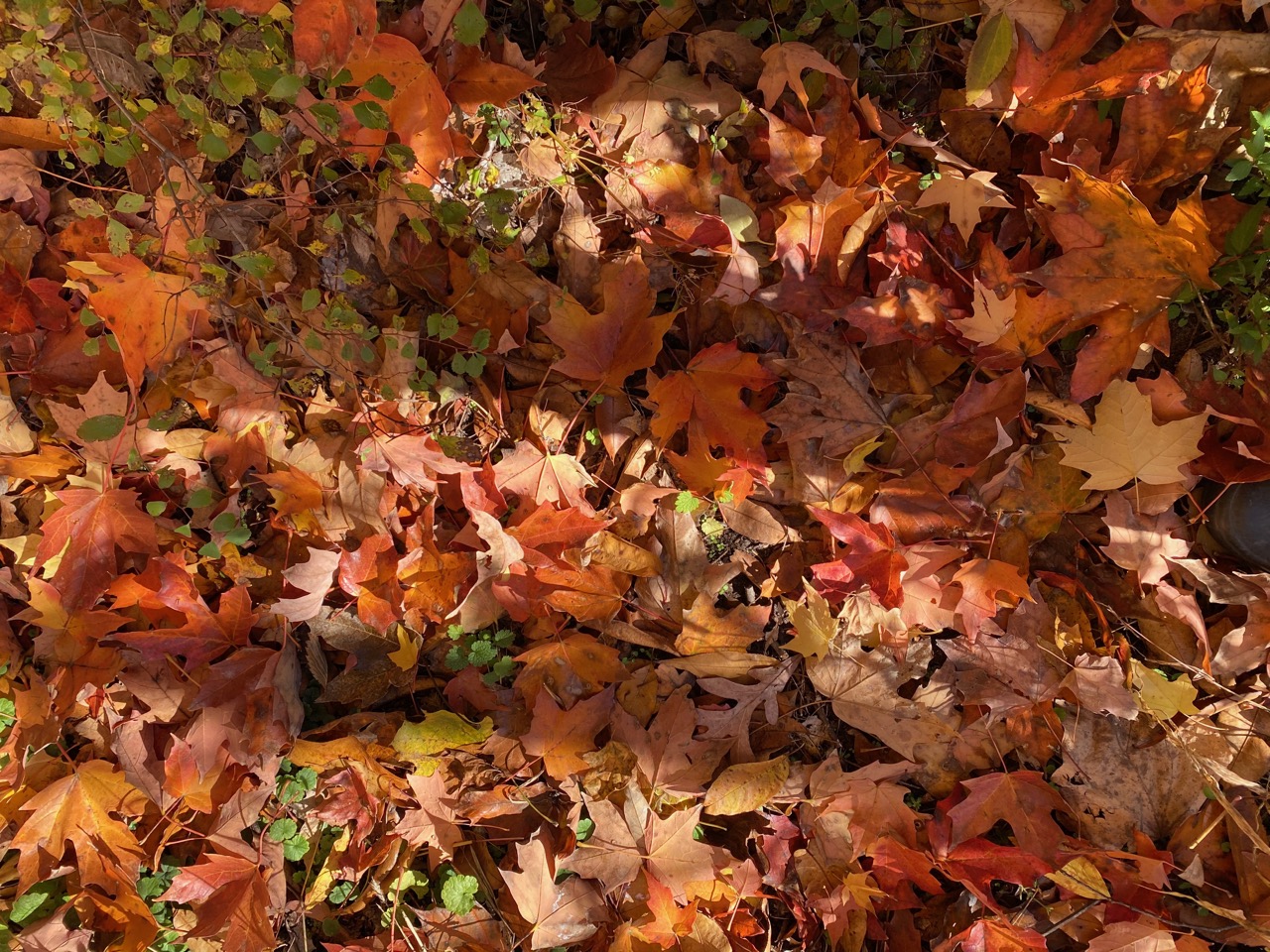 Now the leaves are off about half the trees, the lawn a litter of red and gold slowly going brown. Charlie came and mowed, not to cut the grass, but to chop the leaves into mulchy bits for the wind to scatter evenly over the tired yard. I filled brown yardwaste bags with the remains of plants that showed signs of fungus or other disease, and set them out for collection. Then there are all the plants that would be considered healthy except they’re dead. From frost. Tangled pumpkin vines get piled up onto the raised beds from which they escaped. Anything tall and hollow that looks like it could harbor hibernating bees gets left standing. Two of the remaining empty beds get cleared out for tulips.
 I put the tulips in the fenced garden to keep the deer from eating them, so I can cut them for bouquets come spring. Narcissus are toxic to deer, so those can go boldly into the front yard, the herb garden, the peony patch – anywhere. Even the most clueless fawn leaves them alone. It’s sort of a wonderful association, isn’t it – narcissus and toxicity. I’m sure there’s an evolutionary explanation for this difference between tulips and narcissus, but how telling that the poisonous flower shares its name with the Narcissus of mythology who fell in love with his own image. Toxic self absorption: the narcissist has a Greek root in common with “narcotic.” Luckily for the deer they have figured this out.
 Tulips however, are edible. A Dutch friend tells me that during wartime when they had nothing else to eat, the Dutch sauteed and ate their tulip bulbs, which were delicious (don’t try this now – today the bulbs are treated with fungicides). So I hoe up a trench in the raised garden bed, and plant the tulip bulbs. I’ve said it before, but it’s still true: the end of one season is the start of another.
 Robin Richstone