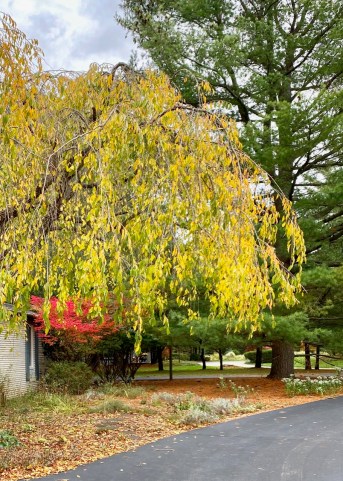
 We finally had a frost, but having it so late made a few things clear. Autumn colors are definitely the result of a dance between falling light levels, frost, and overall weather. Jack Frost’s paintbrush does not operate all on its own. But the details are tricky.
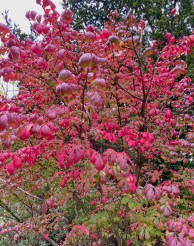 For instance, the dogwoods turn reliably red early in the season, even if nothing else does, and even if it’s still warm. Also, the dogwoods are an understory tree, growing under the broad arms of the taller trees which, if there were a frost, would protect them from it. So it can’t be frost turning them red. On the other hand, as the tall trees lose leaves, the dogwoods get more light, not less. Hmmm. Well, by then they’ve already started getting red, so maybe there’s no turning back.
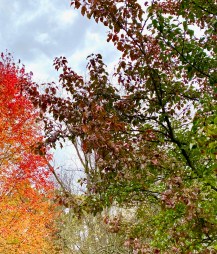 The wild black cherry over the deck is reliable for turning early, but the one at the edge of the lawn always turn a couple of weeks later. Despite this difference, neither requires a frost, and they share an opinion on how colorful to be in a given year. So I’m guessing it’s a combination of daylight and position in the yard for when they turn, but things like rain, drought, and summer temperatures for color intensity.
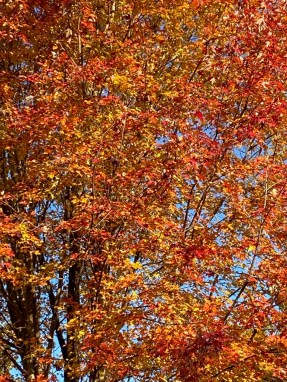 The sugar maples had wisps of color here and there as the hours of daylight fell, but they only burst into their full glory with the frost. Every year they’re different as to when they change, as well as to how bright their colors are. So the maples are taking all factors into account.
 Looking around the yard, I can mostly sort all the other deciduous trees, shrubs, and groundcovers into one of those three categories: the self-motivated, the socially aware, and the introverted but ultimately exuberant. Different manners, but the happy result is to paint the glory of Michigan’s autumn over a bigger canvas than Jack Frost could manage on his own. It takes all kinds.
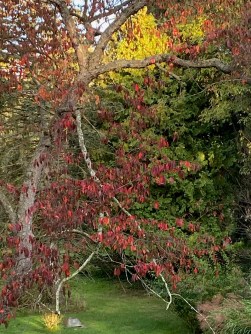 The month of October continues, strangely, with no frost predicted. Some of the trees have decided to go for fall, and some are waiting to see what happens. The zinnias are holding their own, and the morning glories, which held off all summer, finally decided to bloom. This amazed me when it happened last time, but now I have a theory: the black cherry tree at the west end of the deck must have been shading them more than I thought. When it loses its leaves, the afternoon sun gets through and the morning glories wake up. That’s my theory, and since I’m not going to test it by gluing the leaves back on or throwing a shade cloth up there, my theory will remain untested, and therefore unfalsified.
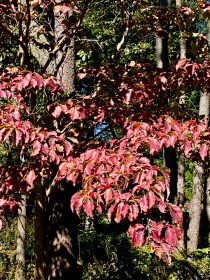 So, the black cherry votes for fall, the dogwood agrees, the morning glories and zinnias say no.
 I decided to bring in the plants that were out for the summer in any case, now, before they feed any more critters. I took them into the garage and sprayed them with soapy water, hoping not to bring insect life into the house with them. Now begins my game of Musical Windowsills, trying to fit light levels to plant happiness, and care needs to convenience of location. I will change my mind about this several times before spring comes back to liberate them all.
 Meanwhile, my hothouse tomatoes have been living it up on a windowsill all summer. Remember the hothouse tomatoes? They looked so modest on the windowsill in June. Well, modest no more. They take up a lot of real estate but the payoff is delicious. Vine ripened. We’ll see how that goes as winter gives us get fewer and fewer hours of sun.
 And while we’re on the subject of tomatoes, here’s a cautionary tale from the still-producing outdoor tomato beds. Suppose you got pushed into a corner, and spent your whole life growing there. You could come out looking like this square tomato. Some might call you a misfit; others might be intrigued to learn your story. If it comes down to a matter of taste, I can tell you it tasted magnificent. Just like the round tomatoes did.
 As we get further into fall there’s less for the critters to eat and they get bolder. One came right up on my deck the other night, ate an entire tall, twelve-inch potful of flowering impatiens down to nubs, and had a few petunias and geraniums for dessert. At first I blamed the woodchuck, but then noticed several zinnias bitten off, raggedly, at a height the woodchuck could not have reached. Deer. Most likely a fawn. The fawns that were tiny shaky newborns in mid July are now learning to eat on their own, with an underdeveloped sense of danger and an uninformed palate. The petunias and impatiens are tasty, but some of what they eat, like my Jasmine Tobacco, is poisonous. They seem to survive, but it can’t be good for them.
 Then a night or two after that, a lot of terrible screaming woke me up about four in the morning. Was it the bunny? I’d never heard this high-pitched wail before. It sounded like it might have been two different animals, and it went on for some time before it stopped, or maybe I just fell back asleep. In the morning I looked all around the yard, the deck, the woods, for signs of a struggle. Nothing. No blood, fur, or feathers; nothing disturbed. I turned to the internet and checked out the recorded screams of cottontail rabbits – no; woodchucks – no; white tailed deer – aha! White tailed deer! And though it sounded painful, according to the hunter who posted the video in question, these were the calls of deer that had been disturbed into running in different directions, calling to each other to get the herd back together. Did the hunter really know that? Was it a rural myth? Since there are urban myths, it stands to reason there are rural ones. The only sound I’ve heard before from deer is the sort of “Huff” a stag makes, generally accompanied by a hoof stamp, to warn the rest of the herd to flee.
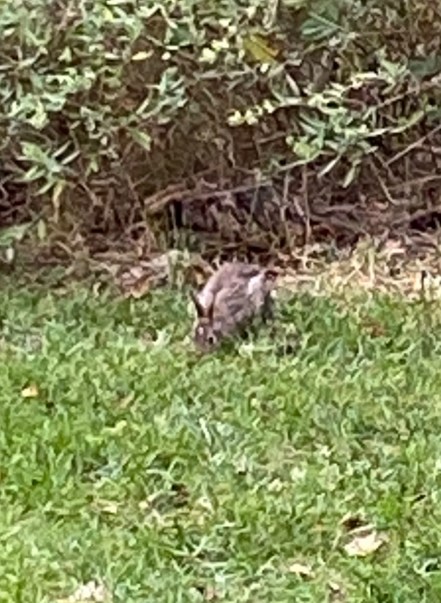 Whether it was a deer or not, it wasn’t the demise of my weed-eating helper bunny, because I saw her the next day. My bunny has a little white blaze on her forehead, very distinctive. I was feeling very smug about the Universe having endowed my back yard with a weed-eating helper bunny. Then I went out into the fenced garden to see how the last of the crookneck squash were coming along. They weren’t. Three tender little baby squash, a foot or two of vine, and many big fat juicy leaves had totally vanished. It was neat work – no messy broken bits a la squirrel, no neighboring plants knocked over a la woodchuck. Rabbits are extremely tidy when they are destroying crops and landscaping.
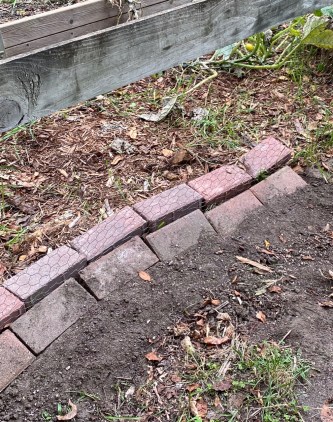 So I inspected the chicken wire around the base of the fence, and found the place where the wire had rusted out at ground level, and a shallow, bunny-size underpass had been excavated. My bunny must have been doing reconnaissance all summer, just in case. I believe the relevant phrase is, nevertheless she persisted. Her erstwhile entry now boasts a temporary patch of bricks on both sides of the chicken wire, sandwiching it in place, and Blaze the Bunny is back to eating weeds in the lawn.
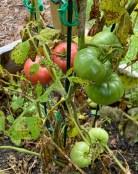 September is the easiest, most rewarding time to be a gardener in Michigan. Weeds have slowed way down but the tomatoes are really rolling in. The yellow squash and eggplants are doing the same. Their leaves may look ratty, but my biggest garden chore is tying the plants up and harvesting their bounty every day.
 Many summer flowers have given up, but the Autumn Clematis that previously did nothing but try to swamp my asparagus, is now in full gorgeous bloom with sweet, sweet scent.
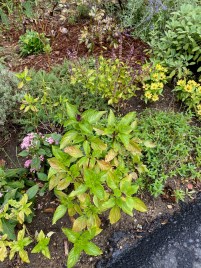 The basil in the front yard shows tinges of its coming shutdown. I’m letting it flower now, since at this point it’s a toss-up whether the basil will go to seed before the frost gets it. The sage in the upper righthand corner of that picture, however, will continue to stand, proudly flavoring the stuffing and festooning the platter of the Thanksgiving turkey. It will still be leafy in the snow. I’ll trim it back in spring when the new leaves start coming out.
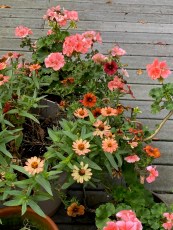 The zinnias and petunias will bloom until frost, and the geraniums will keep them company until I bring them inside for the winter, but I do have to start watching the weather forecasts for frost warnings.
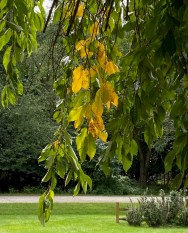 A well-known poem of my childhood was the story of Jack Frost, who came with a paintbrush, unexpectedly and unseen in the middle of the night, and everywhere he went he left a trace of red or gold on the leaves of trees.
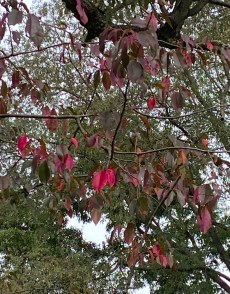 The poem never said whether his brushstrokes were deliberate, and I always imagined them as accidental. I thought Jack Frost was on his way somewhere else with that paintbrush, with something else in mind, and slopping a little color onto the trees as he went along just happened. It looked that way to me then, and it looks no more deliberate to me now, though I’ve learned, as a gardener, that the color change doesn’t necessarily come with a frost. No frost here yet, but there’s a slash of gold on the weeping cherry in the front yard, a spatter of red on the wild black cherry in the back, and I think of that paintbrush, trailing glory like grace over a world that can certainly use it.
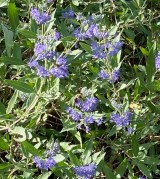 My favorite color is blue, and late summer is when I have the most of it in my garden. Bees love it, too. The caryopteris is full of them – you can see one here.
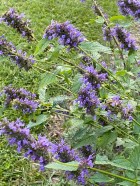 The agastache is just as popular, but the bees zoomed off when I lifted my phone to take their picture.
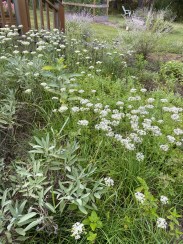 The Russian sage in the herb garden arches its blue branches behind a white froth of garlic chives. Hummingbirds like Russian sage too, but are too fast for me.
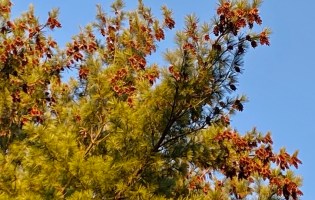 It still looks like summer, but the critters and I can tell it’s winding down. The chipmunks are busy gathering tiny wild black cherries, their cheeks puffed out with the treasure they’re carrying off to their winter nests, hollows in some of the same trees the cherries came from. Black cherry trees, though prolific and fast-growing, always seem to be losing branches and developing hollows, so that I wondered how they ever survived. But their loss of bodily integrity is the chipmunk’s gain of home and hearth. Traipsing through the woods, no doubt he plants a few more cherries as he goes. The tree and chipmunk have a mutual aid society.
 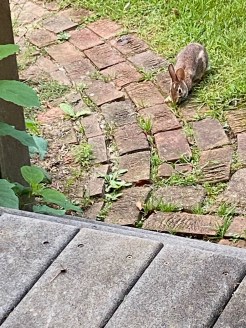 I was surprised to see a bunny in my herb garden. They don’t eat herbs, which I like to think is because then they’d be pre-seasoned, and too many critters eat bunnies as it is. So what was this one doing? A gracious and helpful bunny, she hopped further onto the brick path so I could get a better view. She was eating the weeds! She was cleaning weeds out from between the bricks! Oh best of bunnies! I had no idea. There is always something to be learned in the garden.
 Last Wednesday night we had three thunderstorms in a row between one and four a.m. About three o’clock the thunder was continuous, which means the lightning was. For some reason this inspired the local (electronic) paper to run an article on how good lightning is for your garden. Assuming it doesn’t knock over any trees that smash all your plants, that is. Lightning, it turns out, fixes nitrogen. This is the job that peas and clover famously do in the soil, but lightning does it right in the air. Nitrogen, of which our atmosphere is mostly composed, is a crucial requirement for plant growth but needs to be broken out of its sturdy molecular form, or “fixed,” so plants can use it. Lightning, you know, can kill people, so it’s pretty strong stuff.
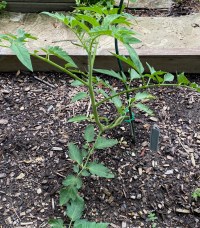 This is where the tomato house comes in. Here you see photographic evidence: on the left, your tomato plants in the garden, on four and a half hours of sunlight.
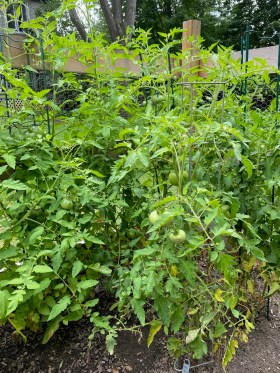 On the right, your tomato plants in the tomato house, on nine hours of sunlight.
 Saturday was a perfect summer day: lightly warm, little breezes pushing puffy clouds around, giving intermittent shade. With the blueberries harvested and the tomatoes not ready, I took my fishtail weeder in hand and went out to weed the garden.
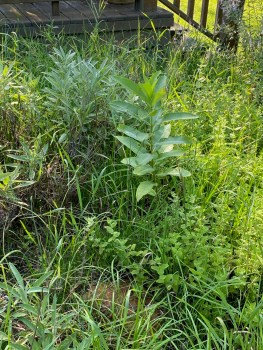 growing where you don’t want it, and one person’s weed is another’s treasure. Community values, current fashion, material needs, individual taste, and no doubt many other things factor into the decision: to pull or not to pull.
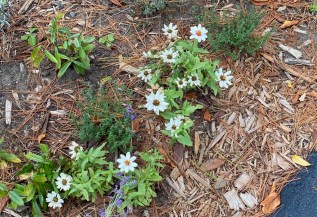
 Then here’s a raised bed full of nascent zinnias, edged by violets that have colonized the mulch on the garden path. They’re invasive but I love the scent of violets in spring, so I pull them back just enough to keep the path open.
 After I cleared out the excess violets, I discovered they were hiding a perfect example of right thing, wrong place: a baby redbud tree has sprung up inside the garden, exactly where no tree should be. I’m going to scout around the yard for a good spot for it, and it will be transplanted.
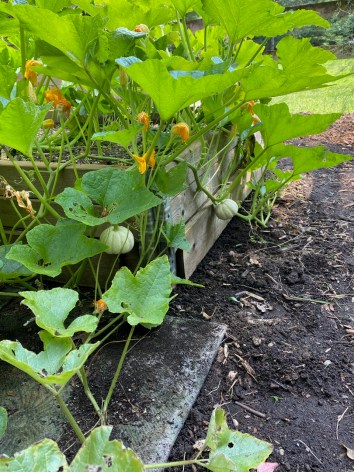 So I knelt happily on my foam pad, hands in the dirt, making order of chaos, and in a short time found another lovely surprise: Baby Boo pumpkins dangling like a string of Christmas lights. Mixed holiday metaphors, I know, but they did seem like a gift. I planted the seed, true, but dirt, rain, and sunlight did the rest.
 them, when something small whizzed by my head on its way to the monarda. Too big for a bee, it sort of looked like a Rufous Hummingbird – its abdomen was reddish – but way too small, and I didn’t think we had Rufous Hummers in Michigan. On the other hand, it was definitely humming, and hovering over the monarda to sip, darting crazily between blossoms. It didn’t hold still very long, but I finally noticed two mothy antennas. What? I may have been “drunk” on lavender scent but I wasn’t actually drunk. A moth?
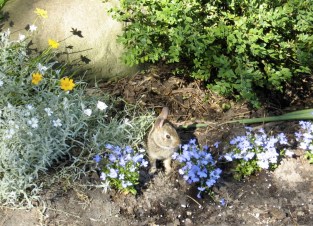 I’d have liked to watch it longer, but it was a very busy creature, sped off, and I went back to weeding, and installing a few zinnias and petunias in bare spots. This is an experiment to see how the deer and rabbits feel about eating them. One of the does came through my yard the other day followed by a fawn so small he barely knew how to use his legs, and there are baby bunnies. Fawns are experimentalists in dining, eating things that make them sick until they become old enough to know better. The bunnies so far are ecstatic about the clover in the lawn, but that could change.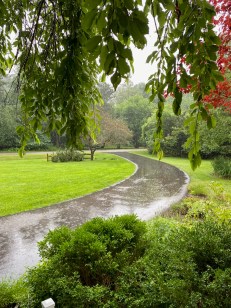
 Since then it’s been raining. Not thunderstorms, just steady, straight down, soaking, chilly rain. If only we could get some of our water to California and get some of their heat here. These mushrooms sprang up, but before I could find out what they were, they were gone. I will be very interested to see if the birds come out in force again to bathe, after the rain. You’d think they got wet enough in these long, soaking rainstorms, but twice now I’ve seen them crowding each other out at the birdbath when the sun comes out. I want to see if they go for a third.
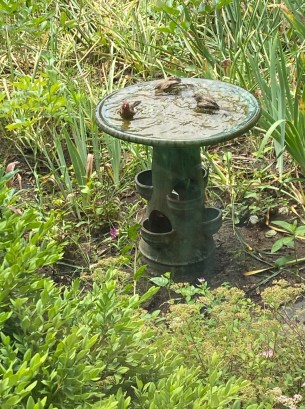 That explained why I could hear but not see them, but why weren’t they here in my yard? Could it be my large number of birds, especially nesting pairs with babies to feed? In addition to the many birds casually passing through, I have robins, mourning doves, finches, wrens, and cardinals all raising nestfuls of voracious offspring. The robin is particularly canny, following me around as I weed, moving in on the turned-up worms and bugs as soon as I shift to a new spot.
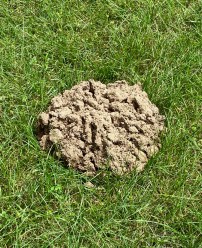 Speaking of the ground, another possible wreaker of cicada havoc is the mole. Moles spend their lives underground, eating critters they find there. Could my mole have cleared out the cicada nymphs? As a lover of words and already deep in the internet, I looked up “mole.” In Middle English it was “moldwarp,” mold meaning soil and warp meaning throw. So, a soil-thrower. How cool that warp comes from throw. Warp speed, anyone?
 Cicadas do not, as far as I know, eat tomatoes or damage tomato plants so I wasn’t worried, but I went and checked the tomato plants anyway. They’re coming along. It will be a while, but I can almost taste the bacon, lettuce, and tomato sandwiches.
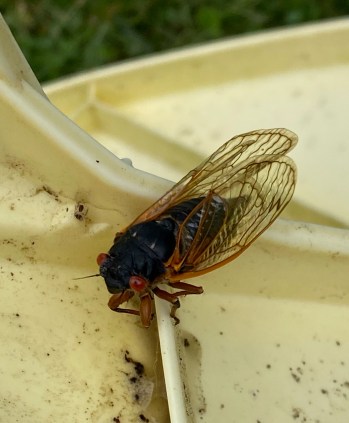 Finally, I saw a live cicada! It was not exactly moving at warp speed, but also not singing – so, likely a female. Doesn’t she have beautiful red eyes? I hope wherever the singing males are, she finds one she likes the sound of. I hope I’m here in seventeen more years, to listen to their progeny.
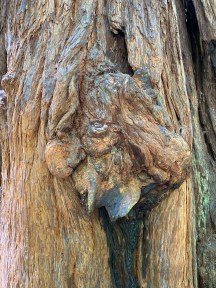 Shortly after that last post I went to California to visit family, masked up but gleeful that we could travel at last! One day we went for a walk in some old growth redwoods. They were tall, stately, awesome, enduring, all of that was true. But these particular redwoods had something else. They had faces. Is that a sheep? Is that a rabbit?
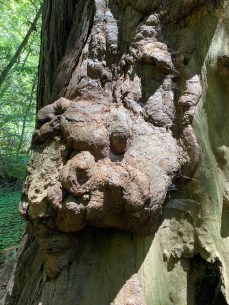 My head began to fill with stories of spirits trapped in trees; or maybe taking refuge in trees? These trees have survived wildfires, droughts, and colonizers, for over a thousand years – and these are the young ones. Being toxic to insects and able to regenerate after fire only go so far. How did they keep us from cutting them all down? Did these faces have something to do with it? Maybe the faceless ones are gone now, leaving behind only the ones that can look us in the eyes.
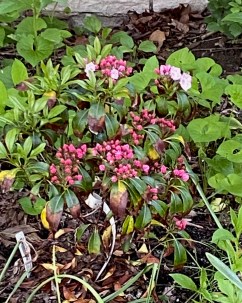 The garden was more or less on automatic pilot while I was gone, sprinklers on timers and mulch on the bare spots to block out weeds. I was pleased to see my three-year-old Kalmia blooming. We had these all around the house where I grew up, and I loved to detach the small blossoms with their stiff pink ribs, and use them as umbrellas to shade the Monopoly houses I took outside and settled between tree roots. Yes, I did that. Monopoly houses used to be made of wood.
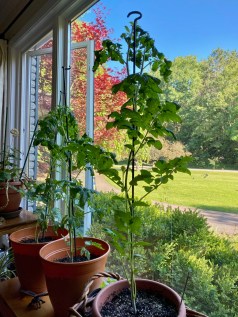 I had left Zerlina and the houseplants in the care of my friend Cindy while I was away, and came home to find she’d done an excellent job. Zerlina was miffed that I’d been gone, but recovered. In the garden, the transplanted tomatoes had rooted themselves in, ready to grow. But the surprise was the greenhouse tomato plants in my front window: three feet tall, thick, and glowing in the captive glassy light. I hope the tomatoes taste as good as the plants look. In fact, I hope there are tomatoes.
 Robin Richstone