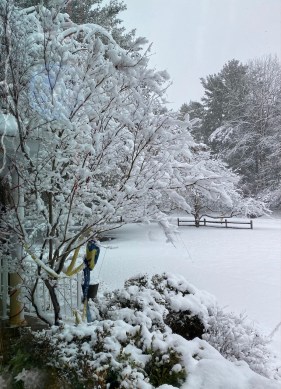
 Snow! Finally, snow! If it’s going to be winter, and cold, and bare branches, then I want my snow. It makes winter miraculous, that smooth bright overlayment that falls out of the sky, establishing itself across what was rough and tired.
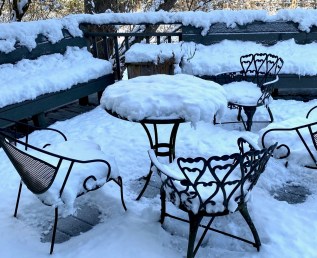 At last the snow came but, for Michigan, it was awfully warm to be snowing. The temperature hovered just around freezing, and the snow struggled. Where past snowfalls stacked neat cakes onto flat surfaces, this one, all six inches of it, sagged, drooped, and slumped. And then it got Michigannily cold, and all the slumps stopped mid-slide and froze into place. I mean, just look at this – like it wanted to be March but changed its mind. It looks like cartoon snow. And what’s with the bare spots under the chairs? There are six inches of snow out there, more than the patio furniture can usually protect.
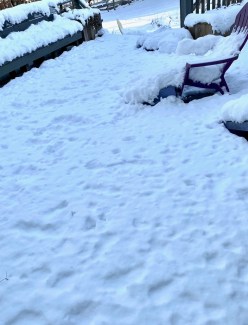 Then we have this Craters of the Moon effect on the deck. It’s probably not the tracks of squirrel gymnastics, since our squirrelopotamus is mostly holed up with his massive supply of pumpkin seeds, and moving slowly when out and about. In fact, this is the snow that tried to stack onto tree branches, but was so wet it kept plopping off onto the deck, little winter asteroids pockmarking Planet Deck as they landed.
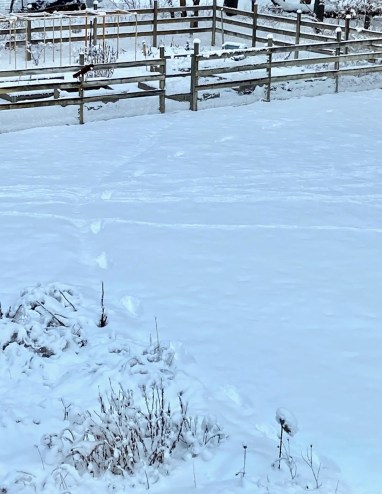 Where no trees overhang the lawn we have a few ordinary trails of the drag-foot deer crossing east to west.. But then, what made this series of plops with the big spaces between them? They’re further apart than I can step – something was jumping, or bounding. The best match from an internet search: a wolverine! Well, I support the local team but not to the point of importing wildlife; and it looks a little dainty for football players anyway. I searched again and turned up the tracks of a marten, an animal once abundant in Michigan but mostly gone now. Could it be squirrelopotamus after all? A bunny? A large, energetic bunny? A bunny large and energetic in spite of there being almost nothing out there for it to eat? It was about 6 degrees outdoors, so I wasn’t inclined to go look into the bottom of the swooshes for telltale toe marks.
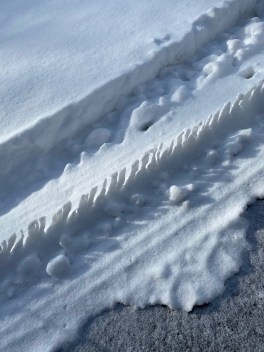 This less mysterious track was made by Christen, the woman who plows my driveway, as she guided her truck around the curve of the asphalt. The temperature had already fallen some when she plowed, the snow being wet enough to take a good imprint of the tire tread, and the air cold enough to freeze it in place before it could slump. I love the row of mini-hoodoos.
 Meanwhile, the bulbs I started are blooming, an indoor snowfall at the window, mirroring the colder fluff outside.
Poem: Winter, Love
Inside the window, paperwhites
lean jealously against the glass,
appraise the falling snow
for signs that it will not surpass
their raw ability to bring
glory to a winter hour.
But what do the narcissus know?
Saturated with delight
as the glass reflects their faces,
each ice crystal is a flower
to the viewer it displaces,
winter passionate as spring
fields of bloom on frozen lawn
harvest what they grow upon.
published in Bluestem
 We finally had someone coming to give us a quote on the broken tree clean-up, so I was out making sure my list was complete. It’s not exactly subtle out there: what’s wrong with this picture?
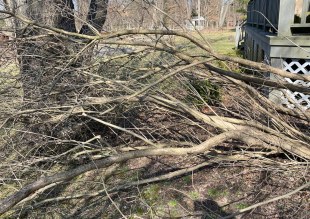 Are lilacs supposed to grow horizontally? Is this redbud limb having a nice meet-cute with these wooden chairs?
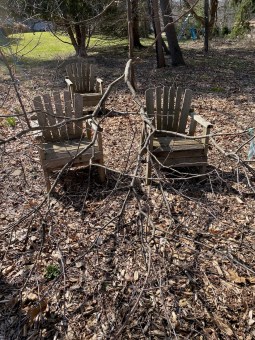 Still, there’s so much, it would be easy to undercount. As I inspected the fallen tops of some crabapple trees, hoping none of the gathering spring birds decided to build nests in these branches bound for the chipper, I noticed a DTE utility truck parked on the street. It had a sign I’d never seen before on its door panel: “Assaulting a utility worker is a felony.” With hotline number. I certainly never approve of assault – and isn’t any assault a felony? – but the image of DTE customers enraged by long, repeated power outages taking to the streets with pitchforks somehow seemed sad and funny at the same time. Funny, because I couldn’t really believe it would happen. Sad, because apparently it does.
 Meanwhile, cheery things are also happening. Between the fallen branches the first daffodils are starting to bloom.
 Indoors, my tulips are going crazy on the windowsill. I’m a little late starting my seeds. Think I’ll go do that right now.
 The garden in winter has a lot to say for itself even when there doesn’t seem to be much happening. Yesterday I tossed a hard loaf of bread and some tired old pumpkins out the back door. Some birds came to the bread loaf right away, and then a deer. The deer had her back to me, but when she heard whatever tiny slight sound I made behind my window, she struck a pose I’d never seen before, and my camera was not in reach. She swiveled her neck 180 degrees, so her face was turned directly toward me, while her body stayed entirely pointed the other way. I didn’t know deer could do that; it made her neck look very long. When she moved on, I found my phone and googled “are deer related to giraffes.” The answer was – yes!
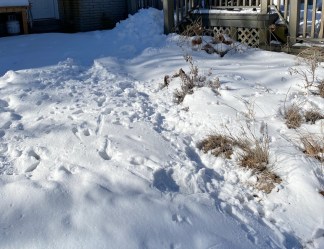
 This morning I found a fuller record of visiting diners stamped into the snow: more deer hoofprints, a bunch of squirrel pawprints, and prints of a cat, but probably that was Mac from up the street, tracking the birds. The front yard recorded an activity I didn’t understand right away: what were the deer doing over where the storm had put the top half a crabapple tree on the ground? I could see the drag marks of deer walking up, and then the crisper prints of deer taking short steps and standing around. A closer look, and aha, the top of the tree, which was now the bottom of the tree, still had dried crabapples on it. I wonder if deer know to look for this after a storm, or if they just stumbled on it.
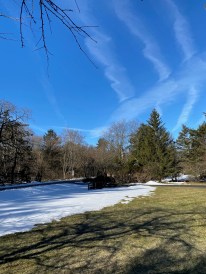 Another record of recent past events was in the sky. It’s a bright, gorgeous day today, with not a cloud in the sky. Except where jets passed through it. The sky trails of enormous birds.
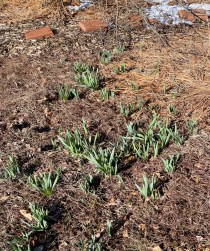 Nearer to the house, spring’s spear carriers are on the job, trailblazing for the daffodils to follow. They start coming up while still covered in snow, but if snow surfaces show any signs of this I haven’t learned them yet.
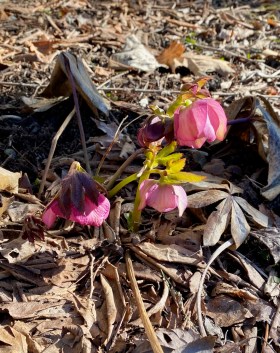 And here by the front door are the faithful hellebores, living up to their common name, Lenten Roses. They gave up snow, or possibly living underground, for lent. We have a lot to do before spring – clearing off the old seedheads and brushy bits I left standing as winter shelter for small critters; getting the fallen tree off the garden fence and making anti-bunny/anti-deer repairs; having a real tree service trim off breaks and snags. With so much damage in our area, it’s taking weeks just to get an estimate. At least I don’t have to worry about the woodchuck. Yet. When she does emerge she’s going to be very hungry.
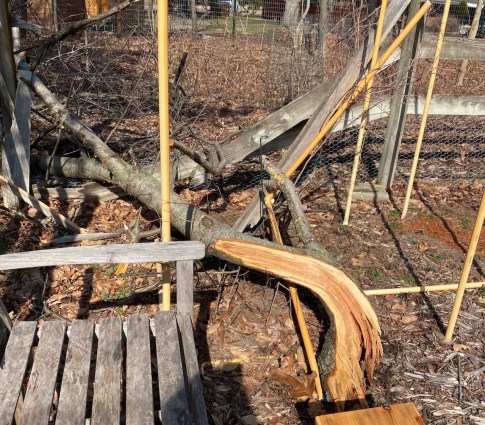 When this branch was attached to its black cherry tree, some forty feet above the ground, it didn’t look so big. It didn’t look heavy enough to smash part of my garden fence and take out one of the blueberry cages. We were in California visiting family when the February rain, which in Michigan should have been snow, froze on contact with it, becoming an unbearable weight of ice. All across southern Michigan branches, limbs, and entire trees fell, crashing into wires, roofs, and each other. The next afternoon was sunny and warmer. The ice all disappeared, leaving runways, freeways, and parking lots ice-free and dry for our drive home from the airport. It looked like nothing had happened. 600,000 people were without electricity.
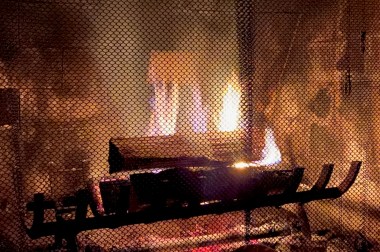 Including us. No heat and, since we have a well, no water. Also no internet, which is why this post is late. We huddled in front of the fireplace, swathed in sweaters and wrapped in blankets. I lured Zerlina under the covers to warm my hands.
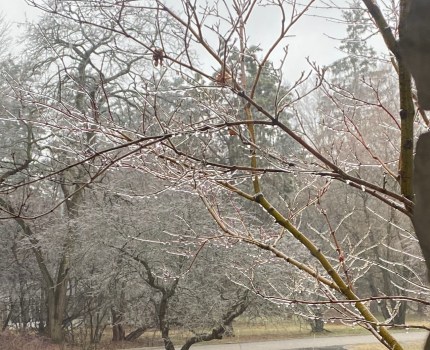 DTE (Detroit Edison) had made little progress on restoring power when another, slighter ice storm blew up the following day. There was very little left for it to knock down, but it did what it could. On the positive side, I was home to see the beautiful ice-twig effects, which are impressive if not comforting. Definitely not comforting.
 DTE said it was a 50-year ice storm, but six years ago we had a 5-day power outage caused by some other kind of storm. How many kinds are there? Maybe DTE should spend more resources on tree trimming, line maintenance, and a better emergency plan instead of whatever else they’re doing with the rate increases they keep scoring. They should have to count the woodsmoke from power-failure-fireplaces against their zero emission goals. We had to throw out everything in the fridge and freezer, another waste of resources.
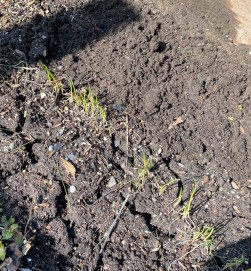
 Inspecting the garden, I found a sign of early spring: last fall’s scallion seed sprouting in the open coldframe. Indoors, Zerlina resettled happily on her favorite cushion, the nearby heat register back in business.
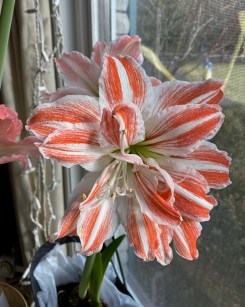 The Dancing Queen is making a repeat appearance, having gone through summer on my deck, an indoor rest, and a January wake-up call several times now.
 The mostly pink Amadeus is the other one I bought new for this year, very elegant, rather more restrained than the Dancer,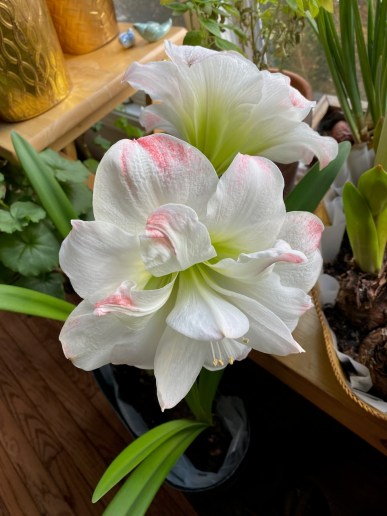
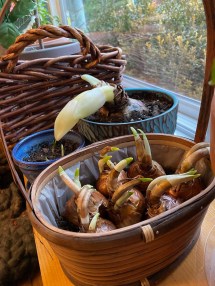 Bulbs are very determined.
 Since they were pretty tumbled around in the bag in the closet, they came out looking arthritic. I felt sorry for them.
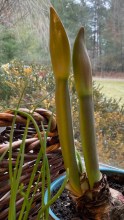 So I moved them into the sunlight and gave them water. They straightened right up and became what they were intended to be.
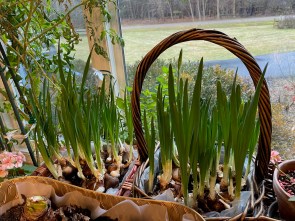 Such an easy metaphor – deformed and awry from lack of light and nourishment; upright, ready to bloom and be productive, when resources are applied. No need to belabor the point. Use it where you will – plants, children, relationships. Good advice from an indoor garden.
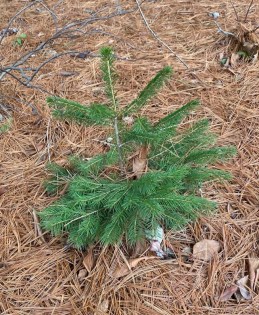 Happy New Year! This is the month named for Janus, the Roman god of gates and transitions, who looks backward and forward at the same time. In my front yard this morning under the wide spreading branches of my big old pine tree, rooted in the past, this new little sprout of a tree faces the future. Janus looks out in both directions, but he occupies the middle ground – a position we could use a lot more of these days. It’s interesting that the Greeks, whose gods the Romans generally paralleled, have no similar god. The Greeks invented Democracy. I hope that’s not a portent.
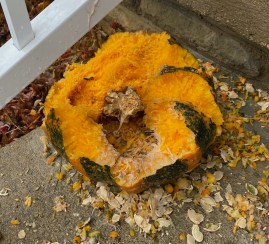 The hipposquirrelamus has made an interesting sculpture while fattening himself on my second pumpkin. He ran away when he saw me, but I wondered where the chipmunks were. In November they were running up and down the yard with their cheeks stuffed out, but I never saw where they took their loot. Unlike the hipposquirrelamus that continues to forage all winter, chipmunks hibernate. They are said to build burrows as much as 12 feet long, with many entrances and separate pantries, sleeping areas, and trash dumps. This sounds way too organized for critters that rush around as chaotically as chipmunks do, but then there are those cheeks. They wouldn’t need capacious carryall cheeks if they didn’t have a plan. Being natural travelers through the underworld, they have co-evolved with various of the foods they gather, for instance spreading spores of fungi. Especially truffles.
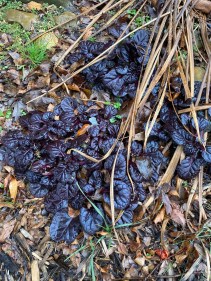 So there are the smart and tidy chipmunks, holed up in their burrow mansions eating truffles, while the deer, possums, and raccoons tromp through the winter scrounging. This explains why the plants that stay green in winter here are the ones critters do not eat. The ajuga looks luscious to me but not to the wildlife, after a week when the temperature fell all the way down and off the thermometer. That’s what zero degrees means, right?
 And here’s the hellebore, not just surviving but planning to bloom before spring comes. Being repellent to mammals is the way to go if you’re a small, low-growing plant that stays green in a Michigan winter.
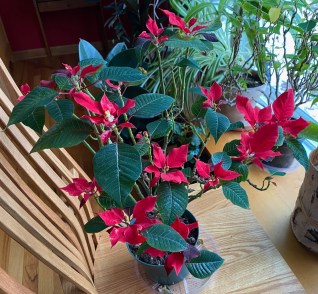 The poinsettias I saved from last year spent the summer outside and dropped many leaves when I brought them in, but now have recovered to holiday glory. After many struggles with mealybugs, to which over-wintered poinsettias are sadly susceptible, I now have an actual houseplant tip for you. For a minor infestation, mix one quarter cup of rubbing alcohol with a cup of water, dip a cotton ball into it, and dab directly onto the little white mealybug clumps. For a major infestation, mix the same proportions of water and rubbing alcohol in a big batch, add a little dishwashing liquid, and spray the plant all over with it. Works better than anything else I’ve tried.
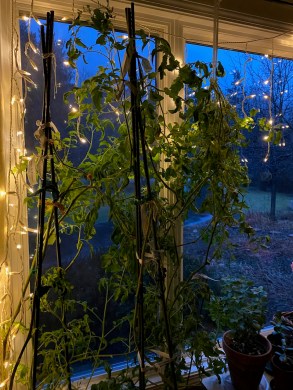 I also used this on my indoor tomatoes, the other victim of mealybugs. Direct application worked better for them, because they grow in big heavy flowerpots that can’t be picked up and set in the kitchen sink to be sprayed. Spraying them as they sat among my books, furniture, and Christmas lights wasn’t a great idea. So, dab it was. The new green tomatoes are reaching the full 2-inch “salad size” they were meant to be before ripening, unlike the pre-treatment tiny red tomato you see here, which was hard as a rock. Definitely worth fixing.
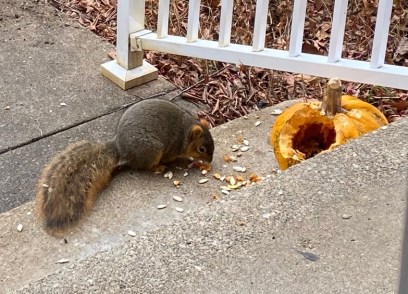 We have a squirrel in our yard so big and chunky, I often mistake him for the woodchuck. The woodchuck, of course, is tucked deep in her den, where I devoutly hope she will stay until, hmm, maybe next September. No, what we have cavorting through the yard here is the Reigning Squirrel Champion of Winter Prep. Squirrels don’t hibernate, but pickings can be slim in wintertime so they are wise to beef up while they can. For instance, by clearing out all those pesky leftover pumpkins from Thanksgiving. This photo doesn’t do him justice, as he’s a very self-possessed squirrel, who does not approach people in an attitude of supplication nor pose for photographs. When he sees me he flounces off.
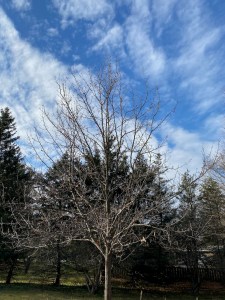 I was on my way to the mailbox, but the sky was especially beautiful so I loitered. No snow yet, but somehow the trees managed to glitter. I love the part of any season where it changes from one into the next, in this case the architecture of trees emerging as the light fades. Not autumn, but not winter until it snows.
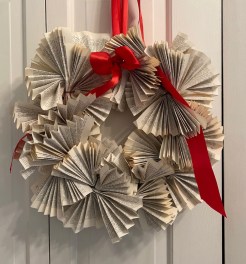 I get ready for the sno by putting up my holiday decorations. I always hope for snow for Christmas but that not being in my control, I go for lights, indoor greenery, and lots of decorations. Though I’m usually averse to tearing up books, I had a collection of old encyclopedias and Slavic dictionaries given me specifically for craft uses (by a friend who taught English in Poland). Here’s the wreath I made by pleating encyclopedia pages and wiring them onto a wreath form.
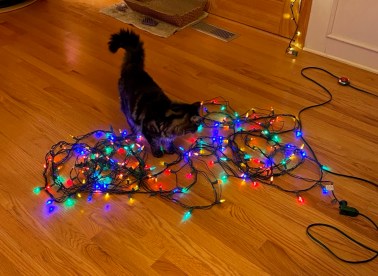 Zerlina always takes an interest in the string of Christmas lights – bright, like the laser pointer she likes to chase, but not going anywhere. I do wonder what she makes of them. She was a street cat in her youth and though she certainly knew about trees, she was not familiar with Christmas trees. When she encountered her first one, in my living room, she immediately climbed it. Fortunately this was before the decorations went on, so no damage ensued.
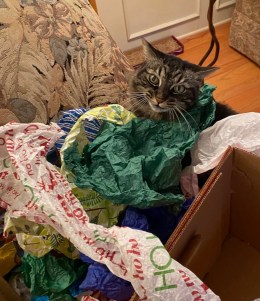 With time she discovered that these strangely fast-growing living room trees never had birds in them, and gave up climbing them in favor of hiding underneath as a stake-out for mice. We do sometimes have mice. She watched the tissue paper piling up as I unwrapped the tree ornaments, and jumped right in to help by checking it out for vermin. Those mice are tricky and could be anywhere.
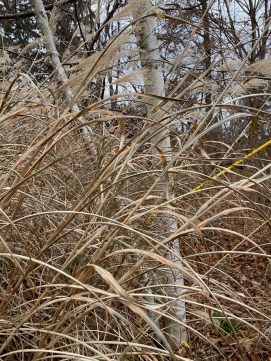 So many people complain about northern Novembers being grey, but I always think of Elinor Wylie’s description: “… landscapes drawn in pearly monotones.” November is an invitation to calm, to quiet, to pause before the big winter holidays, take stock, and be thankful.
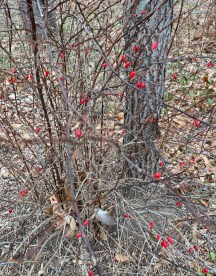 It used to be standard practice, once all the leaves were down, to rake them away, pull out spent stalks and branches, and cut everything else to the ground. If you left ratty edges in a suburban yard, your neighbors would complain, or at least drop hints. Calling it “winter interest” mostly garnered eyerolls. But there has been a lovely confluence of awareness of the ecological value of not cleaning up, and fewer people having time for it anyway, that is bringing improved habitat to the critters that spend winter in our yards. An untrimmed shrub that holds its berries for months, a brushy low plant that provides shelter against the wind and cold – these are real assets for birds that have been kind enough to stick around. Let the leaves lie where they fall, and first you save yourself the effort of removing them, then when they decompose and enrich the soil you save money on compost.
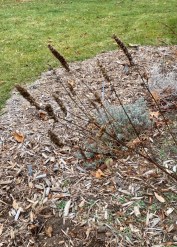 Here’s the agastache standing up with its clutch of seedheads, feeding birds but ignored by squirrels. That’s a win.
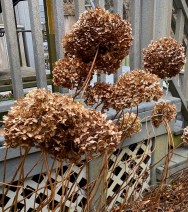 Here, the standing hollow stems of hydrangeas make cozy hibernation homes for solitary native bees. Don’t cut them down until the bees come out, which for me is when the daffodils bloom.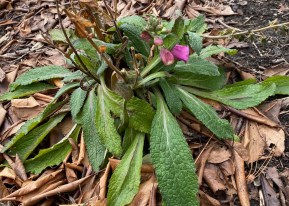
 On a November day, the garden store
 Just before election day, Doug and I took a walk up the road to the bald eagles’ nest. A neighbor had told us the eagles were gone, but I was sure I’d heard them calling to each other, flying over the house. Since the river wasn’t frozen yet, we hoped if they weren’t at the nest we might get a sight of one fishing.
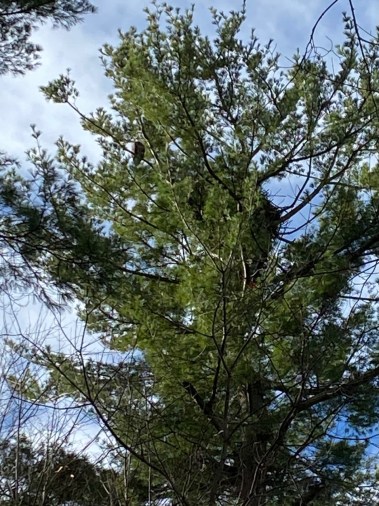 A windstorm had come through the previous night, causing strangely random damage. Leaves were barely disturbed in one spot, and most of a tree knocked down in another. The eagles’ tree was still standing tall, with its big knot of nest bulking at the top. We loitered for a few minutes while no eagle appeared, and then here he came – she came? – over our heads from the river behind us, talons carrying a huge clump of brushy sticks. She glided into the nest with it, disappearing from our sight. Repairs.
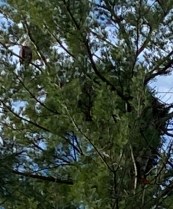 There was certainly a happy spring in my step as we walked the rest of the way up the road, turned, and walked back. When we came again to the eagles’ tree we looked up. There she was, sitting on the usual lookout branch, head turning slowly from side to side as she surveyed the river, the road, the town, the world. The nest was whole again. All would be well.
 Robin Richstone