That Space Between Flying and Falling

I spent last week in Boston, and went to see Rachel Mello’s new work at the Laconia Gallery. The pieces in this show are cut silhouettes of cityscapes painted with clouds, hung from the ceiling so as to cast shadows on the walls, on each other, and on us as we walk through them.

She called the show That Space Between Flying and Falling. I was immediately filled with regret that, as a poet, I had not thought up that phrase. It applied in the first place to the artwork, but then like a good poem it opened out – into the moments full of possibility in anyone’s life. It is the gardener with the seed catalog in her lap, every flower and fruit she’s ever thought of ready and waiting. It is the poet before the poem. The whole world is open at that moment, and you are free, untethered. Your plan might fly, your plan might fall – this is the space where every possibility is open. Even falling can be positive: you can fall in love; you can fall into a run of good luck. Or of course you can fall on your face. But you begin, because you can hold out for infinite potential only so long before it’s time to plant the seeds or lose any garden at all. You begin, and the options of all the other windows start closing.

Rachel’s silhouettes perpetrate the magic of holding that moment open. They are paintings, rich with brushstroke and highlight, but not framed nor on a wall. They are sculptures, meant to be seen hanging in space, but they are flat.

garden gate

Garden Gate, detail with shadow

They are cut in the shapes of urban landscape, but their surfaces are painted entirely with skies. They have one side painted in the full, voluptuous colors of a stormy sunset, but the other side is painted in greyscale. They hold my imagination open, and in the space between flying and falling the garden of my dreams and the poetry of my garden take shape.

If you’re in Boston between now and December 18 you can check it out. The gallery’s website is laconiagallery.com
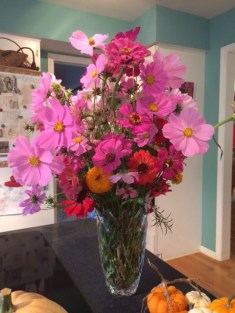
 

Glory

So now we’ve had a real frost, and here is October in its full glory: wild with color, light, freshness, and hyperactive squirrels. The maple tree goes red from the top down, like a stoplight for the summer, and the walnut trees wear yellow so bright they clearly stole it from the sun. Then they all throw their leaves, riotously, across the lawn, the garden, the road, or up into the blue brisk air.

We hear an odd noise from somewhere near the garage, the sound of a hard object bouncing off of metal. What can this be? Walking near the garage makes it stop; walk away a bit, and it starts again. Puzzling, I wander out to the garden to gather the last holdout flowers, and turn to look back to the house. I see a pair of small ears poking up out of the gutter over the garage door. I sneak up a little closer, the ears disappear, and the clanging starts again. Small pieces of walnut husk are flying out of the gutter, onto the driveway. Then a small head appears where there were only ears before. It is one of those small red squirrels. He has carried a walnut up there with him, and is bashing it against the metal gutter as a way to husk it for his winter stores.

At first he freezes when he sees me, and runs off. But after a couple of days of this he gets used to me and keeps working in his improvised kitchen, whether I spy on him or not. He has food to process, and no time to fool around.

But I have time. Most of my work in the garden is done. There is, oddly, some summer squash still growing there, and many perennial herbs, but they don’t need much tending. We drive out along the river to the Dexter Cider Mill for hot fresh-pressed apples to sip. The trees toss their leaves into the water and the sky, reflecting each other, and the sky and the water carry them away. The world outside my garden offers a harvest I did not plant. I am happy to take advantage of it.

Frost Advisory

A few days ago we had our first frost warning of the season, so I headed out to the garden with my Number 6 Felco clippers in hand. I cut all the flowerslate flowers that were in bloom or full-budded, all the green tomatoes that were at least half grown, before the frosttucked the cherry tomato vines into their cold frame and closed the lid. I found a few last yellow summer squash – so much easier to find than those elusive zucchinis – and carried all this largesse into the house. I took in my poinsettias and the potted lemon tree.
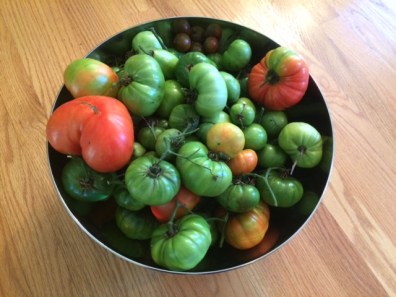
In the morning there was frost on the front lawn and a skim of ice on the birdbath, but in the garden in the backyard there was no sign that the Angel of Death had been near. Zinnias, cosmos, tomatoes, and squash were still coming; and now an entire warm week is predicted, so the remnant will not only survive, but flourish.

I could just hear my severed tomatoes rebuking me: what are we doing inside on a day like this? Most will go on to ripen indoors, but not with the full flavor of joy that is a sun-ripened tomato’s birthright.

It’s hard to decide what to do with a first frost warning. Even taking into account overhangs and land contour, frost damage is not just patchy, it’s capricious. I chose to err on the side of prudence, unwilling to risk a sad morning of blasted vines, beds full of overnight-blackened flowers, tomatoes turned to mush. But the trouble with poets is, as the song says, we see poetry everywhere. No risk, no reward, in the garden just like life. I carried the poinsettias and the lemon tree back out, but once the tomatoes were off the vine it was too late for them.

So since I wasn’t willing to take risks, I will fall back on being resourceful. Fried green tomatoes, like my mother used to make.

At least I left the basil outside uncut.

Columbus Day

Imagine life without tomatoes. This was the grim situation in Europe before 1492. Imagine Szechuan food without chili peppers, or Irish stew without potatoes, or the Swiss without chocolate. For heaven’s sake, what did they eat? These foods are all native to the Americas, and were unknown to the poor sad benighted Europeans before Columbus stumbled on a pair of continents he didn’t think existed, unleashing new and wonderful culinary delights on an unsuspecting Old World. And I didn’t even mention avocados. Or corn on the cob.

Tomato plants were first introduced to Europe as ornamentals, gracing gardens with their lovely bright red fruits which, for a time, were thought to be poisonous. still comingThis may have been because they’re in the Deadly Nightshade family, or because the acid in them leached lead from the pewter dinnerware of the time, or – my favorite – because they were used in cooking first in Spain and Italy where all those Borgias and Medici were always poisoning each other. But eventually their spectacular flavor overcame these foolish prejudices.
Then there’s the argument, or anyway the conversation, about whether they are a fruit or a vegetable. Technically a fruit, I get that, but I’m not thinking “fruit” when I cook them with pasta and meatballs. Laura Ingalls Wilder wrote in her Little House series that her mother served tomatoes as a dessert, with cream and sugar. I tried it and the taste was good, in a demented-berry kind of way, but I couldn’t get my head around it. I wanted to whip them out of there and lay on the bacon, lettuce, and mayonnaise.

Today commemorates the day when the people, places, and foods of the Western and Eastern Hemispheres became known to each other. Contact was as catastrophic to those with the less-effective weapons as it was beneficial to those with the more-effective ones, the same story all the world over, for as far back as we know. Every group alive today has had a turn at being the conqueror, and developing its own set of arts and sciences to contribute to the whole human enterprise. Somewhere in their past, Aztec farmers nourished, encouraged, and improved the tomato. For that they have my deepest thanks.

October Tomatoes

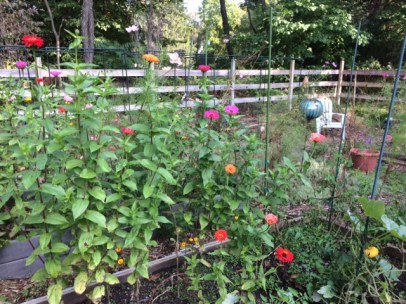
It’s October and no frost yet, so the garden is still producing. The tomatoes are slowing down with decreasing hours of daylight, but the zinnias and cosmos are in their usual autumn glory, lording it over the faded bee balm, the sleeping shastas. Even the phlox has gone to seed. img_1198How have they managed this in the short time since I set them out in the garden?
The passage of time is indisputable, but subjective. When my son was small he told me he had noticed that time went fast when he was having fun, but slowly when he was doing something boring. He wanted to find a way to fool his time sense into doing it the other way around. My own approach to this problem is to try to inject a little of one into the other – consciously savoring the good things while I’m immersed in them, which slows them but risks diluting the direct experience, and looking for a nub of goodness in the boring or bad ones, which can be pretty hard to find. I was taught this last approach by my father who, once when I was weeping on his shoulder over some undeserving high school boy, told me I should look for the good that might come out of that particular disappointment. I’m sure he was thinking, like finding out this guy is a jerk, but he was kind and suggested other possibilities. He was an engineer, and believed there were always parts in a broken thing that could be saved for future use.

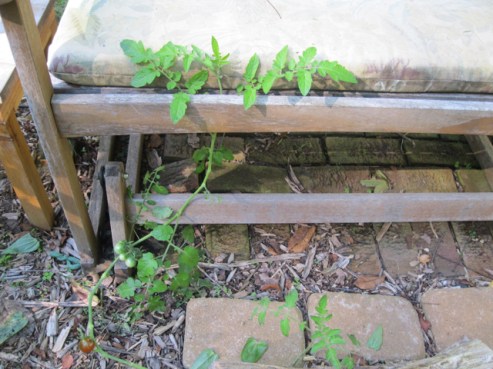
In the garden now, the cosmos and the fallen, burst cherry tomatoes are busy reseeding themselves. Next summer they will come up, as they did this year, in the pathways and nooks between raised beds, adding unplanned delight and useful fruit and flowers to my yard. They are the final touch, the grace note, and in their ripeness and tumble, in the late light on over-ripe produce and nodding, tall, tall flowers, I hear a phrase from a favorite opera: “Oh perfect moment, stay,” the words of a mad philosopher when he finally hears the band of angels singing.

Late September

This is the time of year when my garden is lush, gloriously overgrown, Baby Boo pumpkins climbing the asparagus fern, self-seeded cosmos tall, blushing pink, waving its feathery leaves in my face as I try to untangle the roller-coaster tomato vines plunging from their support towers to the ground and back up again, roses woven with thyme, zinnias rocketing out of the cilantro, and volunteer cherry tomatoes springing up in comical places. You can’t tell the raised beds from the mulched paths because everything is knee-deep in leaf and tendril.

6 a volunteer.jpg

Don’t sit on the glider for a week, see what happens

It is more opulent than it has been all summer, and it’s at this very moment that the first red leaf drifts down from a wild cherry tree, just to let me know that frost could come any time.

Climate change has shifted this part of Michigan from Zone 5b to Zone 6a, the average minimum temperature up a notch, and the average first frost receding a bit further into October. But those are averages, not guarantees. There are many green tomatoes still on the vines, and if I don’t want them to turn to mush I need to watch the weather forecasts and be ready to bring them indoors before a frost, while they’re still firm and whole.

I learned this the hard way, having had no experience with it in California. My first year gardening here I was into protecting them, throwing sheets over the tops of the vines to ward off the cold and keep them going. This was too hard – see above description of tangled tomato vine riot. I do have one cold frame where I grow cherry tomatoes (thank you, Doug), and I can roll the vines up into loose wreaths, tuck them in, close the lid, and harvest cherry tomatoes for a couple more weeks. The other tomatoes stayed on the vine, where indeed they turned into mush. Too sad. The next year I watched the weather more carefully, and at the critical moment gathered them up and brought them inside. There I found that they continued to ripen though off the vine. The result was not as good as the garden-ripened ones, but was still better than store-bought. Besides, they were my own little darlings!

Meanwhile, I am channeling my Texas mother’s way with fried green tomatoes. I haven’t quite re-created it yet, but with every autumn I come a little closer.


Visit to a Neighbor’s Farm

Today my garden group went to a local farm operated by a community of Tibetan Buddhists. They were not, said our guide, ascetic; rather, they believed in appreciating what we perceive through our senses, the pleasure and beauty of everything around us. Their gardens, both the formal and the informal, were beautiful, bounteous, even scenic. IMG_0793.JPGThey had happy goats. They grew produce in raised beds, and sponsored art shows and poetry readings on the lawns. A young fellow was double-digging row after row of raised beds with a big, cheery smile on his face.

Our guide himself was an artist as well as a gardener, and had painted a magnificent mural of buddhas in the large and airy shrine, upstairs in the second barn. There were other artists at the farm, too, and it was graced with stonework, bronze sculptures, wooden shelters, Monet arches with clematis being trained over them, a pond full of koi. The fish wintered over in the pond, but had to be protected from mink that came looking for them. Mink! Little luxury coats, just slinking around right out in the open!

Michigan is farm country, however much the rest of the nation thinks of it as Detroit and cars, and Ann Arbor is quite a foodie town, in no small part due to access to high-quality, local-transit fresh food. I hadn’t realized this because, first of all, I thought it was all corn, and second, well, winter. But it’s not just produce – it’s beef raised eating grass in fields, eggs and chickens from actual barnyards, cheese from happy goats like these. img_0801Once in my small, locally-owned grocery store, I saw a group of Amish farmers – to tell by their clothes – sitting in the small cafe area, talking to the store manager. It was February; they were talking about what crops sold well the year before, and what therefore they should plant for the coming season. This is “local” in action.
For more on the Buddhist farm, see http://whitelotusfarms.com

September Morn

In spite of the fact that I never liked school, that the flowers and tomatoes will soon be shutting down, and that the long hours of daylight are fading fast, I always get this happy feeling of a new year starting in September. I didn’t like school, but I loved going shopping for new school supplies. The smell of freshly-sharpened pencils is right up there with the scent of apple cider in my pantheon of childhood memories, and the remembered delight of shuffling through fallen leaves obscures my negative feelings for the tedious and boring child-warehouse to which I was shuffling. A lot of what I didn’t like about school was that it constrained or separated me from these things – these glorious things.

Because poets love things. “No ideas but in things,” said William Carlos Williams. “A thing of beauty is a joy forever,” said John Keats. Pablo Neruda wrote Ode after Ode to “Common Things.” The thing you can grasp in your hand, the sum of all the effort that went into making it, illuminates it into metaphor, which turns and magnifies it back.

Look, for instance, at these things growing in my garden. I put some seeds into some dirt a few months ago, and for weeks now I’ve been eating the results: yellow summer squash and tomatoes. They look nothing like the dirt. Yellow? Red? Where did that come from? But when I slice them open, there are the seeds inside, like a memory. They are things of dirt, air, seed, water, and care. We eat them unthinkingly, because if we had to pay attention to every commonplace miracle as it happened, our heads would explode. It is necessary, or mostly necessary, to walk through the world with a sort of miracle filter between us and it. This goes for the human-made world as well as for the natural one. We tell each other our thoughts across greater and greater distances, not only expecting this as our due, but being mildly outraged when it fails.

As a gardener and a poet, I volunteer against this onrush of nonchalance, risking soundness of mind in the service of appreciation of the world.

Footprints and Bitemarks

Every morning I go out into the yard to check for signs of late night and early morning visitors. The tomato plants are safely installed behind wooden fencing and chicken wire, but most of the yard is open to all comers. With the help of some Michigan field guides I’ve learned to inventory the damage:

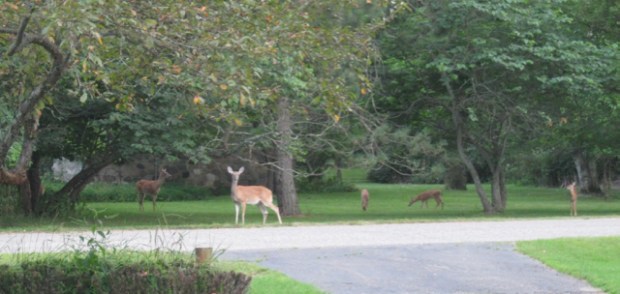
Deer: heart-shaped footprints, often placed daintily between plants without mussing them; chewed stems and leaves look like they were attacked by a kindergartener with dull scissors.

Rabbit: stems look like they were carefully sliced through by a master chef or ikebana expert in one clean, diagonal cut.

Woodchuck: stems, leaves, and flowers are not just bitten off, but wallowed over. Damage includes general crushing, as well as broken stems of innocent bystander plants.

Equally as interesting is discovering what the animals don’t eat. I spent much of my first Michigan growing season believing that sellers of so-called deer-and-rabbit-proof plants were blatant liars, but eventually I realized there’s just no accounting for taste. One deer’s nasty medicine is another deer’s caviar. I learned from a friend who lived in the foothills in California that to know what the animals in your yard will eat, you need a test kitchen: buy just one each of the things you hope to plant, set them out where the critters will find them, and wait a few days. The truth will out.

deer 2 cropped

Highest on the Inedibles List of my local herbivores are, in fact, herbs – thyme, sage, basil, oregano, those scented things we humans use to enhance the flavor of our other foods. These apparently trigger disgust in deer and rabbits. It’s amusing that they’re repelled by things we might cook them with. No sense pre-seasoning themselves.

herb garden

The Herb Garden


Keeping Tomato Faith

Every year in July there comes a day when I am convinced my tomato plants are not going to be productive. I see their struggles with weather, chipmunks, birds, bugs, and weeds, I count how few of them are on the vines, and I sigh to think this is the year when there will not be a whole lot of tomato sauce in the freezer.

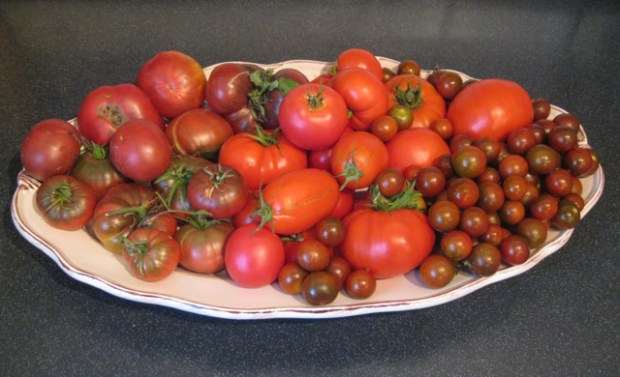
Every year in August I have enough tomatoes to pave the kitchen floor. The two chipmunks spent most of their time fighting each other; the birds ate the bugs; the weeds were not that hard to keep up with; and I didn’t see many tomatoes because they were still small and green and hidden under leaves. They grew, they ripened, and here they are. Oh tomatoes, I am so sorry to have doubted you. Please accept this poem as an apology.rolling in