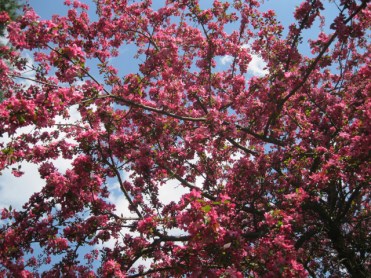
 The yard is so beautiful right now, it’s a pleasure to be out there even if pulling garlic mustard. Petals of crabapples and pears drift down on me while I kneel, and it’s only by getting down to ground level that I see all the wonderful, desirable things muscling their way up. I know I planted some of them in the fall, but many of my markers have been heaved up by frost or hoofed up by deer, so I’ll just have to wait and see what’s where.
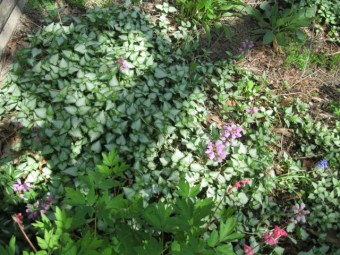
lamium
I always try to get something else to establish when I pull out garlic mustard, and some of what I planted has turned out to be excellent at holding undesirables at bay: nepeta and lamium especially. Nepeta is called catmint, but my cat has informed me that the variety I’m growing is not catnip as she knows it. Lamium is called deadnettle, but I ask you, would you ever willingly plant something called deadnettle? It’s too lovely for that name.
My third confusing, but flourishing, groundcover is plumbago. In Pasadena, plumbago was a fairly tall shrub with thick clusters of pale blue flowers, which did like to sprawl but was definitely not a ground cover. It was also definitely not cold hardy – in our quindecennial frosts it either died back or died altogether, depending on how well it was rooted. How could they sell plumbago in Michigan? It turns out there is a variety called ceratostigma plumbaginoides, which is cold-hardy. It is also delightful, coming up just when needed to cover the fading daffodil leaves, and having deep blue flowers in summer and bright red leaves in fall. It’s hard to believe the two plumbagos are related. Taken together with the catmint that’s not catnip and the deadnettle that’s not dead nor nettley, I’m wondering what they were smoking when they named all these plants.
Meanwhile in the upstairs window, 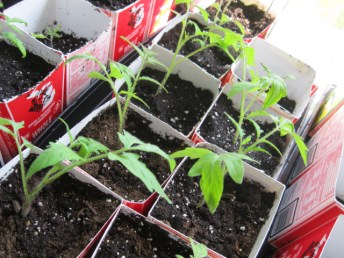 the tomato plants have started waving at me over the tops of their milk cartons: hello! Over here, person who calls herself a gardener! So I thinned them to one plant per container, and filled in around their stems with more dirt, almost to the cartons’ brims. They look happier now.
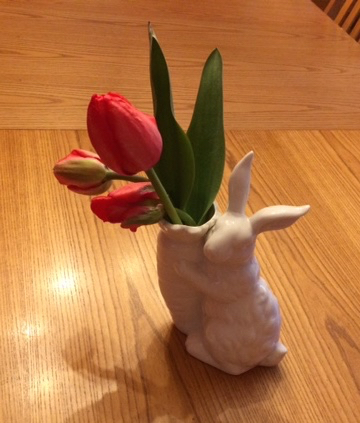 This is an experiment. It was suggested to me that, since the tomato beds are protected by the garden fence and are empty from fall through spring, I could plant tulips there and cut them for bouquets. The tulips would be done when I needed the beds for my tomato plants.
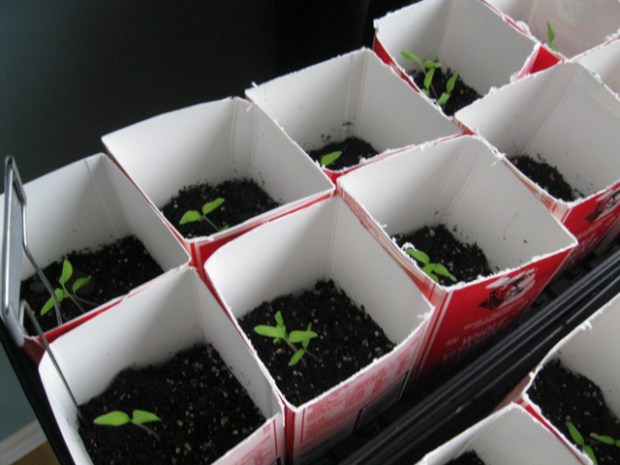 Spring is here; can bacon-lettuce-and-tomato sandwiches be far behind? Well, yes, but not very far behind.
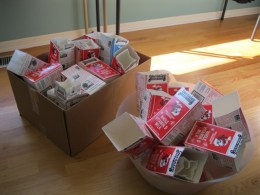 First step was to set up long folding tables in front of the big, sunny windows in my upstairs guest room, with trays on them to catch water. Next, I rounded up my collection of milk cartons. We began collecting the empty half gallon paper cartons in late summer, slicing off the tops, washing them out, and tossing them into a tub and a box in the garage, along with a few smaller
  containers. I carted these upstairs, and sat down to make drainage holes by sticking in a paring knife and twisting it, four holes per carton.
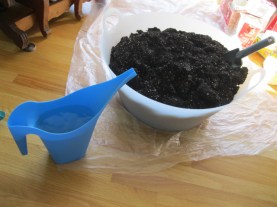 Any bag of potting soil that’s been sitting around a Michigan warehouse in winter will be pretty dry, so once it was in the tub I added a potful of water, and stirred it with my trusty trowel. I went down to the kitchen and fixed a cup of tea, to give it time to soak in.
 I’m getting my hands in it I think of it as dirt. Soiling yourself is what babies do in their diapers. Getting dirty means you’re having fun.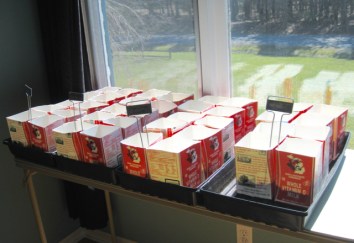

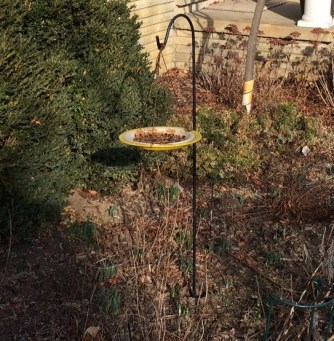 made of a paper plate in a plastic holder, smeared with peanut butter, sprinkled with birdseed, and suspended with three pieces of cord from whatever likely spot there was to hang it from.
 Robin Richstone