A nice big February snowstorm did roll in at last. Over the course of a few days it heaped and layered itself across the yard, stacked itself onto branches, mocked the cars, trucks, and buses trying to cruise around like they own the place, and wrapped


familiar objects in semi-disguise. Some features were emphasized and some obscured, recognizable, but surprizing.
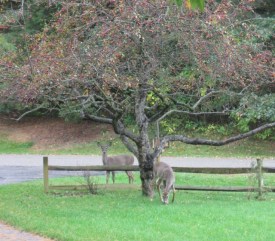
The drag-footed deer trails made the backyard look like a freeway map
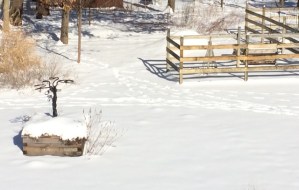
tracks of deer, not people
drawn by cross-country skiers, and a new track ambled in among the others: possum, a neat line of single-file prints despite her waddle.
And now I have learned one more incredible feature of Michigan snow: you can plant native wildflower seed by throwing it directly onto the snow in February. Amazing, right? But these are seeds that need freeze-thaw cycles to settle them in, and enough cold weather to recognize the change when spring comes. I had tried a fussy process called cold stratification, involving baggies, wet sand, and a freezer, but frankly I have enough mysterious baggies in my freezer without adding Jacob’s Ladder and Milkweed.
Then I got an email from Prairie Moon Nursery with a picture of a woman in a big down coat flinging handfuls of seed onto a field of snow. Do this until March,
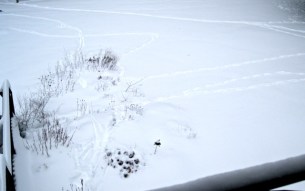
seeding site with amusing deer trails
it said. I had some packets of unstratified milkweed seed in hand, so out I went into the white, crunchy yard, where a cycle of thaw and freeze was expected to fill out the week. I didn’t have as much seed as the happy woman in the email, but it really was fun tossing it around like I was feeding imaginary chickens. In the imaginary barnyard. On the actual snow. I hope the neighbors weren’t watching.
I will let you know how this experiment turns out. I mean with the seeds, not with the neighbors.
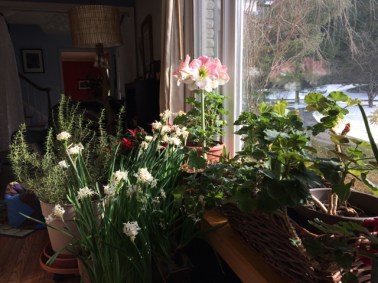 of the window, with my cup of cocoa and my indoor plants. The narcissus is about done and the amaryllis are starting. Geraniums, rosemary, and poinsettias are vacationing in their private tropical island, and will go home to the deck come May. But it’s that slice of snow you see in the middle distance that brings me a happy, settled sense that the world, despite all rumors to the contrary, is going on as it should.
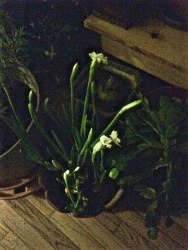 now? Their daffodil cousins are happy enough living outdoors, sleeping under a nice blanket of snow at the moment; but the paperwhites would die in the wilds of a Michigan winter. They are being coddled in here, with heat, and warm storebought soil, and water in its liquid state. They stretch luxuriantly toward the window. I may be waking them up, but no more than that. The force is theirs, not mine.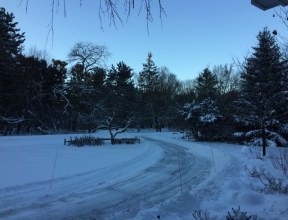

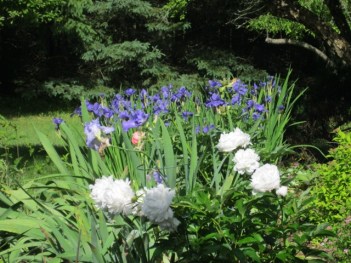 and thyme would stay green all winter; that deer didn’t eat fragrant herbs; and that it’s true, as they say, that the best thing for the garden is the shadow of the gardener. Not only did she give me advice, she also divided her peonies and gave me the divisions.
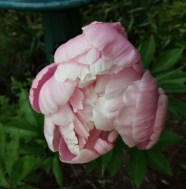 Kathy moved away from Ann Arbor to another place she loved, but she kept in touch with us. I saw her for the last time in the spring; this fall she died after an illness of a few months. But the world still holds her beautiful quilts; and the peonies she gave me are doing well, growing, and in their proper times still blooming, in my front yard.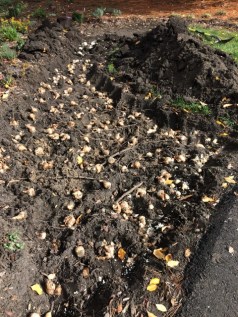
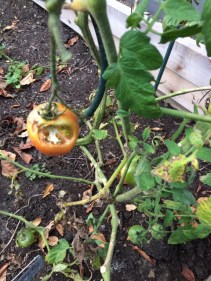
 October 26th. A frost advisory can lead to much agonizing – what to cut and bring in, what to cover and leave out – but this time it was clear. Harvest everything that was left, which wasn’t much. In the shortened hours of late October daylight very little was ripening anyway. I brought in my last armload of green and part-green tomatoes, and a few last cosmos and cornflowers, which looked oddly like William Morris wallpaper as they stood in their vase.
 the last remaining spot in the garden. He had offered to do this last spring, but I’d already planted the area in its unraised state so it had to stay as it was. Setting the bed up now would avoid timing issues next spring.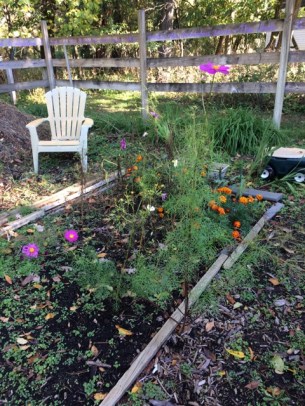

 Robin Richstone