 Things have brightened up considerably in the last two weeks. The forsythia have thickened up, and though temperatures are still skidding around like Olympic slalom wipeouts, it doesn’t seem to matter as much. The sun is up and working before I am in the morning, and didn’t set last night till about 8:30. Brightness rules.
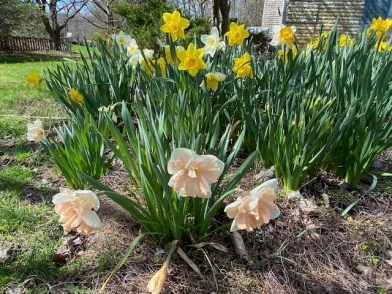 The early daffodils finally shook themselves out, and the less-early pink ones have joined them. Once again the flower buds of the grape hyacinths were nearly all nipped off before they could get an inch off the ground. This is apparently a rabbit delicacy. Since it’s only the flower bud, the plants come back every year. Alas, so do the rabbits. Although yesterday morning the neighbor’s outdoor cat, Mac, went sauntering across my backyard with a very young bunny in his mouth. Whenever Mac ventures into Zerlina’s sightlines, she throws a hissy fit. Cats, you know, invented hissy fits. But she was sleeping by the front window this time, so he escaped being chastised for poaching.
 Mac mostly sticks to the back yard. Meanwhile in the front yard, the birdbath sits near Zerlina’s window. She and I both like to watch it. Either I have lots of robins that like to bathe, or I have one robin that really, really likes to bathe. Here he is all puffed up from just having hopped out and taken a good shake. The cardinal, the mourning dove, the goldfinches, house finches, and chickadees also drink and bathe, but I’d say there’s a proportion of at least four or five robin-baths to each non-robin bath.
 Following the daffodils, the weeping cherry’s blooming now, too. This is the tree with the giant scar down the whole trunk, from a lightning strike before our time here. Every winter it loses another chunk of branch and we think, that’s it; every spring it comes back. It’s a favorite of bees, and the natural pruning process has given it many twisty angles that are popular sites for bird nests.
 You can see it again in the tomato photo. The seedlings are doing much better than they did last year, for no reason I can come up with. It’s still going to be two or three weeks before our last frost means they can go outside, so Doug cut some dowels for me and I staked them. They also have a better than average survival rate, so I will be giving some away. Not too many, though. I can never have enough tomatoes.
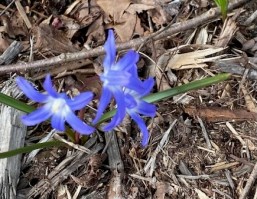 It’s been wet, cold, and windy, and my bulbs and flowering trees are a good two weeks behind schedule. The chionodoxa are coming out but the daffodils, even the early varieties, are holding back.
 I did scrounge up bigger pots for the seedling tomatoes upstairs, giving them all room to stretch their toes indoors while it warms up outside. Downstairs, the Cobra greenhouse tomatoes are just starting to get that little sheen that comes before ripening.
 While I was rearranging seedlings in the upstairs window, I looked down on what appeared to be off-season practice for Santa’s sled-pullers. It’s hard to tell from the photo, but they’re on the edge of a swale along the roadside. What they found there was either extra delicious or the only thing growing yet, because they stayed at it until an approaching car made them scatter. At which point they all ran in different directions, including straight at the car, which fortunately did not veer into the swale. Once they were gone I went out to see what the Deer Yummy was, so I could avoid planting any of it. Moss.
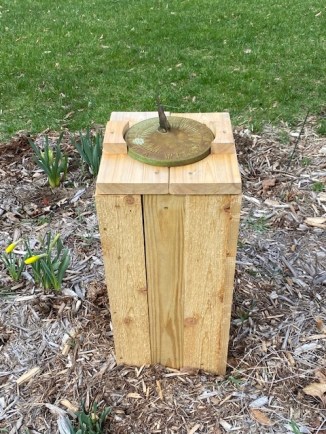 It was drier and more pleasant outside today. We set up my sundial on the new plinth Doug made for it. You can’t use a watch to set up your sundial, especially not in Ann Arbor, which sits well to the west in its time zone. Clock time jumps an entire hour every 1000 miles or so, but the sun doesn’t hop like that. It’s on a nice, smooth roll (or rather, the turning earth is). Then there’s Daylight Savings time, which means nothing to a sundial. You need to line up the gnomon on a sundial with true north, which is not the same as magnetic north. You can get true north by pointing at the North Star, but not in the afternoon. You can put a plant stake in the ground, watch for its shadow to show the sun directly overhead, and line up your sundial for noon. Neither of these methods work on a day full of dancing clouds. So I hover with my watch, and in a fleeting flash of sunlight subtract about 40 minutes for the time zone and another hour to get back to Standard Time, and twist the sundial into agreement. Will have to consult with stars and shadows when the weather clears up.
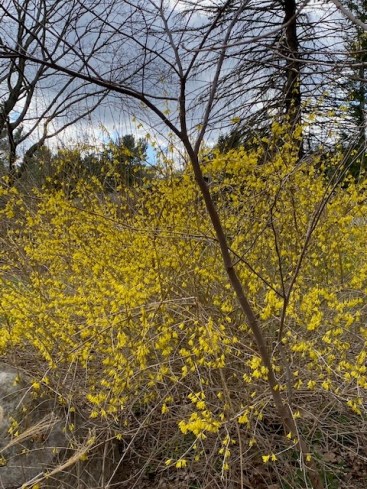 Meanwhile, I realized that my forsythia was blooming while mostly obscured by the plumes of last summer’s zebra grass. Since native solitary bees hibernate in the tall stalks of the grass, I don’t cut them down until a few things are flowering for the bees. Doug came out with the electric hedge trimmer and gave the zebra grass a buzzcut. I spread the fallen stalks around, unchopped, in case any bees were sleeping late. The forsythia was gorgeous against the moody sky.
 Michigan Spring continues making fun of itself. We had a run of 60 degree days interrupted by 30 degree days, but the plants in the yard took all this in stride. The hellebores are very happy.
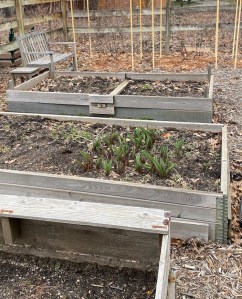 Doug and I took advantage of a warm day to inspect the fenced garden. The tulips, safe from deer, are getting ready to provide bouquets for me. We found several broken places in the chickenwire that need replacing, and the clematis trellis was tilted at an alarming angle. I cut the autumn clematis to the ground, leaving three or four strong-looking stems at about 15 inches high, and we righted the trellis. Don’t try this with a spring bloomer, or you’ll be removing flowerbuds. Autumn clematis blooms on the new growth it produces in the summer.
 Doug had patched up my garden bench as needed over the years, but for my birthday he built me a new one. It spent the winter in the basement, waiting for its moment to emerge into the sunlight like a big wooden butterfly. We brought it upstairs in three pieces, and he assembled it on the spot. It is shiny and glorious, and now sports a few appropriate objects. Also the spare propane tank for the grill, which has to live somewhere.
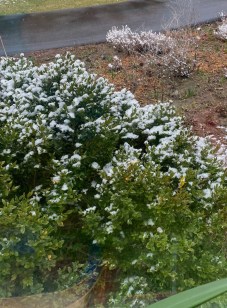 Then another round of snow appeared, wet and fragile but snow nonetheless. It looked very like flowers on the hedges outside my window.
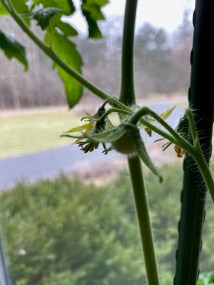 On the inside of the same window, the Cobra greenhouse tomato seedlings are four feet tall and blooming. Since there’s no wind and no bugs – or, no suitable bugs – inside the house, I help the flowers set fruit by tickling them. They like that. One infant tomato has already appeared.
 The outdoor tomatoes are doing well in their new experimental trays. They look droopy here, but it’s because I’d just turned the trays. The plants had developed a severe lean toward the glass in an unexpectedly short time — I have to remember to rotate them more frequently. I’m used to growing them in those big cardboard milk cartons, letting them get pretty big before they go outside. I can see that in these smaller circumstances they’re likely to run out of rootspace before outside time comes. I’ll need to scrounge up some bigger containers, and maybe start them later next year.
 The snow that’s left now lies mostly in disconnected curves and crescents, where our plow service banked its savings at the ends of the driveway and cleared a space to the mailbox. This plowing is done by a woman who is a landscaper in the summer half of the year, and it shows in the careful edges of her beautiful plowing. Then the county street plow comes along and throws the sandy, icy detritus from the road all over her beautiful work. Then the mailman, who in this case is a mailwoman, leaves a note in the mailbox pointing out that she can’t drive right up to it and that this won’t do. So then Doug goes out with a snow shovel and moves the road snow somewhere inoffensive.
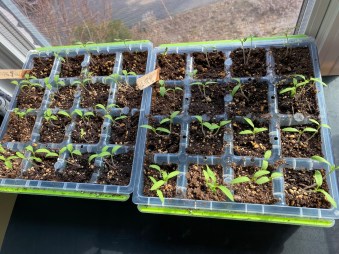 I can see from the upstairs window that he won’t have to do that again this season. I’m tending my seedlings in their new, experimental pots, because during the pandemic we switched to getting milk delivered in glass bottles, so I no longer have all those paper cartons for seed starting. Last year I had a motley bunch of trays, but this year I bought some very fancy, reusable silicone potting sets. I’m going to see how they compare to the empty egg cartons and random leftover bedding pots I had lying around.
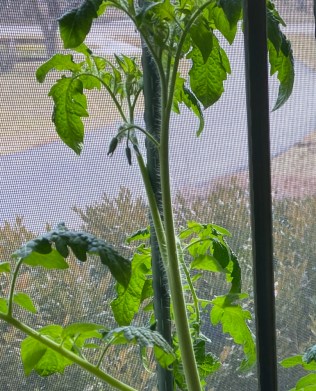 The indoor Cobra tomatoes I started in big pots in the window downstairs are two feet tall now, and developing their first flowers. I calculate this means tomatoes by Memorial Day. Maybe next year I’ll start them earlier and have tomatoes for, oh, Mardi Gras or something. I’ll put on my green and purple glass beads and have a BLT with my paczki.
 Speaking of Lent, Hellebores are also called Lenten Roses, since they bloom at the appropriate time. Mine are a little late starting this year, but there’s still plenty of Lent left for them to catch up. I went out this afternoon to cut away some of the old leaves, and this as my reward. Hello, little flowers. Little signs of hope. Welcome to the needy world.
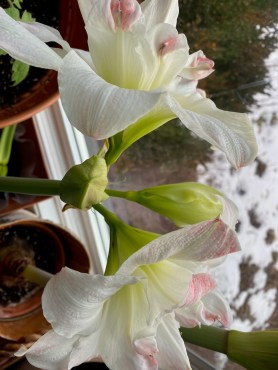
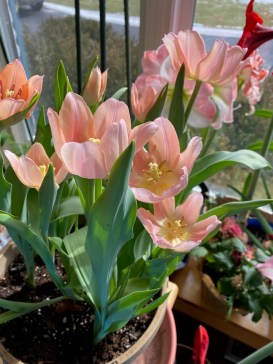 I have many lovely photos of my flowering amaryllis and tulips, blooming on the windowsill in this unaccountably mild early March. I planned to write about them, their colors, how the pink of one brings out the coral tones of another, but I’m having trouble concentrating on their peace and beauty while the news of war, burning through the snow in Ukraine, simmers underneath the Word window on my laptop.
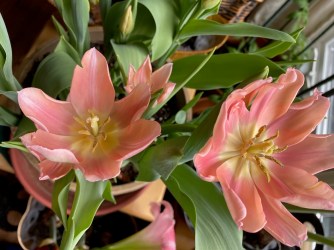 There was a picture in the news this morning of the entrance to a Ukrainian embassy, piled high with flowers, the universal offer of comfort and condolence. These were mostly blue and yellow, the colors of Ukraine’s flag. I have many yellow daffodils and blue forget-me-nots still deep in their winter sleep in my front yard. They’re hardy, and will rise and bloom no matter what is thrown at them. Snow. Sleet. Freeze-thaw-freeze. No matter what, they work their way toward the surface and bump the leafmold out of the way.
 Today in Ann Arbor the snow is in full retreat under a sunny sky and 48 degrees. This is a temperature that would feel cold to me if it rolled through in July, but today I walked outside in my flannel shirt, no jacket. Cold measured by a thermometer is absolute, but cold against the skin exists in relation to other things. We live in a layered world, where beautiful things and terrible things bump up against each other. Sometimes the best you can do against the terrible ones is to try to keep the beautiful ones on top.
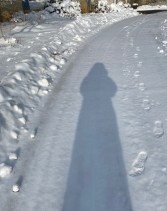 It is February. It is cold. Things are frozen.
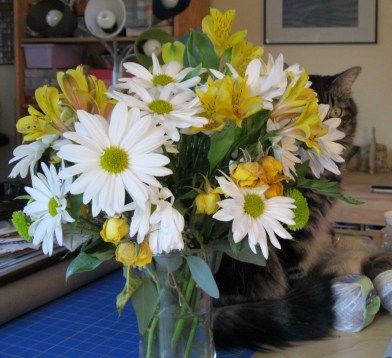 Today begins the Chinese Year of the Tiger. Reading up on it, I found tigers described as brave, confident, strong, and energetic, while at the same time strong-willed, opinionated, craving attention, preferring to give orders rather than take them, and able to go from fiery to calm in the blink of an eye. This describes my tiger cat Zerina so perfectly, I think it’s likely it was written by someone with a housecat. How many people can have been close enough to a full-size, actual tiger, to have known those things about it? So instead of garden advice, here’s a meditation on cats, as inspired by my own small tiger.
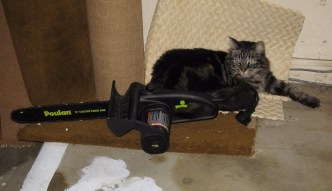 Cats are known for hunting even when they’re not in need of food. Why would they waste energy doing this? Maybe because for ten thousand years people trying to keep birds and rodents from eating our stored grain harvests reacted to hunter cats with “good kitty, come sit by the nice warm fire.”
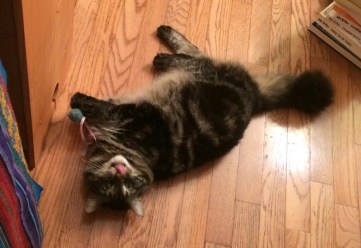 Even today in the suburbs, someone with mice in the kitchen will think of getting a cat. How do you know you’ve got a good mouser? When Zerlina kills a mouse, she carefully lays it out where I will find it. The cat that’s a good mouser makes sure you know about it. I doubt the Big Tigers care whether people appreciate their hunting skills, which since they include us as prey, we don’t.
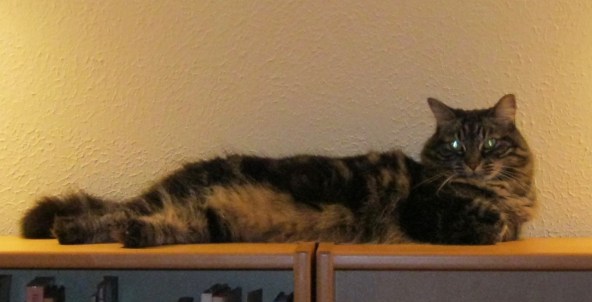 Here’s an interesting point of contact between East and West felines. In the Chinese Zodiac, I’m told, Tigers symbolize immortality. In the West we say cats have nine lives. Less grand for cats than for tigers, but a similar acknowledgement of what? Of their lithe and slinky ability to move without our noticing, so we think they’re gone and suddenly, there they are? When it happens in the dark, with their glowing eyes, it’s startling enough from a cat. From a tiger it must be terrifying.
 Cats are the most popular pet in most parts of the world, but dogs are more popular in the U.S. This is interesting because cats, like tigers, are known for their independence, a trait Americans supposedly prize. Dogs are said to be admired for their loyalty – not a cat/tiger trait – but why then are dogs the paradigm in slurs, and cats in accolades? A cat is cool; a dog, especially a female dog or the son of one, is despicable.
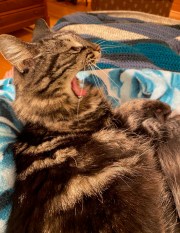 And true to her independent nature, this is Zerlina’s reaction to my opinions about her.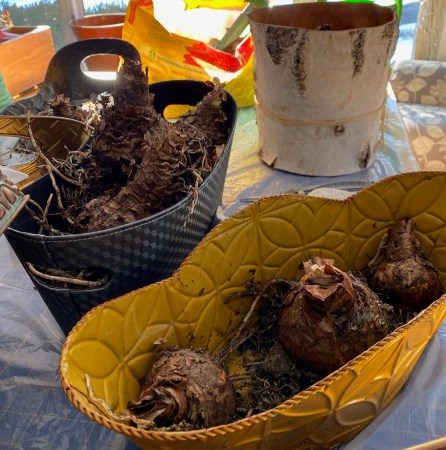
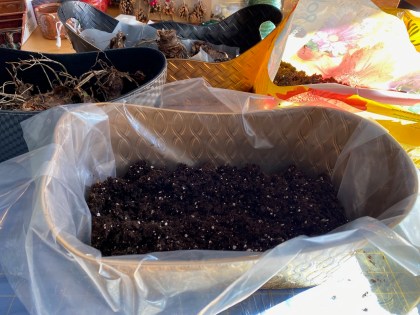 Drape your plastic into your container, folding the corners sort of like you’d fold the corners of a bedsheet, and pleating and tucking around curves. Put in a couple of inches of potting soil, nestle your bulb or bulbs into that, and add soil to about halfway up the bulb. This will anchor the plastic so that you can now trim it off at the rim of the container – or lower, as you choose.
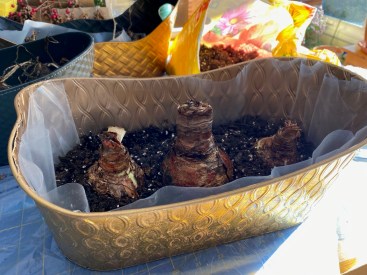 Just be sure to leave enough liner standing above the soil so when you water the bulbs the water doesn’t slosh into the space between container and liner. Which would be really annoying after you’ve messed with all this plastic. Halfway up the bulb is all the soil you need. Water your containers carefully, remembering there’s no drainage. On the other hand, if you’re doing this indoors in someplace like Michigan in winter, the air in the house is dry enough to suck up a lot of moisture, so watch that they don’t dry out.
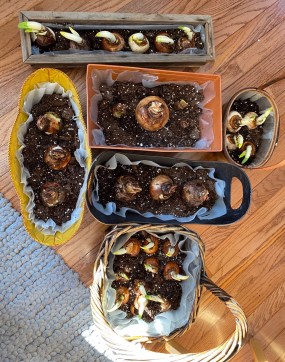 container at the top is a favorite. It was given to me, planted with bulbs, by my dear friend Barbara more than thirty years ago. It’s been repaired, relined, has traveled across country, and has spent its summers on the shelves of various garages. But every January I bring it out and settle it with paperwhite narcissus bulbs, and I think of Barbara. When they bloom, all in a row like that, they’re a line of poetry.
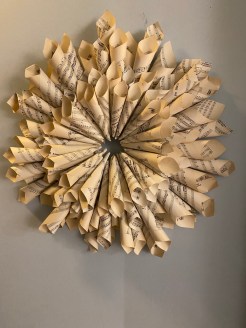 I am honored to say that Maria Newman has set one of my poems, “The Theory of Art,” originally published in American Scholar, as the fifth movement of her new work, “Six Canzonettas.” The premier performance was on December 28th. The link is
  The snow has melted again, but the yard has clearly shifted into winter landscape. The zebra grass has gone blonde, the birch tree displays its fine bone structure, and random shallow holes speckle the ground where squirrels are able to stash a few last walnuts, chestnuts, or acorns in the still-green lawn.
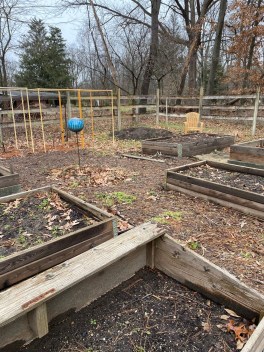 Out in the fenced garden the raised beds are asleep, tulip bulbs tucked in against spring rabbits. The blueberry nets have abandoned their frames to spend a quiet winter curled up in the garage. Too cold for the cold frame, so we’ve taken the lid inside to protect it – or rather, to protect the hinges from the ripping power of winds.
 The green that lingers longest is also the one that comes back first. I tried last spring to establish hellebore in the hat of my Green Lady, who sits on the north side of my garage. Nothing happened until November, when the sprout appeared that became this lovely sprig. It will continue green as winter goes on, but by the time it’s looking really weather-beaten in early March, it will shrug, brighten back up, and bloom.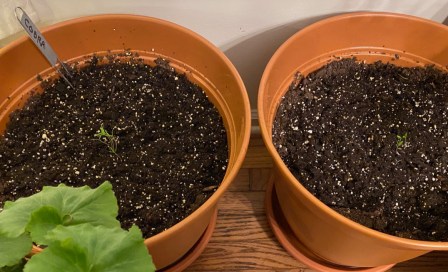
 Robin Richstone