 Michigan Spring continues making fun of itself. We had a run of 60 degree days interrupted by 30 degree days, but the plants in the yard took all this in stride. The hellebores are very happy.
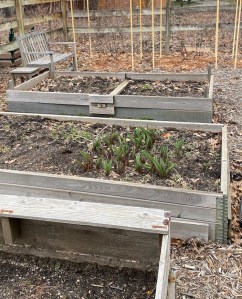 Doug and I took advantage of a warm day to inspect the fenced garden. The tulips, safe from deer, are getting ready to provide bouquets for me. We found several broken places in the chickenwire that need replacing, and the clematis trellis was tilted at an alarming angle. I cut the autumn clematis to the ground, leaving three or four strong-looking stems at about 15 inches high, and we righted the trellis. Don’t try this with a spring bloomer, or you’ll be removing flowerbuds. Autumn clematis blooms on the new growth it produces in the summer.
 Doug had patched up my garden bench as needed over the years, but for my birthday he built me a new one. It spent the winter in the basement, waiting for its moment to emerge into the sunlight like a big wooden butterfly. We brought it upstairs in three pieces, and he assembled it on the spot. It is shiny and glorious, and now sports a few appropriate objects. Also the spare propane tank for the grill, which has to live somewhere.
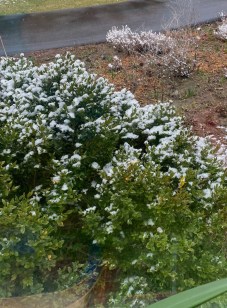 Then another round of snow appeared, wet and fragile but snow nonetheless. It looked very like flowers on the hedges outside my window.
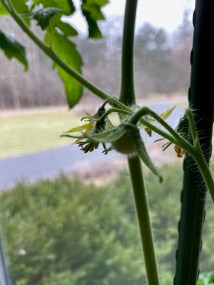 On the inside of the same window, the Cobra greenhouse tomato seedlings are four feet tall and blooming. Since there’s no wind and no bugs – or, no suitable bugs – inside the house, I help the flowers set fruit by tickling them. They like that. One infant tomato has already appeared.
 The outdoor tomatoes are doing well in their new experimental trays. They look droopy here, but it’s because I’d just turned the trays. The plants had developed a severe lean toward the glass in an unexpectedly short time — I have to remember to rotate them more frequently. I’m used to growing them in those big cardboard milk cartons, letting them get pretty big before they go outside. I can see that in these smaller circumstances they’re likely to run out of rootspace before outside time comes. I’ll need to scrounge up some bigger containers, and maybe start them later next year.
 The snow that’s left now lies mostly in disconnected curves and crescents, where our plow service banked its savings at the ends of the driveway and cleared a space to the mailbox. This plowing is done by a woman who is a landscaper in the summer half of the year, and it shows in the careful edges of her beautiful plowing. Then the county street plow comes along and throws the sandy, icy detritus from the road all over her beautiful work. Then the mailman, who in this case is a mailwoman, leaves a note in the mailbox pointing out that she can’t drive right up to it and that this won’t do. So then Doug goes out with a snow shovel and moves the road snow somewhere inoffensive.
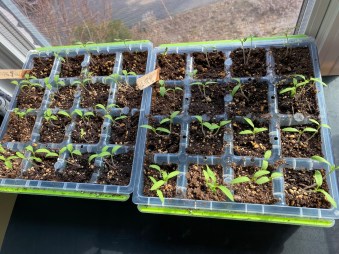 I can see from the upstairs window that he won’t have to do that again this season. I’m tending my seedlings in their new, experimental pots, because during the pandemic we switched to getting milk delivered in glass bottles, so I no longer have all those paper cartons for seed starting. Last year I had a motley bunch of trays, but this year I bought some very fancy, reusable silicone potting sets. I’m going to see how they compare to the empty egg cartons and random leftover bedding pots I had lying around.
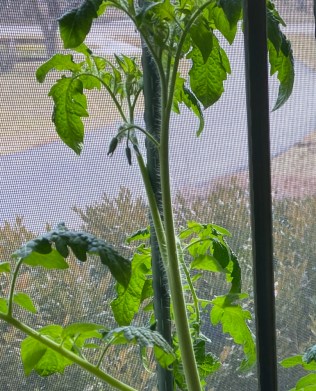 The indoor Cobra tomatoes I started in big pots in the window downstairs are two feet tall now, and developing their first flowers. I calculate this means tomatoes by Memorial Day. Maybe next year I’ll start them earlier and have tomatoes for, oh, Mardi Gras or something. I’ll put on my green and purple glass beads and have a BLT with my paczki.
 Speaking of Lent, Hellebores are also called Lenten Roses, since they bloom at the appropriate time. Mine are a little late starting this year, but there’s still plenty of Lent left for them to catch up. I went out this afternoon to cut away some of the old leaves, and this as my reward. Hello, little flowers. Little signs of hope. Welcome to the needy world.
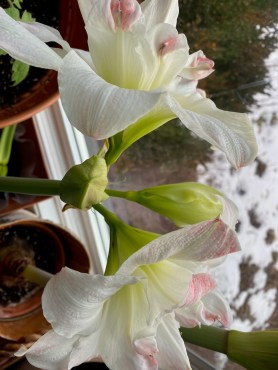
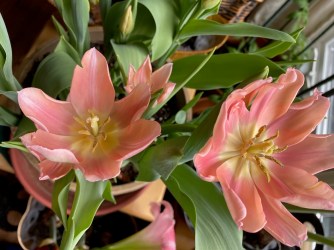
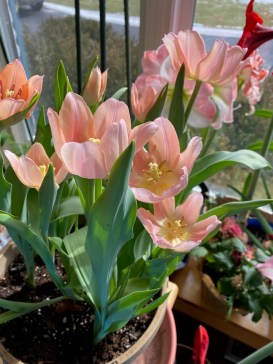 I have many lovely photos of my flowering amaryllis and tulips, blooming on the windowsill in this unaccountably mild early March. I planned to write about them, their colors, how the pink of one brings out the coral tones of another, but I’m having trouble concentrating on their peace and beauty while the news of war, burning through the snow in Ukraine, simmers underneath the Word window on my laptop.
 There was a picture in the news this morning of the entrance to a Ukrainian embassy, piled high with flowers, the universal offer of comfort and condolence. These were mostly blue and yellow, the colors of Ukraine’s flag. I have many yellow daffodils and blue forget-me-nots still deep in their winter sleep in my front yard. They’re hardy, and will rise and bloom no matter what is thrown at them. Snow. Sleet. Freeze-thaw-freeze. No matter what, they work their way toward the surface and bump the leafmold out of the way.
 Today in Ann Arbor the snow is in full retreat under a sunny sky and 48 degrees. This is a temperature that would feel cold to me if it rolled through in July, but today I walked outside in my flannel shirt, no jacket. Cold measured by a thermometer is absolute, but cold against the skin exists in relation to other things. We live in a layered world, where beautiful things and terrible things bump up against each other. Sometimes the best you can do against the terrible ones is to try to keep the beautiful ones on top.
 It is February. It is cold. Things are frozen.
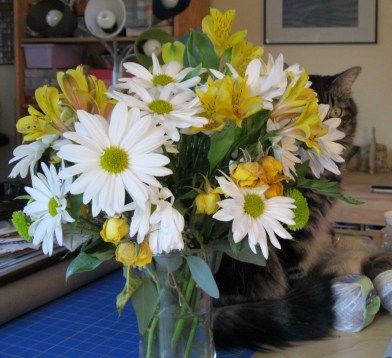 Today begins the Chinese Year of the Tiger. Reading up on it, I found tigers described as brave, confident, strong, and energetic, while at the same time strong-willed, opinionated, craving attention, preferring to give orders rather than take them, and able to go from fiery to calm in the blink of an eye. This describes my tiger cat Zerina so perfectly, I think it’s likely it was written by someone with a housecat. How many people can have been close enough to a full-size, actual tiger, to have known those things about it? So instead of garden advice, here’s a meditation on cats, as inspired by my own small tiger.
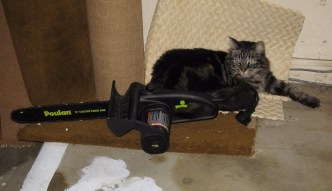 Cats are known for hunting even when they’re not in need of food. Why would they waste energy doing this? Maybe because for ten thousand years people trying to keep birds and rodents from eating our stored grain harvests reacted to hunter cats with “good kitty, come sit by the nice warm fire.”
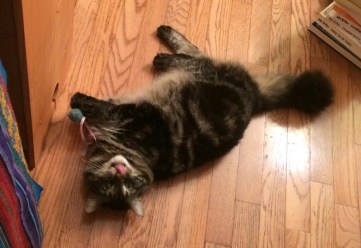 Even today in the suburbs, someone with mice in the kitchen will think of getting a cat. How do you know you’ve got a good mouser? When Zerlina kills a mouse, she carefully lays it out where I will find it. The cat that’s a good mouser makes sure you know about it. I doubt the Big Tigers care whether people appreciate their hunting skills, which since they include us as prey, we don’t.
 Here’s an interesting point of contact between East and West felines. In the Chinese Zodiac, I’m told, Tigers symbolize immortality. In the West we say cats have nine lives. Less grand for cats than for tigers, but a similar acknowledgement of what? Of their lithe and slinky ability to move without our noticing, so we think they’re gone and suddenly, there they are? When it happens in the dark, with their glowing eyes, it’s startling enough from a cat. From a tiger it must be terrifying.
 Cats are the most popular pet in most parts of the world, but dogs are more popular in the U.S. This is interesting because cats, like tigers, are known for their independence, a trait Americans supposedly prize. Dogs are said to be admired for their loyalty – not a cat/tiger trait – but why then are dogs the paradigm in slurs, and cats in accolades? A cat is cool; a dog, especially a female dog or the son of one, is despicable.
 And true to her independent nature, this is Zerlina’s reaction to my opinions about her.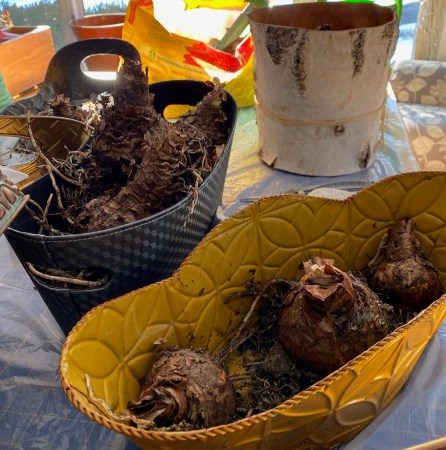
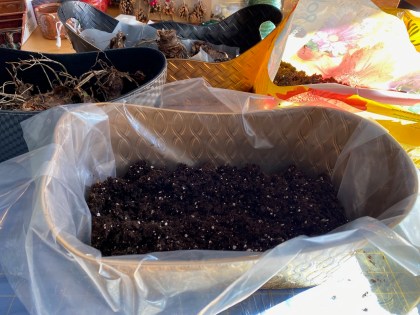 Drape your plastic into your container, folding the corners sort of like you’d fold the corners of a bedsheet, and pleating and tucking around curves. Put in a couple of inches of potting soil, nestle your bulb or bulbs into that, and add soil to about halfway up the bulb. This will anchor the plastic so that you can now trim it off at the rim of the container – or lower, as you choose.
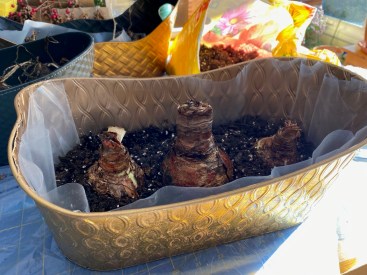 Just be sure to leave enough liner standing above the soil so when you water the bulbs the water doesn’t slosh into the space between container and liner. Which would be really annoying after you’ve messed with all this plastic. Halfway up the bulb is all the soil you need. Water your containers carefully, remembering there’s no drainage. On the other hand, if you’re doing this indoors in someplace like Michigan in winter, the air in the house is dry enough to suck up a lot of moisture, so watch that they don’t dry out.
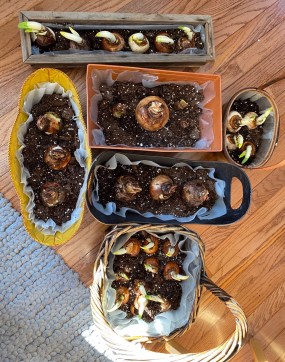 container at the top is a favorite. It was given to me, planted with bulbs, by my dear friend Barbara more than thirty years ago. It’s been repaired, relined, has traveled across country, and has spent its summers on the shelves of various garages. But every January I bring it out and settle it with paperwhite narcissus bulbs, and I think of Barbara. When they bloom, all in a row like that, they’re a line of poetry.
 I am honored to say that Maria Newman has set one of my poems, “The Theory of Art,” originally published in American Scholar, as the fifth movement of her new work, “Six Canzonettas.” The premier performance was on December 28th. The link is
  The snow has melted again, but the yard has clearly shifted into winter landscape. The zebra grass has gone blonde, the birch tree displays its fine bone structure, and random shallow holes speckle the ground where squirrels are able to stash a few last walnuts, chestnuts, or acorns in the still-green lawn.
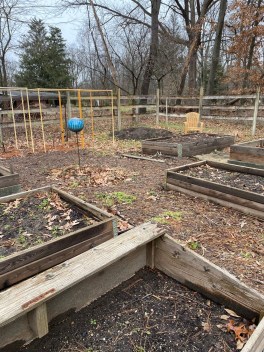 Out in the fenced garden the raised beds are asleep, tulip bulbs tucked in against spring rabbits. The blueberry nets have abandoned their frames to spend a quiet winter curled up in the garage. Too cold for the cold frame, so we’ve taken the lid inside to protect it – or rather, to protect the hinges from the ripping power of winds.
 The green that lingers longest is also the one that comes back first. I tried last spring to establish hellebore in the hat of my Green Lady, who sits on the north side of my garage. Nothing happened until November, when the sprout appeared that became this lovely sprig. It will continue green as winter goes on, but by the time it’s looking really weather-beaten in early March, it will shrug, brighten back up, and bloom.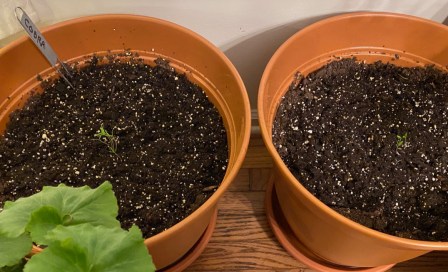
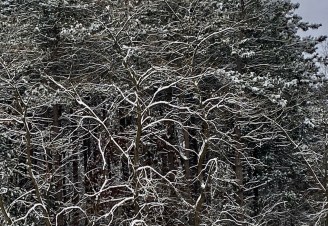 The first full-coverage snowfall lifts the heart in a way the snows of March just cannot do. Everything was green, and now it’s white – isn’t that miraculous? The yard that was looking a tad ratty is now glorious with fairy lace. It’s beautiful, and I expect that of snow. But it does other things that are more surprising.
 For example, one look at the snow and it’s clear I am not seeing most of what the deer are up to. Look at all the traffic! It’s a deer parade ground out there. The path from house to garden gate has been picked out by the snow, but all the other trails were made by deer. They sort of drag their toes as they walk, making the characteristic little swoop as they go. From closer up you can see their heart-shaped hoof prints stamped into each step.
 Where were they going? Over here, apparently. Their trails go in and out of a cozy, secluded sleeping spot under thick evergreens.
 Snow also does a forensic on the weeping cherry. That’s a most un-treelike right angle, there, and whatever was once at the narrow end of it has broken away. These branches overhang the driveway. Hmmmm. Thanks for letting me know about that, snow.
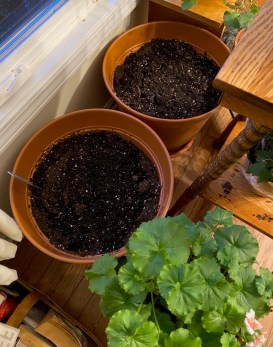 Meanwhile on the other side of the windows, the geranium has kindly made way for two much larger pots for a new crop of hothouse tomatoes. These pots are about twice as big as those in my first indoor tomato trial. Tomatoes will root deeply and be fairly drought resistant if you give them a chance. The small pots didn’t. I filled these with new potting soil and planted “Cobra” variety tomato seeds. The tomatoes will be nice and warm there, but still have a view of the snow, just like me. Progress reports will follow.
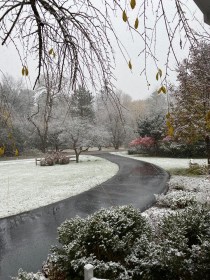 Doug put the snowstakes in early this year, a condition we always aspire to but seldom achieve. Viewing the result, however, he decided a few more were needed to keep the plow on track and off the lavender that edges the driveway. Or maybe he just likes the workout, hammering snowstakes into frozen ground. I see him smiling out there while he does it. He really is part polar bear, happy to be moving around in the cold. I was happy to stay inside and look out at him, and wave. Cheerfully, with my mug of hot cocoa in hand. And then we did get some snow, soft and wet and soon gone, which fooled no one.
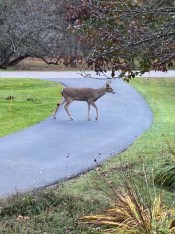 Signs of winter are all around. The deer that were traveling in small groups, maybe a pair of does with two or three fawns, or a couple of siblings past their spotted fawn stage but not yet into antlers or motherhood, began to consolidate. I’d see seven, then eight, then nine of them browsing for leftover black cherries and crabapples, a six point stag standing guard. The stag will stand behind the herd, and at the sound of danger he stays put while the rest of them run away. People sometimes think him a coward for not taking the lead, but though human hunters may lie in wait for deer, their natural predators give chase. The wolf, the coyote, come at the herd from behind, where they will meet the sharp, defending hooves of the stag.
 There’s very little to do outside now, but a few garden tasks have moved indoors. I get better repeat performance from my amaryllis if, after I bring them in, I lift them, clean them, and let them rest with a lot of air but not much light. I’ll pot them back up after Christmas, to have flowers of joy and enthusiasm when most needed. In February.
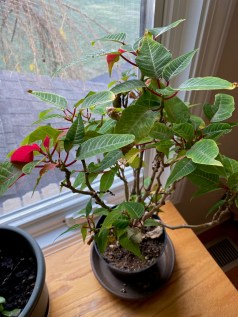 The poinsettias enjoyed their summer on the deck and came in full, green, and leafy, but the idea with poinsettias is to get them red for Christmas. For this, they need bright light for a short number of hours every day. The low Michigan sun in winter shines more directly into my south-facing windows than the high-flying summer sun does. Very bright light. I put the poinsettias in windows of rooms I don’t go into much – guest bedroom, formal dining room – so I don’t interfere with the natural hours of available autumn light by flipping switches.
 Meanwhile I am extending tomato season with some success. Not only are the hothouse tomatoes continuing to flourish, but the nice, bright window light has been ripening the green ones I brought in from the garden before the frost. To everything there is a season. To flowers and tomatoes, may the season never end.
 Robin Richstone