 Happy New Year, the day that looks both forward and back. This is my antique clock, that rang in the New Year last night as it did through my childhood, when it sat on our living room mantelpiece and it was my job to wind it. I was the one among my siblings who’d wind it slowly enough not to break the mainspring. The little angels visit the clock when I decorate for Christmas, and they will fly back up to heaven, or somewhere, after January 6th when the decorations come down.
Once again our early December snow vanished, disappointingly, in days of rain before Christmas. So I was surprised, yesterday, to notice what looked like bits if snow surviving on the lawn behind the deck. But wait – not snow. Pillow fluff. It was bits of the pillow fluff the little red squirrel tore out of a deck cushion last August. Did she toss it out of her nest as a bad choice after all? Did its synthetic fluffiness make it too easy for the wind to blow it out of position? I started wondering about nesting materials for squirrels, but tripped over the word – squirrels – and wondered about that instead. Could it be a Native American word, maybe Ojibwa or Ottowa? But no, it’s from the Old World: Middle English from Old French from Latin from Greek, in which it was skia (shade) plus oura (tail), a nice description of the way it holds its tail. How about chipmunk then – was that a native Michiganian word? Indeed, in Ojibwa the word “chipmunks” is “ajdamoog,” turning into chipmunks the same way Ojibwa turned into Chippewa. “Chipmunk” sounds like it should mean cheeky little devil, but it means “one who descends trees headlong,” and is in fact the name of – the red squirrel!
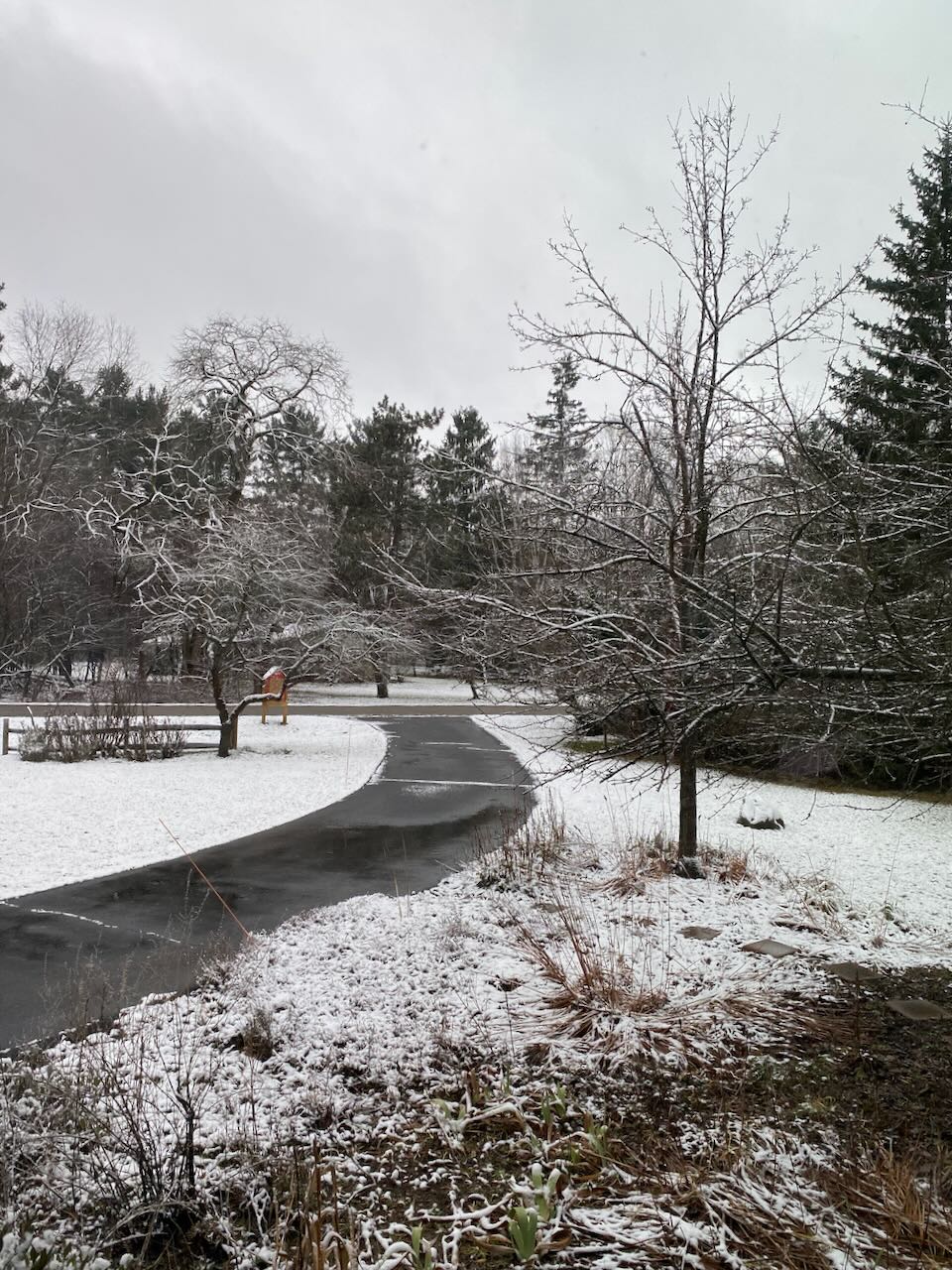
Doug and I toasted in the New Year watching the ball drop in Times Square via television – old school, I guess, not to have streamed it. The temperature dropped overnight, and we woke this morning to a thin snowfall. A little more snow would have covered the yard like a clean sheet of paper, ready for a fresh start. The snow this morning brightened things up but let the past show through, reminding me that’s it’s always there, the base under all new beginnings.
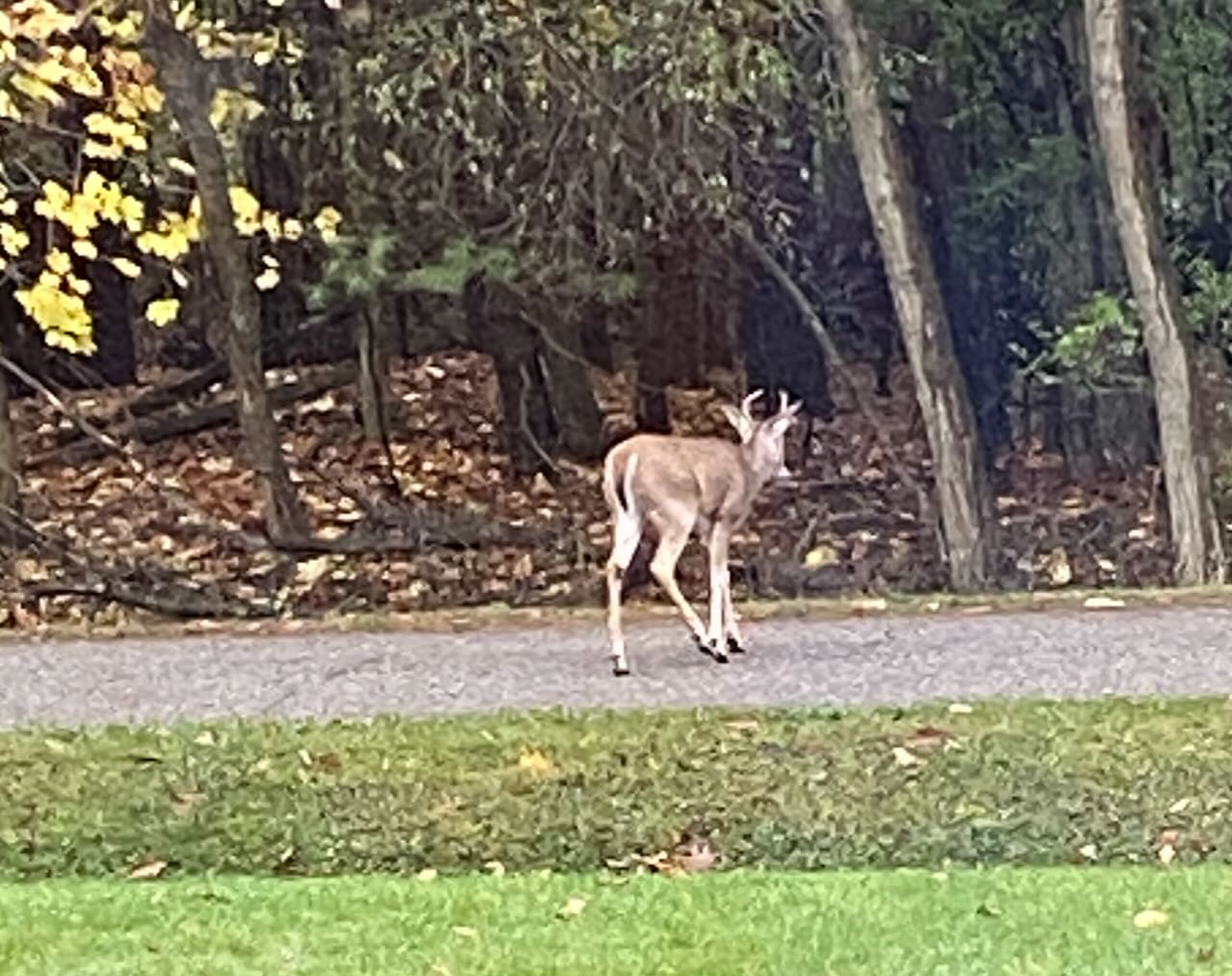 After weeks of summer and fall bumping into each other in a jumble, fall seems to be emerging triumphant at last. The stags are about done destroying small trees by using them to rub the velvet off their antlers. I’m still waiting for one of them to graciously leave his shed antlers in exchange – seems like the least he could do. Maybe this will be the year.
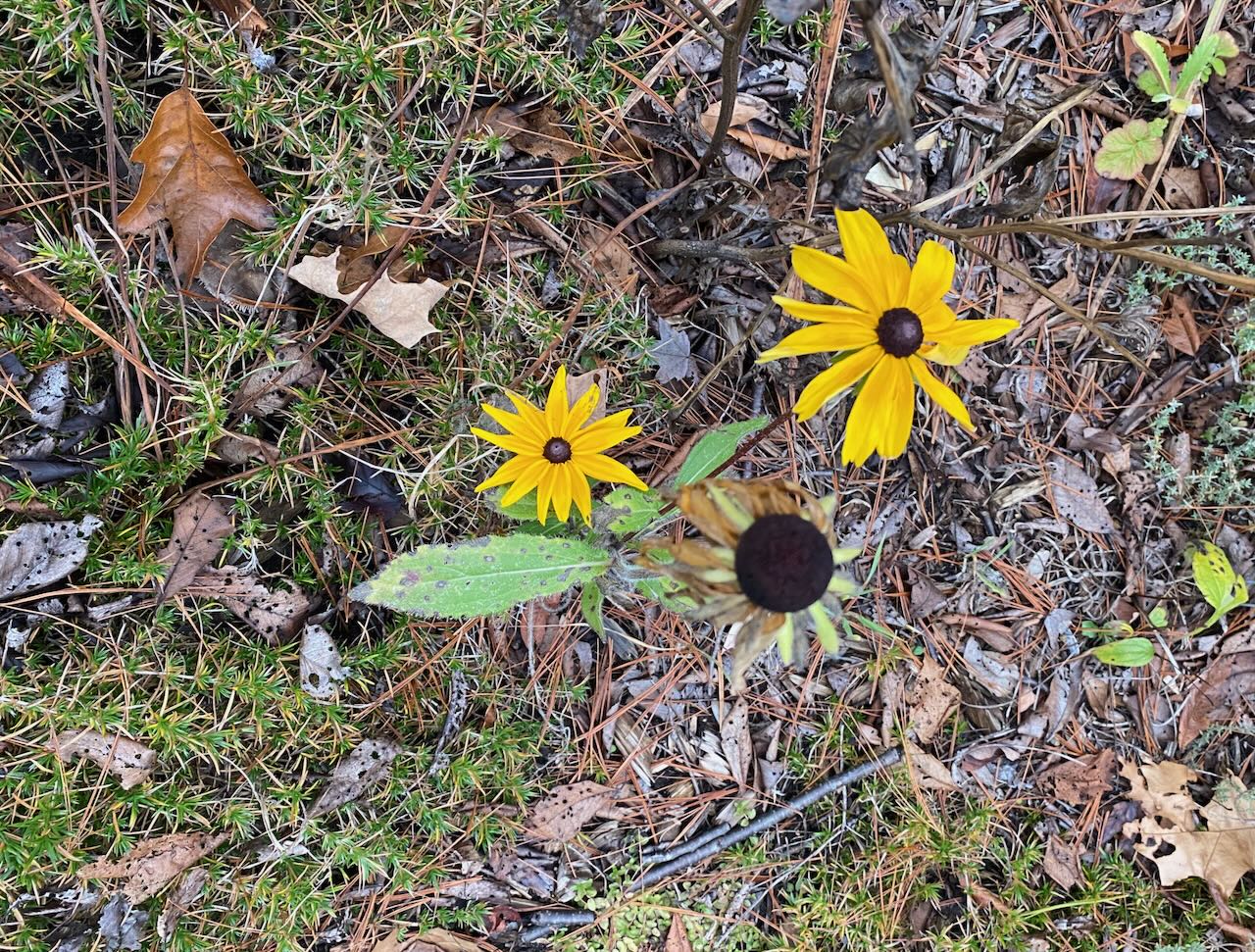 Between the light frosts and the subsiding hours of sunlight most of my flowers and tomatoes are gone, but out in front, facing south, one rudbeckia plant persists. It’s not the only rudbeckia out there, but it’s the only one still blooming. A mystery of nature.
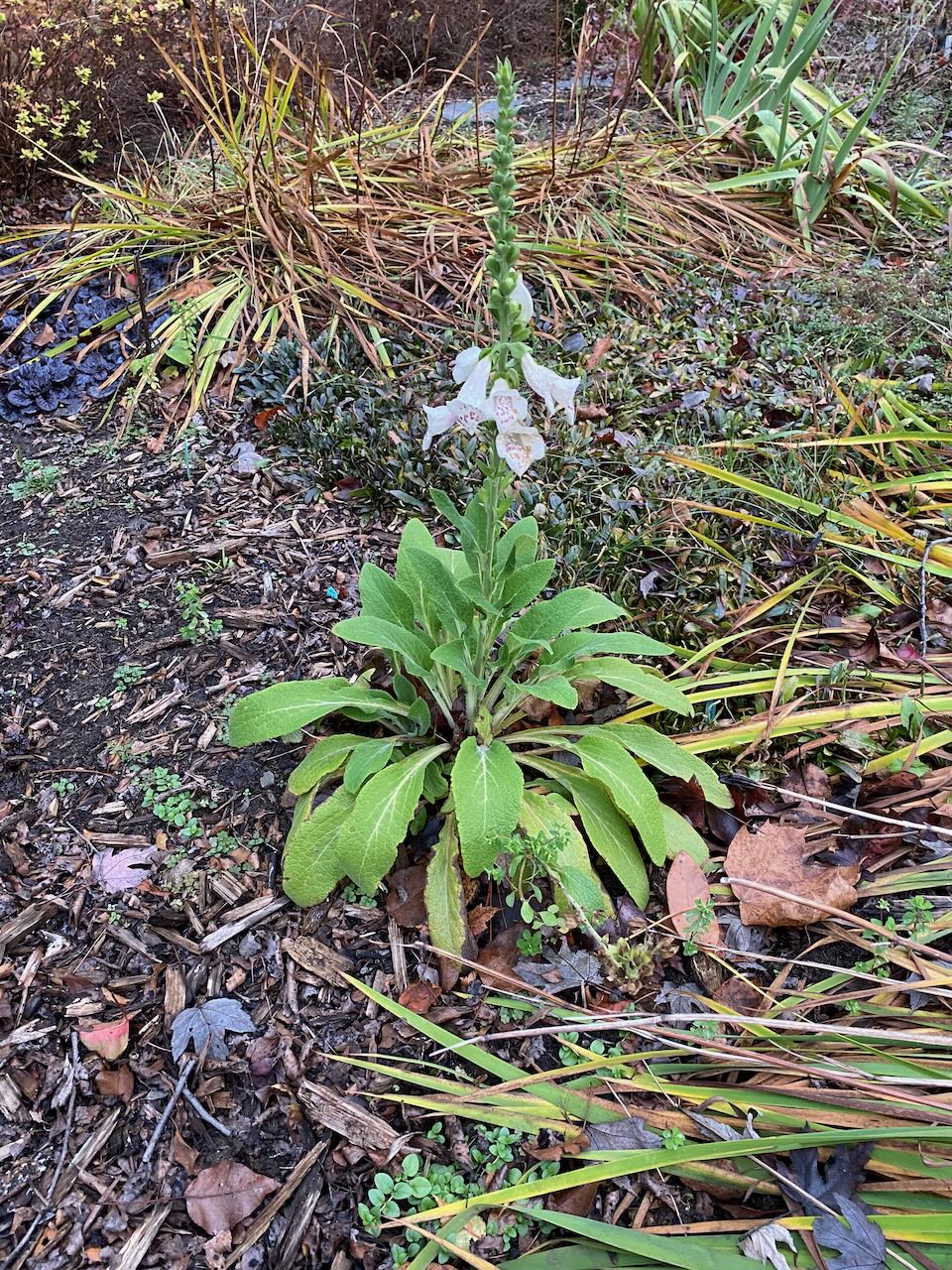 Over in the shady section, a single foxglove has re-bloomed. It was pink the first time, but has paled in the shortened hours of daylight. The foxgloves are spaced widely, so in their case it’s understandable that individuals may have different amounts of light, or shelter, or competition from other plants. Less mysterious.
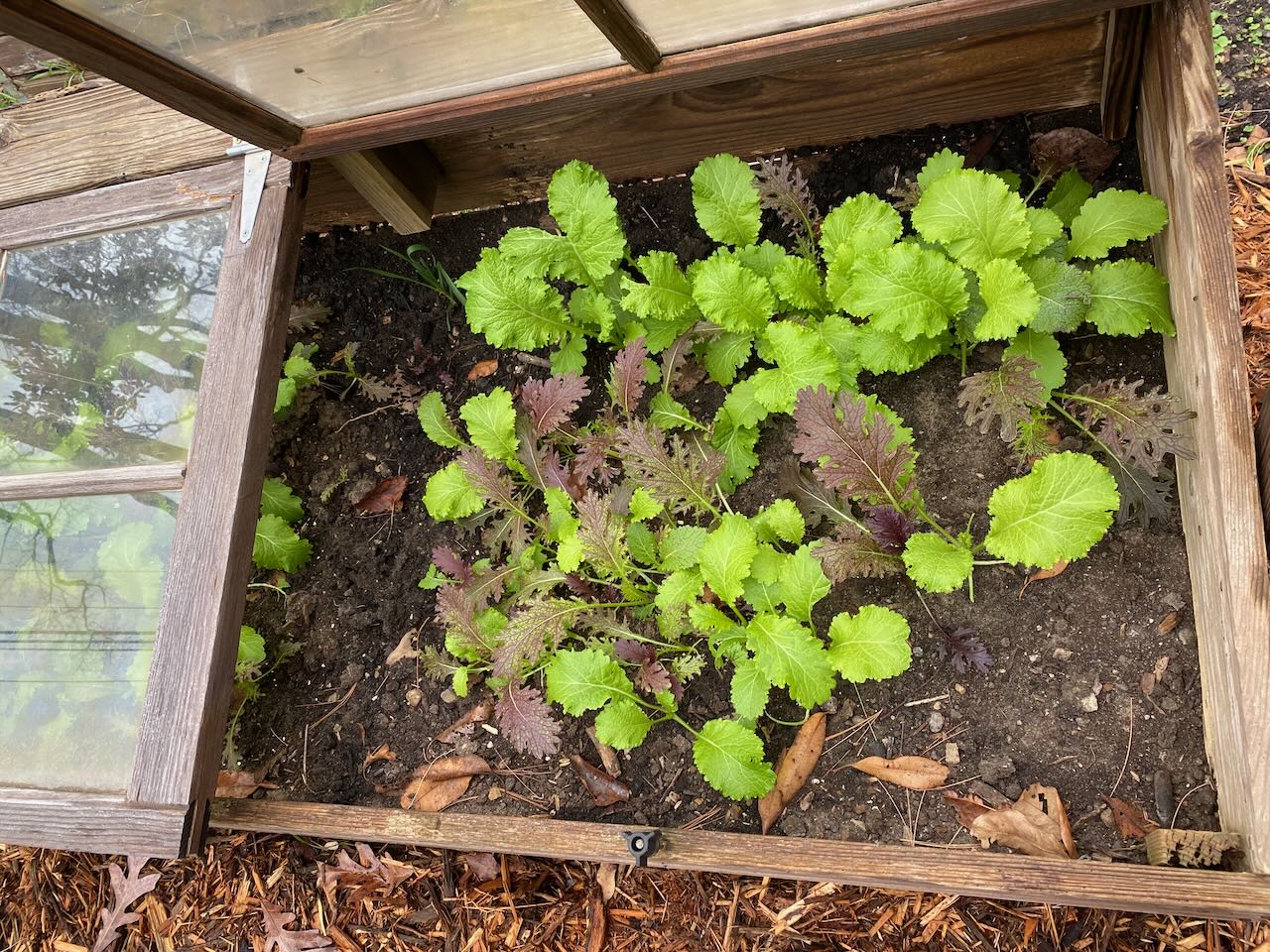 Out in the fenced garden, once the tomatoes were gone, I planted lettuces in the cold frame. They’re flourishing. This is very satisfying to me as a gardener, but the flaw in the plan is that I really don’t eat much salad in cold weather.
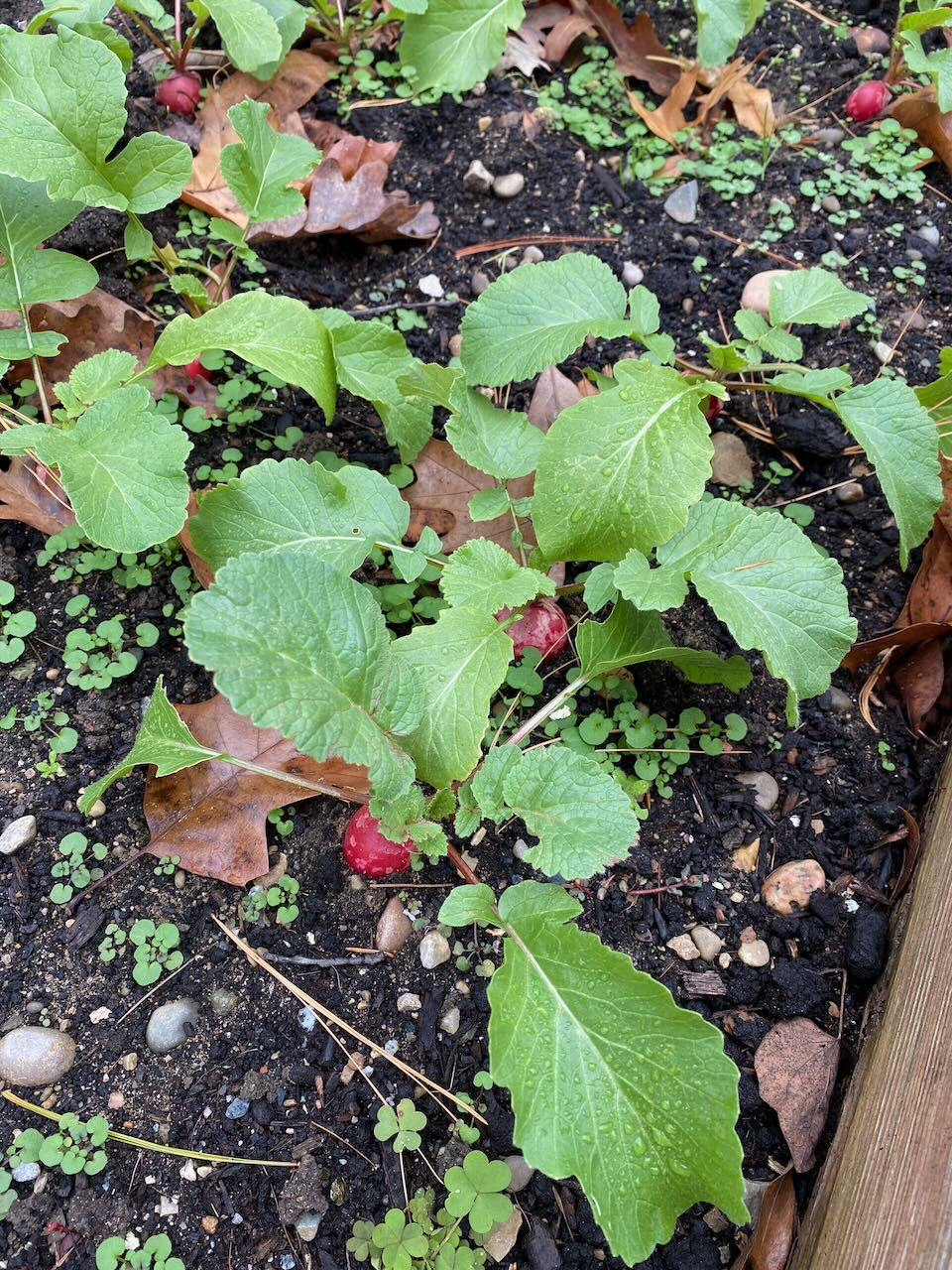 That was the trouble with radishes too, until I learned that they can be cooked. How did I get to be as old as I am, and never knew this? They’re so cute out in the garden, with their little round, red shoulders peeking out of the dirt, and they demand so little in the way of warmth and sunlight, I can’t resist planting them when random space becomes available. I’m still working out the best recipes for them.
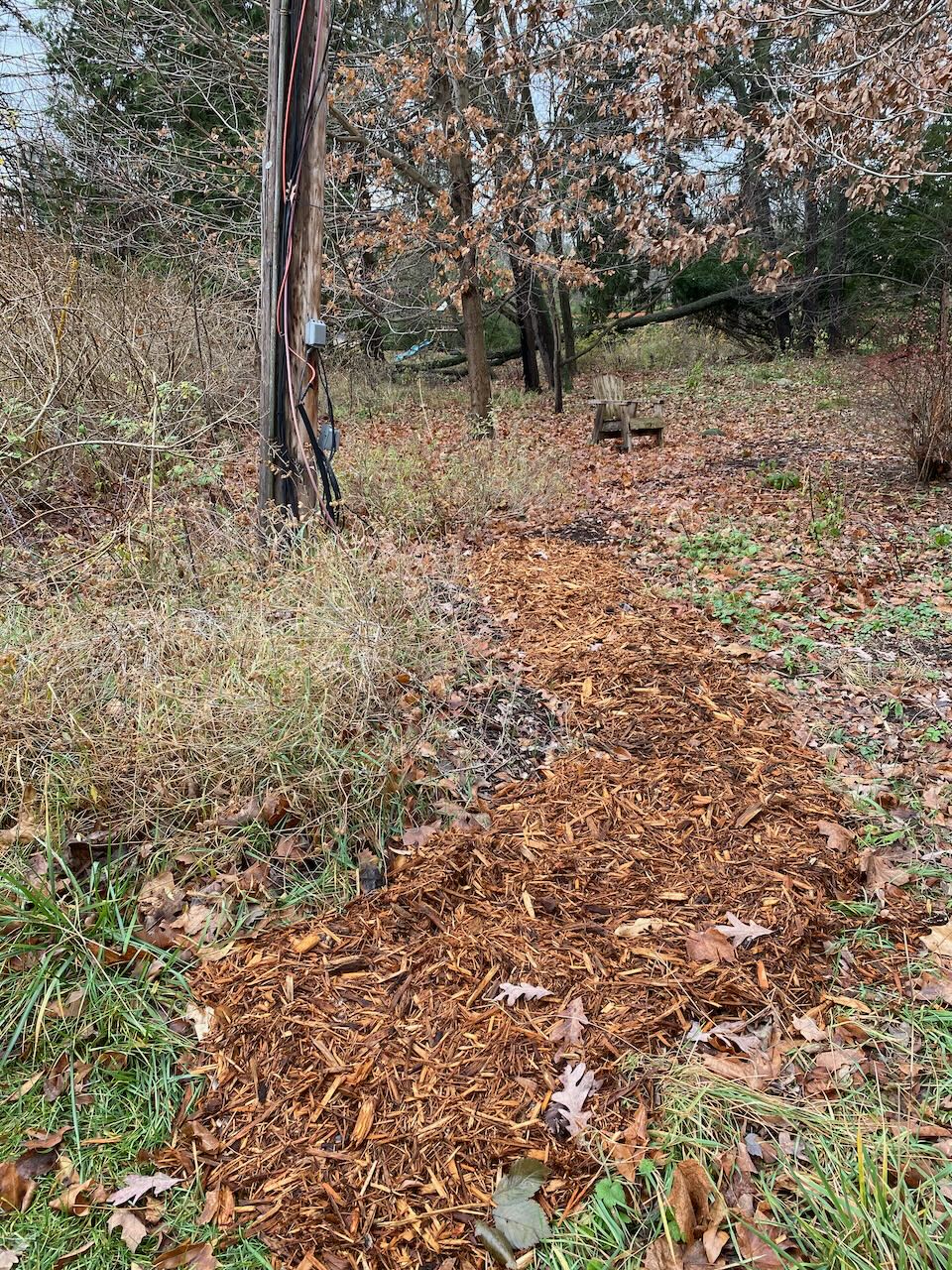 Meanwhile, the main path into my woods needed help. I spread several layers of the Sunday New York Times over the old path, poured a bucket of water over that so it wouldn’t blow around as I worked, and topped it with mulch. That will be one less thing to do come spring, when things to do are plentiful. As much as I love gardening, there comes a time when I really need a break. If spring is the reward for winter and harvest is the reward for spring, winter is the reward for three seasons of hard work. Just curl up with a good book and eat all those quarts of tomato sauce.
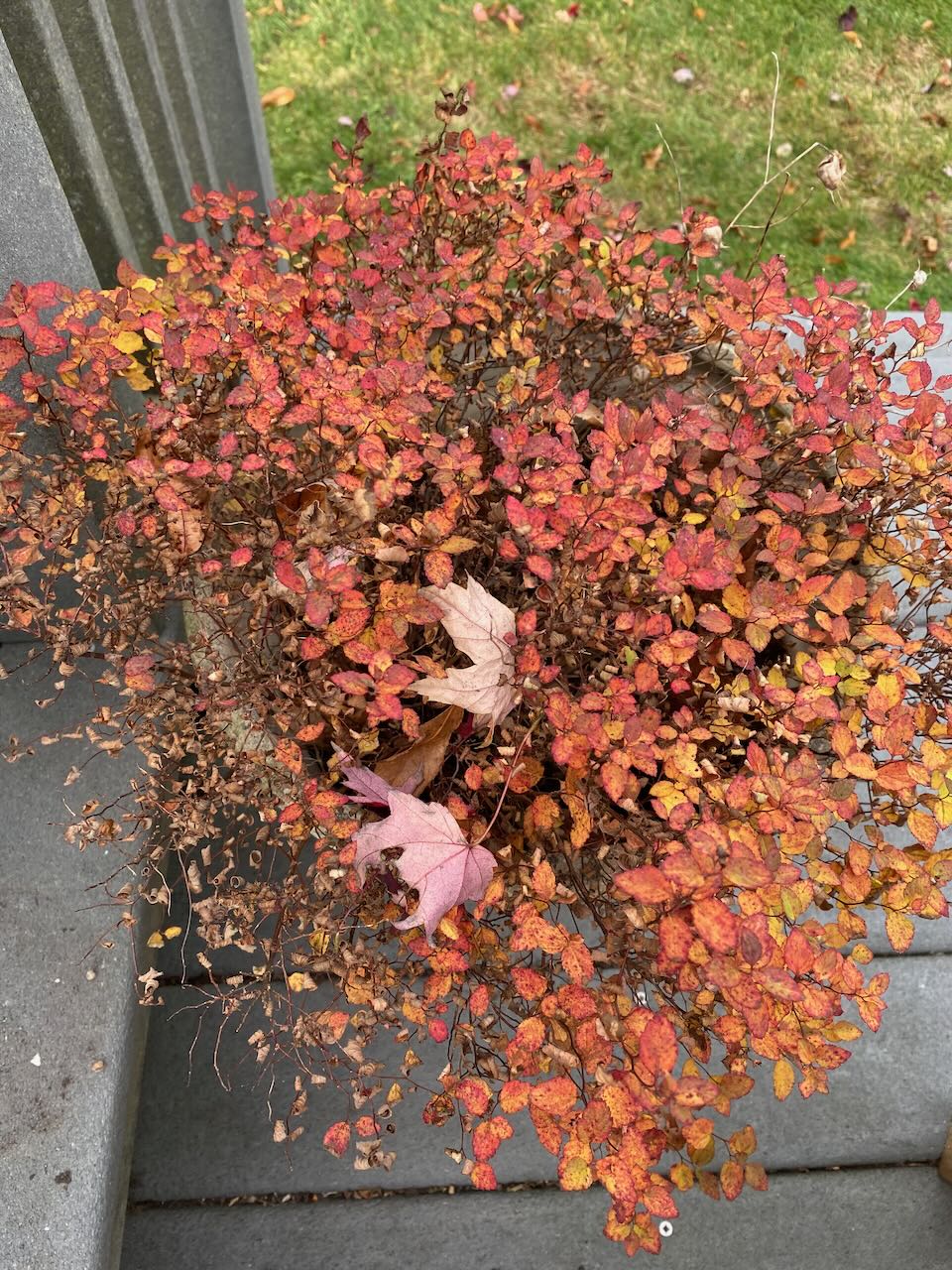 The late warm season continues. Most of the flowers are gone, but there’s still a lot of autumn color. The spirea planted in front is mostly down to bare branches, but this one in a pot on the deck is still in glory. This is odd, first because the front yard gets more sunshine, facing south, and the deck faces north; but also because roots in the ground get more protection from weather than roots in pots do. Nature surprises us whenever she wishes. The potted spirea is a volunteer – a pot of nigella was colonized by free-range spirea seed, and quickly became too lovely to remove. Here it is garnished by a couple of immigrant maple leaves, likely carried by whatever forces brought the spirea seed.
 Here’s the donor tree for those maple leaves, with just a little left in its branches to continue decorating the yard.
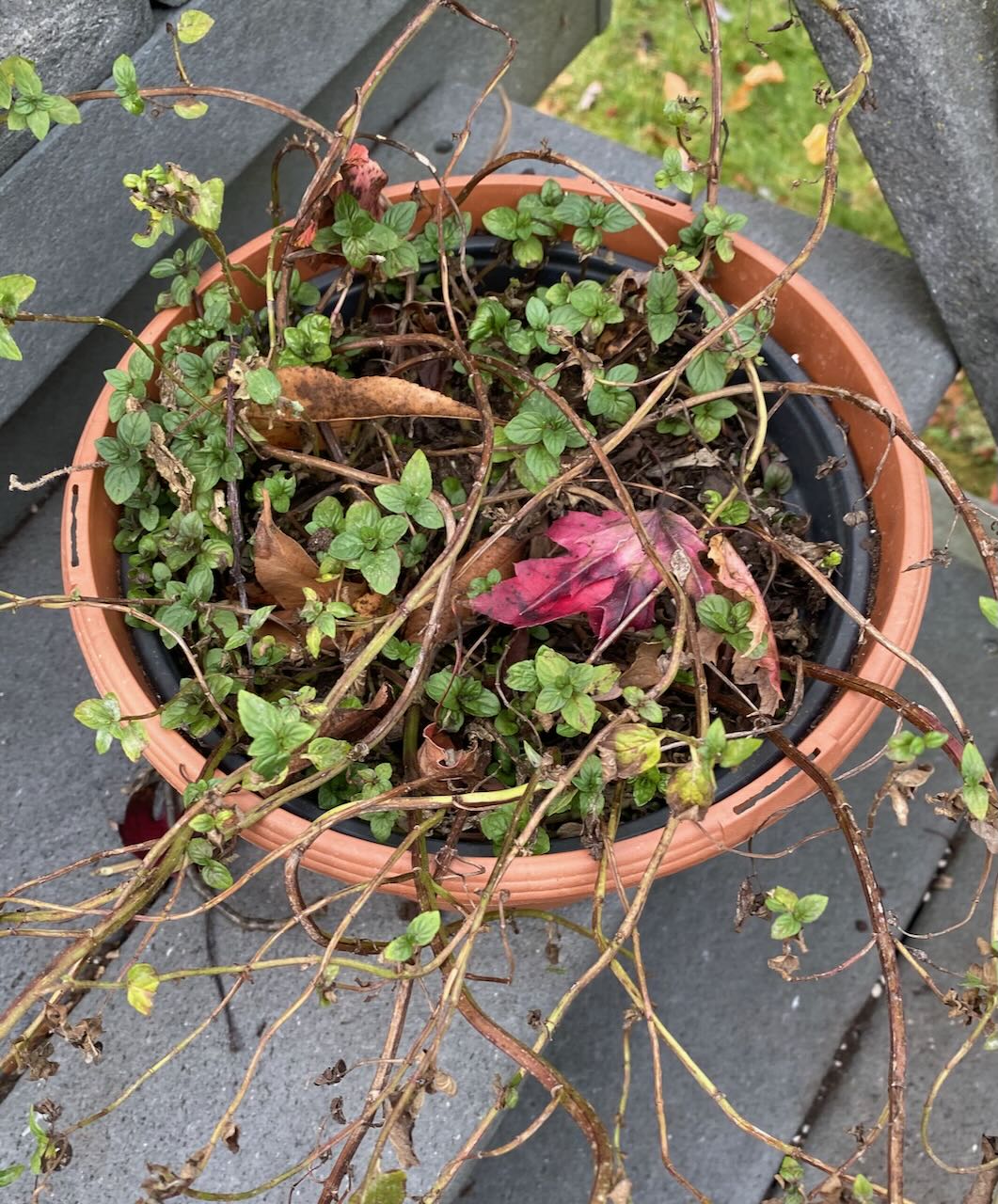 My herb collection has a mixed response to autumn. I had to bring the basil indoors, but thyme and sage will persevere outside all the way to Thanksgiving. The pot of mint may not last quite so long, but meanwhile has collected its own leaf embellishment.
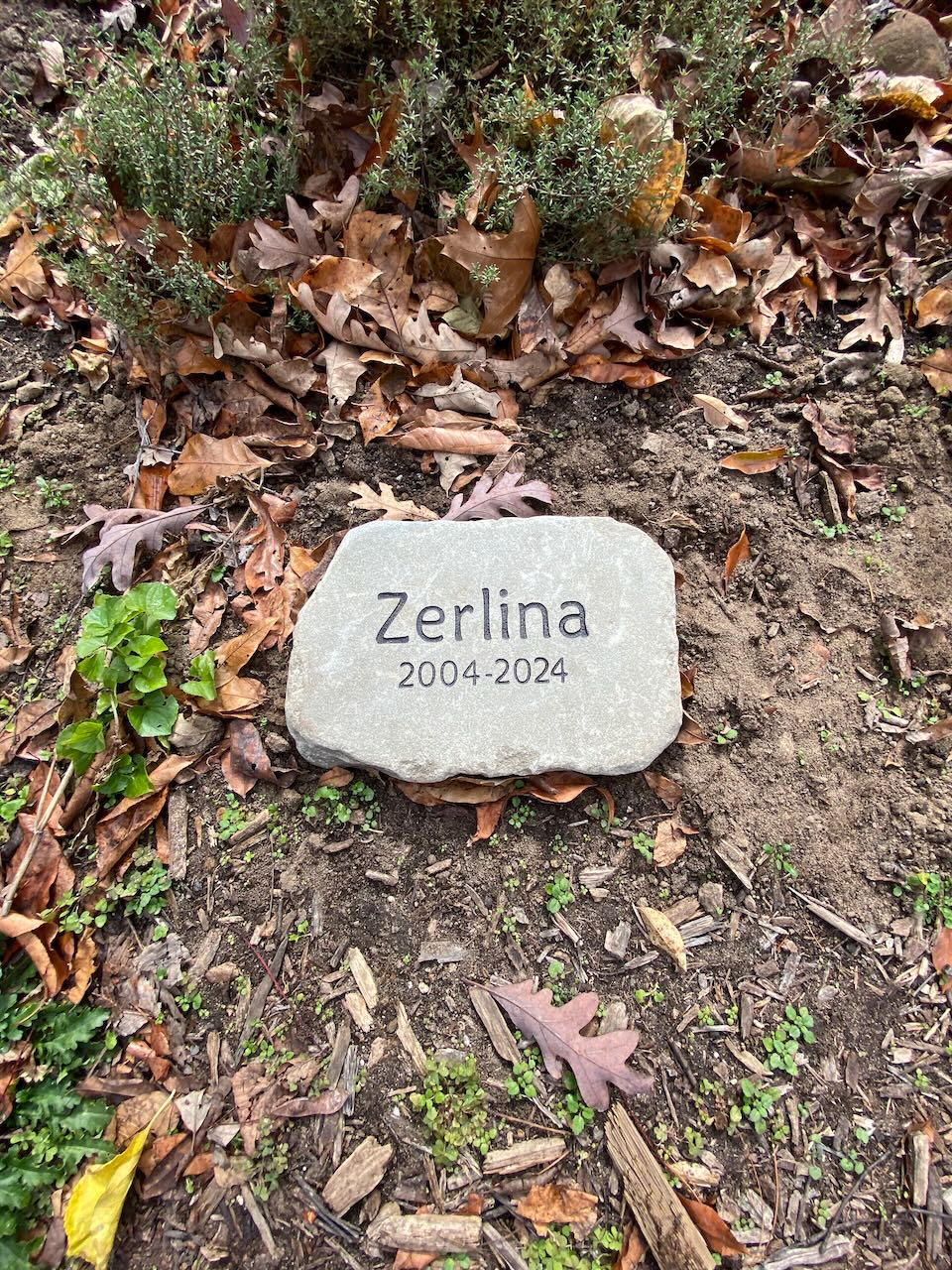 Meanwhile, after much inspection via the internet, I ordered a memorial stone for my wonderful cat, Zerlina. Many of those offered had elaborate decorations and extensive text, but none came up to Zerlina’s level of elegance. I chose one in her colors, with a soft shape. Not that a stone will be puffy, but hard angled edges seemed wrong. Doug came out to the garden with me while I buried her ashes in the center of the garden next to the thyme, and placed the stone on top. I needed the hugs. Then I sat for a while on my glider bench, thinking about her. The thyme will spread, and maybe I’ll encourage it to surround the whole stone. I haven’t decided yet, but thyme sounds like it belongs with memorials.
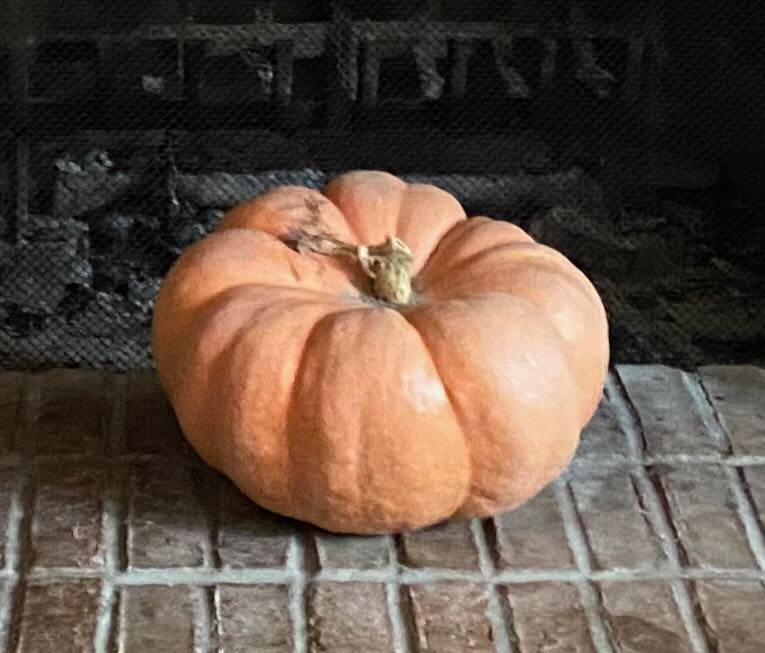 Then I went back into the house, where I picked up all the pumpkins and put them back in different places. I had to remember that things can change. And I found a sort of puffy one for the hearth.
 This morning my sprinkler guy, Craig, came and winterized the system. It’s pretty exciting to watch – he hooks up his air compressor, and it blows the water out of all the pipes at once, like an inverted thunderstorm. All over the yard, clouds rise out of the ground as if the woodchuck is popping open a lot of champagne.
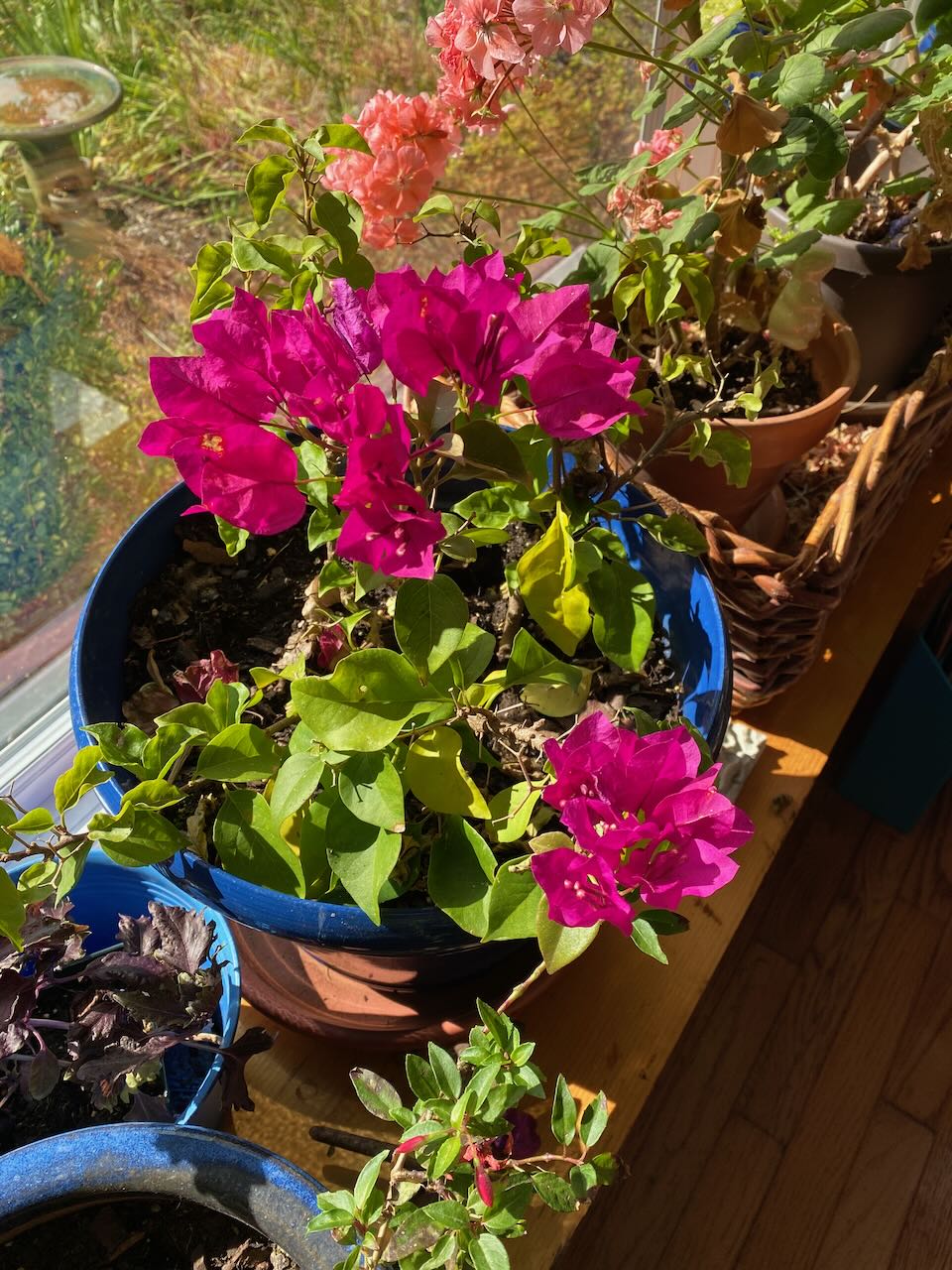 We haven’t had a frost yet, but with the cooler temperatures and shorter hours of daylight, what flowers remain won’t need me to water them. When I moved here fifteen years ago, Labor Day was the time to bring in your tender plants before the frost. Now, Columbus Day is in plenty of time. My bougainvillea gets a spot the sunniest window.
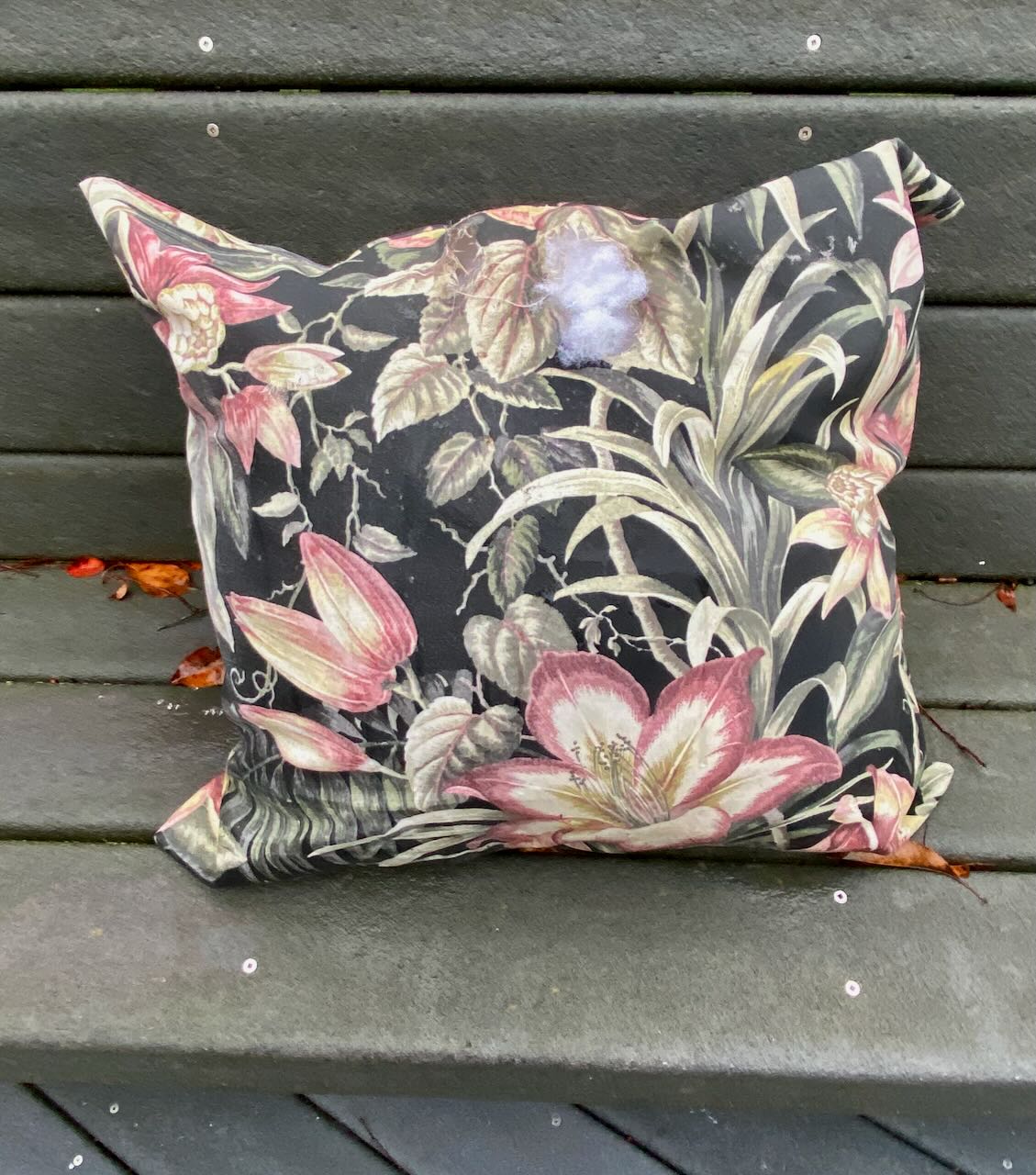 Next up will be bringing the pillows in from the deck. You see the white puff on this one – that’s the spot where the little red squirrel has been pulling stuffing out and carrying it away. I tried to take a picture of him at it, but he was way too fast for me. I also tried to see where he was taking it, but he was too fast for that, too. My first impulse when I saw this marauder, was to save the pillow by bringing it in. Two considerations made me leave it out there: one, that taking it away would encourage him to break into another pillow, whereas leaving it might mean only this one pillow was damaged; and two, it was very entertaining to watch him pack improbable amounts of fluff into his mouth for each trip. Squirrels don’t hibernate, but build nests for warmth in the winter.
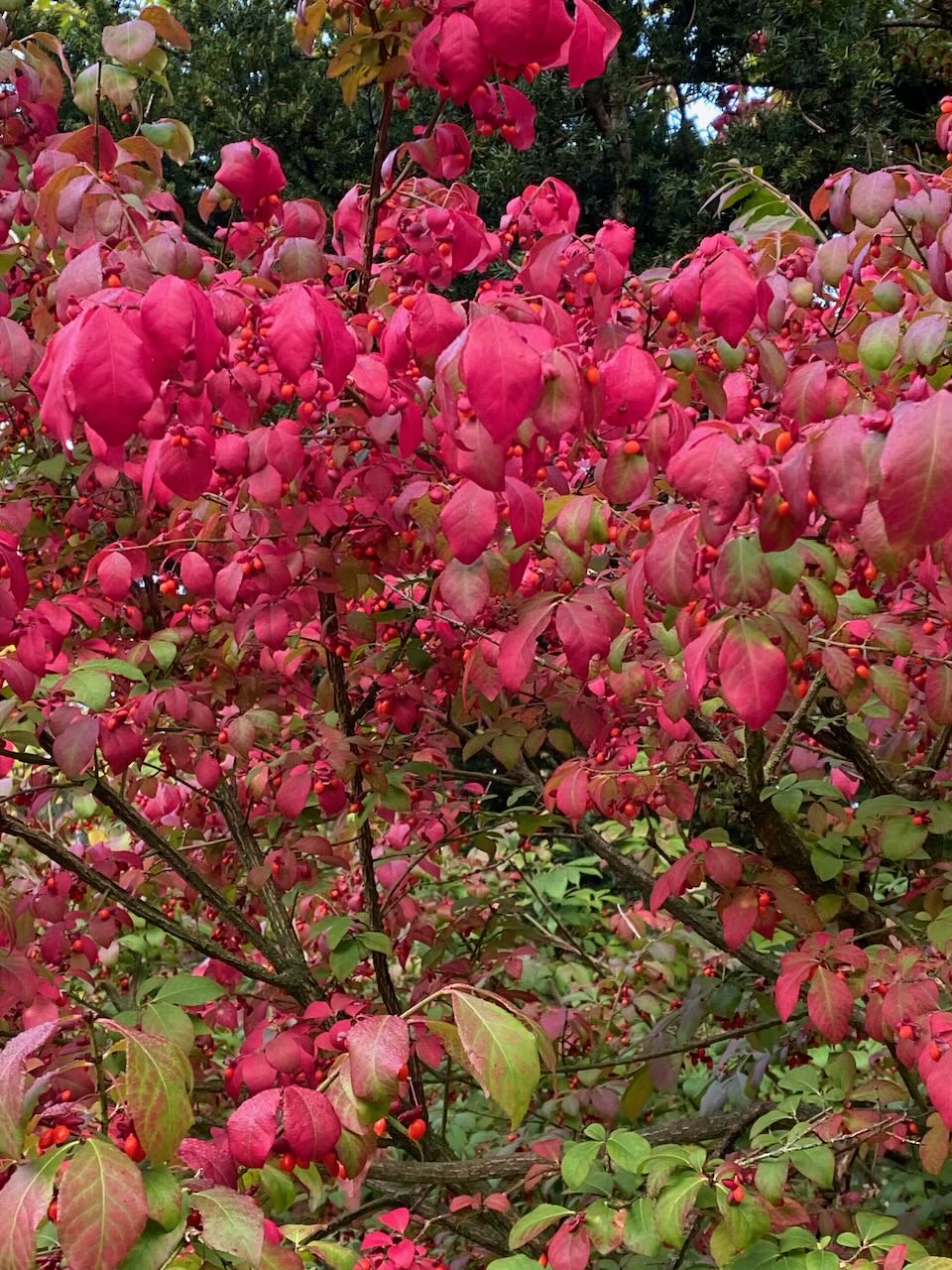 It doesn’t take a frost for the burning bushes to live up to their name. The color is glorious, and it’s very generous with its seeds, a benefit to the birds and small mammals that stay for the winter. Burning bush is not native, and in many areas is considered an invasive pest with no natural predators. Around here, though, the deer are happy to step up.
 Out in the garden I still have a few zinnias, but mostly I have miniature pumpkins. I love growing them myself because they’re small enough not to overrun the garden, and I get to cut them with long stems and curlicues still attached. Here they are perched on the hearth of my fireplace, on normal size bricks for a sense of scale. I’ll go down to one of the farms this week to buy some big pumpkins – some for the house, and some to set out on the porch where, when they’re finished building nests out of my pillow, the squirrels will have a handy pumpkin snack.
 I have a good lawn for deer and rabbits, full – if only accidentally – of diverse edible weeds. Looking out over it, especially when Charlie has just mowed, the lawn looks smooth and manicured. Appearances frequently deceive. For instance, this photo might look like a nuclear deer family, two fawns, a buck, and a doe. But four other the deer had already gone ahead into the woods before I got my camera out. The buck would have been bringing up the rear as usual, except that the fawns were lollygagging behind. But as soon as I made a tiny sound of satisfaction at getting this photo, their heads snapped up and the fawns leaped after the does, while Mr. Buck stood guard in case I made any moves. I didn’t. I was trying to see whether he was an eight point or a ten point, but he was gone before I could be sure.
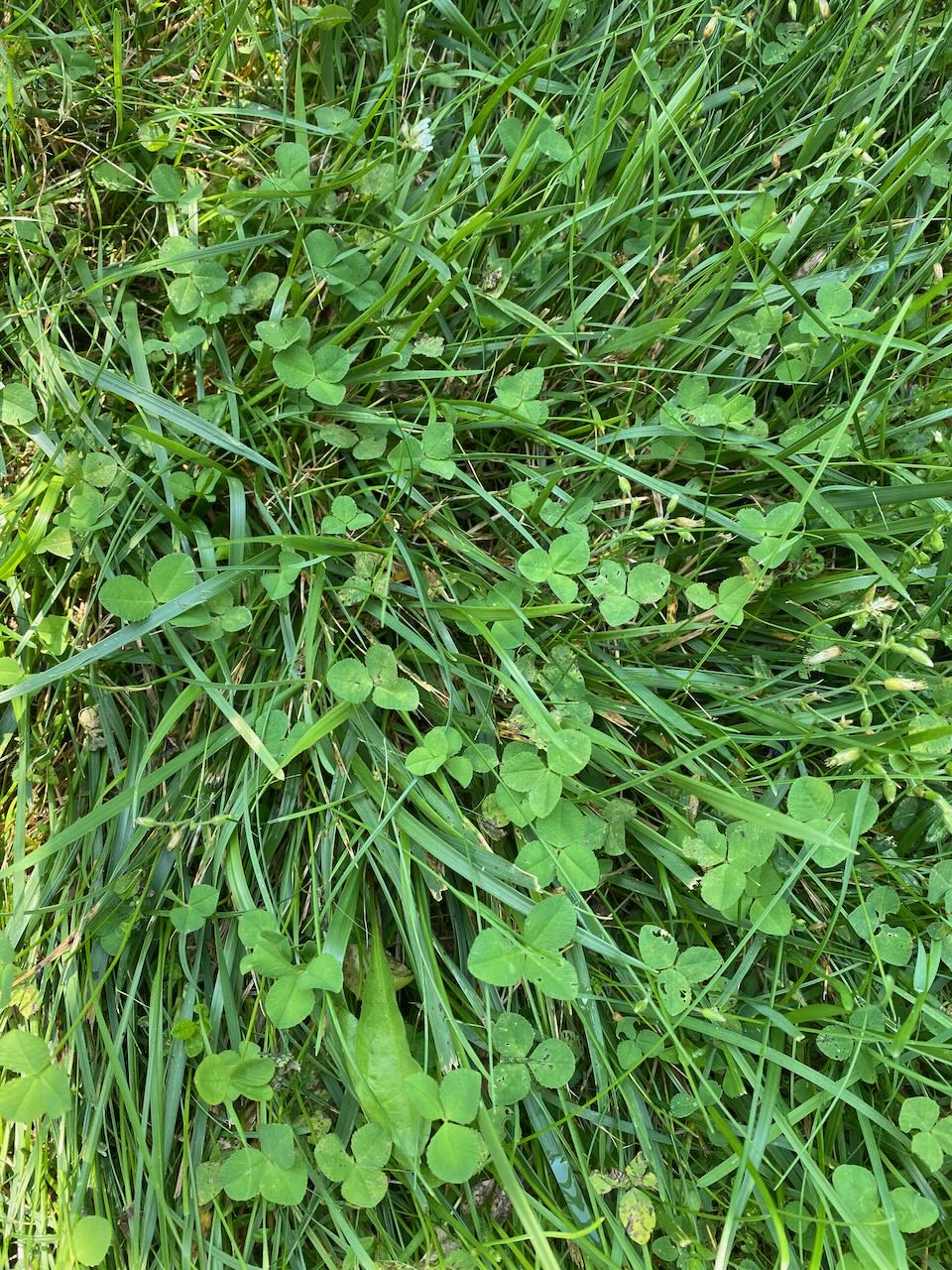 My lawn has a lot of white clover in it, which some consider a weed but I do not. In my suburban childhood it was common for lawns to be seeded with half grass and half clover. Clover is sturdy, holding up well to children and pets; clover fixes nitrogen so you don’t need fertilizer; and clover flowers attract bees, which will pollinate your garden plants and fruit trees. Charlie was late mowing this week, because we had two days of Hurricane Beryl’s leftovers drenching Michigan with rain. Amazing that a hurricane came all the way from Africa to crash into Texas and charge up the Mississippi and Ohio River valleys to the normally hurricane-free Michigan. Many were the frantic sump pumps in Ann Arbor, but the sandy soil of my yard was up to the task. When it was over, everything was safe and green, green, green.
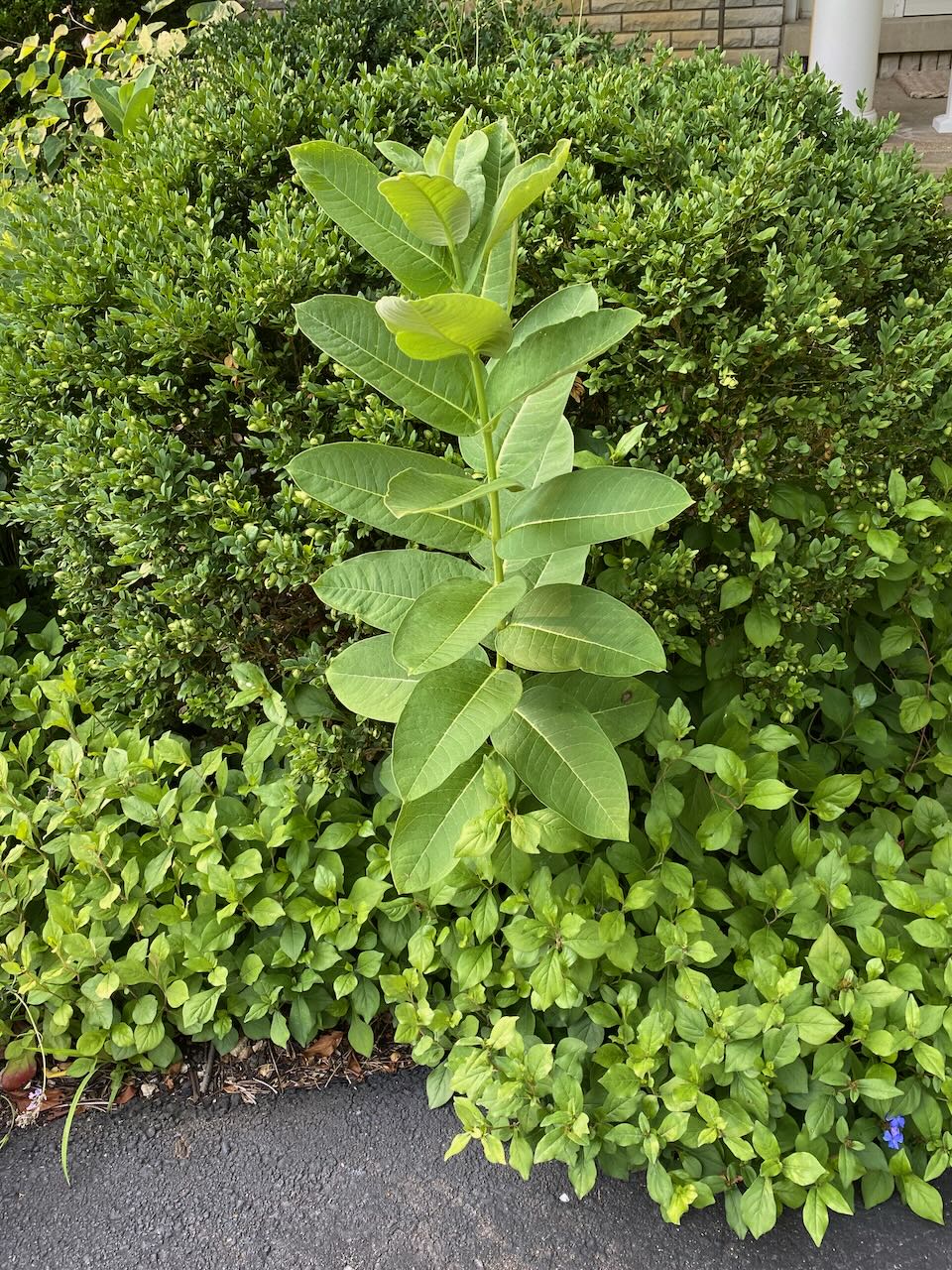 Besides the clover, there’s plantain in the lawn and purslane at the margins. Plantain, native to Europe, was called “white man’s footprint” by Native Americans: where the white man set his foot was where you found plantain. It’s not only edible to deer, it’s edible to us. Purslane is, too. My attempts to actually eat these plants have never worked out. Purslane leaves are small and have to be gathered in large quantities, and I found plantain, which grows flat against the ground, hard to clean. I magnanimously leave them for the deer, in spite of which they persist in eating things they really, really shouldn’t. For instance, milkweed. Milkweed is poisonous, but if you are a clueless fawn, well, just look at those big, juicy leaves. I assume it’s the fawns because I assume they don’t grow up if they eat the milkweed.
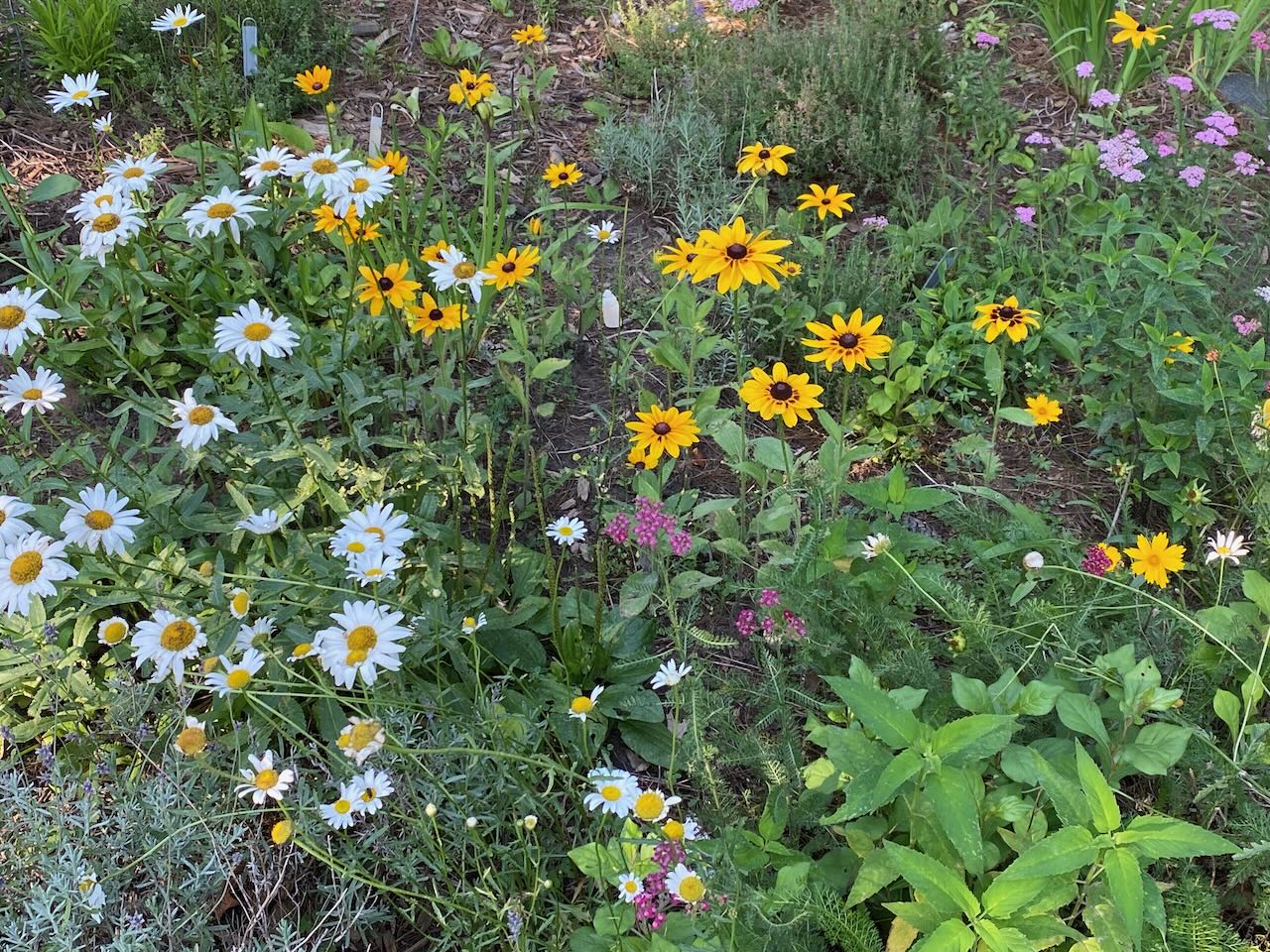 Deer sometimes also eat my rudbeckia, yarrow, and shasta daisies. Garden catalogs will tell you they shun these plants, but garden catalogs have never met my deer. Every evening or two, I walk through the yard with my trusty spray bottles of animal repellants, switching off now and then so the critters don’t get used to one of them. I almost dread to say so, for fear it will jinx their effectiveness.
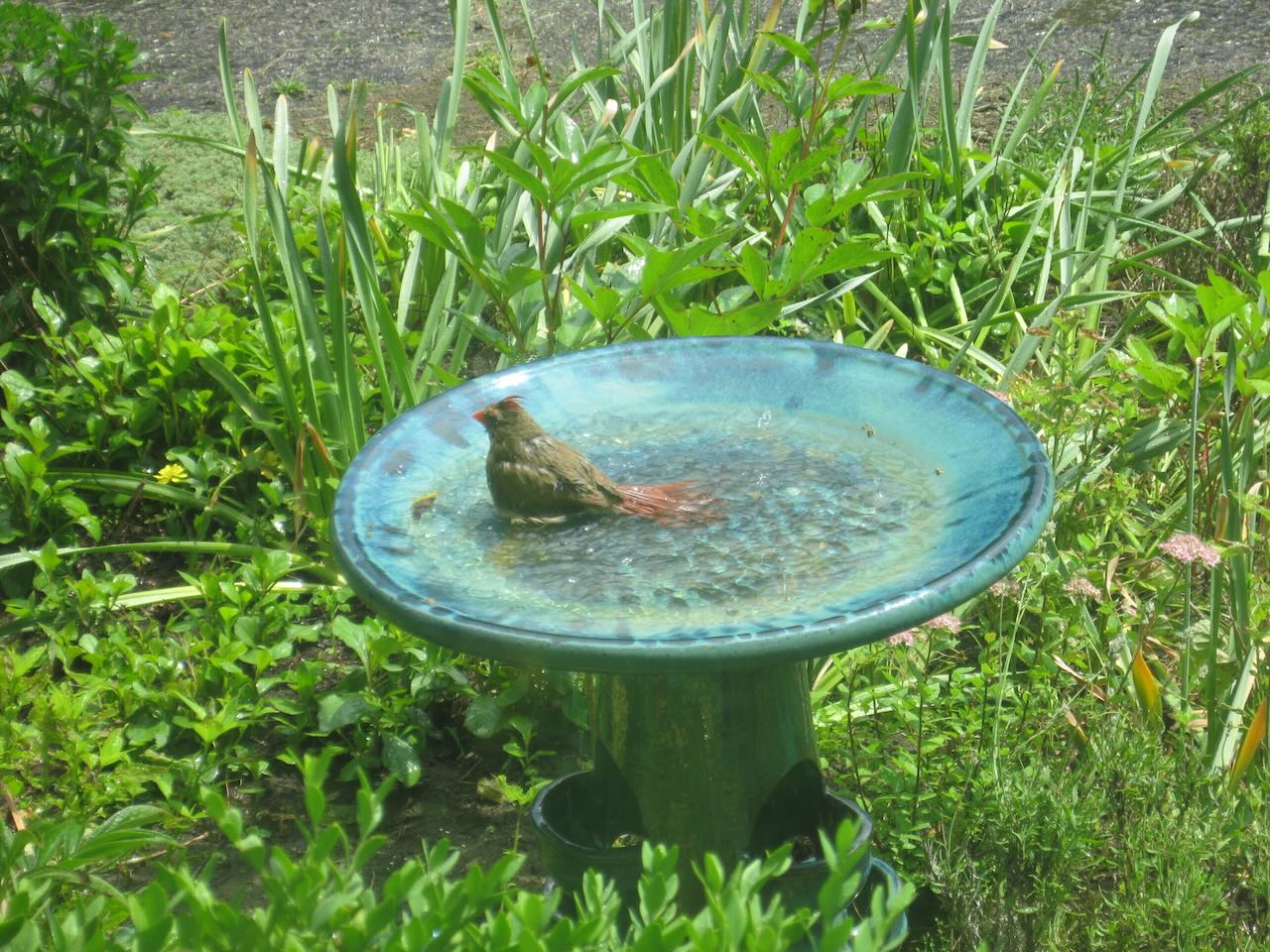 The amount of rain in that storm varied a lot from one part of town to the next. I don’t currently have a working rain gauge, but friends and neighbors have measured anywhere from five to seven inches over two days. One curious thing I’ve noticed is more birds using the birdbath after a rainstorm. This seems totally counter-intuitive to me. Didn’t they shower in the rain? Is it easier to bathe when they’re already wet? Or maybe newly-fallen rain is more attractive to them than water that’s been sitting around for a few days. Not being a bird, I will never know.
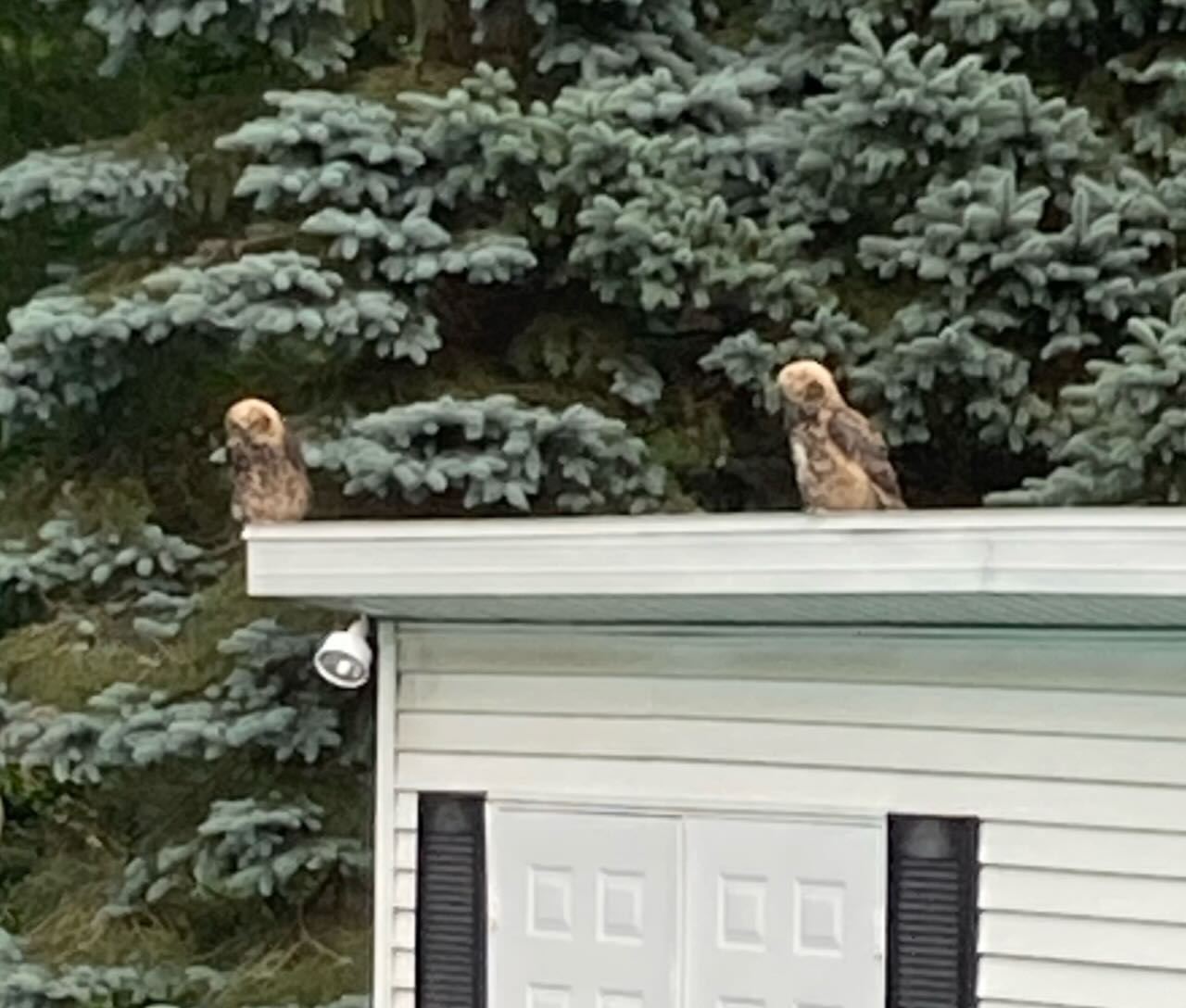 My neighbor texted me the other day to tell me there were two great horned owls on the roof of her pool house. They were eyeing the pool vacuum with great interest, in case it climbed out of the pool and was revealed as dinner. Eventually they lifted their heads, the larger one outstared the smaller, and the smaller retreated to the far corner of the roof. Since female great horneds are larger than males we assumed this was a couple, and anthropomorphized a spat for them. But this was way past mating season for great horned owls, and on reflection this was more likely Momma and a growing chick. Was she teaching him to hunt? Trying to get him to fend for himself? Trying to get some time to herself for heaven’s sake? Still anthropomorphizing.
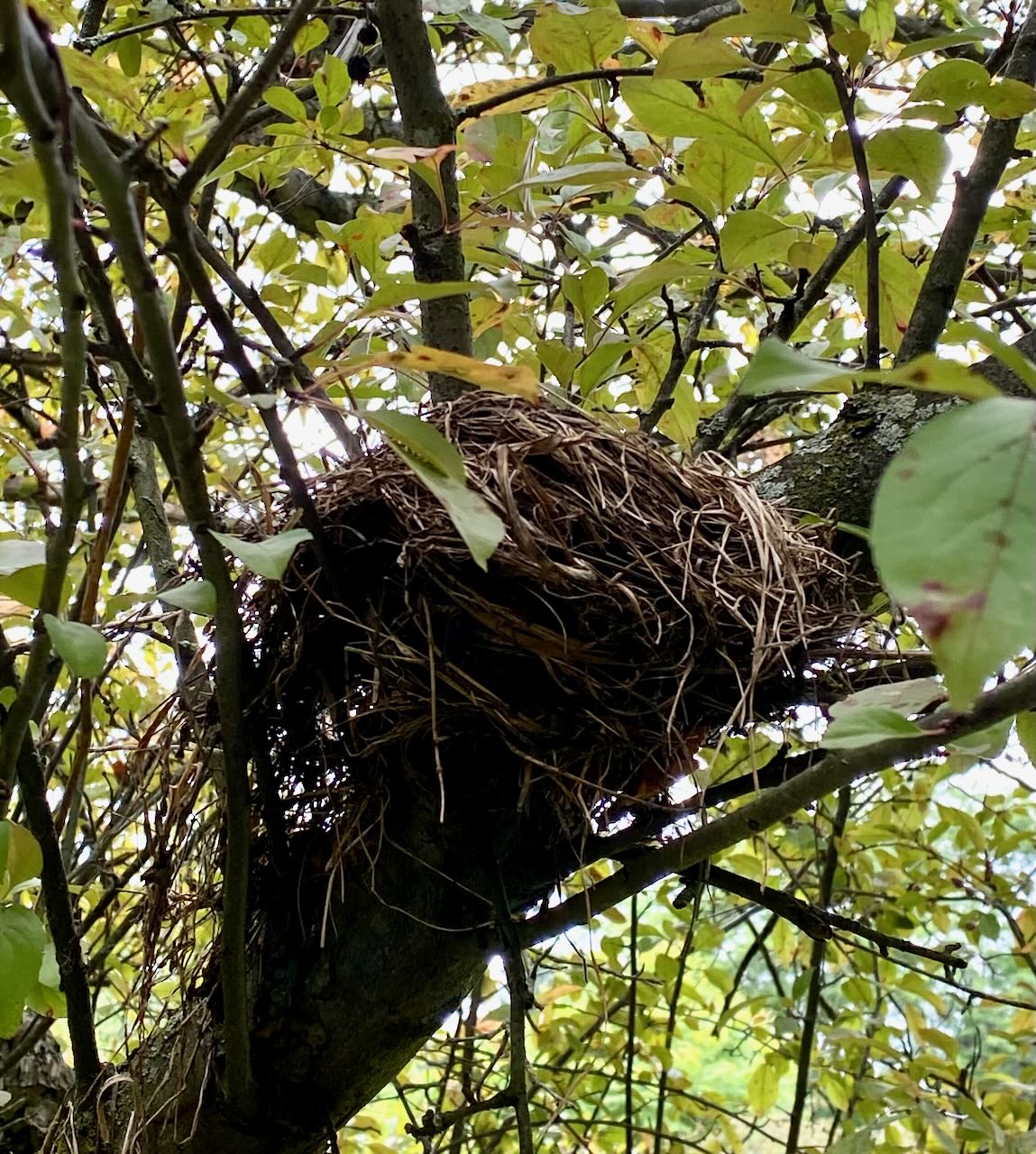 But birds, like people, do need to care for their young for a good chunk of their lives. We can relate. Not long after seeing the owls – though, sadly, after leaving my camera in the house – I walked out to my mailbox and found a baby robin hopping along the driveway near the crabapple tree. I could see where the nest was, though I couldn’t reach it. It looked like everyone else had fledged, but Junior had not quite made it. As he hopped he flapped his wings a bit, but didn’t get any lift.
 I walked after him wondering what I should do, but the point was soon moot. He headed for this nice, thick stand of mountain mint, disappeared into it, and began to cheep. Good cover, I thought. It was a nice, steady cheep, like a beacon. Then I noticed that baby and I were being watched by a full-sized robin on the lawn. I took the mail back into the house and looked out the window to see big robin pulling a worm from the lawn, and carrying it into the cheeping mintpatch.
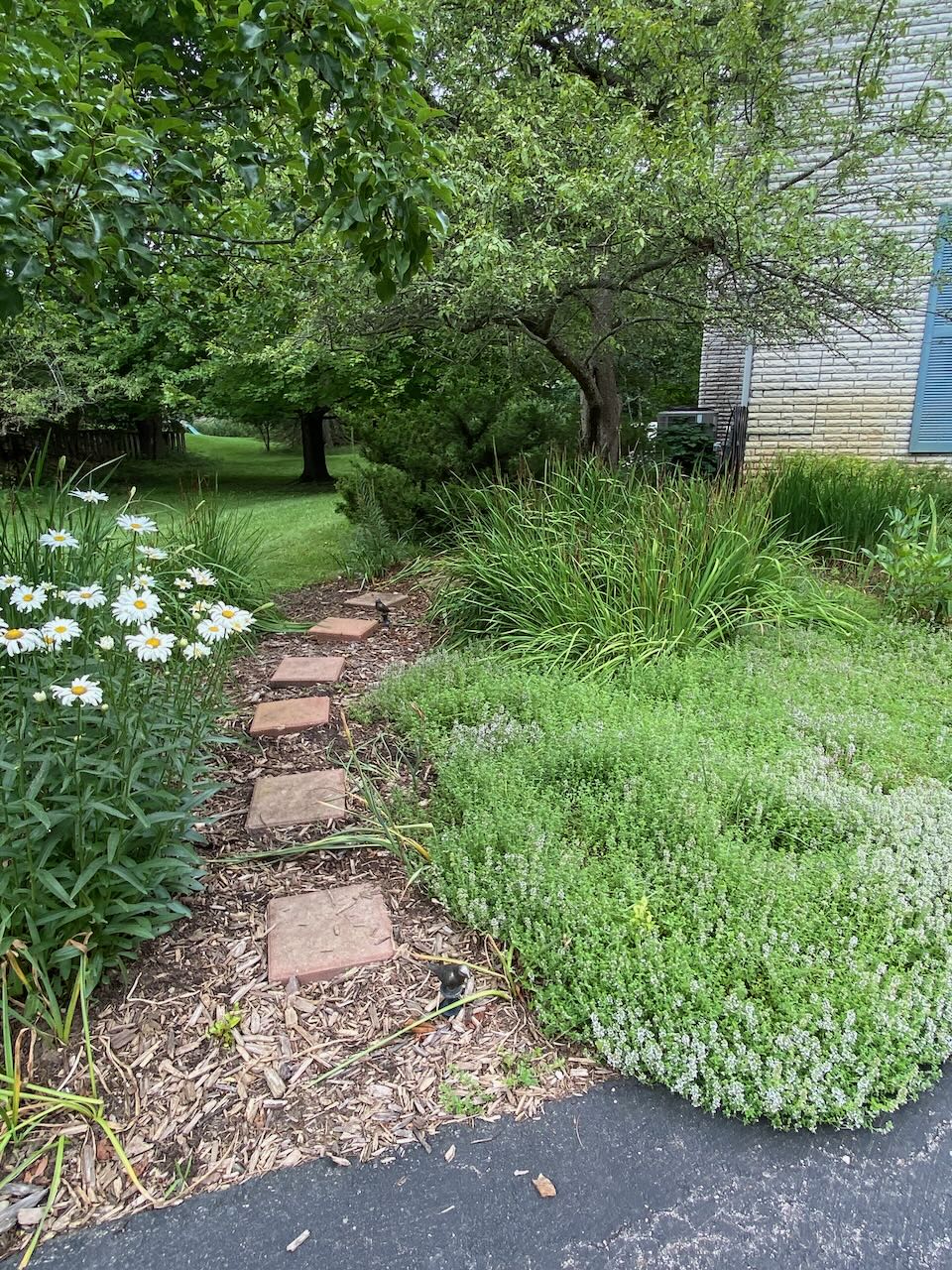 Next morning the cheeping came from a tall clump of Siberian Iris on the other side of my front door, and the parent robin waded in with another beakfull of worm. A successful night. There was cheeping and worm catering the next day too, from a little further back. A second successful night. The morning after that I didn’t hear him. Did baby bird learn to fly? Was he cheeping somewhere else? I hope those owls didn’t find him.
 I’ve read that fewer than half of all baby robins survive, and yet robins are not endangered. They’re busy all summer, laying eggs, feeding babies, traipsing around after fledglings, repeating the process two or three times per summer just to survive. Free as a bird, we say, watching them fly and hearing them sing. In fact they are bundles of purpose. I’m glad to see them taking the occasional break – or so I think of it – in the local spa.
 Of all the birds in my yard – and though I’m partial to Robins, for obvious reasons – my favorites to watch are the wrens. They’re tiny and adorable, they wag their tails, they hang around the house, and then they open their teensy beaks and this huge, rolling, gigantic wave of song comes out. How do they do that? When one of them sings outside a window, you’d swear he – or she – is inside the house. A group of them is called a “chime.”
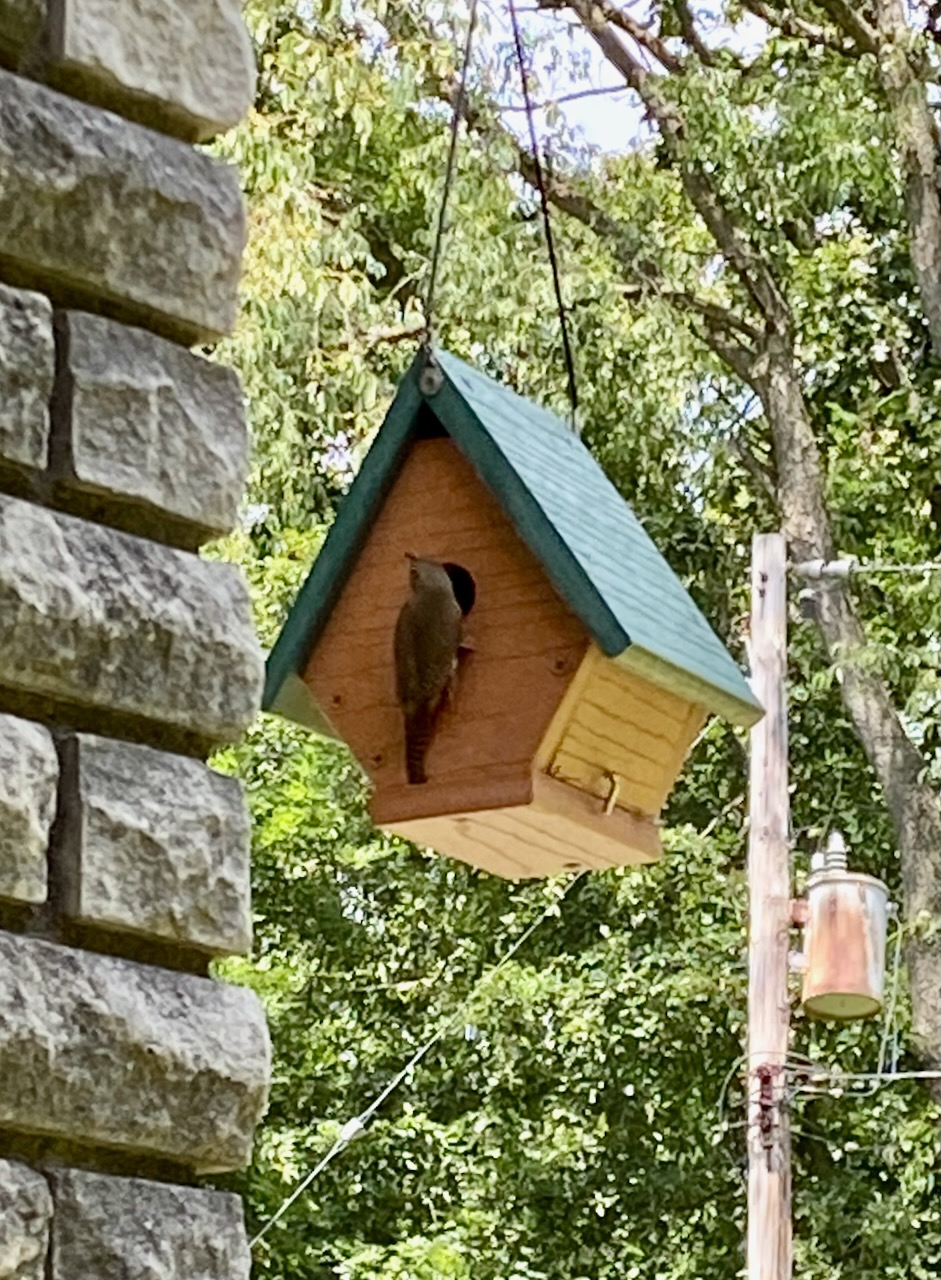 The hanging gourd they nested in last year fell apart over the winter. Doug was willing to build a wren house for me, but spring came so early that the birds were back while he was still working on the eighty-seven other projects I’d asked him for. Well, probably not eighty-seven, but you get the idea. So I went down to the local bird-supply store, bought a ready made wren house, and hung it from the eaves. I really felt it was inferior goods, and wasn’t sure the wrens would go for it. They did.
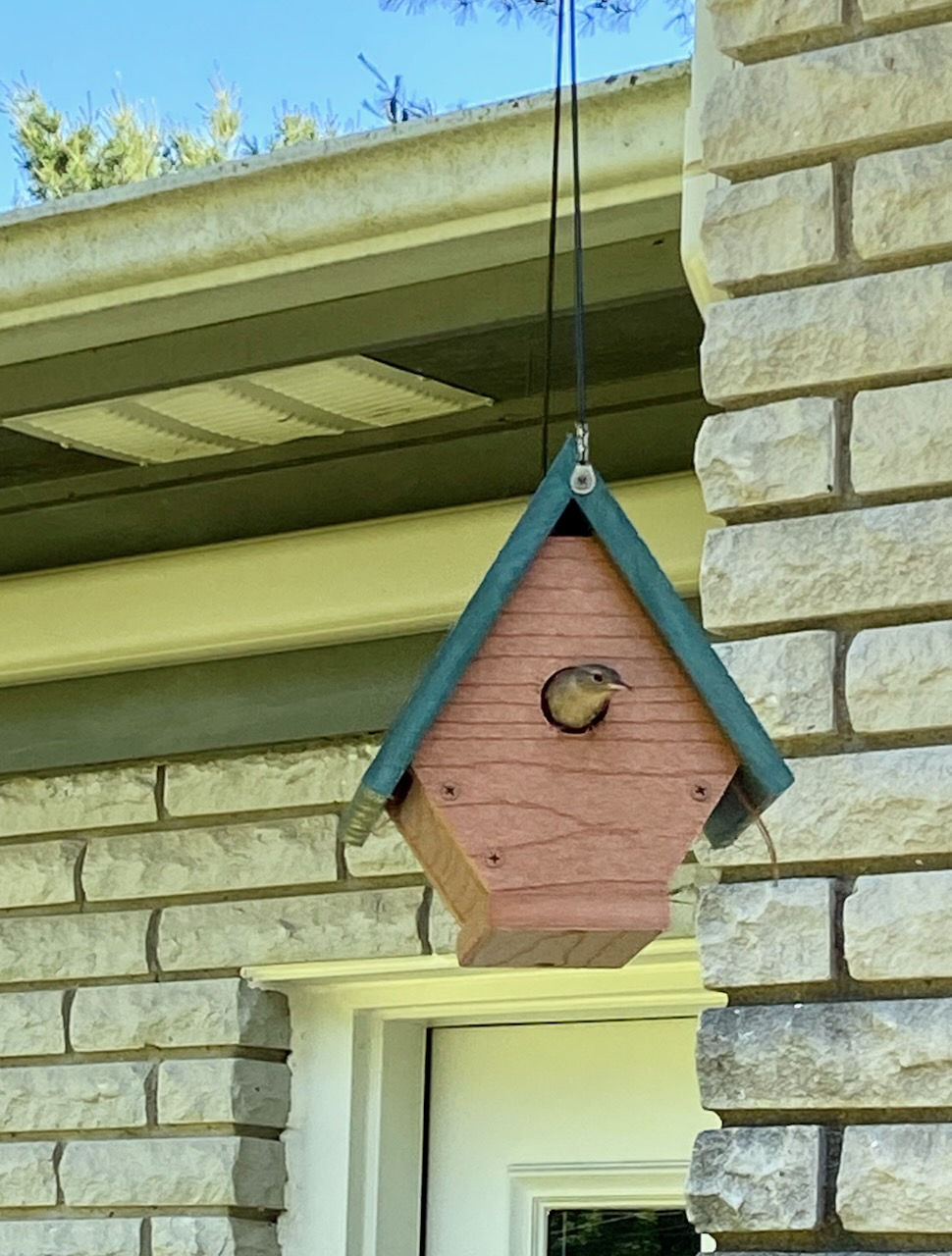 Apparently I was standing too close while taking these pictures and aroused parental wren suspicions. Whoever it was on duty – hard to tell male from female wrens – watched very carefully for several minutes. I tried to look nonchalant, backing off a little, but when I looked up again the wren leaped out into the air and took off flying, straight to the fake nest of the ceramic birdhouse.
 I was sorry the wren felt threatened, but pleased to know I had provided the fake nesting site. I hope it works well for them. And I did get a nice photo of flight.
 The wrens are used to me puttering at my garden bench or on the deck, so I went back to doing that, hoping to be recertified as harmless. But I did watch, making sure the wrens came back. It didn’t take them long, so I guess I’m not so scary after all.
 One of the joys of the spring garden is surprise. Where did these ultra-fluffy, double pink columbine come from? Not only don’t I remember buying them, I don’t remember even knowing they existed. Could they have arrived as seeds embedded in bird droppings? Such an ignoble origin. Could there be a Johnny Columbineseed at large in Ann Arbor, spiriting unusual flowers into unsuspecting gardens under cover of night?
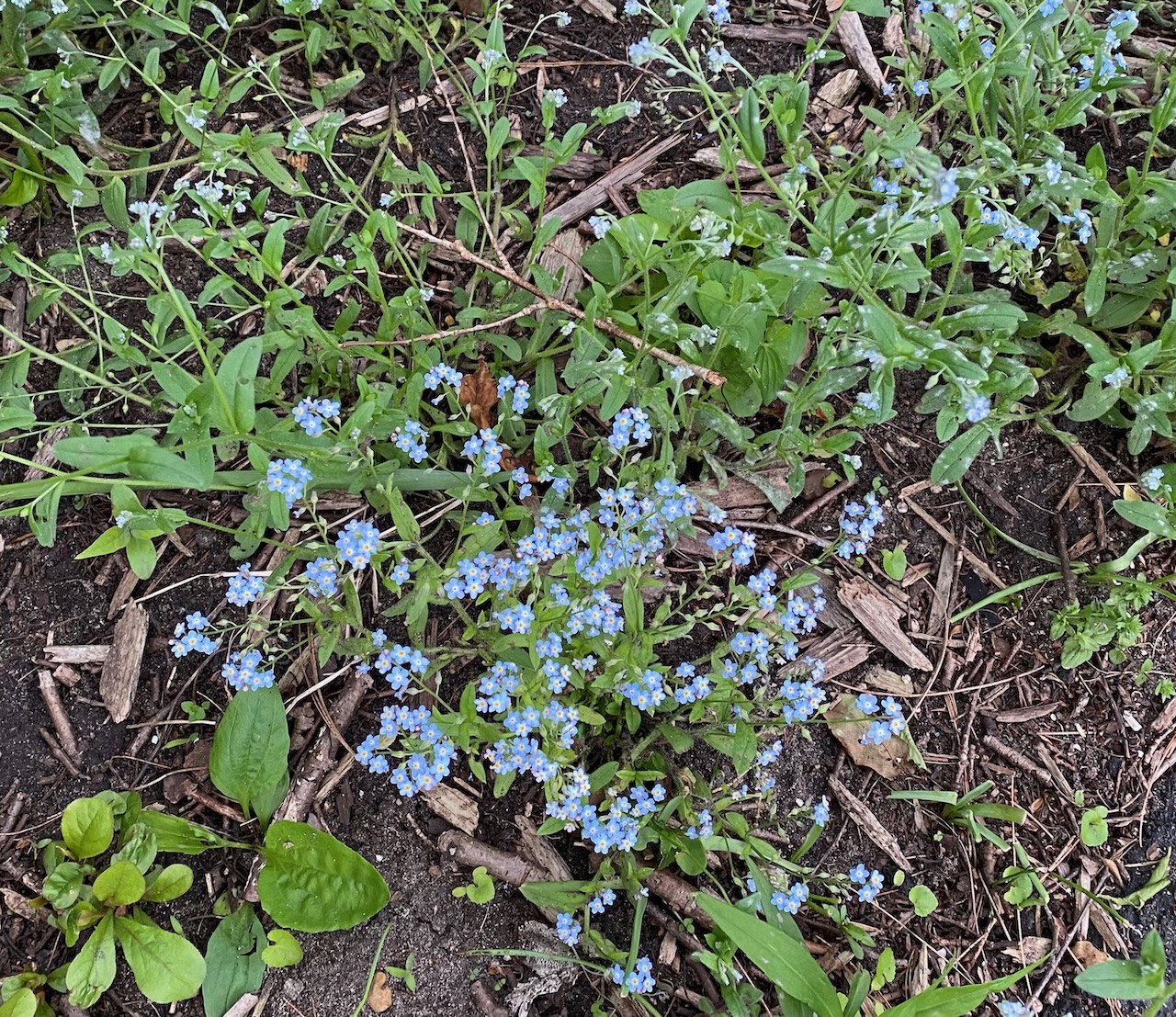 Then over here, how did one tiny patch of forget-me-nots take over the entire flowerbed, even crowding out weeds? A blue haze under the fading spikes of daffodil leaves, it manages to be really in your face despite such tiny petals. It should be called I-dare-you-to-forget-mes.
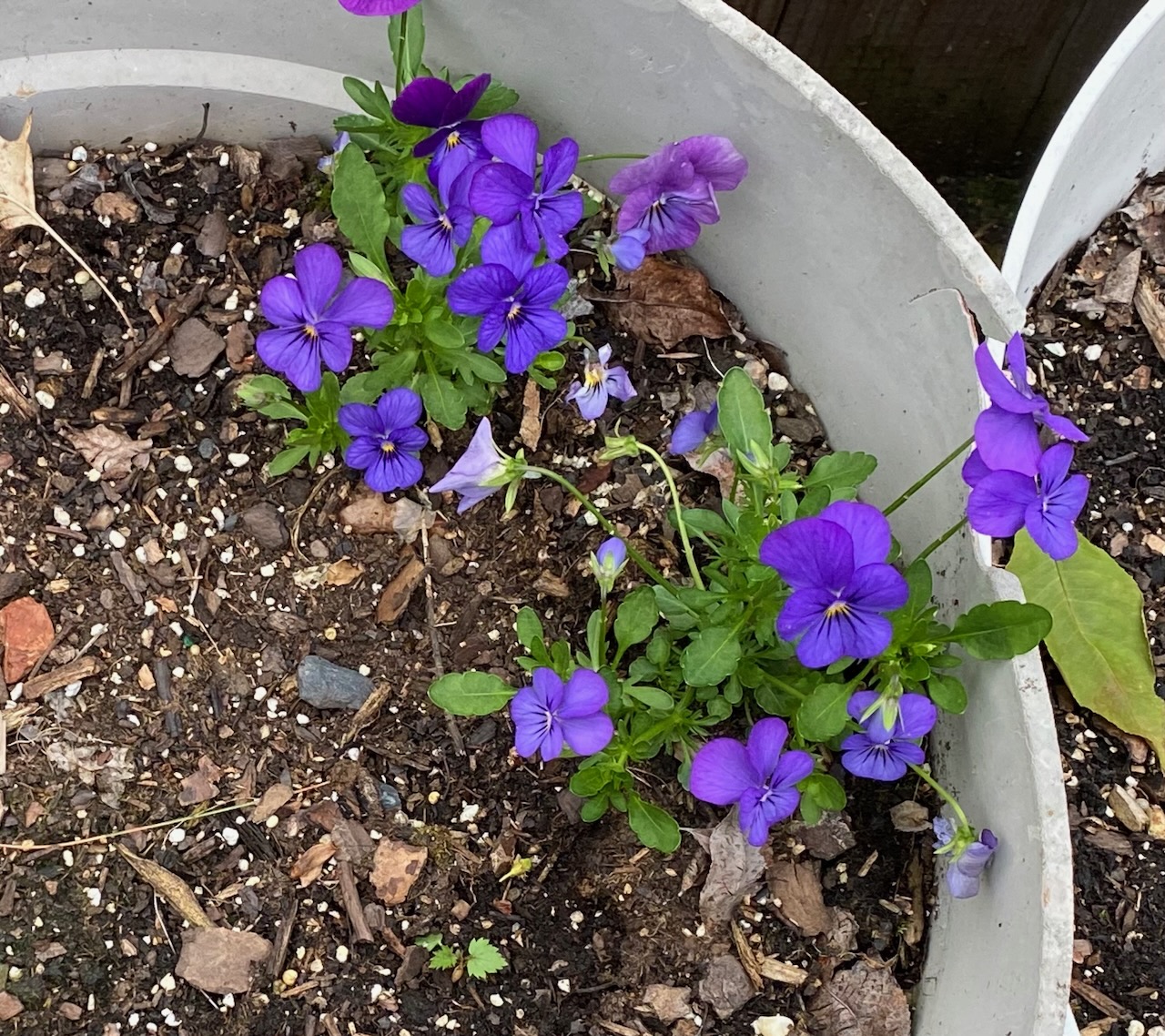 Moving around to the back yard, a flower pot that once held cosmos has come up with a crop of these little purple flowers, small enough to be violets but somehow I wasn’t convinced. Pansies were in the pot next to it last year. My garden books say four petals up and one down makes it a pansy, two petals up and three down is a violet. Two up, one down, and two sticking out to the side? Panselets?
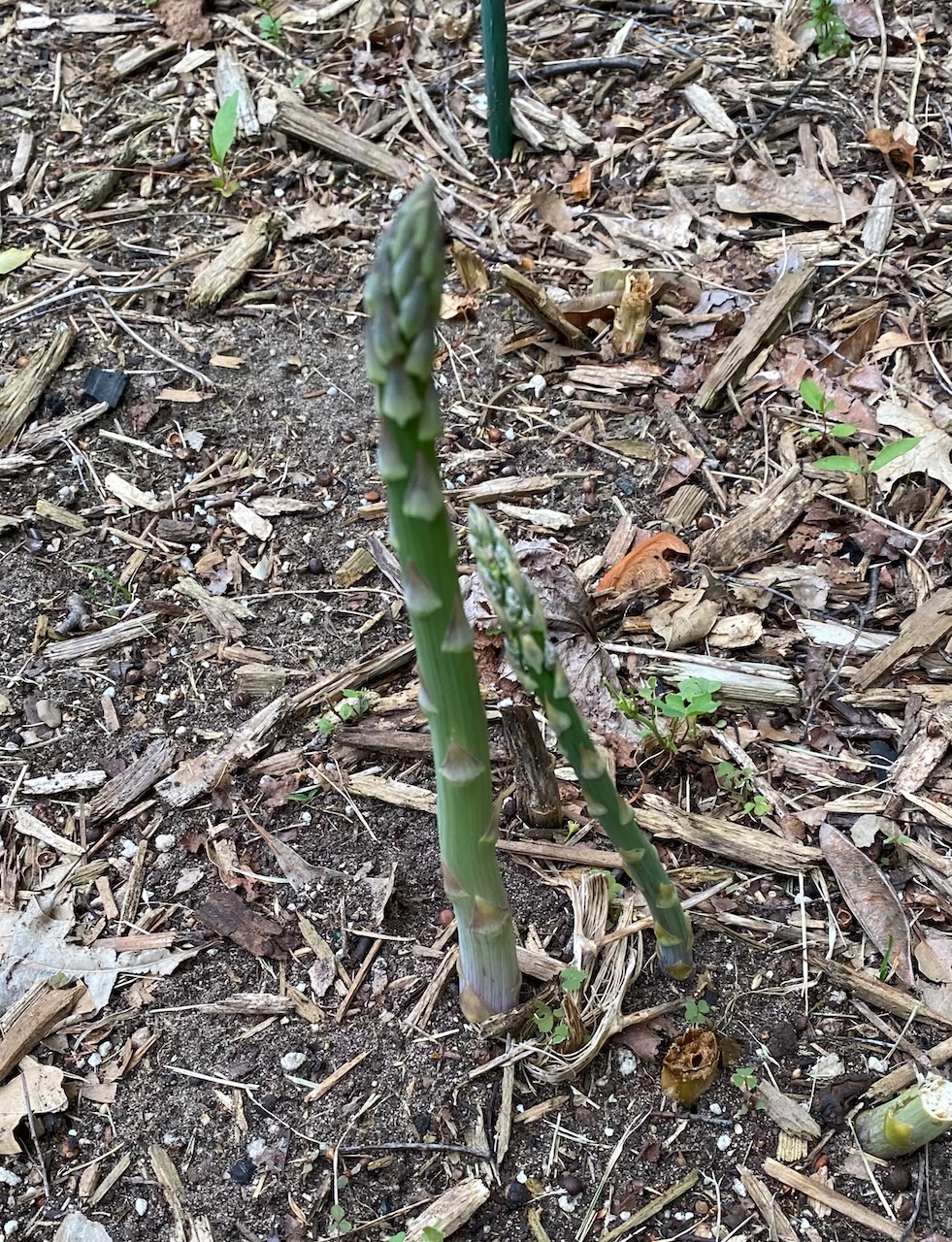 And then there’s the asparagus patch. I’ve seen it every year since we moved into this house, but it still makes me laugh to see the way it comes up out of the ground, looking for all the world like someone has snuck out to the garden and stood a bunch of asparagus spears upright in the dirt as a practical joke. But no, they’re growing right out of the ground. The second joy of the spring garden: that dirt, water, and sunlight turn into food and beauty, whether the way we expected or not.
 Robin Richstone