Footprints and Bitemarks

Every morning I go out into the yard to check for signs of late night and early morning visitors. The tomato plants are safely installed behind wooden fencing and chicken wire, but most of the yard is open to all comers. With the help of some Michigan field guides I’ve learned to inventory the damage:

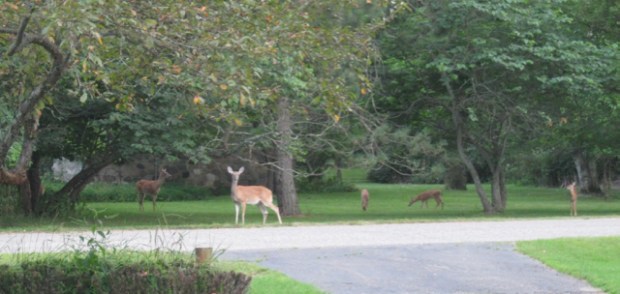
Deer: heart-shaped footprints, often placed daintily between plants without mussing them; chewed stems and leaves look like they were attacked by a kindergartener with dull scissors.

Rabbit: stems look like they were carefully sliced through by a master chef or ikebana expert in one clean, diagonal cut.

Woodchuck: stems, leaves, and flowers are not just bitten off, but wallowed over. Damage includes general crushing, as well as broken stems of innocent bystander plants.

Equally as interesting is discovering what the animals don’t eat. I spent much of my first Michigan growing season believing that sellers of so-called deer-and-rabbit-proof plants were blatant liars, but eventually I realized there’s just no accounting for taste. One deer’s nasty medicine is another deer’s caviar. I learned from a friend who lived in the foothills in California that to know what the animals in your yard will eat, you need a test kitchen: buy just one each of the things you hope to plant, set them out where the critters will find them, and wait a few days. The truth will out.
deer 2 cropped

Highest on the Inedibles List of my local herbivores are, in fact, herbs – thyme, sage, basil, oregano, those scented things we humans use to enhance the flavor of our other foods. These apparently trigger disgust in deer and rabbits. It’s amusing that they’re repelled by things we might cook them with. No sense pre-seasoning themselves.

herb garden

The Herb Garden


Keeping Tomato Faith

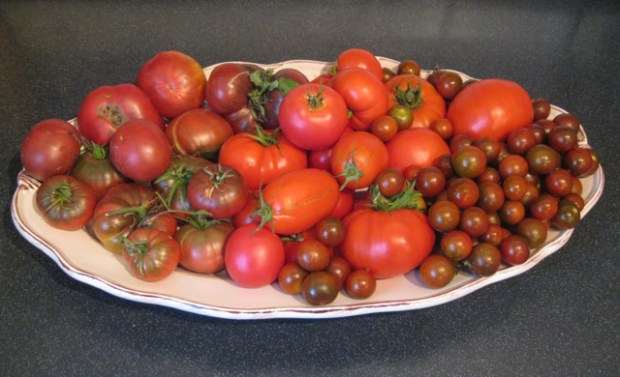
Every year in July there comes a day when I am convinced my tomato plants are not going to be productive. I see their struggles with weather, chipmunks, birds, bugs, and weeds, I count how few of them are on the vines, and I sigh to think this is the year when there will not be a whole lot of tomato sauce in the freezer.

Every year in August I have enough tomatoes to pave the kitchen floor. The two chipmunks spent most of their time fighting each other; the birds ate the bugs; the weeds were not that hard to keep up with; and I didn’t see many tomatoes because they were still small and green and hidden under leaves. They grew, they ripened, and here they are. Oh tomatoes, I am so sorry to have doubted you. Please accept this poem as an apology.rolling in


Revisiting the Eagles

Some weeks ago I wrote a post about seeing the eagles’ nest. I knew I’d get a poem out of that. Here it is.

Walk With Eagles and Thunder

As the road nears the river,
drama, but at altitude:
rumbling clouds, a waving tree,
a nest of eaglets stretching their wings,
aspirational silhouettes on a sky,
we see them, waiting
for the white-headed pair
now bearing captive fish, up, up,
through flights of lightning,
to those who are innocent
of that weight and struggle,
water and air laced with each other,
rain starting to fall,
we will be soaked with it
before we can get home.

A Perfect Sunday

Sometimes a summer day really hits all the marks.

The temperature was under seventy degrees when we got up, so Doug was agreeable to some yard work. The weeping cherry tree, so lachrymose that parts of it had died, was in need of a good trimming, which we effected by means of ladder, loppers, extension poles, and leaning out of second story windows. Really. Alas, I did not take pictures.

Happy with the result of that, no bones broken and the temperature now in the very pleasant seventies, I settled on the deck for my usual Sunday observance: the Church of the New York Times. Having already read most of the front section’s news Saturday online, I breezed through that, skimmed the Sports section – hey! an article about Jim Harbaugh! – and made my way through style, opinion, arts, business, travel, and magazine, to the real and only reason I subscribe to the Sunday Print Edition: the puzzles. When they announced they were redesigning the magazine, dudgeon was high among puzzle-lovers. “Put down your pitchforks,” said the New York Times (how did they know?) and treated us to a batch of extra puzzles without harming the beloved crossword. A soft pencil, a cup of tea, and I was set for the afternoon. Yes, I can do the crossword in pen, but I need a pencil for the seven-box Ken Ken and the acrostic, and I like all the writing to match.

When all the boxes and blanks were filled in, I weeded the herb garden. This sounds like work, but it consisted of kneeling on a cushion and running my hands through lavender, thyme, lemon balm, sage, and three kinds of basil, tugging out bits of grass, oxalis, and purslane that had wound their way in among them. I’m told purslane can be used as a salad green, but not by me. Too bitter.

After this I could have just sat around all evening sniffing my hands. Yum. Instead, I cut up some tomatoes and basil, laced them with olive oil, salt, and pepper, and tossed them into some pasta. We ate outside, on the deck, as the fireflies came out and a sense of enormous peace wafted over the yard and settled around my shoulders.

Simple enough. What made this a perfect day? The summer light, the temperature, the quality of the air? The balance between physical and mental activity? Was it having things to do that I thought worthwhile, but that didn’t really matter if I messed them up? Not all perfect days are alike, and often the intention to have one is not enough. Nevertheless, as you see, I am writing this one down, in case it turns out to hold any useful instructions for my future self.

A Little Assistance

I had a helper in the garden last week. He’s only been on the planet for two years now, and like most modern two-year-olds he loves to play with grown-ups’ smart phones and tablets, but what he wanted that morning was to help with a grown-up pastime of much longer pedigree. And he enjoyed it so much, he asked to do it again the next day.

He was adept at pinching off ripe blueberries one by one – “no green,” he reminded us both as he reached for the blue ones and popped them into his mouth. Then we went out the garden gate, into the woods, and he showed the same excellent technique with black raspberries (“no red, only black”). I don’t know if he was surprised that berries, one of his favorite foods from the grocery store, could be found outside growing on bushes. When you’re only two years old everything might surprise you, so that in essence nothing does.

There were clearly thought processes going on, and he used the vocabulary he had at hand to express them.

“Water plants?” for instance meant, “can we play with that hose and spray water all over our bare feet like we did yesterday?”

Yes, we can. We did. It was a hot day.

We raked some lawn, cultivated flowerbeds, and dug around in a barrowful of compost. He was a full partner in these activities, each of them interesting to him, adding to his repertoire of life’s possibilities. Discovering and expanding on those possibilities is what growing up is all about. Whatever else he does as he grows up, I hope he’ll remember that cool water on a hot day and the taste of a favorite fruit, and know that gardening will always be there for him. We’ve made a good start.

The Poetry of Weeding

I enjoy weeding. I really enjoy it, the rhythm, the fresh air, the gentle physicality of kneeling on the ground and digging my fingers into the dirt, purposeful but not obsessive. It’s a good example of how humans are born gardeners: we distinguish little green growing bits from each other by sight, not scent; we have opinions about which ones we value and which should take their business elsewhere; and our opposable thumbs and index fingers are exactly suited for pinching the weeds out from among the tomatoes, leaving the tomato plants unharmed.

Weeding is also one of the most reliable things for me to do when I’m working on a poem and get stuck. Writing a blog post or essay, there’s always some part of it I can keep doing even if I’m not making progress on its substance. I can play with paragraph length, check straight-up grammar and punctuation, polish a sentence or two. Just keeping at it will yield results.

Not so for poetry. When I hit a sticking point while writing a poem, I have to stop and go do something completely unrelated for a while, something where I’m paying attention to actions but not thoughts. Weeding is a perfect activity for this. Right in the middle of it the solution for the poem will pop into my head. It’s like when you can’t remember where you put your car keys, and you rack your brain for a while, and then give up and go do something else. You are not thinking about your car keys at all, but suddenly it leaps to the front of your mind: this is where the car keys are. Clearly the wheels have been turning in your head. You haven’t planned this. You haven’t asked the weeds to help with the poem; you haven’t said okay, I’ll just leave my brain alone for a while and it will figure this out. Your brain did this for you as a gift, totally on its own. Or so it seems. Thank you, brain.

Fireflies

Dusk is late in Ann Arbor in July, it comes halfway between dinner and bedtime. I walk through the yard in the last light with a cup of tea, watching the fireflies’ silent calls, small lightning without thunder, across the falling evening. I can’t see them at all until they light up, and I wonder if they can see each other, if they’re aware of each other, in their dark phases. Their movements are not frenzied like moths at windows, they float in deep silence, no chirps or clicks, and they wink out in one place to reappear as a surprise in another. They dance to light, not music. It might for all I know be wild, frenzied excitement to the fireflies themselves, but to me it is peace and calm, the benediction of a summer night.

I am barefoot, and I feel the grass dampening as the air cools. It’s still light enough to see where I have weeded, planted, tidied, and where I still have more to do. It’s deeply satisfying to have finished what I’ve finished, and also that there’s more to keep on doing. A garden is always a work in progress.

It’s been another good and ordinary day, some reading, some writing, some sketching, some gardening, and now watching the fireflies like tiny angels bringing their news in flashes, bright against dark. Once, as a child, I put them in a jar, but I didn’t know what to feed them so I let them out. Stay free tonight, fireflies. Forage, and mate, and do whatever makes a good and ordinary firefly day. I don’t know how a firefly feels about that, but I will be grateful enough for both of us.


Sparklers

There are many things I really like about the Fourth of July. There’s picnicking with friends; potluck barbecues; decorating with flags without feeling like a Republican; and Mama woodchuck finally kicking her babies out of the den, decreasing woodchuck damage to about half. But my favorite thing is sparklers.

Sparklers have many advantages over other types of fireworks. For one thing, they are quiet: a little hiss and pop, but nothing to knock down the tiny hairs inside your inner ear. For another, you can hold them right in your hand while they are lit and sparkling, which means you can write your name in the air with them, or conduct phantom symphonies, or illustrate your best dance moves. And because they are so nearby instead of expoding high in the air, you can deploy them before dark. In Michigan, where the 4th of July sky does not go dark until ten o’clock at night, this makes it possible for children to wield them before cranky time sets in.

A lawn full of children with sparklers is a joyous sight, rather like having an entire corps de ballet of lightning bugs performing for you. A small child who has never had one before is likely to be hesitant or fearful of the sparkler at first, may take it tentatively, with one eye on the water bucket where the burnt-out sparkler sticks are collected, having been reassured the sparkler can be discarded there at any time. But when the bright, ecstatic, symmetrical arrays of glittering starpoints burst improbably from the plain grey stick now in the child’s control, delight overcomes doubt. Confidence is born. Dancing happens. Another name is written on the coming night; another masterpiece of unheard music is conducted. And when it burns out another laughing child runs to the bucket, drops in the spent stick to the sound of a deeply satisfying hissssss, smiles up at me, and asks, can I have another?

Of course.

Eagles and Thunder

On our Sunday morning walk, Doug and I came across a woman standing in the road with a large pair of binoculars, looking intently up into the trees. Naturally we asked her what she had found.

“It’s the eagle’s nest,” she said, as if we must have heard of it, which in fact we had. Or rumors of it, anyway. Somehow it’s hard to believe, in a suburb, that there could be an eagle’s nest in an ordinary tree. I mean, I do crossword puzzles, I know what an aerie is, but I always associated it with high steep cliffs. Not what you typically find around Ann Arbor.

“Which tree?” we asked, and she pointed it out, noting that it was harder to see the nest now, with the trees leafed out, than it had been just a couple of weeks ago. We scanned as high up the trunk as we could, peering through the many other trees between us and it, unsure which clump was the nest. But all speculation ended when a pair of wings lifted out of one clump, spread, shook, and subsided again.

“Those babies,” said the woman, “are so ready to fly.”

She said there was a live webcam view of the nest, which we had also heard. But right at this moment we heard something else. Thunder. Oops. Last night’s weather forecast was for no rain until afternoon. Guess we should have checked for an update before we went out. A few drops began to fall.

“I’m going to duck into my friend’s house,” said the birder, as we all started back up the road. She rapidly outpaced us, since Doug kindly kept to my slower speed, but the storm outpaced us all. The rain came by the bucket, and we were soaked to the skin in minutes. It was warm enough that it was sort of like taking a shower, except for that thunder, which certainly implied lightning. In a few more minutes we saw lightning, too, and Doug counted seconds to the thunder to judge how far away it was. Five seconds. Then six. Good, that was going in the right direction.

As soon as I stopped worrying about being electrocuted, I began to see this whole event in terms of a poem: the wings, the noise, the sudden revelation. It has everything going for it. I just need a pen and some paper.

Meanwhile, here’s the webcam. Remember, it’s live, so you need the patience of a birdwatcher to stick with it until anything happens, like the parents coming in with a fish, or the juniors flapping around: