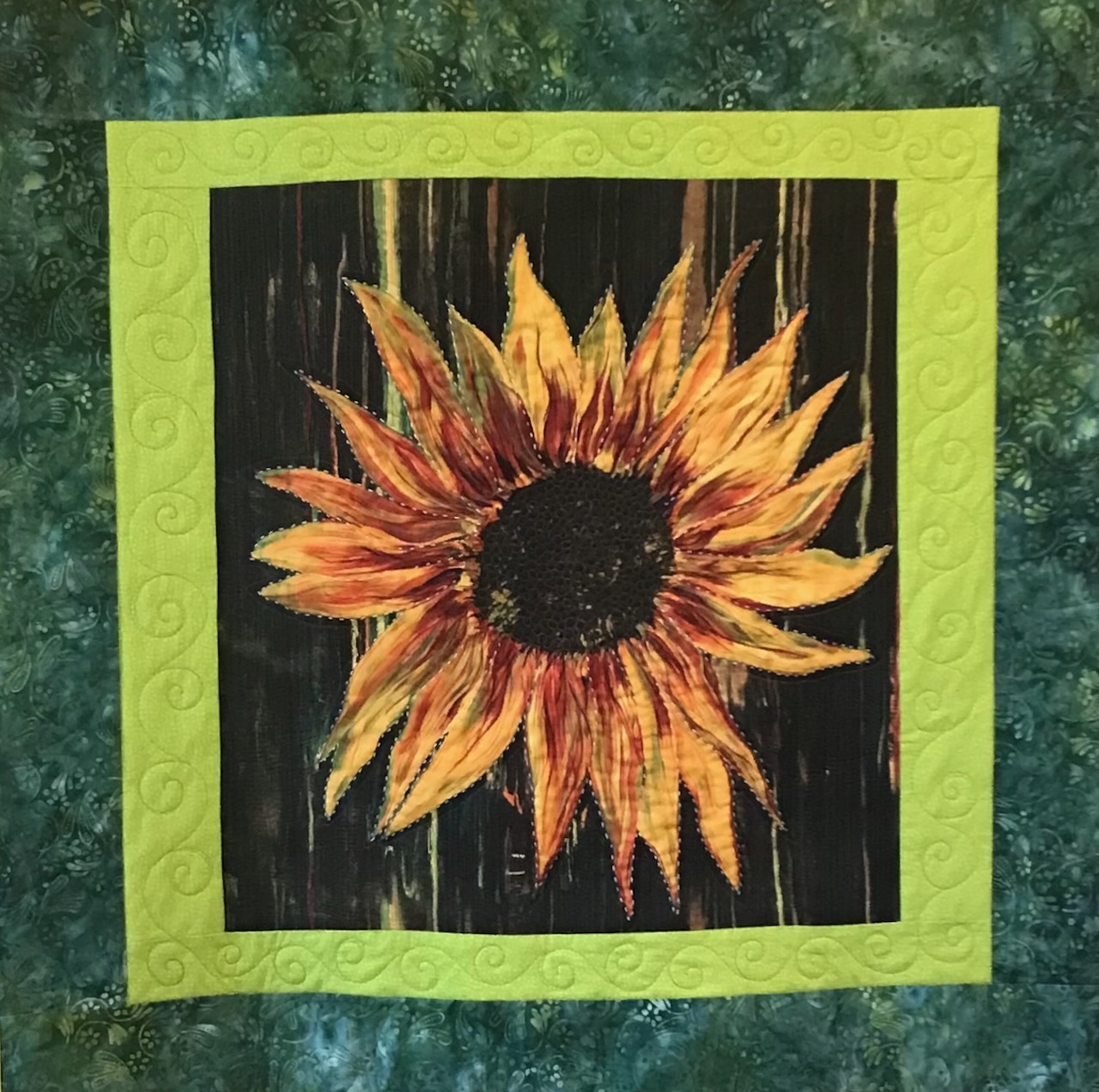
 It was exciting to find that the path of April’s solar eclipse ran through the Midwest. This was cool, except that the Midwest is charmingly green and fresh in April because it typically rains a lot in April. Cloudy weather, at the least, was to be expected. We only had to go as far as Toledo, a 45 minute drive, to see totality, so we wouldn’t need to set out before we had a weather report. The University of Toledo had a football stadium called The Glass Bowl – Toledo is the Glass Capital of the World – with free entry and a large, free parking lot. And bathrooms. Doug and I set out with our friends Bob and Sue, a picnic lunch, and folding chairs, and sailed right into traffic. But we anticipated that, so even with the ridiculous two and a half hours it took to get there, we were in plenty of time.
We parked at the stadium, unfolded our chairs, and set up our tailgate. A reporter from the Detroit News came, took our picture, and asked where we were from. Ann Arbor, we said. What made us come “to the University of Toledo, of all places” to see the eclipse? We told him – bathrooms and free parking – but he must have found people with better stories because he didn’t use ours. I noticed that the UT Rockets’ team colors were blue and gold. Perfect!
 The clouds were thin. We ate our sandwiches and nibbled grapes, mandarins, and trail mix, looking up now and then through our eclipse glasses. Inside the stadium they had rock music and an announcer, which we could hear, but weren’t really listening. Until we heard him announce that it was six minutes to totality, and be sure to wear our glasses as long as we could see even a sliver of the disc of the sun. Now we turned completely toward the sun, glasses in place.
The shadow would be coming from the west and we didn’t have much of a view in that direction, so what we clearly saw was not the shadow on the ground, like last time, but what’s been called the Column of Doom. If you didn’t know what caused the eclipse it would be extremely frightening: heavy, dark, chilling, yet clearly not a thunderstorm, more like a shroud carried by some very determined spirit left unappeased.
The announcer went into his play-by-play: “The moon’s shadow has now crossed the border into Ohio State. Five minutes to totality.” More music; then “The moon’s shadow has just crossed Dayton. Three minutes to totality.” Through our glasses we saw the disc of the sun become a child’s drawing of a sickle moon – then a fingernail paring – then a tiny, tiny sliver, a smiley-face frown.
From the stadium, the announcer said “ we are going to stop talking and stop playing music when totality arrives, so that everyone can appreciate it in their own way. We’ll talk again when totality is over. You can take off your glasses for totality, but be sure to put them back on as soon as the smallest bit of sun returns.”
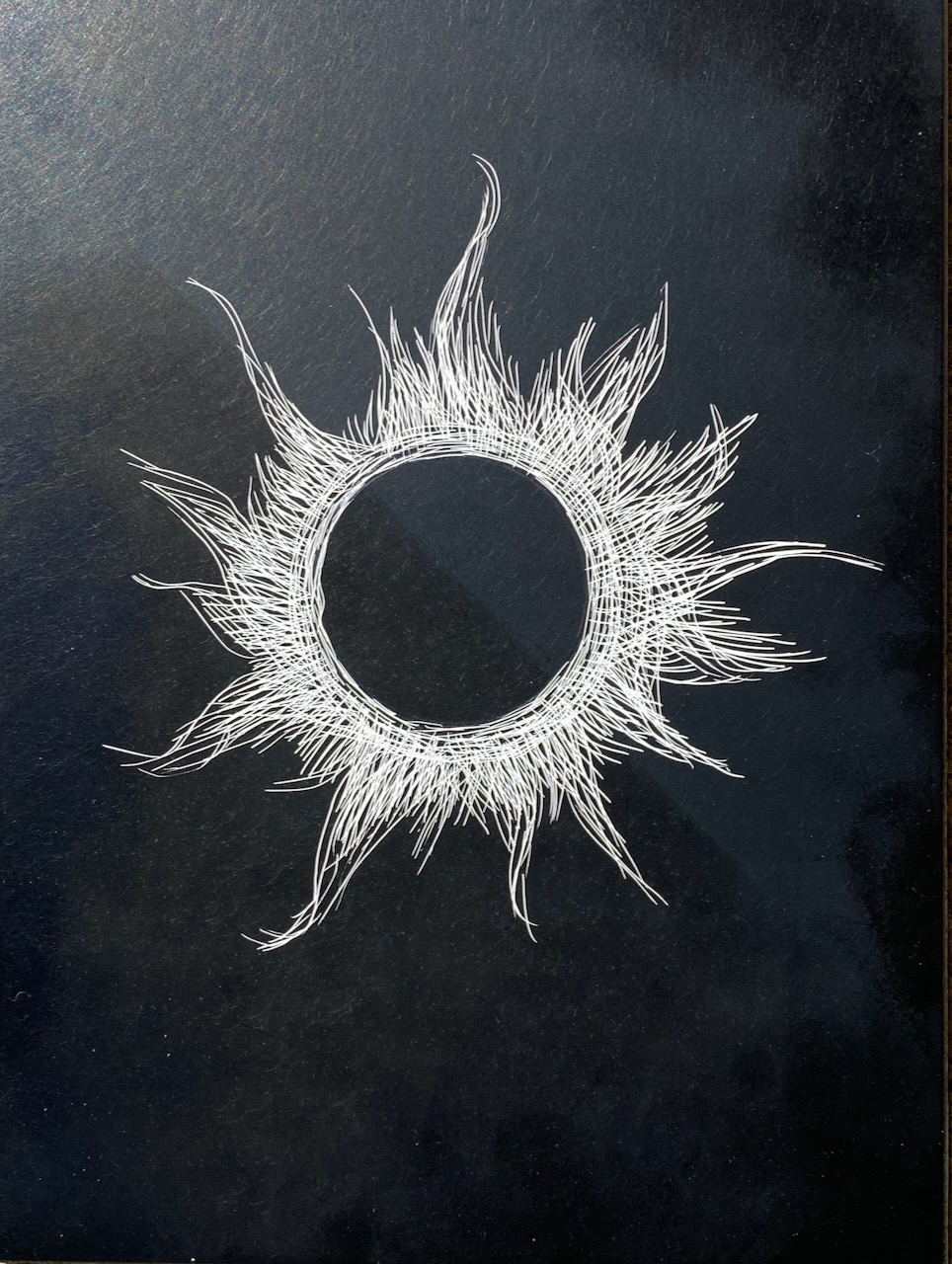 And then it was quiet. It got cold. It was dark. Birds chirped and nested in the nearby trees. The last sliver of sun succumbed to the moon’s shadow and we took off our glasses. There was the diamond ring, a brilliant, one-sided flash the clouds did not conceal, and then even the diamond ring disappeared and suddenly – so suddenly – the sun was a hole in the sky, pitch black, and a big corona danced around its perimeter. It was startling, how suddenly the corona leaped out at us. Where had it been all this time? How weird that it was always there and we could never tell – never, because even the smallest sliver of sun was too much for it, overpowered it. But now there it was – not showing up for our cameras, but perfectly plain to our bare eyes – a crown of flames; a circle of crazy lightning bolts, a nuclear lei, glorious. The moment it appeared, a cheer went up from the stadium. This was just what happened at totality in the eclipse of 2017: a spontaneous cheer! Hurray for the cosmos, which does not disappoint. Hurray for knowledge leading to reliable predictions, hurray for something to trust, hurray for the universe delivering beauty no matter how much we down here mess up. Hurray for good news. Hurray for something we can agree on: that it takes our breath away. Hurray for the shared experience and not carping that our awareness of it was provided by – oh yes – elites. Hurray for forgetting ourselves for these two minutes, and talking part in something bigger.
Then the diamond appeared on the opposite side of the ring, and the announcer returned. “Totality is over,” he said. “Put your glasses back on.” The lyrics of the music he chose said “Everything’s gonna be alright.”
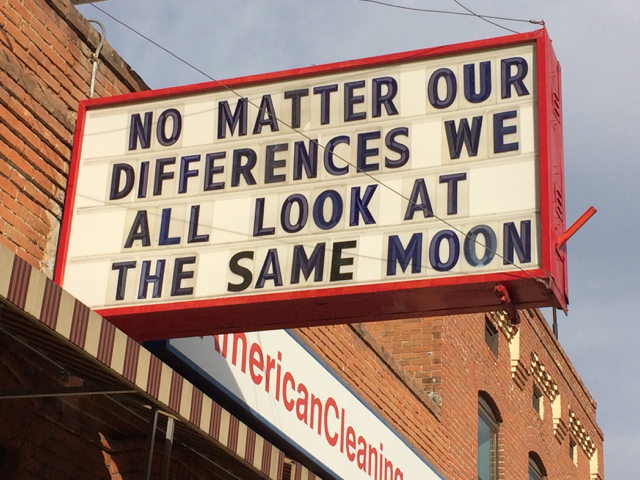 We packed up the car and joined the crowd streaming home, strangely tired considering all we did was sit while the moon did all the work. Elation, exuberance, and amazement can really tire you out. Once again, Doug was right: there is nothing like an eclipse.
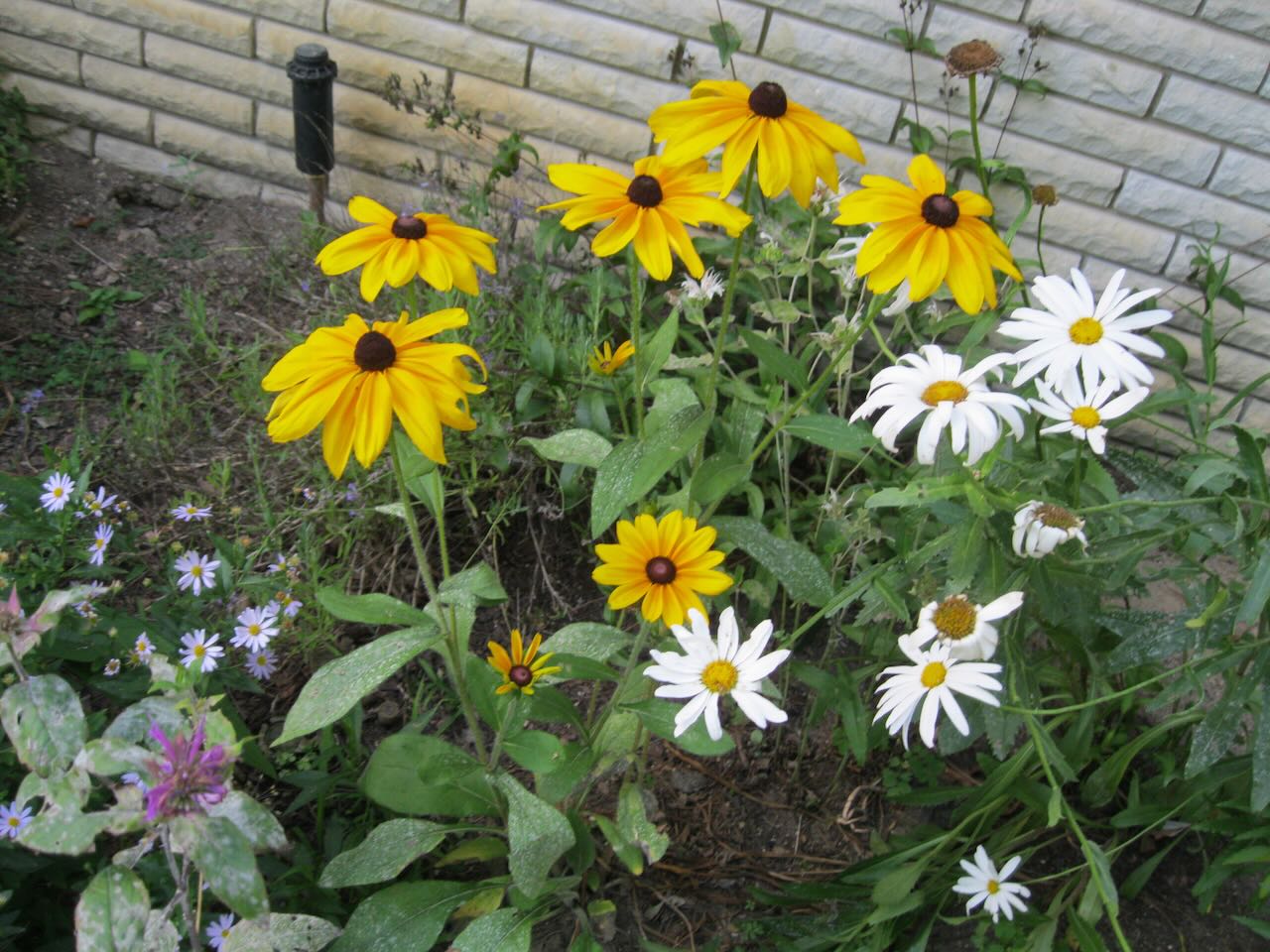 My friend Cindy is always a little sad when the rudbeckia bloom because in Michigan, she says, it means summer is almost over. But Labor Day is no longer the benchmark it once was, not even for schoolchildren, who are increasingly likely to go back to class in August. No one would say summer is over in August. And this year frost is not predicted for southeast Michigan until November, so I think she has plenty of summer left.
 So do the fawns. I’m told they’re mostly born in June, but we don’t see them foraging in our yard until mid-July, and more of them in August. They will lose those spotted markings as they grow their winter coats, usually starting in September. It will be interesting to see when that happens this year.
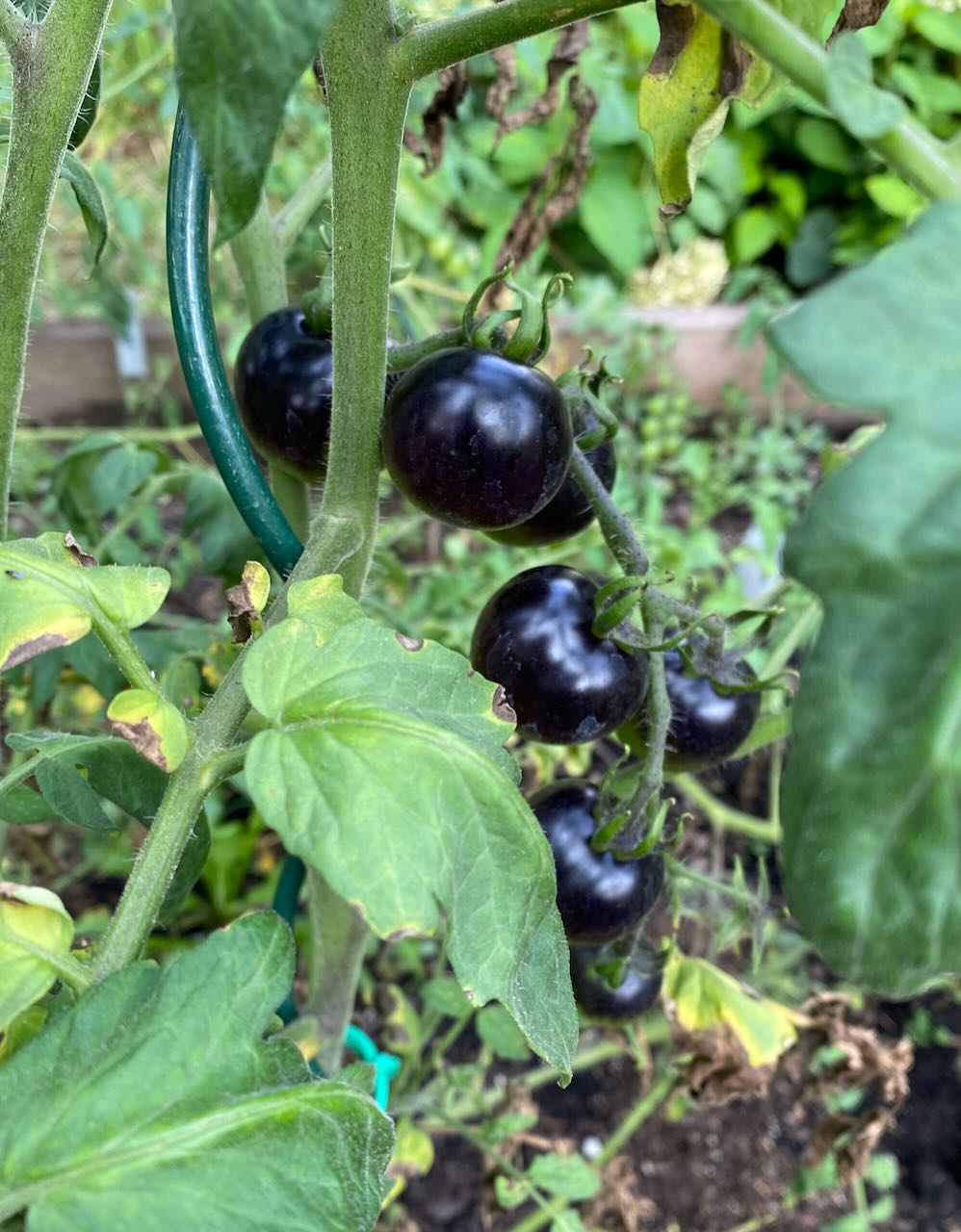 But of course August is also the big month for tomatoes. Such an inspiring fruit, in its masquerade as a vegetable and its ability to make anything delicious. What would bacon and lettuce be without it? How would spaghetti manage? Whatever did they eat in Italy before tomatoes arrived from the New World? Here are my “indigo” tomatoes, that fool the squirrels, a harvest with basil, and a poem I wrote to celebrate them all.
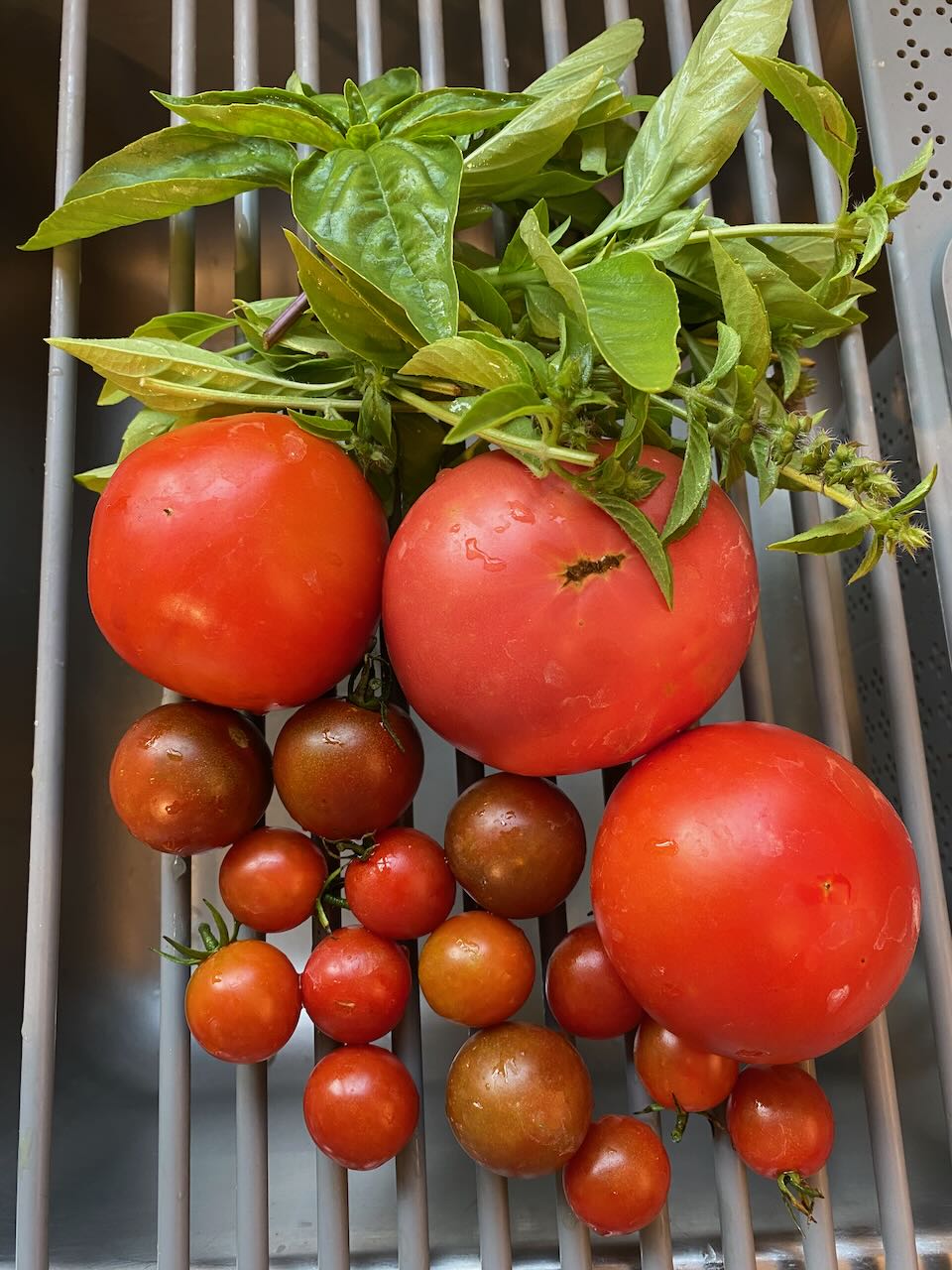 Bumper Crop
 I have a good lawn for deer and rabbits, full – if only accidentally – of diverse edible weeds. Looking out over it, especially when Charlie has just mowed, the lawn looks smooth and manicured. Appearances frequently deceive. For instance, this photo might look like a nuclear deer family, two fawns, a buck, and a doe. But four other the deer had already gone ahead into the woods before I got my camera out. The buck would have been bringing up the rear as usual, except that the fawns were lollygagging behind. But as soon as I made a tiny sound of satisfaction at getting this photo, their heads snapped up and the fawns leaped after the does, while Mr. Buck stood guard in case I made any moves. I didn’t. I was trying to see whether he was an eight point or a ten point, but he was gone before I could be sure.
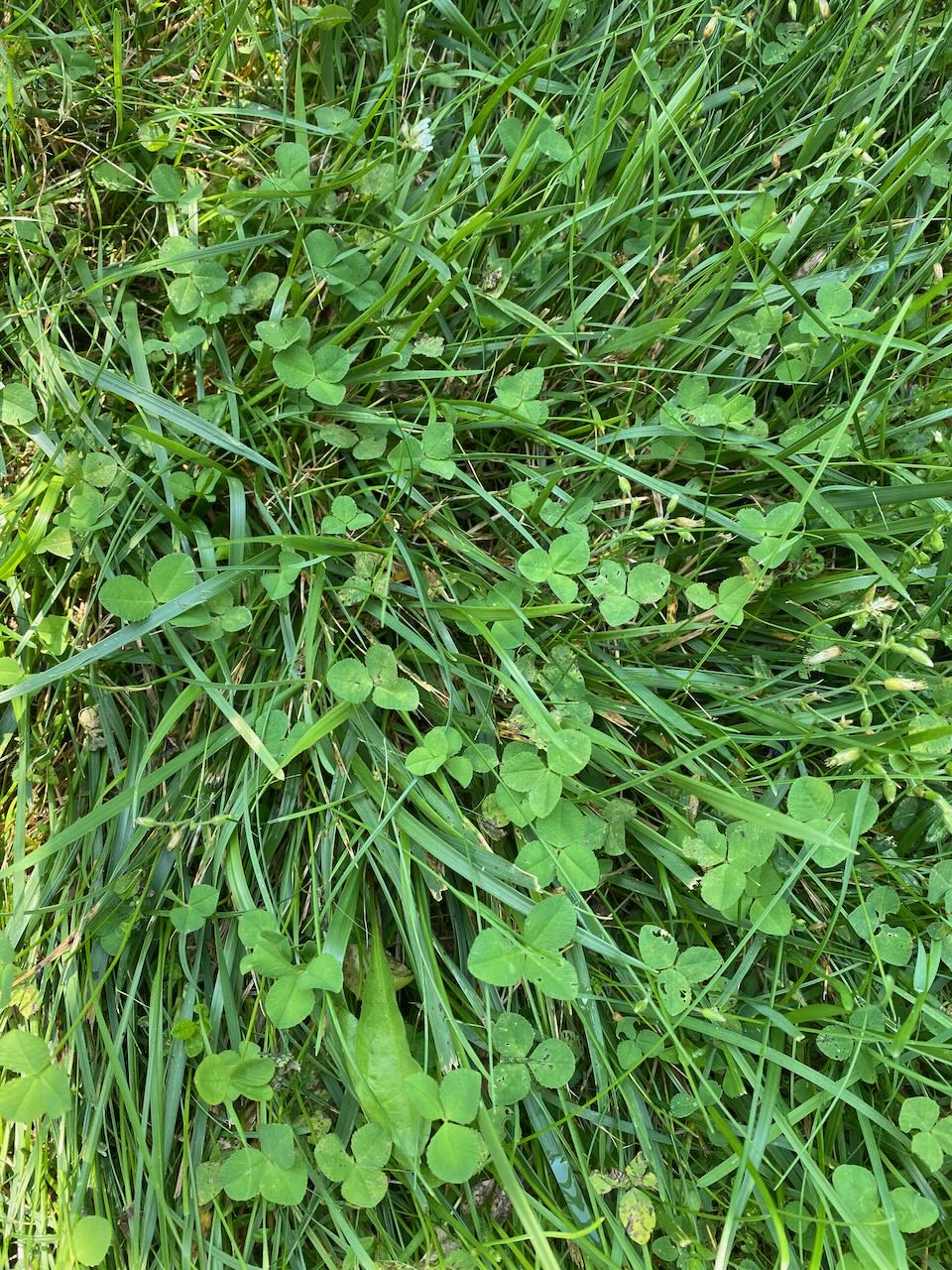 My lawn has a lot of white clover in it, which some consider a weed but I do not. In my suburban childhood it was common for lawns to be seeded with half grass and half clover. Clover is sturdy, holding up well to children and pets; clover fixes nitrogen so you don’t need fertilizer; and clover flowers attract bees, which will pollinate your garden plants and fruit trees. Charlie was late mowing this week, because we had two days of Hurricane Beryl’s leftovers drenching Michigan with rain. Amazing that a hurricane came all the way from Africa to crash into Texas and charge up the Mississippi and Ohio River valleys to the normally hurricane-free Michigan. Many were the frantic sump pumps in Ann Arbor, but the sandy soil of my yard was up to the task. When it was over, everything was safe and green, green, green.
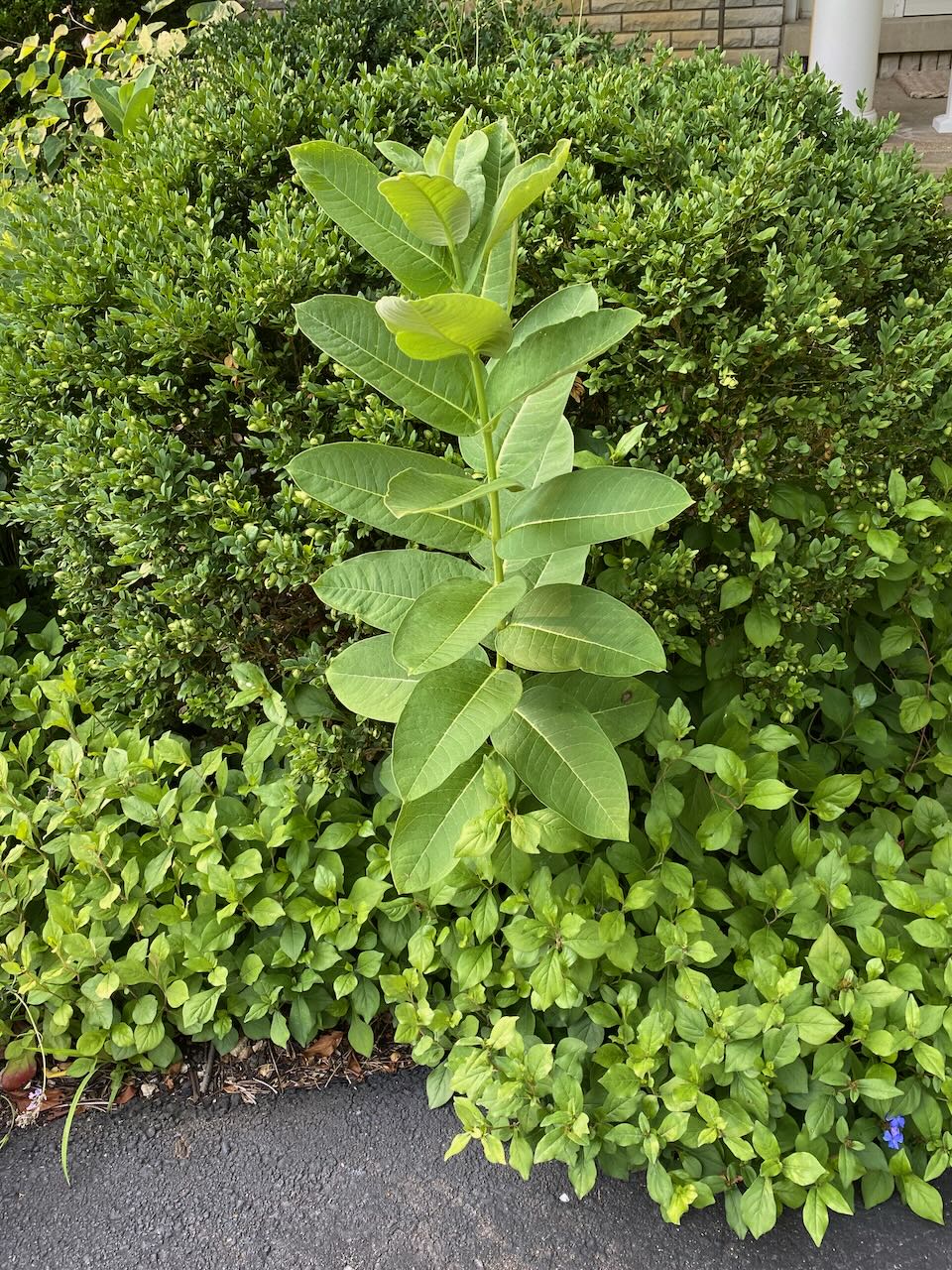 Besides the clover, there’s plantain in the lawn and purslane at the margins. Plantain, native to Europe, was called “white man’s footprint” by Native Americans: where the white man set his foot was where you found plantain. It’s not only edible to deer, it’s edible to us. Purslane is, too. My attempts to actually eat these plants have never worked out. Purslane leaves are small and have to be gathered in large quantities, and I found plantain, which grows flat against the ground, hard to clean. I magnanimously leave them for the deer, in spite of which they persist in eating things they really, really shouldn’t. For instance, milkweed. Milkweed is poisonous, but if you are a clueless fawn, well, just look at those big, juicy leaves. I assume it’s the fawns because I assume they don’t grow up if they eat the milkweed.
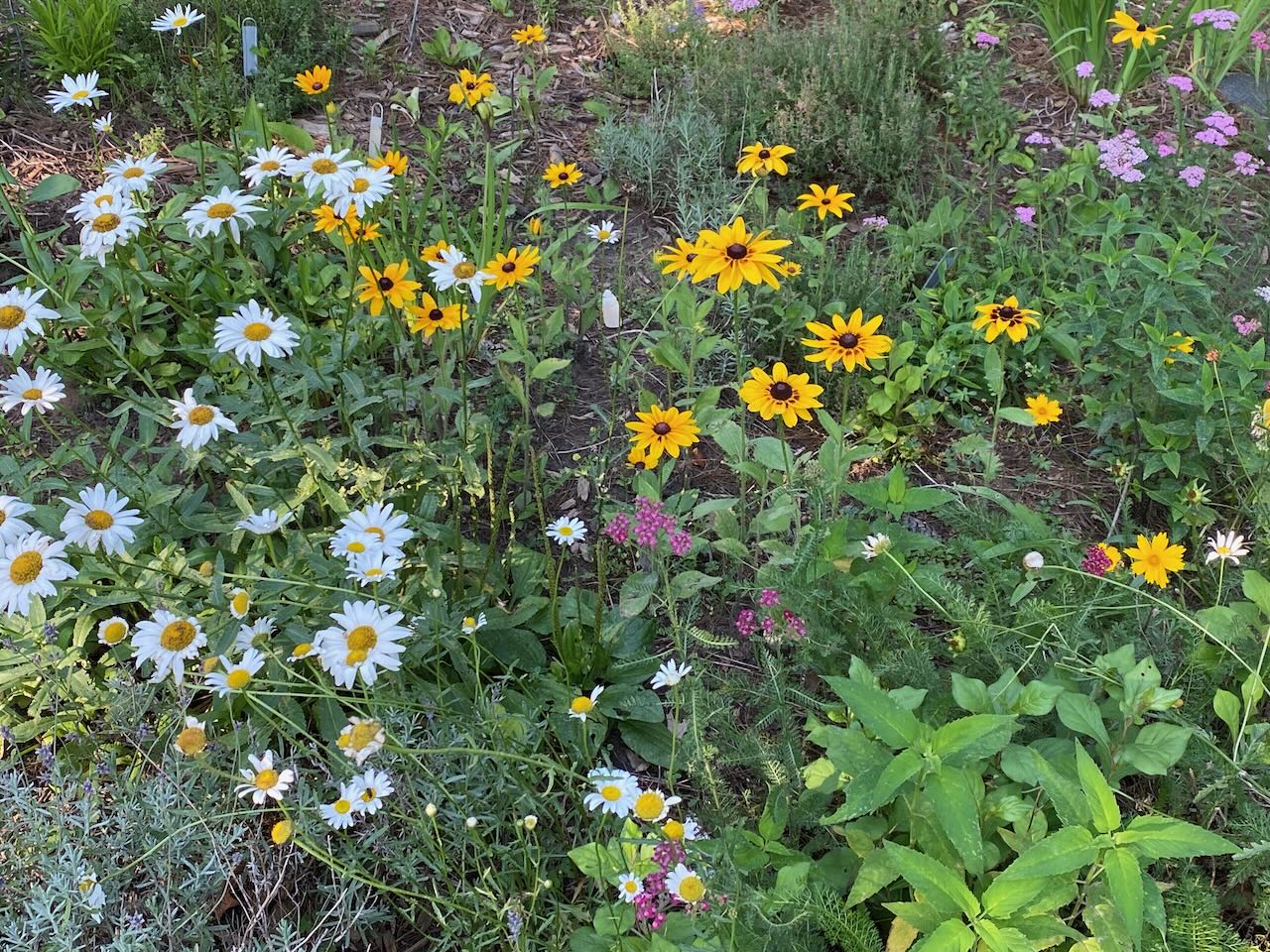 Deer sometimes also eat my rudbeckia, yarrow, and shasta daisies. Garden catalogs will tell you they shun these plants, but garden catalogs have never met my deer. Every evening or two, I walk through the yard with my trusty spray bottles of animal repellants, switching off now and then so the critters don’t get used to one of them. I almost dread to say so, for fear it will jinx their effectiveness.
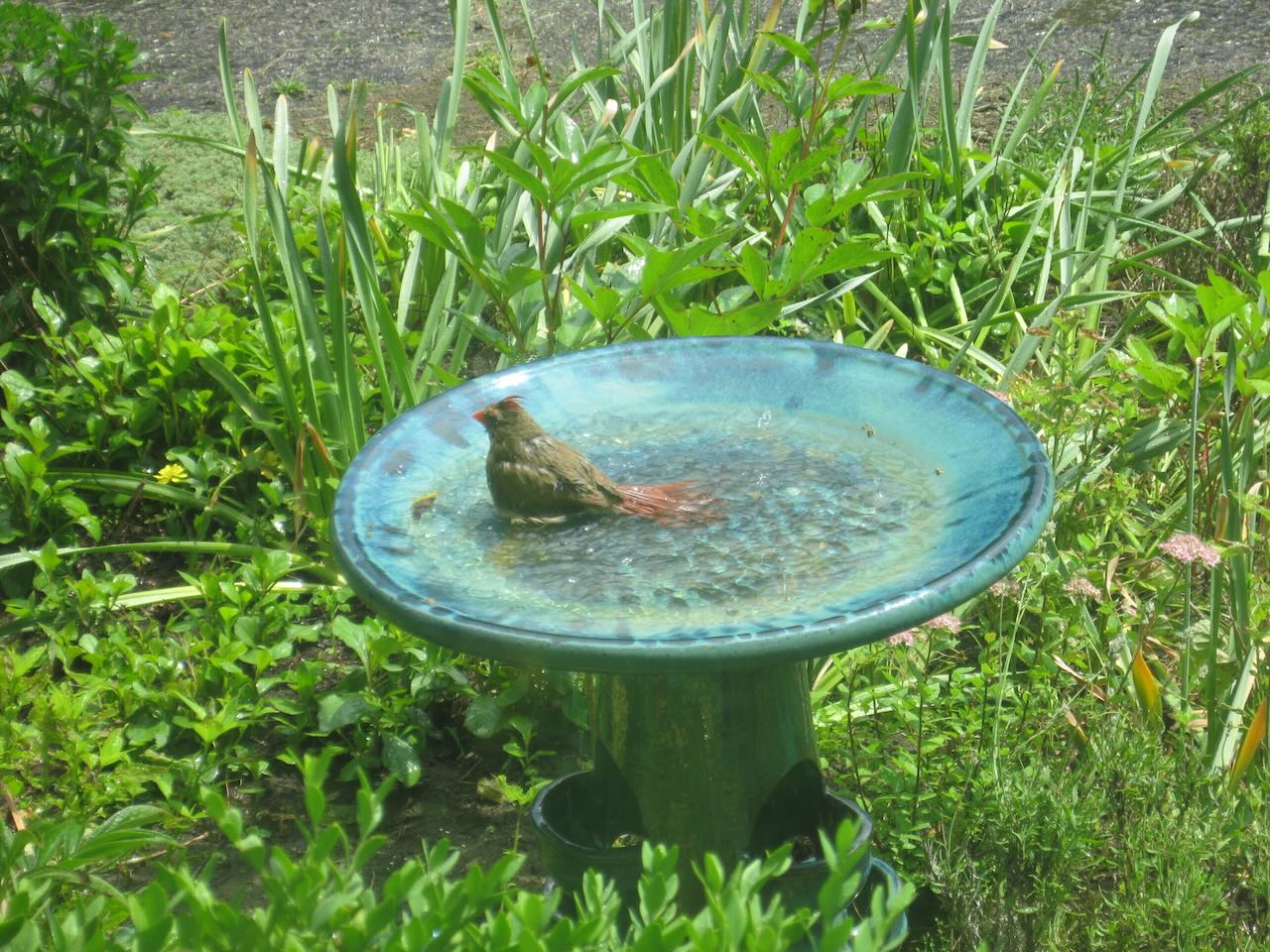 The amount of rain in that storm varied a lot from one part of town to the next. I don’t currently have a working rain gauge, but friends and neighbors have measured anywhere from five to seven inches over two days. One curious thing I’ve noticed is more birds using the birdbath after a rainstorm. This seems totally counter-intuitive to me. Didn’t they shower in the rain? Is it easier to bathe when they’re already wet? Or maybe newly-fallen rain is more attractive to them than water that’s been sitting around for a few days. Not being a bird, I will never know.
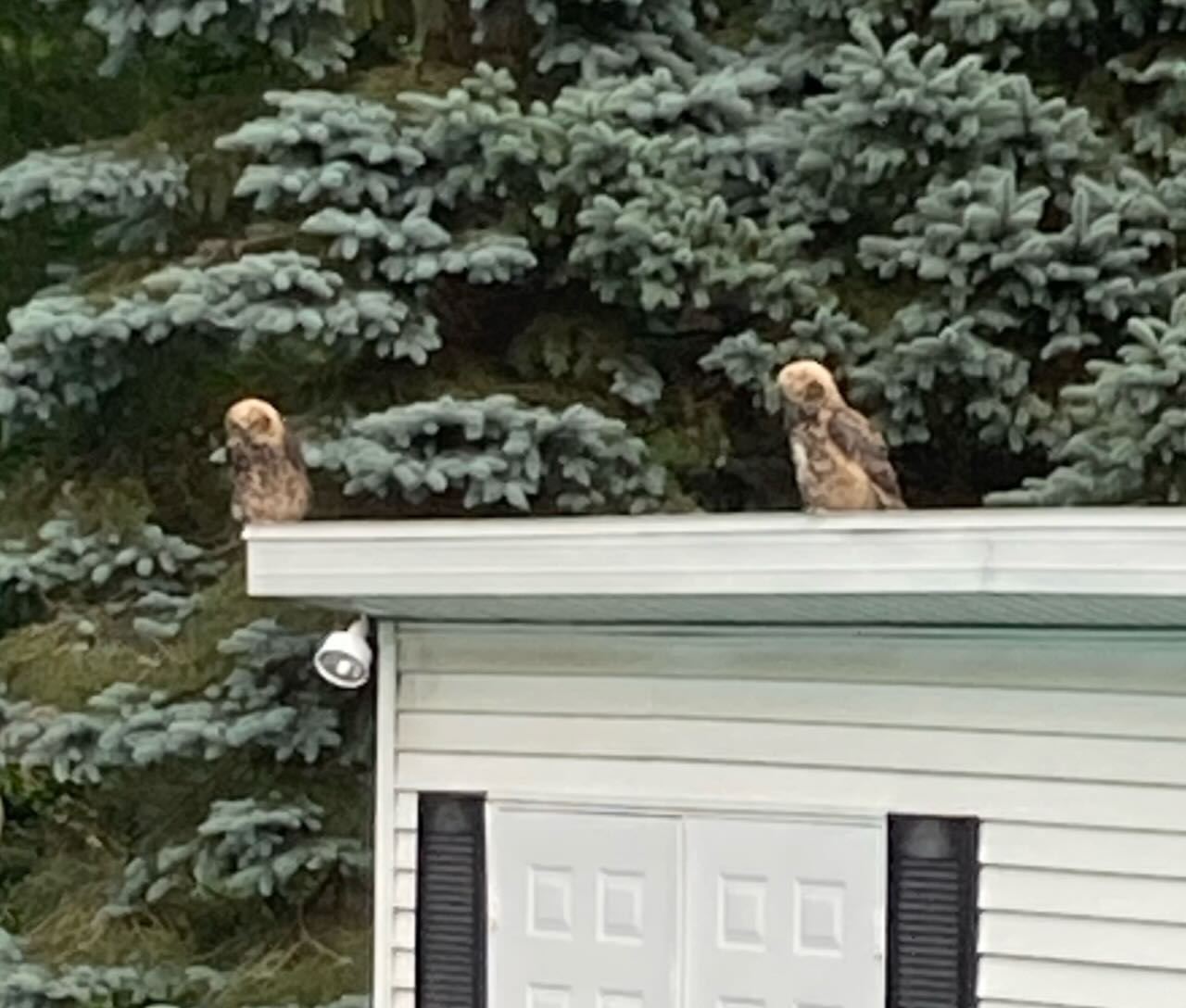 My neighbor texted me the other day to tell me there were two great horned owls on the roof of her pool house. They were eyeing the pool vacuum with great interest, in case it climbed out of the pool and was revealed as dinner. Eventually they lifted their heads, the larger one outstared the smaller, and the smaller retreated to the far corner of the roof. Since female great horneds are larger than males we assumed this was a couple, and anthropomorphized a spat for them. But this was way past mating season for great horned owls, and on reflection this was more likely Momma and a growing chick. Was she teaching him to hunt? Trying to get him to fend for himself? Trying to get some time to herself for heaven’s sake? Still anthropomorphizing.
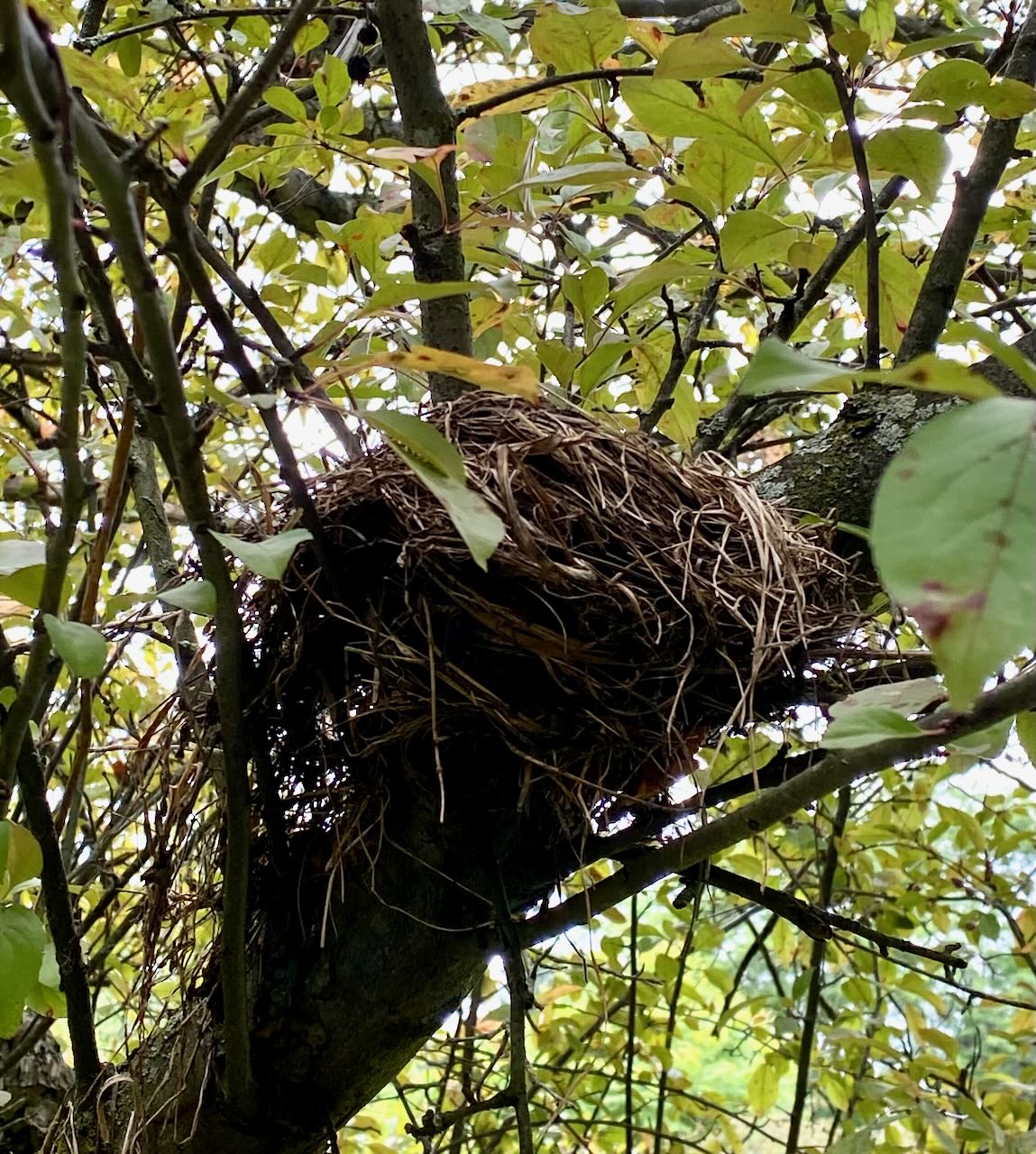 But birds, like people, do need to care for their young for a good chunk of their lives. We can relate. Not long after seeing the owls – though, sadly, after leaving my camera in the house – I walked out to my mailbox and found a baby robin hopping along the driveway near the crabapple tree. I could see where the nest was, though I couldn’t reach it. It looked like everyone else had fledged, but Junior had not quite made it. As he hopped he flapped his wings a bit, but didn’t get any lift.
 I walked after him wondering what I should do, but the point was soon moot. He headed for this nice, thick stand of mountain mint, disappeared into it, and began to cheep. Good cover, I thought. It was a nice, steady cheep, like a beacon. Then I noticed that baby and I were being watched by a full-sized robin on the lawn. I took the mail back into the house and looked out the window to see big robin pulling a worm from the lawn, and carrying it into the cheeping mintpatch.
 Next morning the cheeping came from a tall clump of Siberian Iris on the other side of my front door, and the parent robin waded in with another beakfull of worm. A successful night. There was cheeping and worm catering the next day too, from a little further back. A second successful night. The morning after that I didn’t hear him. Did baby bird learn to fly? Was he cheeping somewhere else? I hope those owls didn’t find him.
 I’ve read that fewer than half of all baby robins survive, and yet robins are not endangered. They’re busy all summer, laying eggs, feeding babies, traipsing around after fledglings, repeating the process two or three times per summer just to survive. Free as a bird, we say, watching them fly and hearing them sing. In fact they are bundles of purpose. I’m glad to see them taking the occasional break – or so I think of it – in the local spa.
 Of all the birds in my yard – and though I’m partial to Robins, for obvious reasons – my favorites to watch are the wrens. They’re tiny and adorable, they wag their tails, they hang around the house, and then they open their teensy beaks and this huge, rolling, gigantic wave of song comes out. How do they do that? When one of them sings outside a window, you’d swear he – or she – is inside the house. A group of them is called a “chime.”
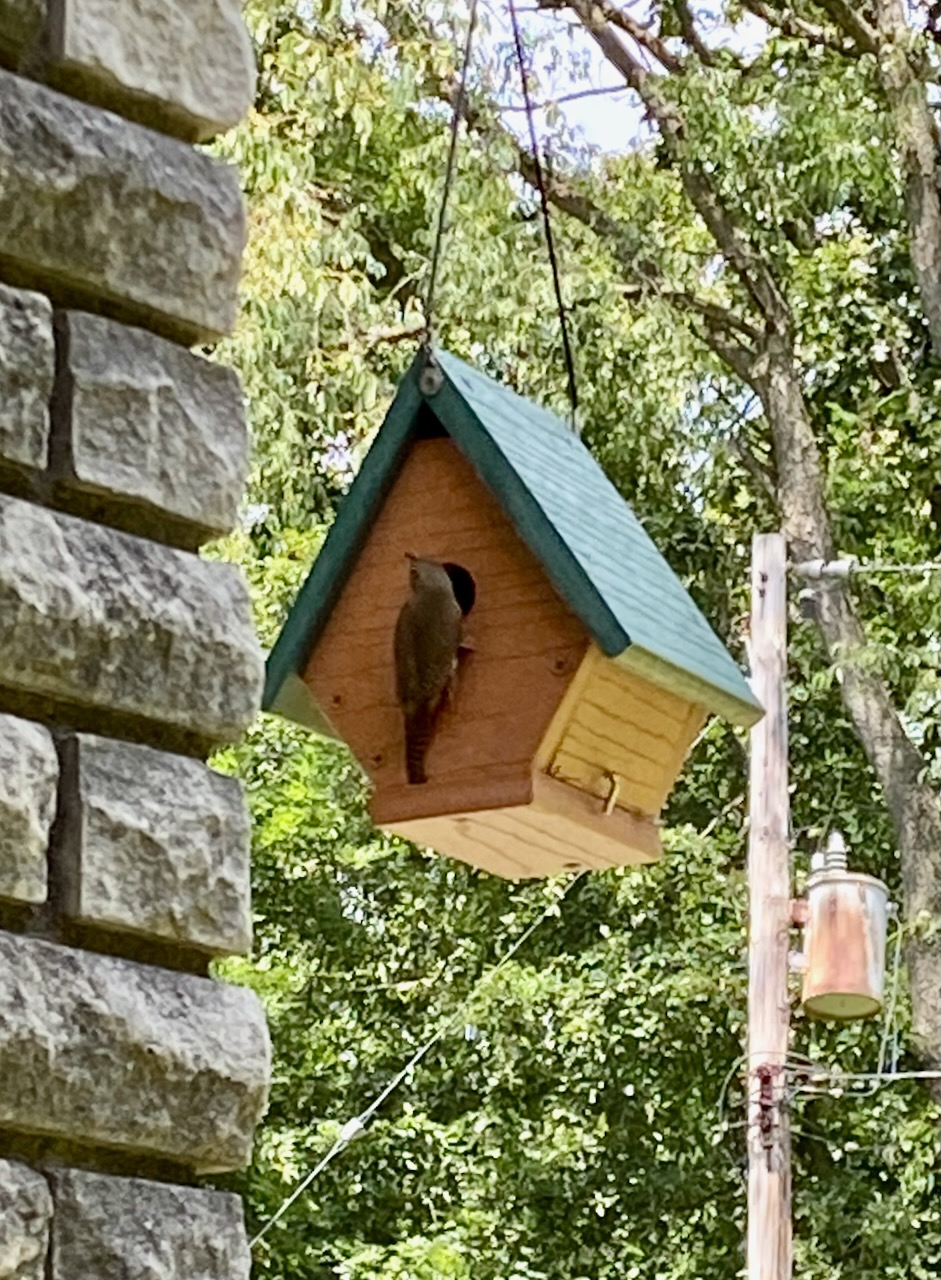 The hanging gourd they nested in last year fell apart over the winter. Doug was willing to build a wren house for me, but spring came so early that the birds were back while he was still working on the eighty-seven other projects I’d asked him for. Well, probably not eighty-seven, but you get the idea. So I went down to the local bird-supply store, bought a ready made wren house, and hung it from the eaves. I really felt it was inferior goods, and wasn’t sure the wrens would go for it. They did.
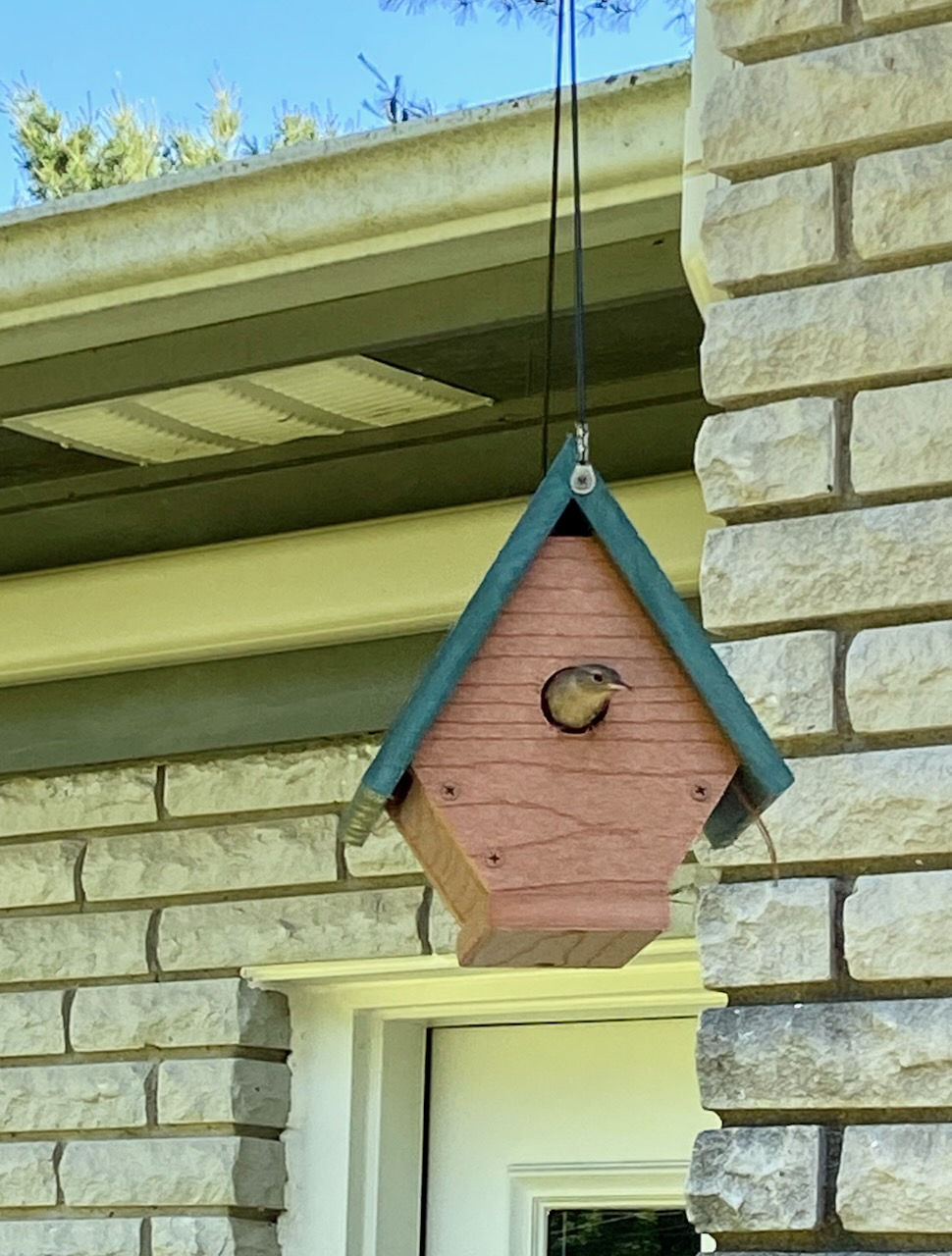 Apparently I was standing too close while taking these pictures and aroused parental wren suspicions. Whoever it was on duty – hard to tell male from female wrens – watched very carefully for several minutes. I tried to look nonchalant, backing off a little, but when I looked up again the wren leaped out into the air and took off flying, straight to the fake nest of the ceramic birdhouse.
 I was sorry the wren felt threatened, but pleased to know I had provided the fake nesting site. I hope it works well for them. And I did get a nice photo of flight.
 The wrens are used to me puttering at my garden bench or on the deck, so I went back to doing that, hoping to be recertified as harmless. But I did watch, making sure the wrens came back. It didn’t take them long, so I guess I’m not so scary after all.
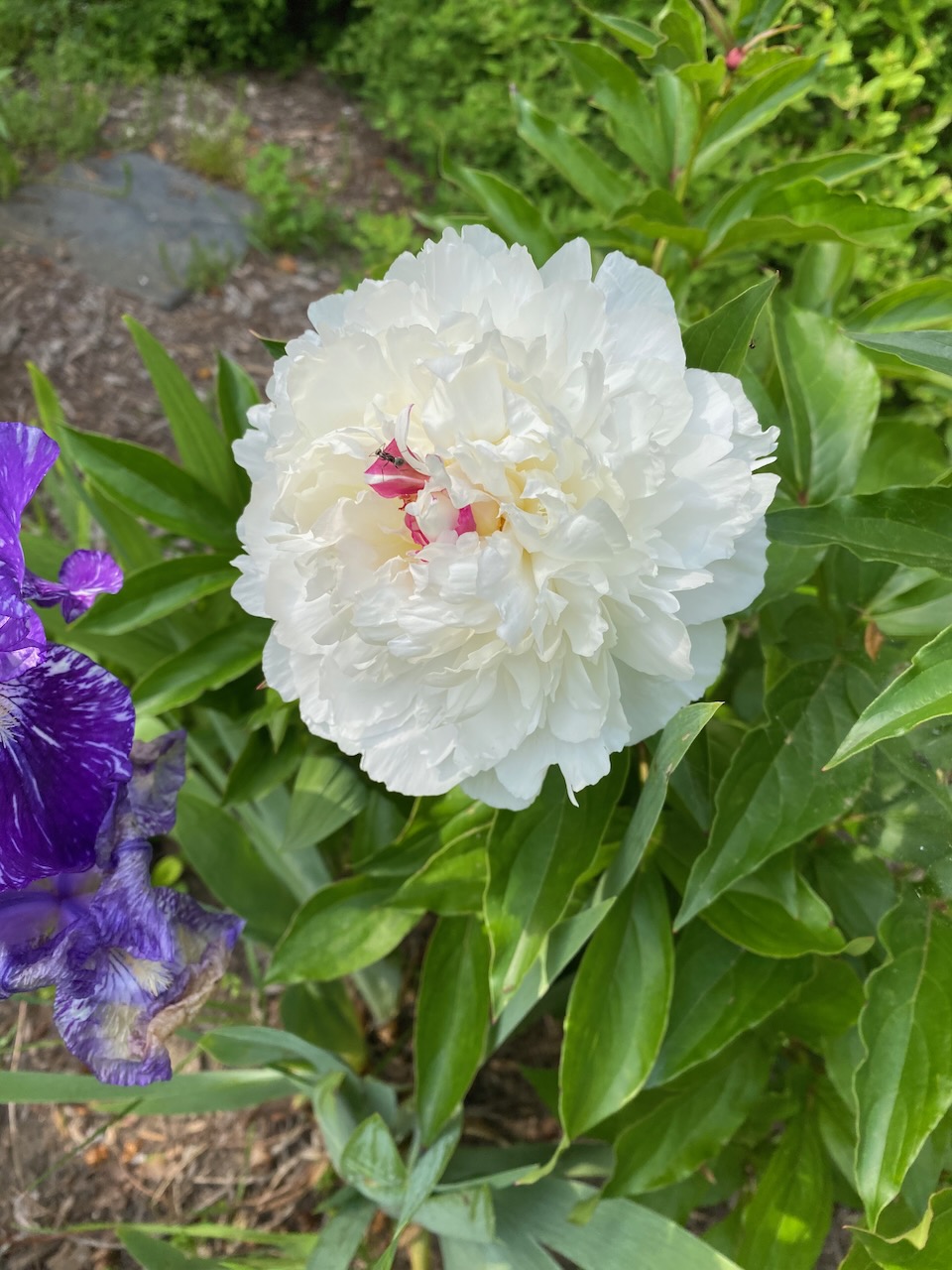 The forget-me-nots have gone to seed and the late asparagus spears have grown tall and branched into ferns, but the Michigan spring continues to overwhelm me with beauty and drama. This peony, though it’s originally an heirloom bred 150 years ago in France, is nevertheless called Festiva Maxima, which is Latin for Big Party. It produces lots of flowers in conditions where other peonies pout. Definitely a party girl, not a wallflower.
 In the even showier department, this one’s called Bowl of Beauty. The outer petals are more curved than they look in my photo, so yes, quite bowl-like.
 For drama, how about this sky? I was assured there was no threat of tornado, but it sure looked like it had something up its sleeve. Not even rain, as it turned out. Just drama.
 No rain so no rainbow so no pot of gold, but a plot of good fortune. They don’t always leap out at me, but I have two clumps of clover in my garden that regularly produced four-leaf clovers last year. They’ve come through again. One four-leafer lurks deep in the center of this photo.
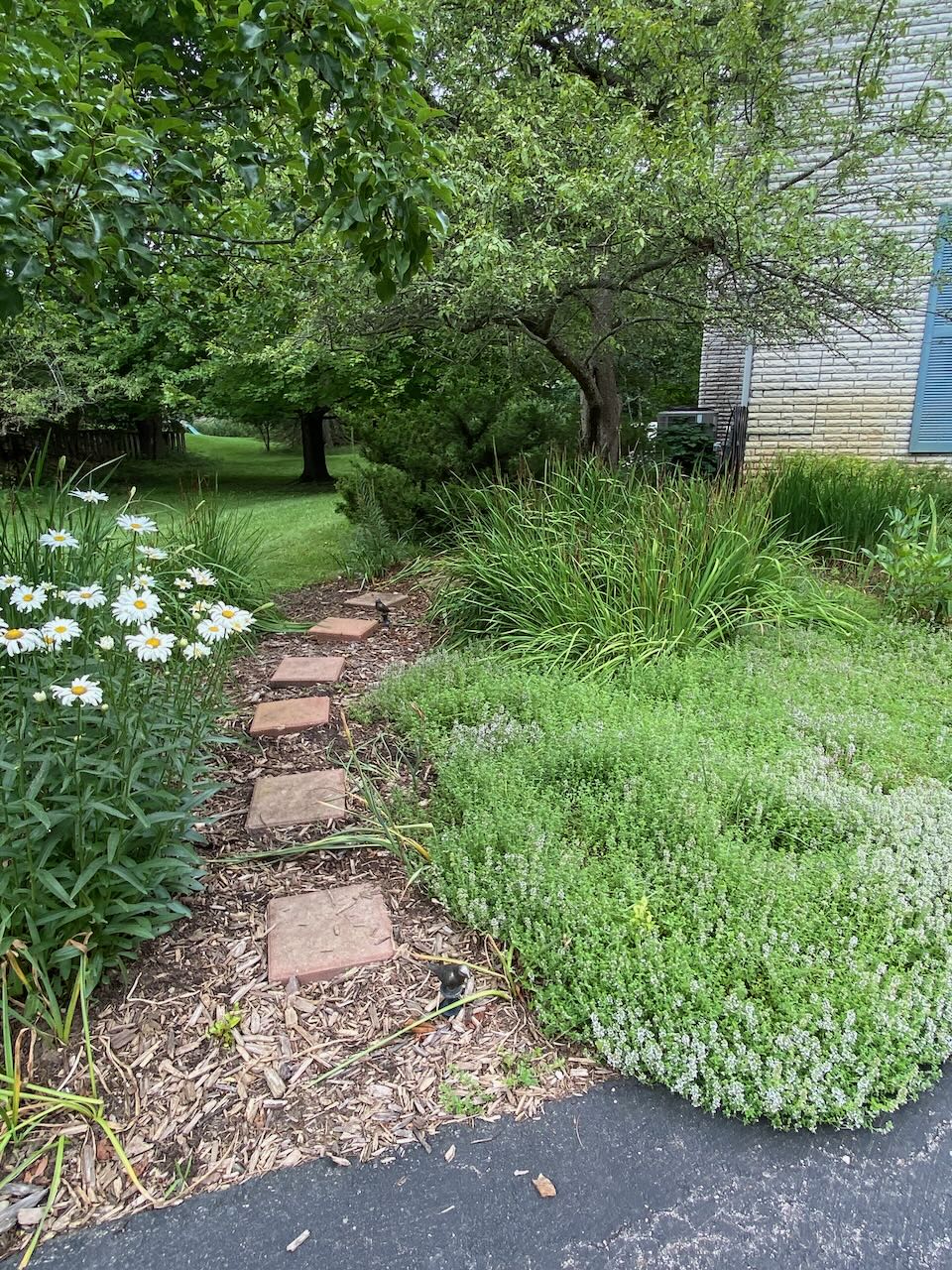
 Then there’s mystery – this little path that looks like it goes somewhere magical, or at least interesting. Nope. It goes to my hose bib. Appearances can be deceiving; in fact, in a garden, we often aim for that. In Japanese gardening tradition this is called Borrowed Landscape. My lawn fades into my neighbor’s lawn before you get to that fence.
 And so we have it all here – beauty, drama, fortune, intrigue. I’ve been out in it all day, weeding, planting, staking, and of course spraying deer deterrent. When I find a four-leaf clover I bring it in, put it in a vase until it withers, then make a wish and add it to my “luck basket.” Still the same wish, and I can’t say what it is but we’ll all be very happy if it comes true.
 One of the joys of the spring garden is surprise. Where did these ultra-fluffy, double pink columbine come from? Not only don’t I remember buying them, I don’t remember even knowing they existed. Could they have arrived as seeds embedded in bird droppings? Such an ignoble origin. Could there be a Johnny Columbineseed at large in Ann Arbor, spiriting unusual flowers into unsuspecting gardens under cover of night?
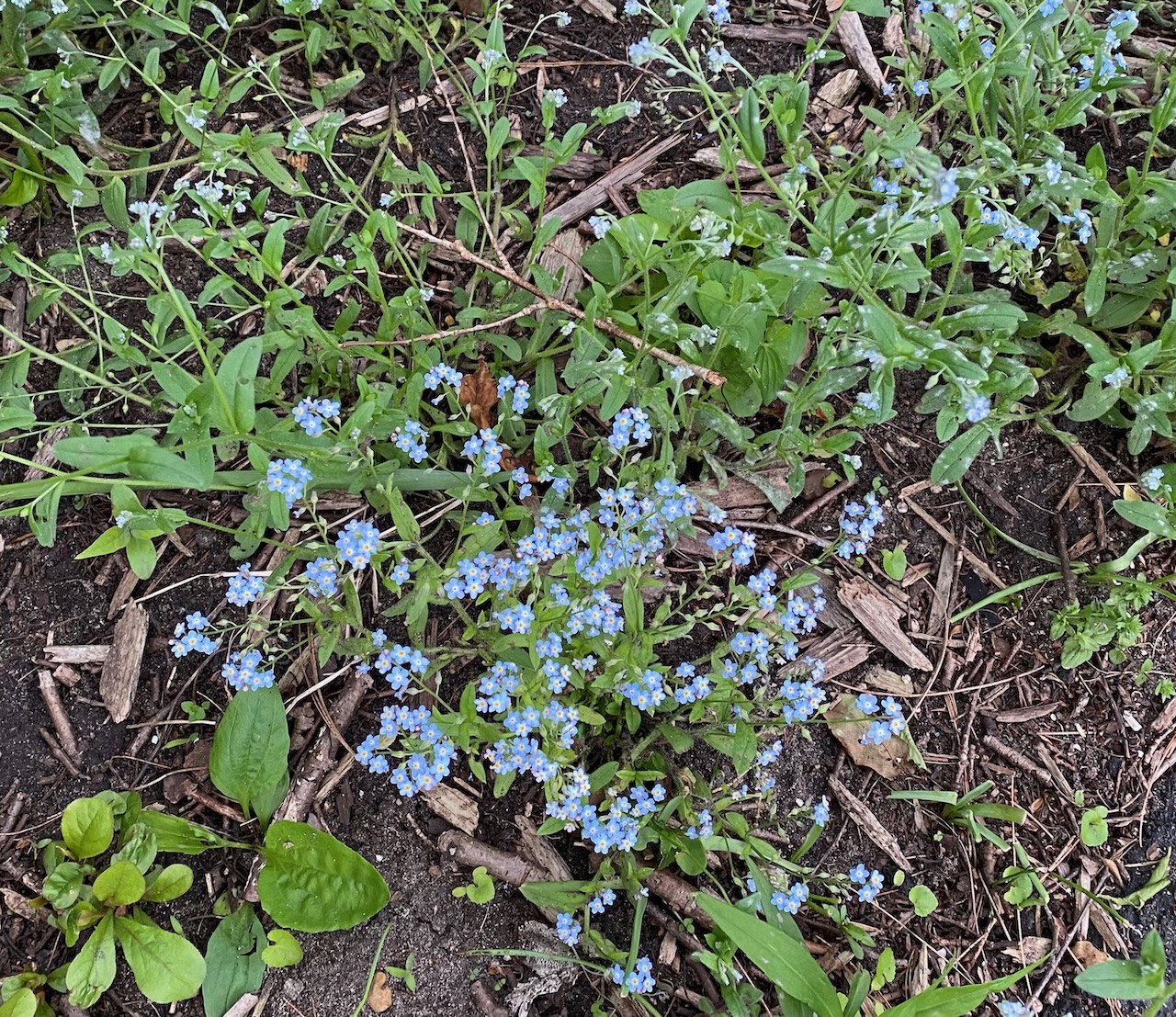 Then over here, how did one tiny patch of forget-me-nots take over the entire flowerbed, even crowding out weeds? A blue haze under the fading spikes of daffodil leaves, it manages to be really in your face despite such tiny petals. It should be called I-dare-you-to-forget-mes.
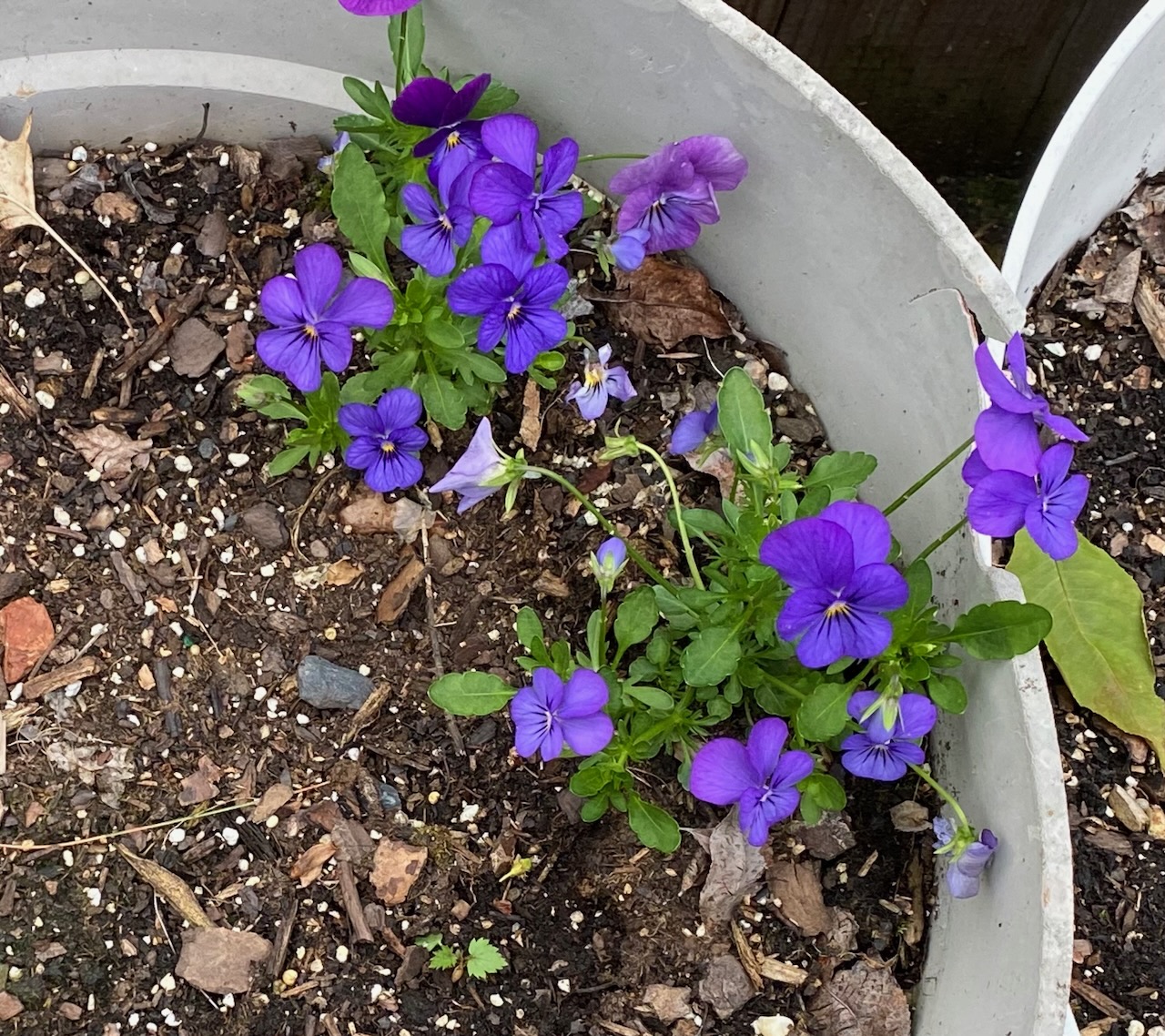 Moving around to the back yard, a flower pot that once held cosmos has come up with a crop of these little purple flowers, small enough to be violets but somehow I wasn’t convinced. Pansies were in the pot next to it last year. My garden books say four petals up and one down makes it a pansy, two petals up and three down is a violet. Two up, one down, and two sticking out to the side? Panselets?
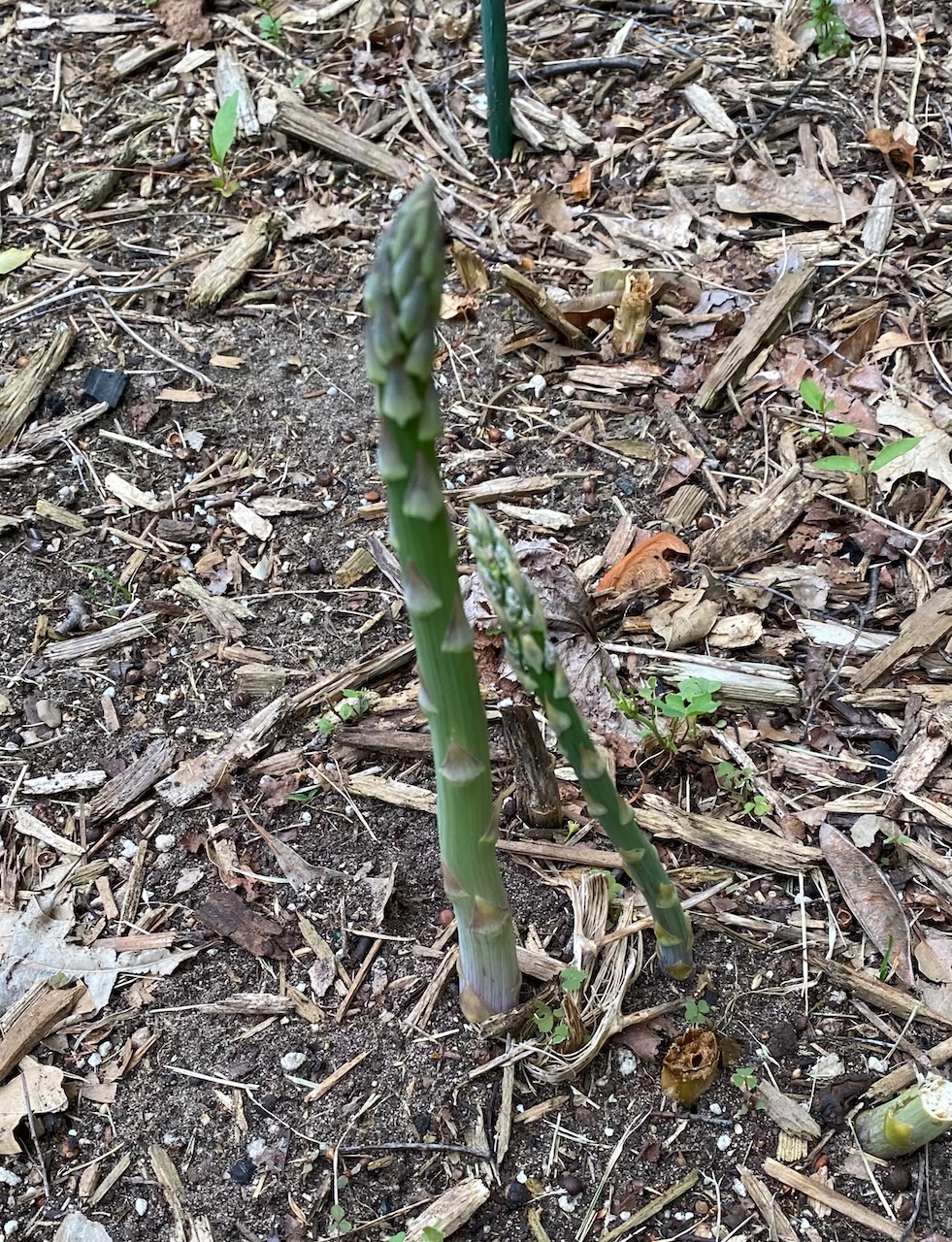 And then there’s the asparagus patch. I’ve seen it every year since we moved into this house, but it still makes me laugh to see the way it comes up out of the ground, looking for all the world like someone has snuck out to the garden and stood a bunch of asparagus spears upright in the dirt as a practical joke. But no, they’re growing right out of the ground. The second joy of the spring garden: that dirt, water, and sunlight turn into food and beauty, whether the way we expected or not.
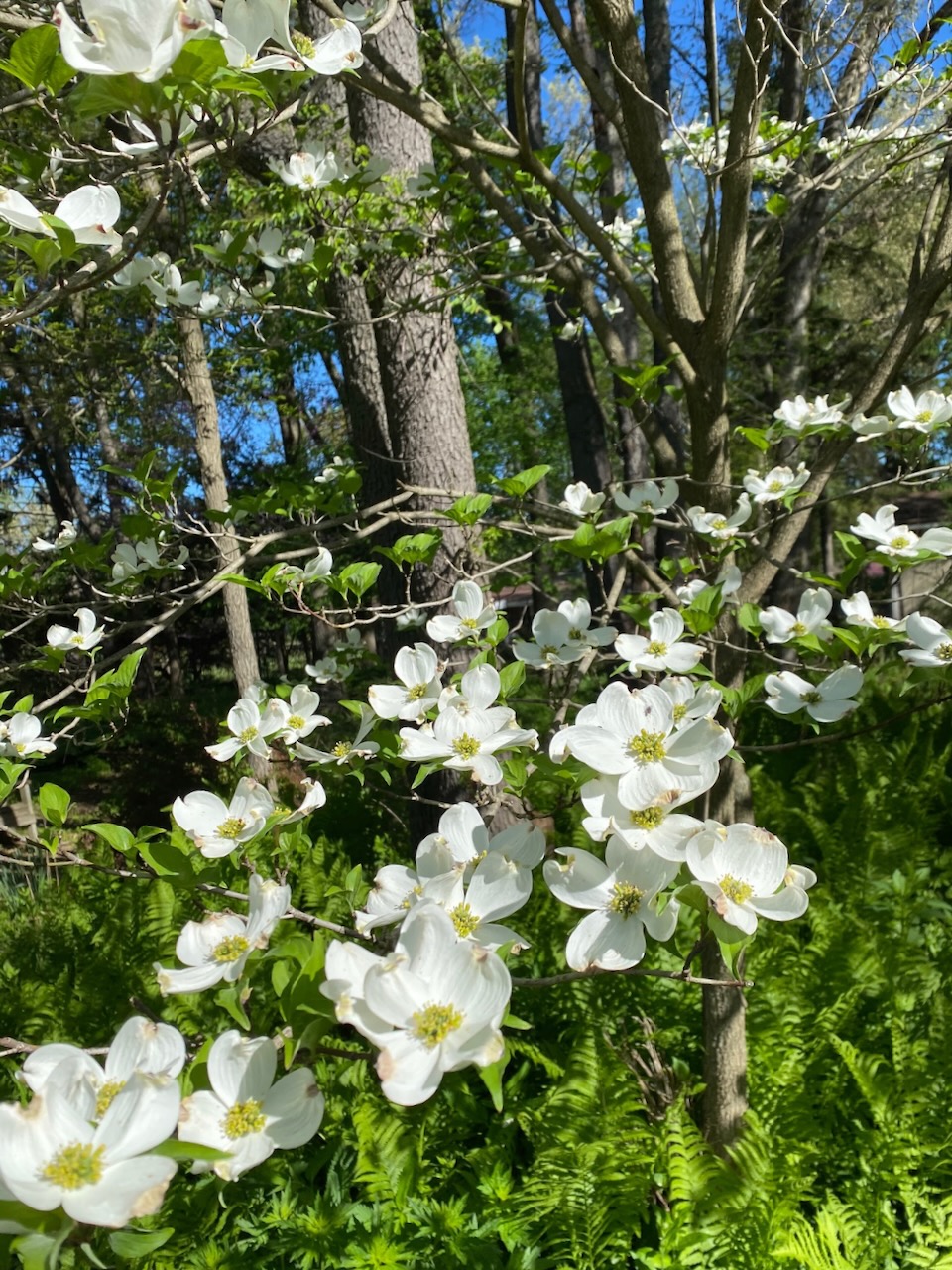 I have done nothing to deserve this tree.
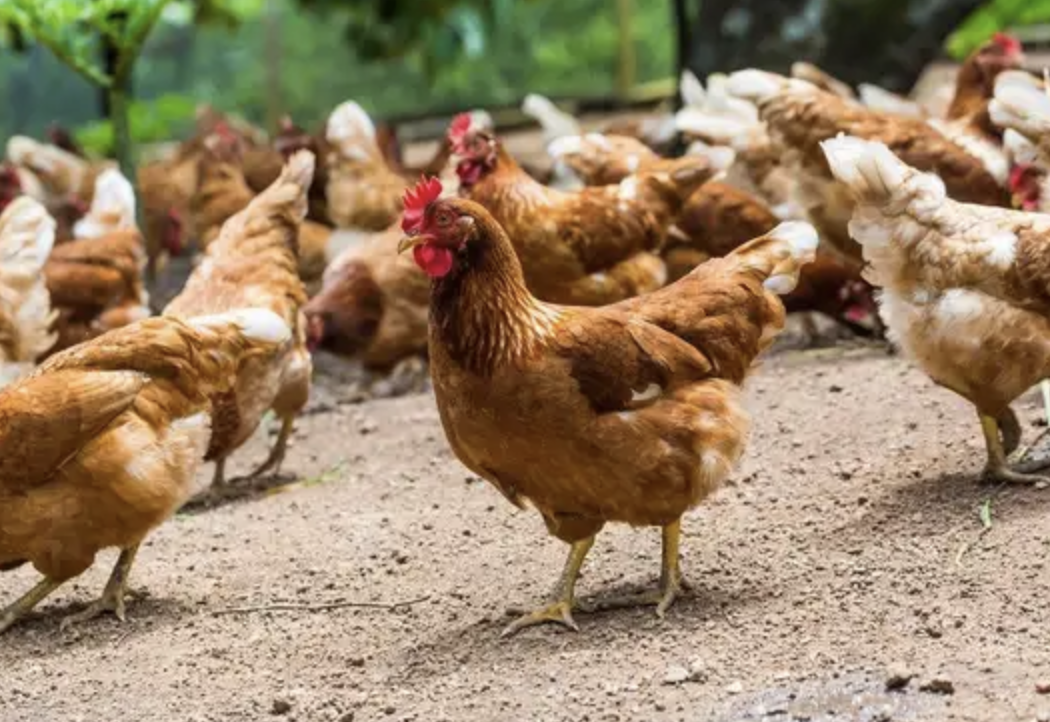
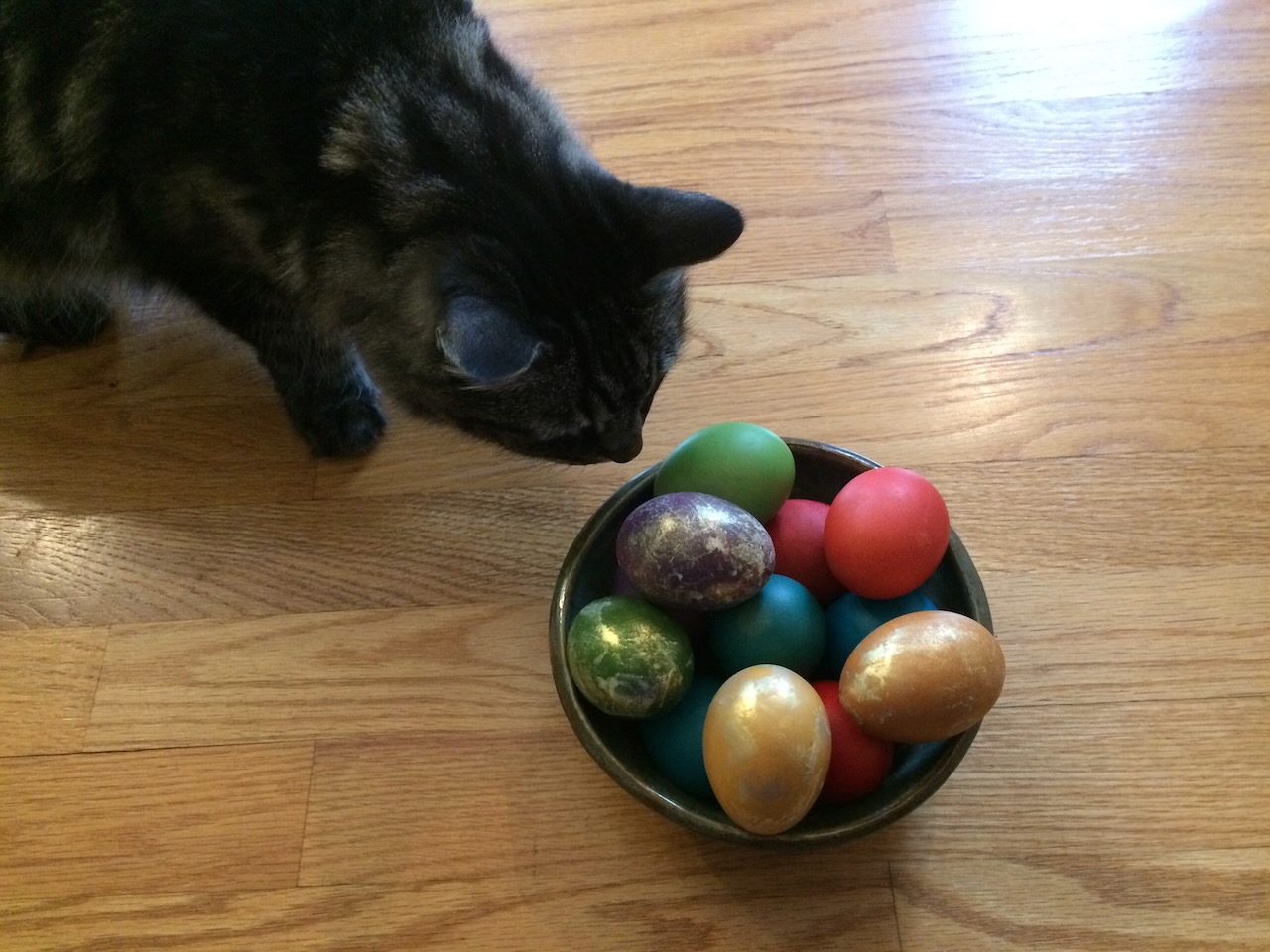 It seems odd coming right after Easter like this, but happy April Fools Day! Salt in the sugar bowl, bubble wrap under the rug – are they classics, or cliches? Here’s a poem for which I gathered and strung together all the chicken cliches I could think of. Credit to Blain’s Farm and Fleet of Jackson, Michigan, for the chicken flock photo.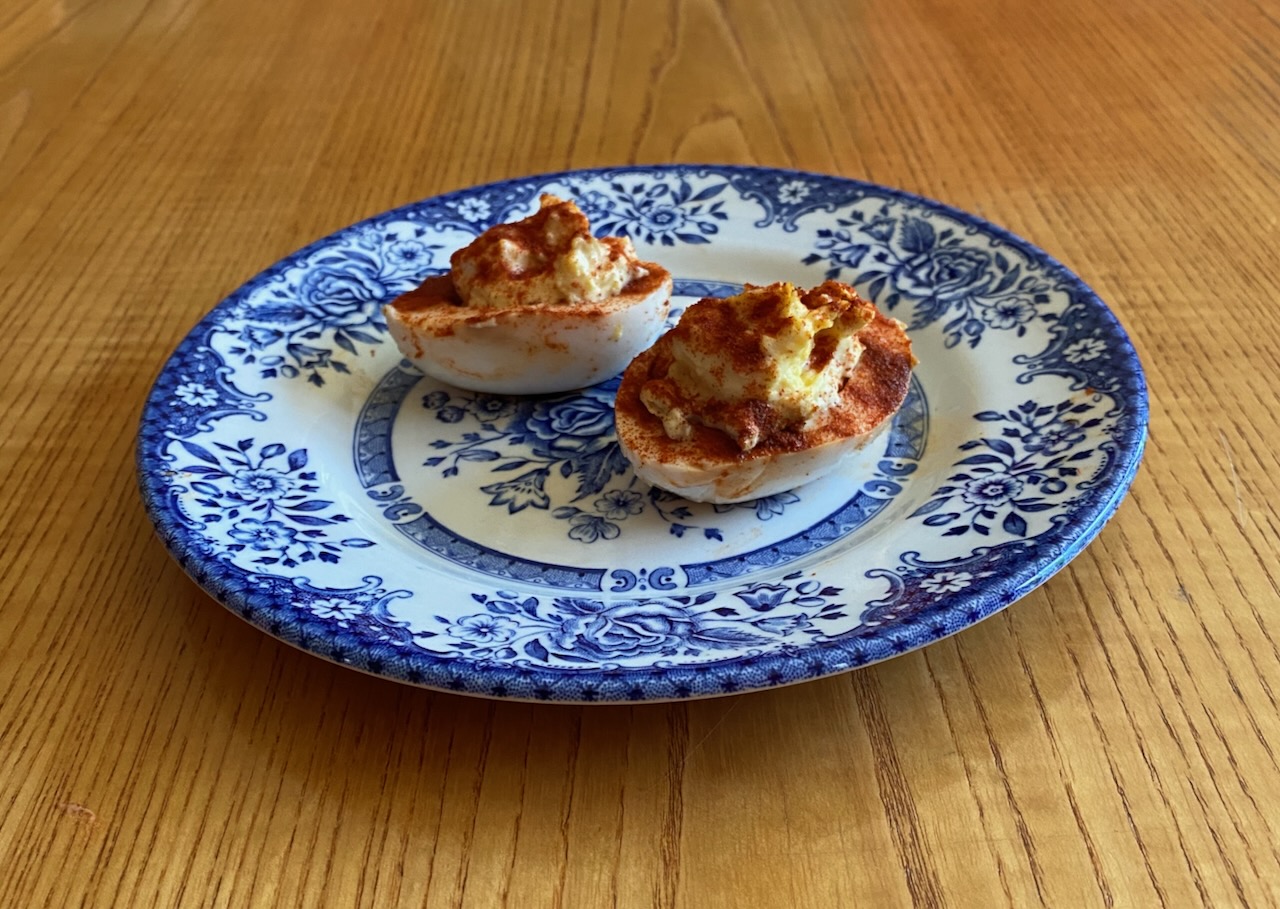
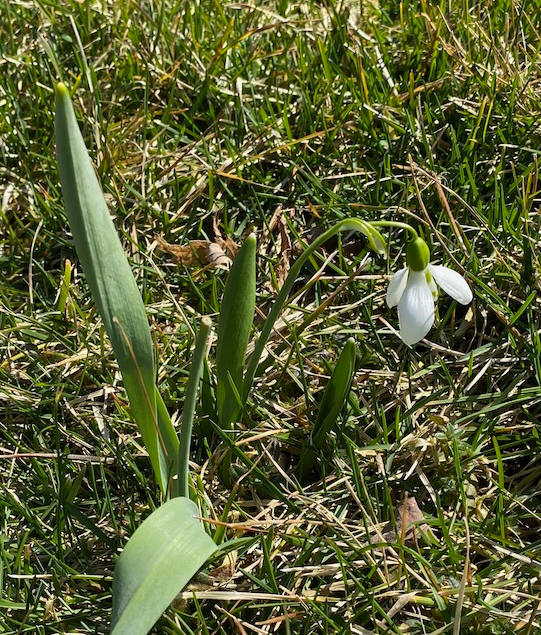 The dearth of snow continues. Can we still call these little early flowers “snowdrops” when there’s no snow? “Raindrops” is already taken. Lawndrops? Not only are they coming up in lawn instead of snow, but the lawn is already turning green.
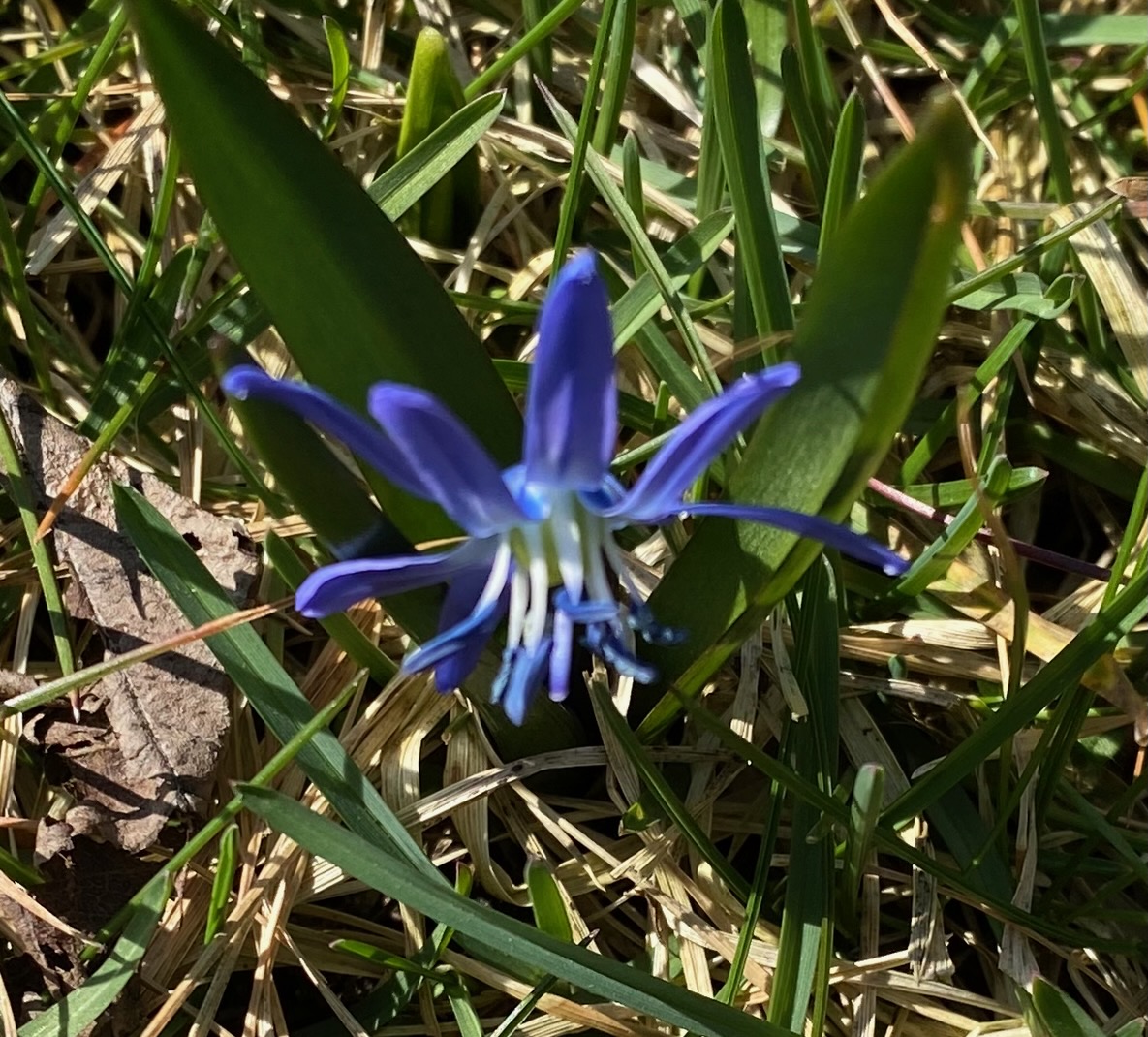 It’s hard to know how much temperature shift to take into account for next year’s plantings since change, including climate change, proceeds in a zigzag fashion. Even if the long-term trend is higher up the zone chart, it could still be cold again next winter. On the other hand, it could just keep right on warming up. I worried about my scilla, also known as Siberian Squill, but it turns out not to be native to Siberia at all, and is said to be able to flourish up to Zone 8. So I have two zones to spare.
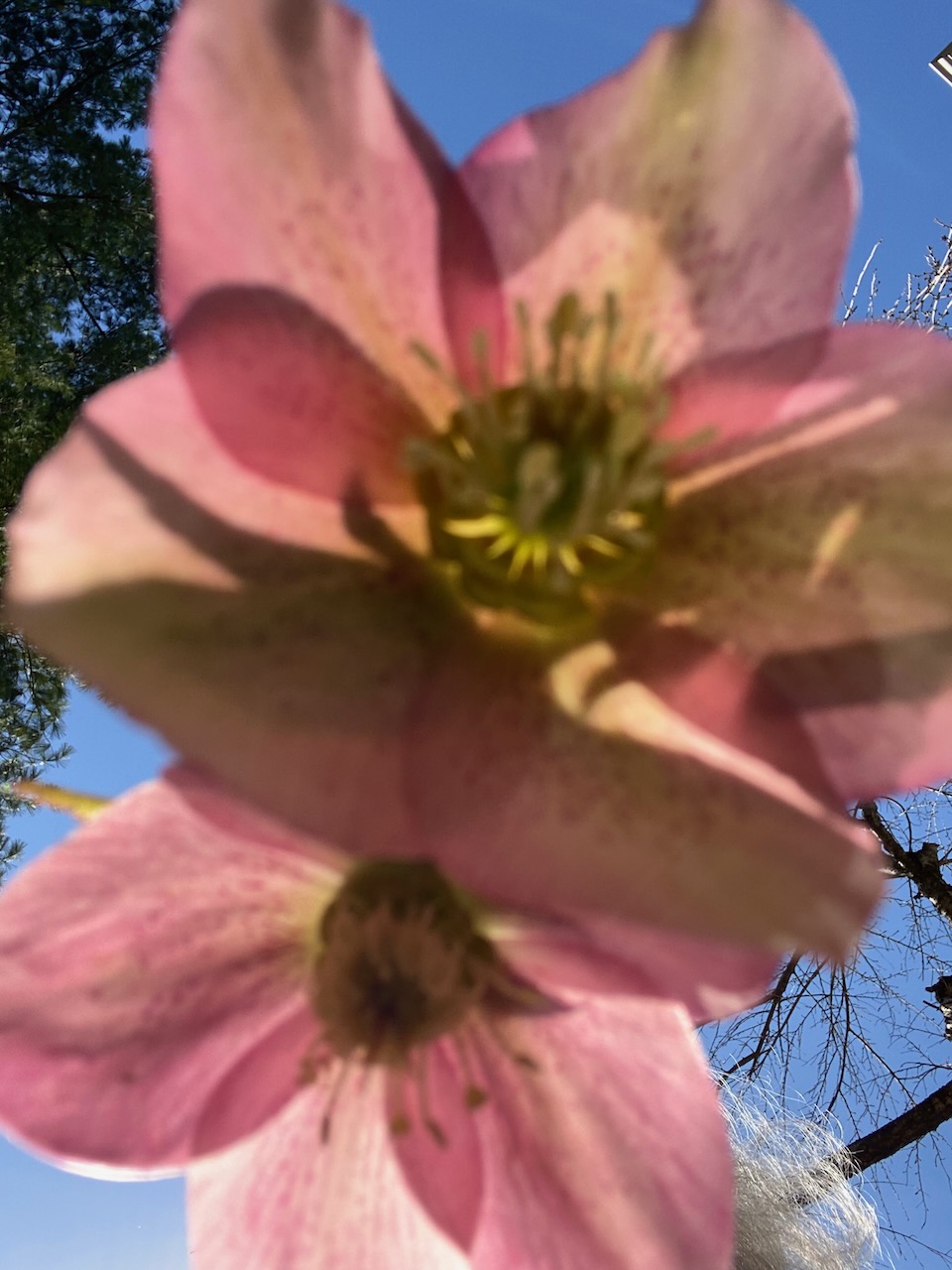 Hellebores turn out to be native to the Mediterranean, which makes me wonder what on earth they’re doing blooming in Michigan in February and March – in snow, when we had any. Apparently they’ll be fine if Ann Arbor warms up.
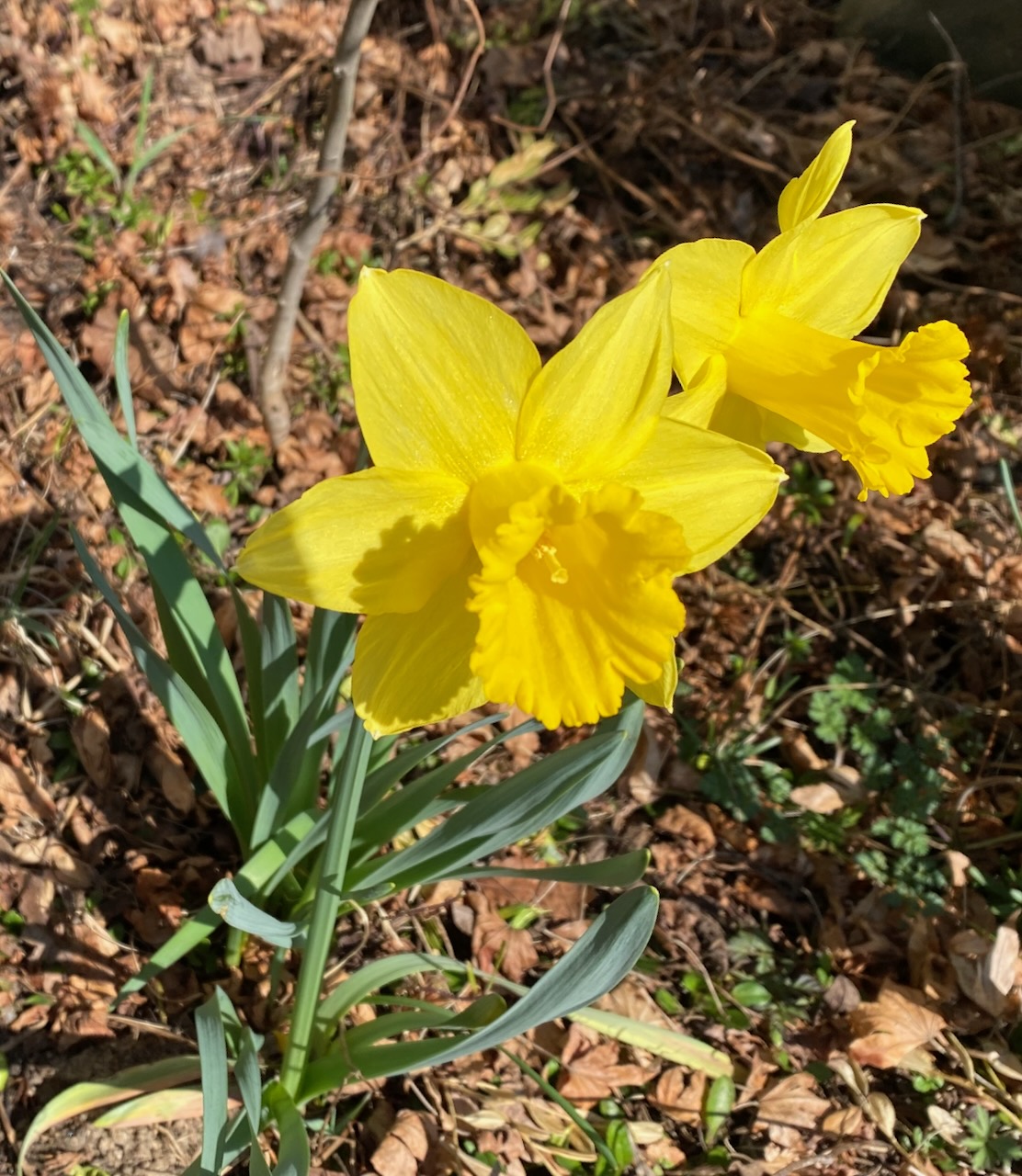 I was able to grow paperwhite narcissus outdoors when I lived in Southern California, but had mixed results with other daffodils and tulips. In my front yard here I have an extremely satisfying collection of daffodils that bloom from March through April and into early May. The first of these are out and dancing right now, in the rain, little happy suns.
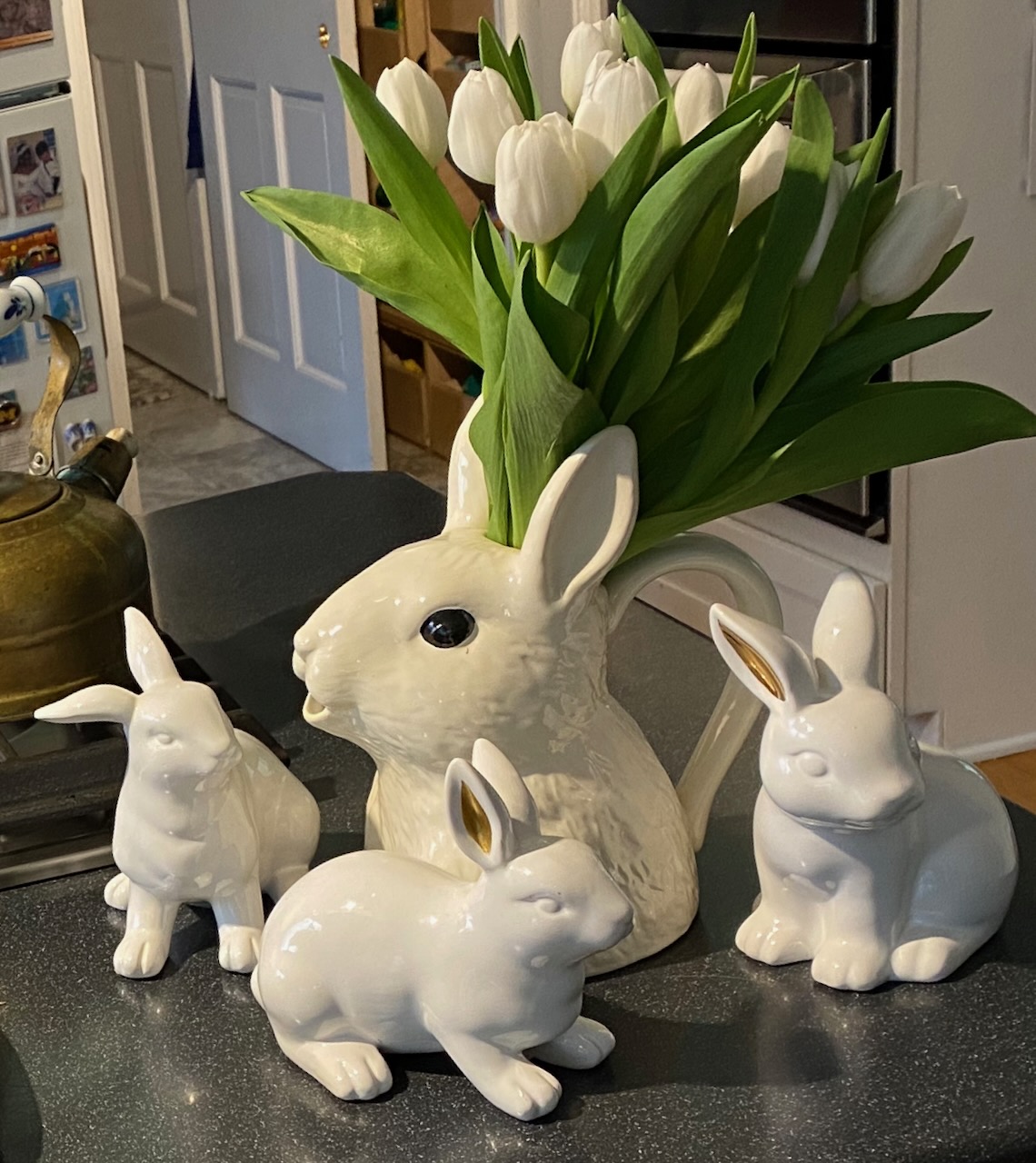 Deer do not eat any of these – the tulips they would love to feast on are coming up inside the fenced part of the garden. Rabbits will nibble on the emerging buds of grape hyacinth, but the hawks and owls are keeping the rabbits in check at the moment. That balance of power shifts sometimes for reasons I haven’t figured out. The bunnies are not abroad yet, but as Easter approaches my little window of Bunny Appreciation opens. Critters responsible for lovely baskets, brightly painted eggs, chocolate candy, and new beginnings, surely deserve to be cut a little slack while I check the garden fence for break-ins.
 Robin Richstone