Weeds

It’s a season of overlap in the yard now. The beginnings of things wanted and unwanted come up together in the woods and need to be sorted out. Garlic mustard, low to the ground and hard to pull, mingles with the much-desired nepeta. Tiarella hides under mystery weeds. Forsythia throws its yellow arms across a mess of nettles.

This year there’s an added layer of confusion due to our huge windstorm: the remains of the broken tree, sawed randomly by Edison to get it off the wire, were dropped in tangled chunks onto what was then a lot of dead mulchy leaves. But soon that spot will be an arena for ferns and lilies-of-the-valley to fight their way through skunk cabbage and motherwort. I want very much to weigh in on the fern and lily side of that argument, but the interlaced arms and fingers of the fallen treetop are really going to be in my way.

I didn’t know the name of the weed called motherwort until about half an hour ago. It wasn’t something I had to deal with in my Pasadena garden, and though I’ve learned a few names – garlic mustard, stinging nettle – from the common complaints of other gardeners here, this plant was still anonymous to me. So, what was it?

It turns out when you google “Michigan weed finder” you get a list of marijuana dispensaries in the state. But, like a true weed, I persevered, and “noxious” weed finder did the trick. Some of the finders supplied were pretty useless – the latin name? If I knew the latin name, would I be searching through the traits in your plant finder? It seemed hopeless until I remembered it had a square stem, so it was probably some kind of mint. After a brief detour through money management and the history of coinage, there it was, mystery solved: motherwort. Sounds vaguely insulting. It’s said to have medicinal properties. If anyone would like to gather several dozen bushels of it for their health, please let me know.
Here They Come

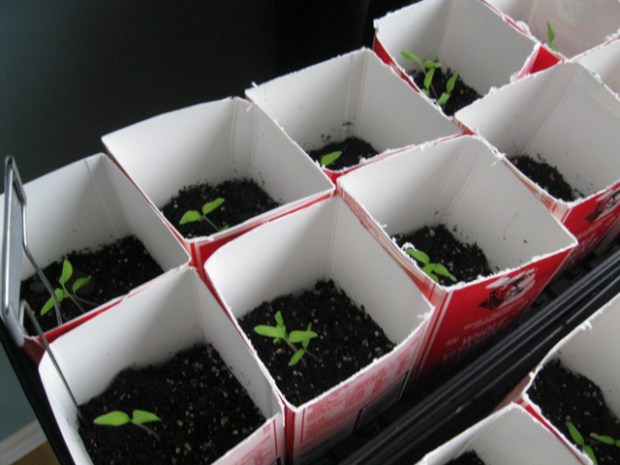
Looks like nothing’s happening as I walk into the room, but a peek down into the milk cartons reveals that the tomato seeds have been busy in their cozy new dirt homes. Hello, tomato plantlets, waving your cotyledons at me! Here Come the TomatoesSpring is here; can bacon-lettuce-and-tomato sandwiches be far behind? Well, yes, but not very far behind.
Since I can never believe all the seeds will sprout, I have planted two or three to a carton and when they get a little bigger I will have to thin them. This will make me sad for a bit, but a gardener is always making judgements: thou shalt live; thou shalt die; thou art a weed; thou art worthy of a place at the table. Not to mention interlopers causing trouble. No wonder our creation story starts us out in a garden.

In Pasadena we had a killing frost about once every 15 years, so the tomato plants would keep right on going through the fall. Being lovers of heat and light, they were a sad and scraggly lot come December; and being annuals, they had exhausted themselves by then. It was hard to face that I had to pull them up, but the fruit they bore in winter had sunk to a hothouse-like ghost of its former glory. I gave them an honored place in my tiny compost pile, and in turn they nourished the next year’s crop.

I have also started some basil indoors, and will sow some directly outside. This is a ploy to keep it coming, since I use it as a landscaping plant and therefore let it flower and go to seed. The flower stalks of basil are really lovely and very attractive to bees, so it’s a shame not to let them go; but then it’s a shame not to have any more fresh basil to eat. Planting successive waves of it satisfies both the landscape and the kitchen.

The Yard Wakes Up

Sooner than usual this year, the ground is thawing out and spring plants are taking advantage. This includes a lot of Michigan weeds I still haven’t learned to recognize, a fair amount of incipient garlic mustard which I do, sadly, recognize, and, happily, lots of narcissus. The yellow ones that were first up have been joined by many friends. I see the lavender I planted between batches of them, though not in new growth yet, will need to be pruned back. Lamium, sturdiest of groundcovers, reasserts itself; nubs begin to swell on the forsythia (Spring’s Yellow Telegram – how does the rest of that poem go?); fingers of peony leaf, red instead of green, reach out of the bare dirt and scratch the air.

There’s a lot of deadfall to clear from the small wooded area out back, including the better part of a tree hacked down by Edison as it dangled, mid-air, across a cable, threatening more damage when we’d barely escaped from the Big Power Outage. It’s still in large chunks, but will make good firewood if Doug’s chainsaw is up to the task.

I patrol the yard and garden, thinking of different schemes for all those seedlings soon to sprout in my upstairs window. I am learning to landscape with herbs, since they seem to repel the deer, the squirrels, and even the woodchuck. Miraculous basil, worthy of its royal name.

Speaking of squirrels, I have an update on my peanut-butter-and-hot-spiced-birdseed feeder. Among the squirrels there’s one that’s very, very fat even for a Michigan Gigunda Squirrel, by which I assume he has advanced food-gathering techniques. I noticed him lurking near the feeder at various times during the day, but never saw him on it until near dinnertime one day. By that hour the birds had eaten most of the seeds, but a lot of the peanut butter was still in place; and Mr. Gigunda climbed boldly up, reached out his little gray hands, and scraped all the remaining peanut butter into his mouth. I didn’t see the days in between when he figured this out, but it seems when the seeds are gone, the hot pepper goes with them. Once he was down to the peanut butter he was in the clear. And that’s okay with me. I’m happy to let Mr. Gigunda have the peanut butter as long as he lets the birds have the seeds.

For an interesting look at what your weeds can tell you about your soil, try this: Weeds as Indicator Plants . Although they could also be telling you what kinds of seeds spilled out of your birdfeeder.


Starting Seeds

Our power was out for five days, but like birds in spring it did come back at last. We cleaned out the fridge, and my thoughts turned to starting tomato seeds.

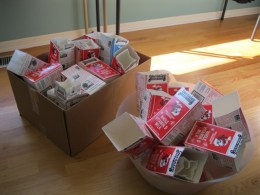
cartonsFirst step was to set up long folding tables in front of the big, sunny windows in my upstairs guest room, with trays on them to catch water. Next, I rounded up my collection of milk cartons. We began collecting the empty half gallon paper cartons in late summer, slicing off the tops, washing them out, and tossing them into a tub and a box in the garage, along with a few smaller drainagecontainers. I carted these upstairs, and sat down to make drainage holes by sticking in a paring knife and twisting it, four holes per carton.
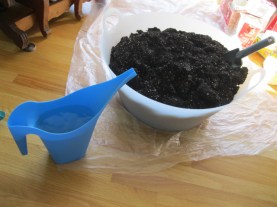
I filled the now-empty collection tub with a bag of potting soil. I’ve experimented with various types of potting soils and seed-starting mixes, and for me regular potting soil gets the best result. Seed-starting soil is very fine, and I have trouble keeping it around the roots of the seedlings when I plant them out in the garden. You should, however, test this with your own style of gardening, because you might easily have different results.

dirtAny bag of potting soil that’s been sitting around a Michigan warehouse in winter will be pretty dry, so once it was in the tub I added a potful of water, and stirred it with my trusty trowel. I went down to the kitchen and fixed a cup of tea, to give it time to soak in.

Next, since this session was strictly for tomatoes, I filled the milk cartons only
about a third of the way up with dirt. Which is the same as soil, but once loading upI’m getting my hands in it I think of it as dirt. Soiling yourself is what babies do in their diapers. Getting dirty means you’re having fun.
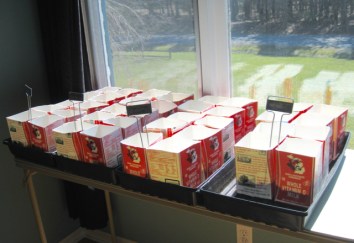
Now at last, time to plant the tomato seeds. I set the cartons in the trays on the tables and planted two or three seeds in each. Ten milk cartons fit in a tray, and I like to have each tray seeded with one variety of tomato. Unfortunately, we were late starting on our carton collecting this year and I ran out before I could start the cherry tomatoes, but I’ll find something else for them. If you’ve ever had tomato vines in your garden that flopped over and sat there for a while before you tried to tie them up, you will have discovered that tomato stems put out roots wherever they touch the ground. As the seedlings grow I will fill in around their stems with more dirt. By the time they are out the top of the carton they will have nice big sturdy root systems underneath.planted

Last step: watering them, then standing back to admire my work. The cartons look very cheerful peering out the window, and they look cheerful from outside, too. My neighbor says she knows its spring when she sees them up there. I know it’s spring when they start to grow.

Power Out

Sometimes the state of things and my state of being really line up. Wednesday, trash pickup day on our street, started innocently enough, no blizzard, no thunder, nothing to keep Doug from rolling the big, heavy green trashcan out to the street and carting the recycle bins full of plastic and paper to join them. He left for work, and I curled up in my chair by the window with a cup of tea, nursing the remnants of a cold.

But on Wednesday our strange, warm February weather collided with “a big blob of arctic air” (technical term used by local meteorologist) and produced what Detroit Edison is calling a “once-in-a-century weather event.” As I alternately nodded off and woke up, the bins went for a wild ride down the street, were kindly returned by a neighbor, and blew away again. Trees whipped around, tossing random bits of themselves across the yard. Wind gusts peaked at 68 miles per hour. By the time it was over, we and roughly one million other people across the southeastern corner of Michigan were without power. We had cell phone signal and so could check for news updates. Edison, usually prompt and fairly accurate with predicted repair times, made a blanket statement that they had no idea when they’d get this sorted out. Their first priority was to pick up all the downed lines draped across roads; then get power to first responders and health care sites. Ordinary homes would only come after that. Doug walked up and down the street collecting the trash bins, and we went to bed early.

In the morning the house was cold. Not cold as in, the pipes might burst, but cold as in, fifty degrees, with no way to make tea. I headed to the library, which I knew to have a coffeeshop, functioning heat, bathrooms, power outlets, and books to read. Half the neighborhood seemed to have the same idea, but it’s a big library.

You might think, as I did think, that I’d have been more comfortable in my semi-recovered state if I could have stayed home. But when I was home I felt the press of things I should have been doing, though I lacked the energy to do them. Now – I couldn’t do them! In my normal mode I’d probably have found this frustrating, but as it was my lack of energy lined up neatly with my house’s lack of power. The timing was strangely right.up early

When I went back to check on the house – before we got a nice warm hotel room for the night – I noticed these daffodils blooming. The earliest of my bulbs have never bloomed before late March until now. Did the flowers really push up out of the ground, or did the wind blow several inches of dirt off of them?

The Bird Feeder

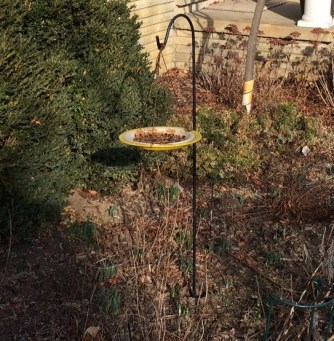
In honor of February being National Bird Feeding Month, and last weekend in particular the Great Backyard Bird Count, my Garden Group hatched a plan to make bird feeders as lures. This seemed like cheating to me – would these birds come to your party without the bribe? Are you really that popular? Our gal Sally had a simple design for us, birdfeeder version 3made of a paper plate in a plastic holder, smeared with peanut butter, sprinkled with birdseed, and suspended with three pieces of cord from whatever likely spot there was to hang it from.
All very well, but the real problem with bird feeders is the gate crashers. Squirrels. Ann Arbor, a city proudly full of trees, abounds with native Michigan Gigunda Squirrels. These guys are the heftiest, fattest squirrels I’ve ever seen – I suspect them of being cross-bred with woodchucks. For unknown reasons, and in spite of their short legs, small ears, and lack of grace, they are called Fox Squirrels. I put my bird feeder outside my window and waited.

First to find the goods were the chickadees. Beside themselves with joy, they blasted in and out of the seedy landing pad, which barely swayed under their weight. Then the fox squirrel showed up. He climbed the little shepherd’s crook with only slight trouble, but when he went for the paper plate it tipped up, swung wildly, and though he attempted to recover through some impressive acrobatics, dumped him on the ground. It was really entertaining, and he tried twice more before giving up. As planned, the peanut butter kept the seeds on the plate for the birds.

But soon after that a small red squirrel came along, and being about half the size of the Gigunda was more successful. Time for plan B. I reloaded the plate with seed laced with red pepper flakes. Mr. Red snuck up, grabbed a pawful, ate it, ran off, and did not come back. Chili peppers taste like that so mammals will leave them alone, and let the birds, which can’t taste hot pepper, disperse their seeds far and wide. The chickadees seemed happy to collaborate in this scheme. I don’t know how happy the squirrel was.

Valentine’s Day

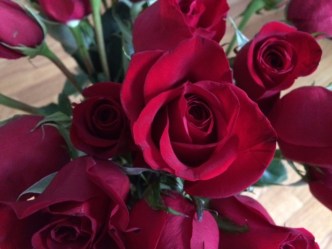
“Roses red and violets blue” comes from Edmund Spenser’s The Faerie Queen. Oddly, his next line is: “and all the sweetest flowers that in the forest grew.” In the forest? Roses? Don’t they need more sun than that? I’m not likely to find out, since marauding deer cavort through my woods all the time. You wouldn’t think deer would eat roses, since they generally don’t like anything highly scented and what about the thorns? But they will chomp happily on roses. Sunlight would be the least of the problem for any roses out there. My roses are tucked safely into their beds in the fenced garden.

Which brings us to the next question: isn’t this a strange day to celebrate with roses? Even in the non-winter we seem to be having in Ann Arbor this year, there are no roses sprouting, let alone blooming, in the garden in February. When I lived in California there were no roses blooming in February either, because January was the time to prune them, hard, all the way back to bare sticks, so the poor things got a rest in that frost-free climate.

No, I’m afraid our nation relies on immigrant roses for Valentine’s Day, doing the work our native sleepyhead roses shun. Will foreign roses be allowed into the country? They mostly come from Latin America – what about that wall? Maybe it will be ok if they’re long-stemmed and say they’re coming in for beauty pageants.roses

And right on that cue, the doorbell rang, and red roses appeared on my doorstep. Their country of origin is undisclosed, but I see they have a sponsor. Thank you, Doug.

The Call of the Catalog

It is time. The seed catalog has called, and I answer. My resolve to deploy a smaller army of tomato varieties in my not-enormous garden weakens. What am I to do when confronted by all these admirable traits, painstakingly acquired and voluptuously displayed in the glossy pages of the seed vendors of the world? Their names alone are so inspired, so evocative, that entire novels could be written just by listing them. Or anyway, short stories:

On a Cloudy Day in Oregon Spring Indigo Rose, Defiant. She was a Summer Girl with a Hungarian Heart and though she was the Patio Princess she refused to make an Heirloom Marriage with the Black Prince. Big Mama and Big Daddy had already invited Madame Marmande, but that was too bad. She wanted a Better Boy. As the Skyway flashed with Red Lightning bright as the Fourth of July, the prince’s henchmen, Jersey Devil, Martian Giant, and Bloody Butcher, rode up to the castle on a Bobcat, throwing Cherry Bombs, looking to capture the Damsel. She quickly dispatched her Orange Pixie on its Crimson Sprinter to get word to her Champions, Gladiator, Super Sioux, and Mortgage Lifter, who rode down the Big Rainbow on Green Zebras to defeat the Big Boys, reducing them to Carbon. So the princess put on her Zapotec Pleated Pink Berkeley Tie Dye Cherokee Purple dress, invited a Celebrity or two, and they all sat down to eat Supersteak, Pork Chop, Black Pineapple, and Chocolate Stripes while drinking Cherry Buzz and Brandywine. At last, in a Sweet Zen mood, the princess decided Mr Stripey was a Longkeeper and took him home to her Red House Free Standing where they live in Peacevine Harmony. Oh Happy Day!

Yes, those are all really names of tomato varieties, and there are enough other plot-provoking names left over for a sequel. But don’t worry, I’m not going there.


The Unfairness of Woodchucks

This week brings up a question that has especially puzzled me since I began gardening in Ann Arbor: why do groundhogs get their own special day? I’m not aware of other holidays dedicated to clumsy thieves. Is it an attempt to lure them out of their burrows so they can be disposed of before gardening season starts? Tell me anyone around here really believes there is a choice on February 2nd other than six more weeks of winter.

The thing that bothers me most about woodchucks, aka groundhogs, is that when they waddle over to eat the blooms off the tops of my deerproof flowers, they smash everything else in their path. I get that they have to eat, but do they have to bash up all the other growing things while they do it? It’s true they dig such excellent tunnels that foxes will sometimes run them out and move in, and foxes kill mice, voles, and other crop-eaters. But this can hardly be counted as a direct benefit of groundhogs, since they will fight tooth and claw to prevent it.internet chuck

Right now my local woodchuck/groundhog is no doubt hunkered into her burrow for the winter, but is she sleeping? Or binge-watching Netflix?

Pink

It’s the color of girlhood, the flag of female babies, the shade of aspiring princesses and ballerinas, and for years I was prejudiced against it for the girly, ruffly, dismissability it carried with it. When the call came to knit pink pussyhats for the Women’s March, I wondered at my own pink-misogyny, and decided to reassess.

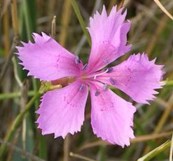
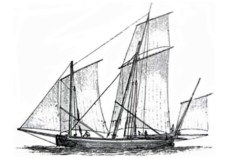
Being a writer, I looked into the derivation of the word. Words have back-stories as well as living, flexible presents, and the connections can be strange. Here I was Pinkmerrily on my way to a dissertation on garden flowers, the pinks I know best, when I was brought up short: the word “pink” originally meant a small coastal fishing vessel. Even the most stalwart scholars have had trouble figuring out how we got here from there – “derivation unclear,” they say – but in broad outlines it is, or might be, something like this: the boat was small; Pinquethe word began to stand in for any of the smallest things in a group, for instance your pinkie finger, or the smallest flowers in the garden; then to one specific small flower; then the color of that flower (and the shape of that flower’s ragged edge, “pinked”). It became the canonical female color when a little girl whose grandmother called her Pinky – smallest member of the family – commissioned a portrait of the girl wearing the color.

Several friends questioned the wearing of pink pussyhats for the Women’s March, since we don’t want to be cute and non-threatening. HatsBut why not reclaim the color for its assertiveness, its kinship to the powerful red, and the way it matches the inside of my cat’s mouth when she shows her fangs. She kills things with those fangs. Let’s reclaim the fighting side of pink for womanhood. Warning: do not mistake pointy ears and pinkness for submissiveness. I have never met a submissive cat.

While on the subject of the meanings of things, I paged past Imposture, Impertinence, and Implosive, to Inaugurate, with its root in Augury. Inauguration means: to take omens from the flights of birds, then install on the results of their omens; to invest a thing with sacred character. The next word I came to after that was Inauspicious. Like a flight of birds coming too close to a cat.