The three-year juvie eagle was sitting atop my chimney this morning. An assortment
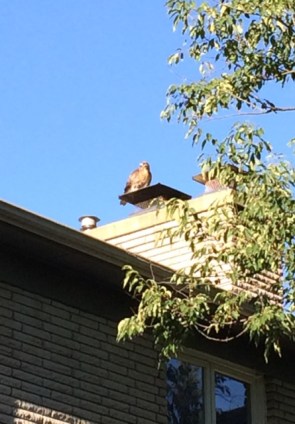
Mr. Juvie Eagle, not bald yet
of small birds that nested nearby were dive-bombing him in panic and outrage, trying to drive him off. He was busy with a very extensive grooming session, beaking and smoothing away at his chest, his shoulders, his tail, completely unperturbed by these dinky birds, whose eggs and young would not have made a decent snack for him.
And so the National Bird held himself above the fray.
Down on the deck my Fourth of July decorations are still flying. There was a time when I was not enthusiastic about the flag. During the Viet Nam war, supporters of the war adopted the flag as their emblem, defining patriotism as refusal to evaluate whether one’s country was perhaps making a mistake. They hogged up the flag to the point that you couldn’t be seen with one, without being taken for a war supporter. My anti-war friends and I shunned the flag.
Then one day Senator George McGovern, a prime opposer of that war, appeared with a flag pin on his lapel. The assembled reporters went wild, assuming it meant he had switched sides. “Why are you wearing that flag?!” they called out. Senator  McGovern smiled innocently. “It’s my flag,” he said.
So I learned not to cede worthy symbols to opponents.
It’s as true now as it was then, that you have no claim to loving the nation if you hate half its inhabitants. And as Peter, Paul, and Mary once sang, “there is no freedom in a land where fear and hate prevail.”
I watched the eagle for a long time, hoping to get a photo when he took flight. But when he was all preened and ready, he swooped off the other side of the roof, out of my field of vision. I couldn’t see him as he went, but I have faith that he was flying.
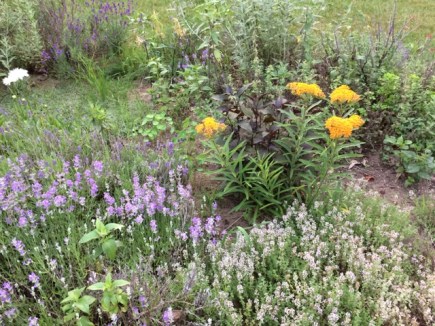
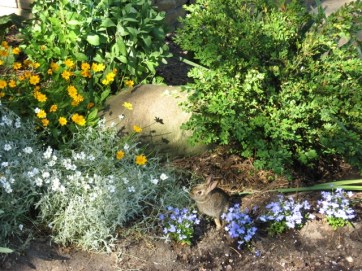
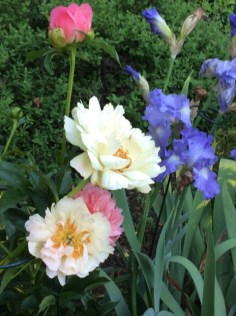 Memorial Day used to mark the start of the gardening season in Ann Arbor, the date after which you could be reasonably certain your new plants would not be killed by frost. Then the garden catalogs began to arrive with new information. This, they said up front, was not a political statement and they did not want to get into any political arguments. It was just their duty, as provider of my seeds and plants, to notify me that my Ann Arbor garden was no longer in Zone 5. It was now Zone 6a. I could start planting on Mother’s Day.
 Flowers carry so many associations. They fill the bride’s hand, grace the table on Mother’s Day, wreathe headstones on Memorial Day, and have done these jobs for a long time. Fossil pollen has been found in burials from thousands of years ago; if we had wedding fossils I’d bet there would be flower remnants there, too. Flowers, fragile and short-lived, do a lot of emotional heavy lifting for us. Speaking for us in difficult situations, they are also traditionally used in apologies and fence-mending, activities that always seem to be in short supply right when we need them most. So, grow some flowers. Give them to someone you’ve had a disagreement with. Start a dialogue.
 a fescue. We took out a flowering shrub that needed more space than it could have. We put in some compact lavenders. We nestled a few succulents around the stepping stones. Julius handled the watering, pulling the curly hose along, pointing its spray nozzle at the new plants, and bending down to them with a big smile.
 Daffodils are the clear choice for spring bulbs here, because we have lots of deer. Deer eat tulips, not daffodils. You could plant tulips anyway, curse the deer as the tulips are beheaded and trampled, and join the vast army of trolls contributing only negative comments to the social enterprise. Catastrophizing. Getting so pumped from your own outrage that you lose sight of any flowers, at all.
 I expected to be outside weeding and planting perennials by now, but the ground is too cold and too wet and not good to stomp around on in its current, compactible state. We’ve had some little lost snowfalls – forlorn flakes blowing around with a what-am-I-doing-here look to them.
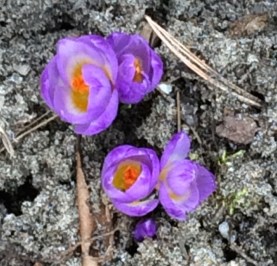 through personal connection – someone who taught at the reservation told her friends, who told their friends. The people shivering in the cold were no longer “them.” They became “us.” Small-scale solutions are often criticized as being a patchwork, but whole big, bed-covering, life-warming quilts are made that way. Patch by patch. Piece by piece.
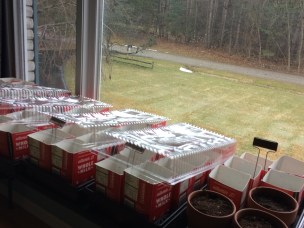 full of dirt. In went the seeds: Black Pearl and Supersteak tomatoes as usual, and a new bush variety I decided to try; Japanese eggplant; and cucumbers for my niece who likes to work in the garden with me. And lots of white Profusion zinnias. Seeds for the big zinnias will go directly in the ground, but I like to give these little ones a head start to help them stand up to marauding woodchucks. My neighbor tells me that when she sees the cartons lined up in that big front window, she knows spring is really on the way.
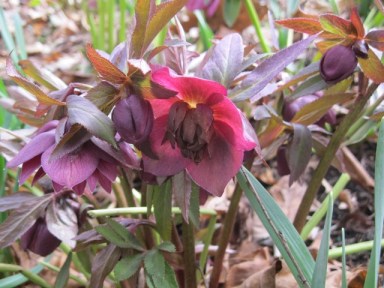 know they are because Facebook, helpfully, keeps sending me images marked “last year” and “two years ago today,” and what’s out there now is pathetic by comparison. But the hellebores and crocuses are holding down the fort, and I think there will be daffodils tomorrow. They’re that close to bursting out of their sheaths.
 First, winter is informative. The structure of trees, the depth of woodlots, the secret nests where birds and squirrels made their summer lives, are revealed both by the absence of leaves and by the snow echoing and outlining them. Shrubs that were a green curtain in summer become transparent, revealing burrows and pathways previously unsuspected. The snow clearly displays the tracks of animals you may never have seen, but which you now know have laid claim to your garden. The clarity of winter explains many things that were mysterious the rest of the year.
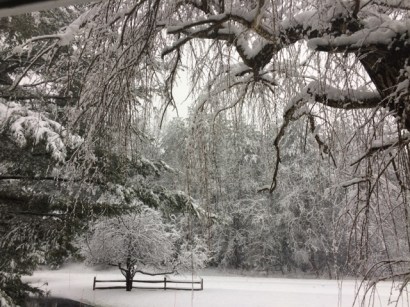 of a snowfall when they say winter is gloomy? Michiganders will see high, bloomy, rolling clouds and say the sky is grey, but if you’ve never lived with the “June Gloom” of the west coast’s seasonal low fog, you do not know what grey is. Yes, it’s cold outside, but you need sunglasses when you walk out in it.
 Robin Richstone