Saturday I had a book signing party for my chapbook, The Museum of Fresh Starts. Some people had ordered it directly from the publisher, and my first thought was to thank them with food and wine. My next thought was to invite people who might
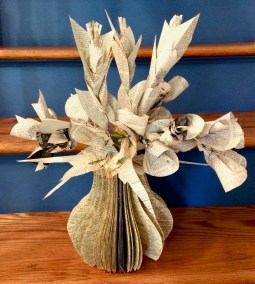
book party centerpiece made from old dictionaries
like to see the book before committing themselves to buying it. Then I asked everyone to bring their spouses, so Doug wouldn’t be the only one. My next thought after that was, what have I done, all these people are not going to fit in my house! This thought determined that we were going to have a non-seated, cocktail party type event, but with wine instead of cocktails. And tea. I’m a big tea drinker.
So my menu was a combination of tea sandwiches and canapes. I made the food; Doug bought the wine.
The hard part was planning the reading. Most poetry readings I’ve been to start with forty minutes of reading, and if there’s a reception it comes after. Forty minutes of reading has always seemed long to me. Even when it’s from one specific book, people aren’t following along with the text – they are listening, and after a while it’s hard to keep it all in your head. Plus, this wasn’t primarily a reading, it was primarily a thank-you party. I wanted it to feel festive, celebratory.
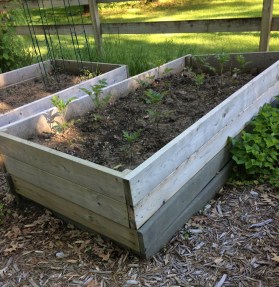
I went out and weeded the garden while I thought about this. With a task like weeding you can assign complicated questions to the underbrain, while the upperbrain pays a more carefree type of attention to sorting out the chickweed from the lamium.
Okay, how about four poems? And how about embedding them right in the middle of the party, with food both before and after? I read three poems from book, the title poem, the cat pantoum, and the last poem, which you can find here.
I ended the reading with a poem not in the book, a poem about Doug, “The Professor’s Nap.” It’s here on my website.
And then we went back to eating and drinking, and a good time was had by all.

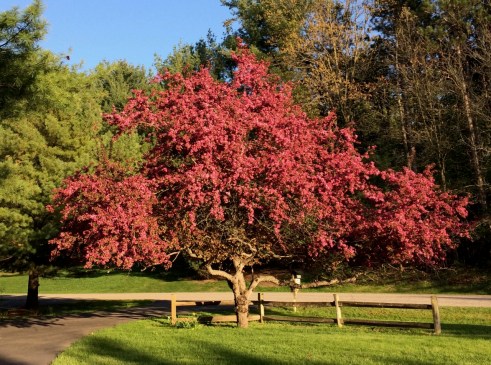 Hello, I am a crabapple tree. I put on my best crinoline to dance with you, finally, now that we’re well into May. You didn’t know it would take all the way into May? I’m so sorry. I’d have been here sooner, but I was delayed by so many distractions. Playing with unicorns and rainbows. Tying the peonies’ shoelaces together. I wanted toeshoes for myself, but the daffodils ran ahead and bought them all. I got the best dress, though, didn’t I?
 Spring is a suitable time for commencement, beginning one thing and ending another. With four seasons and a university here, time marks itself well: colored leaves, snow, flowers, out-of-town drivers making sudden right turns from left lanes and people walking around with tasseled hats, corn ripening in fields. To everything there is a season.
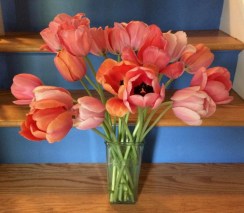 Thus I have tulips in the garden now, where tomatoes were and will be. This was an inspired suggestion made to me, of course, by a bulb-seller’s catalog. Last fall after I pulled the frost-bitten tomato plants out of their raised beds, I put in tulip bulbs. My daffodils are safe in the open yard, but tulips need to
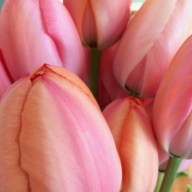 be inside the garden fence or the deer will eat them. The bulbs liked it in there, and produced many huge, beautiful bouquets.
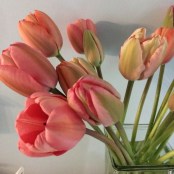 It was especially nice to deck the house with them to celebrate, because this spring our very dear great-niece concluded her time as an undergraduate and set out for her future. The two sides of commencement – we all want the children to launch, but it’s a sweet chapter that’s ending. The tulip chapter is ending, too.
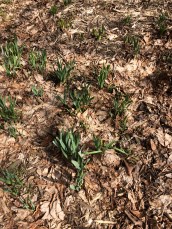

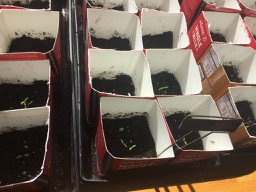 orders for some time now, bags of potting soil have appeared in the garage, and the clocks have been set forward to so-called daylight savings time, bringing dark mornings back to Michigan. It’s time to start seeds for the garden.
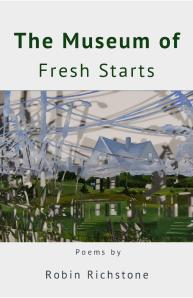 Speaking of metaphor, I’ve just been reviewing and correcting proofs for my chapbook that’s being published by Finishing Line Press. Pretty exciting!
 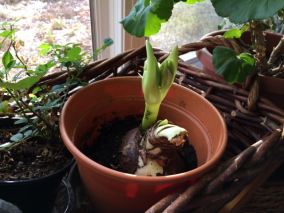 Here’s how it starts: a lump of a bulb, some dirt, water, and a great big window keeping the cold midwestern winter out. Add time. That’s it, just time – the bulb is tightly packed with flowers, waiting to escape. If you cut off the first amaryllis stalk after it fades, another will come up and bloom. You do nothing to deserve this, but there it is.
 will stock itself back up so it can do this again next year. But don’t let it go to your head. The narcissus may or may not go along with this.

 Robin Richstone