 Saturday was a perfect summer day: lightly warm, little breezes pushing puffy clouds around, giving intermittent shade. With the blueberries harvested and the tomatoes not ready, I took my fishtail weeder in hand and went out to weed the garden.
Weeding shows how well adapted humans are for gardening: anyone with thumb and index finger has a deft tool for weeding at arm’s end, able to extract one small sprout from between others. I use the fishtail weeder to pry out deep roots and rhizomes, but nothing’s better than fingers at close quarters.
The other thing we’re well adapted for is difference of opinion. A weed is something 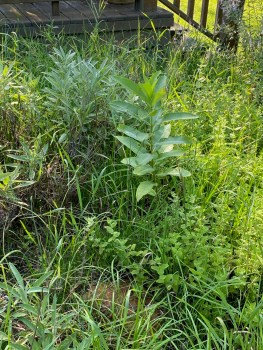 growing where you don’t want it, and one person’s weed is another’s treasure. Community values, current fashion, material needs, individual taste, and no doubt many other things factor into the decision: to pull or not to pull.
Take for instance milkweed. It’s right in the name: weed. Whatever its history, it is in good repute today because Monarch butterflies are endangered, and it’s crucial to their survival now. In this photo it’s growing in a mix of sage, chives, mint, and invasive grass. The mint and chives spread like crazy, but it’s only the grass that I’ll be pulling out.
 Then here’s a raised bed full of nascent zinnias, edged by violets that have colonized the mulch on the garden path. They’re invasive but I love the scent of violets in spring, so I pull them back just enough to keep the path open.
 After I cleared out the excess violets, I discovered they were hiding a perfect example of right thing, wrong place: a baby redbud tree has sprung up inside the garden, exactly where no tree should be. I’m going to scout around the yard for a good spot for it, and it will be transplanted.
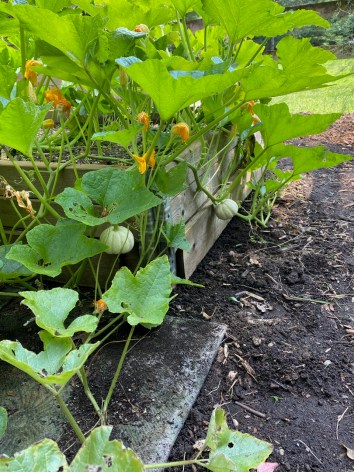 So I knelt happily on my foam pad, hands in the dirt, making order of chaos, and in a short time found another lovely surprise: Baby Boo pumpkins dangling like a string of Christmas lights. Mixed holiday metaphors, I know, but they did seem like a gift. I planted the seed, true, but dirt, rain, and sunlight did the rest.
 them, when something small whizzed by my head on its way to the monarda. Too big for a bee, it sort of looked like a Rufous Hummingbird – its abdomen was reddish – but way too small, and I didn’t think we had Rufous Hummers in Michigan. On the other hand, it was definitely humming, and hovering over the monarda to sip, darting crazily between blossoms. It didn’t hold still very long, but I finally noticed two mothy antennas. What? I may have been “drunk” on lavender scent but I wasn’t actually drunk. A moth?
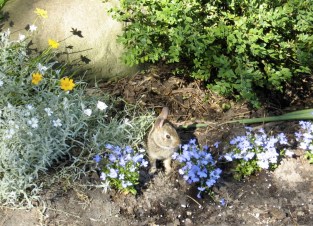 I’d have liked to watch it longer, but it was a very busy creature, sped off, and I went back to weeding, and installing a few zinnias and petunias in bare spots. This is an experiment to see how the deer and rabbits feel about eating them. One of the does came through my yard the other day followed by a fawn so small he barely knew how to use his legs, and there are baby bunnies. Fawns are experimentalists in dining, eating things that make them sick until they become old enough to know better. The bunnies so far are ecstatic about the clover in the lawn, but that could change.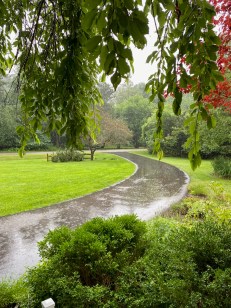
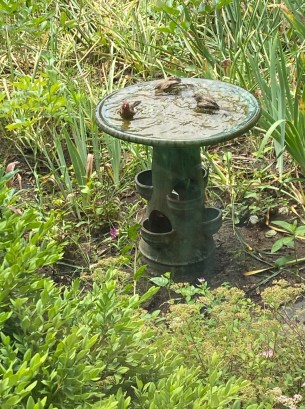
 Since then it’s been raining. Not thunderstorms, just steady, straight down, soaking, chilly rain. If only we could get some of our water to California and get some of their heat here. These mushrooms sprang up, but before I could find out what they were, they were gone. I will be very interested to see if the birds come out in force again to bathe, after the rain. You’d think they got wet enough in these long, soaking rainstorms, but twice now I’ve seen them crowding each other out at the birdbath when the sun comes out. I want to see if they go for a third.
 That explained why I could hear but not see them, but why weren’t they here in my yard? Could it be my large number of birds, especially nesting pairs with babies to feed? In addition to the many birds casually passing through, I have robins, mourning doves, finches, wrens, and cardinals all raising nestfuls of voracious offspring. The robin is particularly canny, following me around as I weed, moving in on the turned-up worms and bugs as soon as I shift to a new spot.
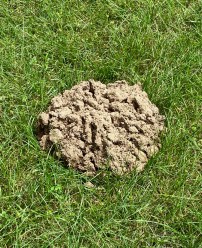 Speaking of the ground, another possible wreaker of cicada havoc is the mole. Moles spend their lives underground, eating critters they find there. Could my mole have cleared out the cicada nymphs? As a lover of words and already deep in the internet, I looked up “mole.” In Middle English it was “moldwarp,” mold meaning soil and warp meaning throw. So, a soil-thrower. How cool that warp comes from throw. Warp speed, anyone?
 Cicadas do not, as far as I know, eat tomatoes or damage tomato plants so I wasn’t worried, but I went and checked the tomato plants anyway. They’re coming along. It will be a while, but I can almost taste the bacon, lettuce, and tomato sandwiches.
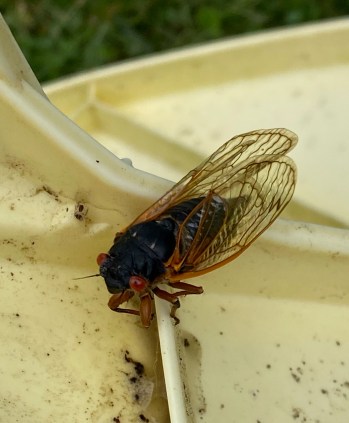 Finally, I saw a live cicada! It was not exactly moving at warp speed, but also not singing – so, likely a female. Doesn’t she have beautiful red eyes? I hope wherever the singing males are, she finds one she likes the sound of. I hope I’m here in seventeen more years, to listen to their progeny.
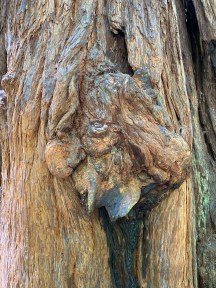 Shortly after that last post I went to California to visit family, masked up but gleeful that we could travel at last! One day we went for a walk in some old growth redwoods. They were tall, stately, awesome, enduring, all of that was true. But these particular redwoods had something else. They had faces. Is that a sheep? Is that a rabbit?
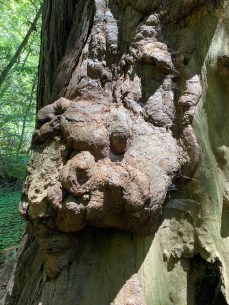 My head began to fill with stories of spirits trapped in trees; or maybe taking refuge in trees? These trees have survived wildfires, droughts, and colonizers, for over a thousand years – and these are the young ones. Being toxic to insects and able to regenerate after fire only go so far. How did they keep us from cutting them all down? Did these faces have something to do with it? Maybe the faceless ones are gone now, leaving behind only the ones that can look us in the eyes.
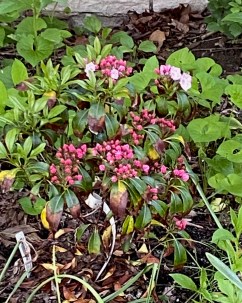 The garden was more or less on automatic pilot while I was gone, sprinklers on timers and mulch on the bare spots to block out weeds. I was pleased to see my three-year-old Kalmia blooming. We had these all around the house where I grew up, and I loved to detach the small blossoms with their stiff pink ribs, and use them as umbrellas to shade the Monopoly houses I took outside and settled between tree roots. Yes, I did that. Monopoly houses used to be made of wood.
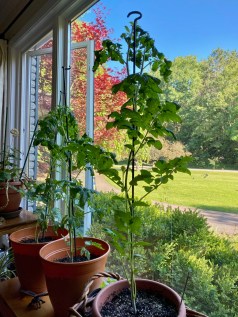 I had left Zerlina and the houseplants in the care of my friend Cindy while I was away, and came home to find she’d done an excellent job. Zerlina was miffed that I’d been gone, but recovered. In the garden, the transplanted tomatoes had rooted themselves in, ready to grow. But the surprise was the greenhouse tomato plants in my front window: three feet tall, thick, and glowing in the captive glassy light. I hope the tomatoes taste as good as the plants look. In fact, I hope there are tomatoes.
 My plants have strong opinions about the unusual spring weather we’ve had. The crabapple trees were giddy in their delight; the lilacs are in such a sulk, most of them have refused to come out. Dame’s rocket is thriving; garlic mustard is in retreat – happy, that. The asparagus was very late. The Jacob’s Ladder is flowering on every rung, and the ferns in the backyard are, well, full of themselves.
 A gardener, like plants, accommodates to the weather. Weeding for instance: pull when wet, hoe when dry. That’s what they say, and mostly I follow that advice. Between hoeing weather and pulling weather I cleared a lot of space. The relevant advice for that is, cover bare ground or the weeds will do it for you. I was able to get all my seedling tomatoes in the ground and sowed several varieties of zinnia and cosmos, on a late afternoon when rain was predicted for the next morning. Seedlings and seeds are happiest if you can set them out in such a situation. I felt somewhere between blessed and smug.
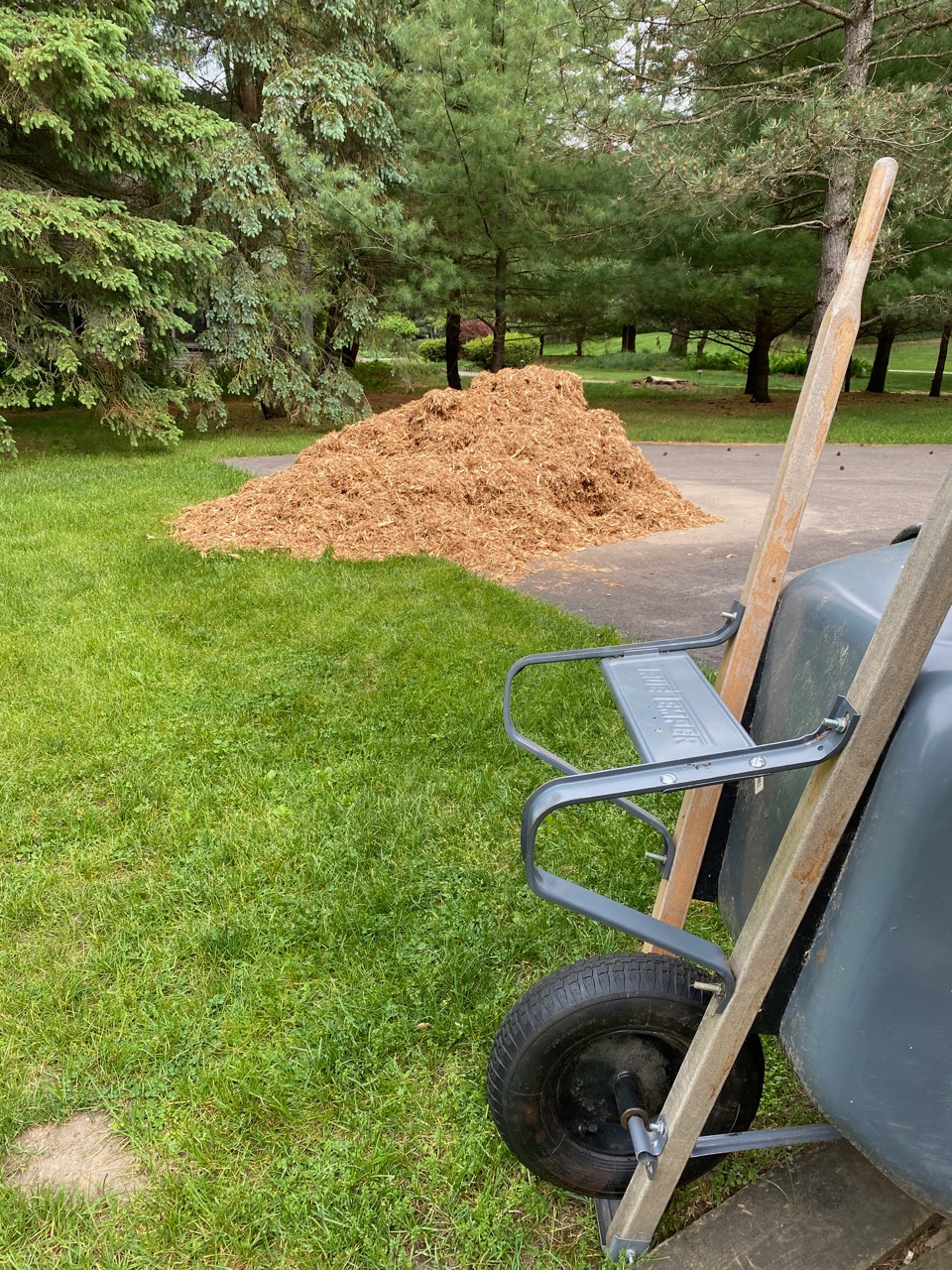 I also put in a bit more lamium, a favorite groundcover, but there was more ground to cover. The situation called for mulch. I called my dirt supplier, and the cedar mulch arrived soon after. Mulch is lighter than dirt, so we’re handling it ourselves without the Rent-a-Rowers. Which means Doug carts it and I spread it – brawn and brains, he says.
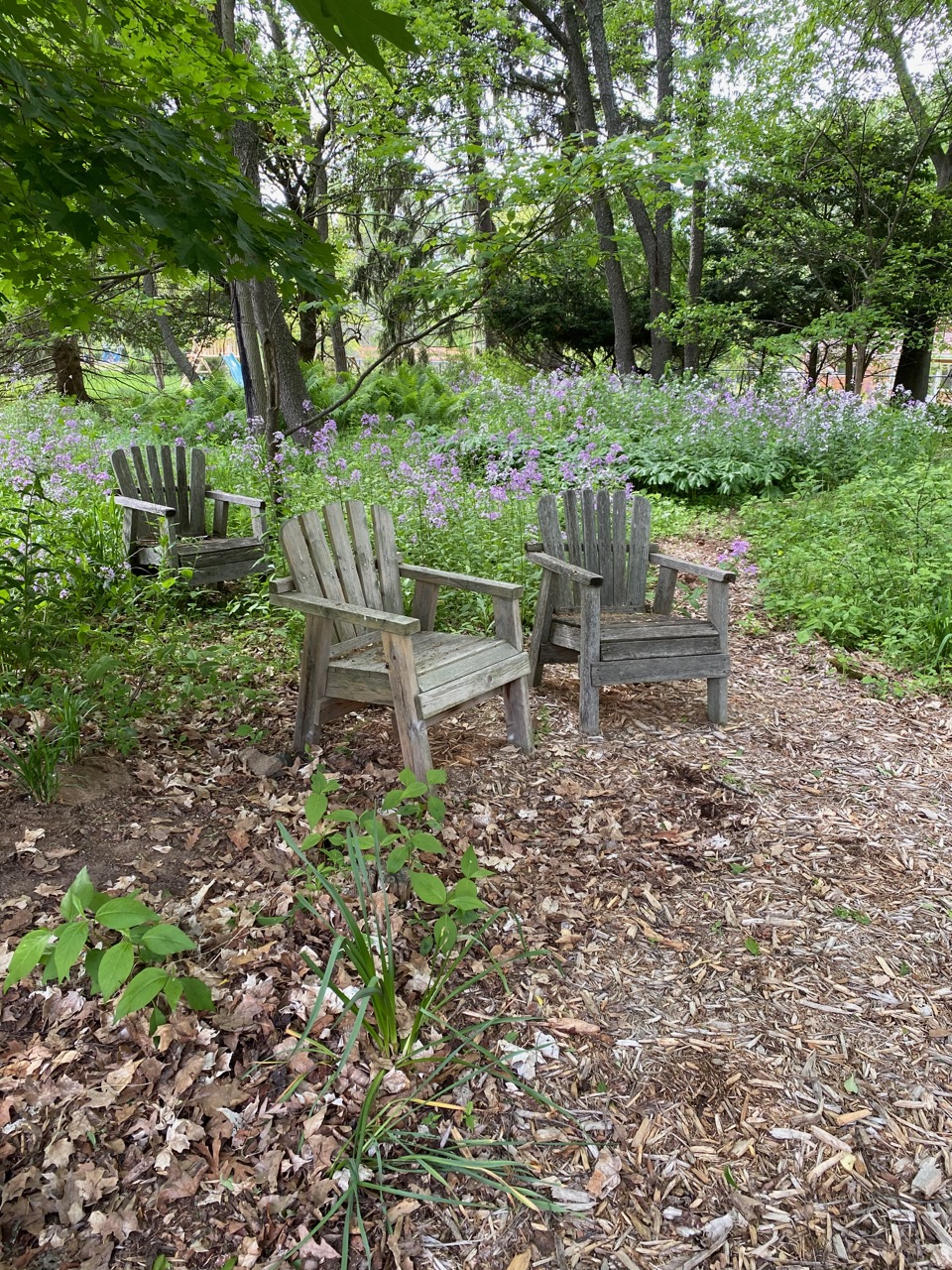 For a break we sat in our little wooded spot, enjoying the mulch job from last year, listening to the territorial arguments of the cardinals and storm warnings of the jays, basking in the success of the tomato house… and contemplating what to do about the compost bin.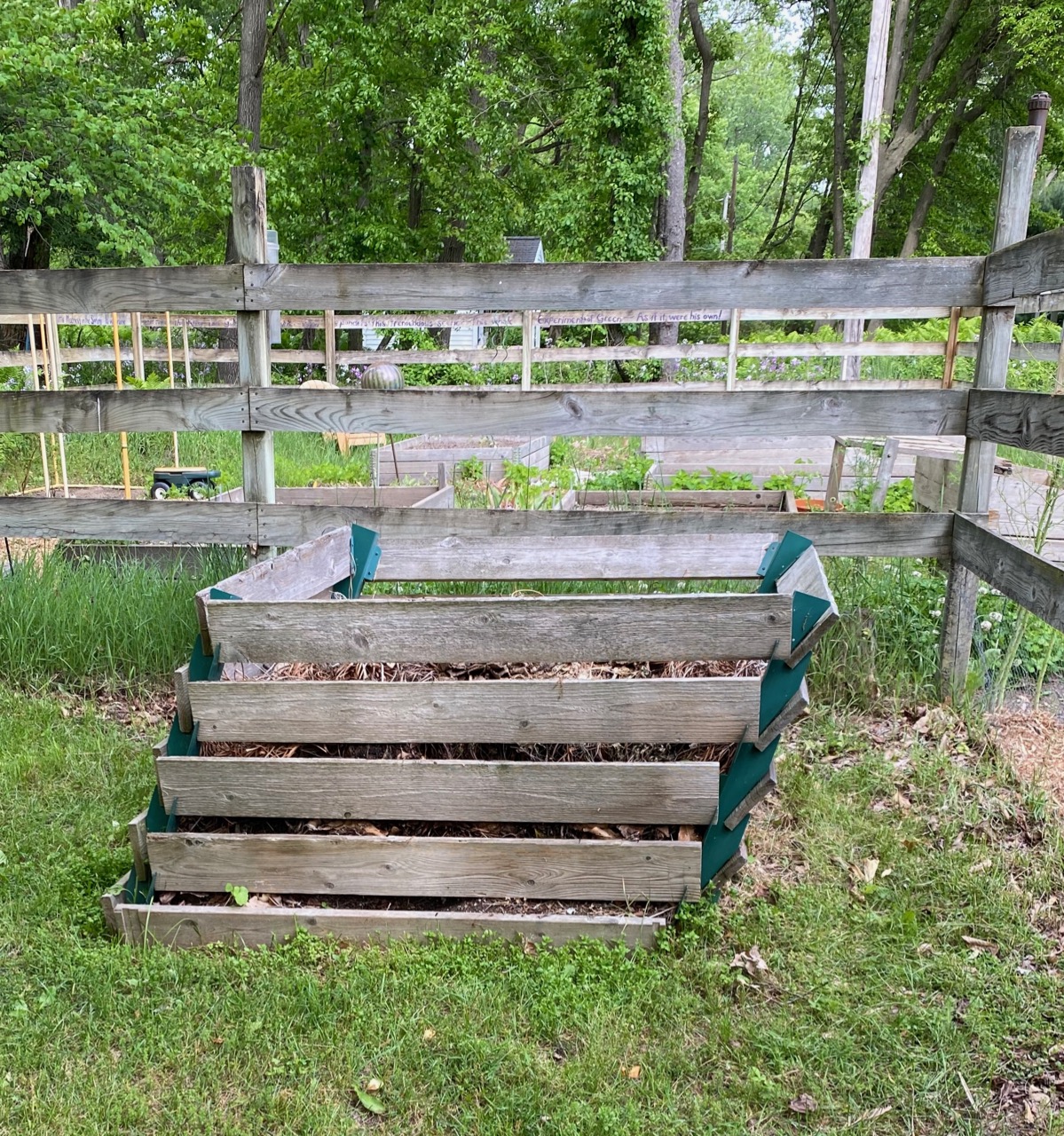
 Doug got the tomato house framed in, and I ordered some dirt to fill it: three cubic yards of half garden soil and half compost, to be delivered by dump truck. When I ordered it, they asked if I wanted it dumped at the top of the driveway or at the bottom. Top? Bottom? On a flat driveway? This was news to me. To avoid confusion I said, the end of the driveway next to the garage. That’s where my dirt was dumped, but of course that’s not where the tomato house is. The tomato house is in the middle of the back yard, about 80 feet away, and dirt is heavy. So we called in Rent-a-Rower.
 Rent-a-Rower is a fund raising effort by the University men’s rowing team. These guys are strong. They can be hired to do such things as shoveling three cubic yards of heavy dirt into aging wheelbarrows, rolling it 80 feet, and shoveling it out into a tomato house, without breaking a sweat. I hired two of them and they finished with the dirt so quickly, I had them dig up two giant clumps of zebra grass before time expired, even with a pizza break. I always like to have pizza with them and find out what they’re up to at UM, their majors, their areas of interest. As Doug has said of the undergraduates he teaches, they’re all such nice kids, it gives you hope for the future.
 The next day Doug started putting up chicken wire, currently at bunny-preventing level, as you see in the photo. There will be another round of chicken wire filling in to block the deer, so he has put a latchstring through the post for me to open the gate when I’m inside. The critters will have to try their luck elsewhere.
 There was also a little dirt left to top up one of the raised beds in the fenced garden. I did some weeding to prepare for that, and found another four leaf clover. A good omen for the garden, for the new tomato venture, for the Rowers, and we hope for the whole world.
 My fenced garden was here before I was. It works beautifully for keeping the deer and rabbits out of my zinnias and tomatoes, but it’s clear the trees nearby have grown – a lot – since the garden fence went up. I expect the garden got more hours of sunlight then than it does now. I love the trees and have no desire to cut them back or cut them down, but their shade is impinging on my tomatoes.
 This is where Doug’s woodworking skills come in. He is constructing a new raised bed for me, out from under the trees, in a spot I picked last summer for its shadelessness. Because it’s out there unprotected, it will need chicken wire all the way up the sides, or at least to above deer-munching height. I’m calling it the Tomato House.
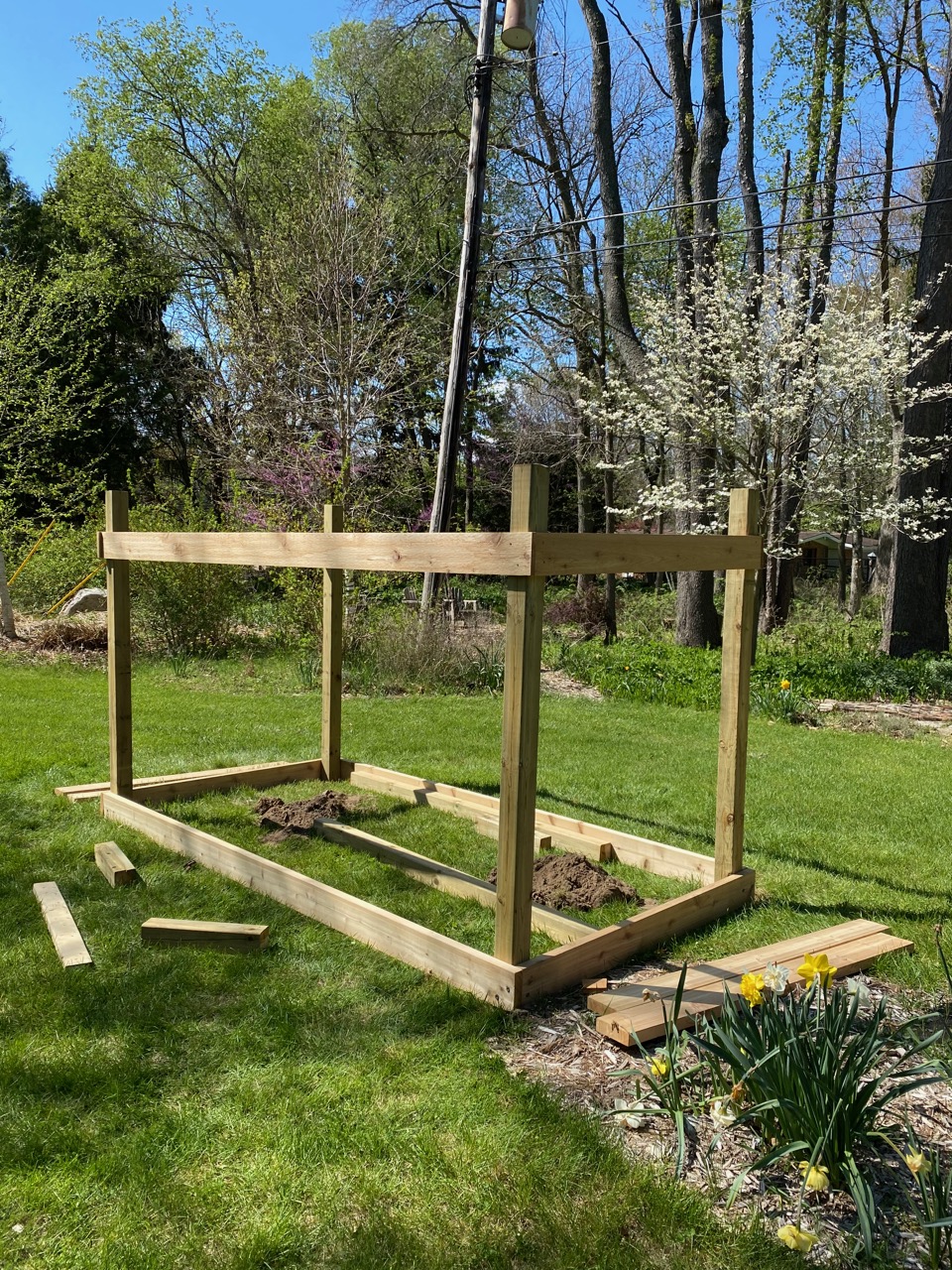 Here’s progress so far – the frame laid out, and the posts rising. The door will be on the north side, to avoid losing any southern exposure. Though in Michigan in summer, the sun is wa-a-a-a-a-y high up, north of overhead. I found this confusing for a while, but I’ve gotten used to it. In this photo the tree shadow brushes the edge of the incipient Tomato House, but don’t worry – it’s barely May now. In a couple of weeks the sun will not be doing that any more.
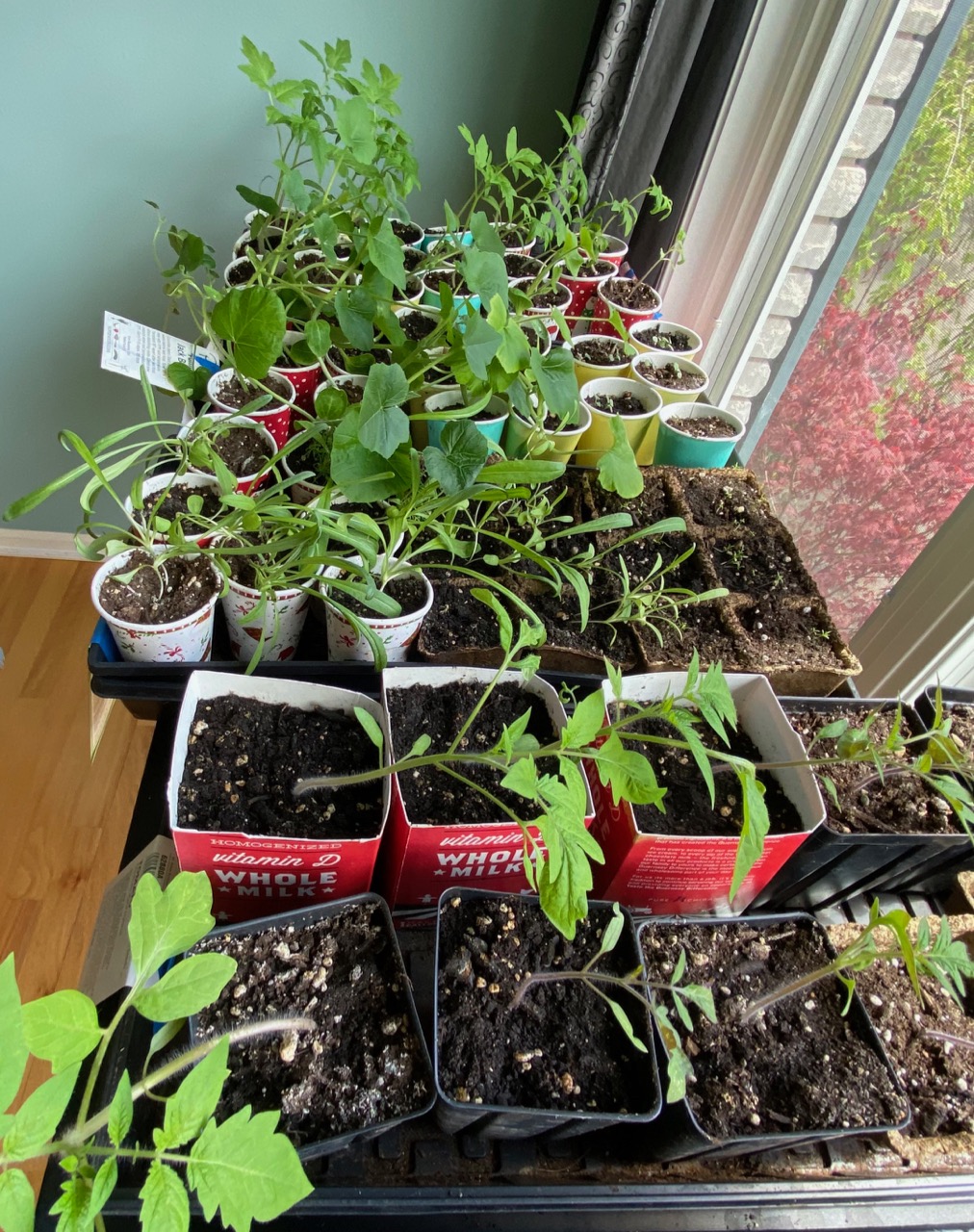 Meanwhile in the upstairs window, the seedlings are trying to bust out. They have to wait. People who’ve lived here for decades say not to plant till Memorial Day, but the latest planting guides say mid-May. I’ll probably split the difference.
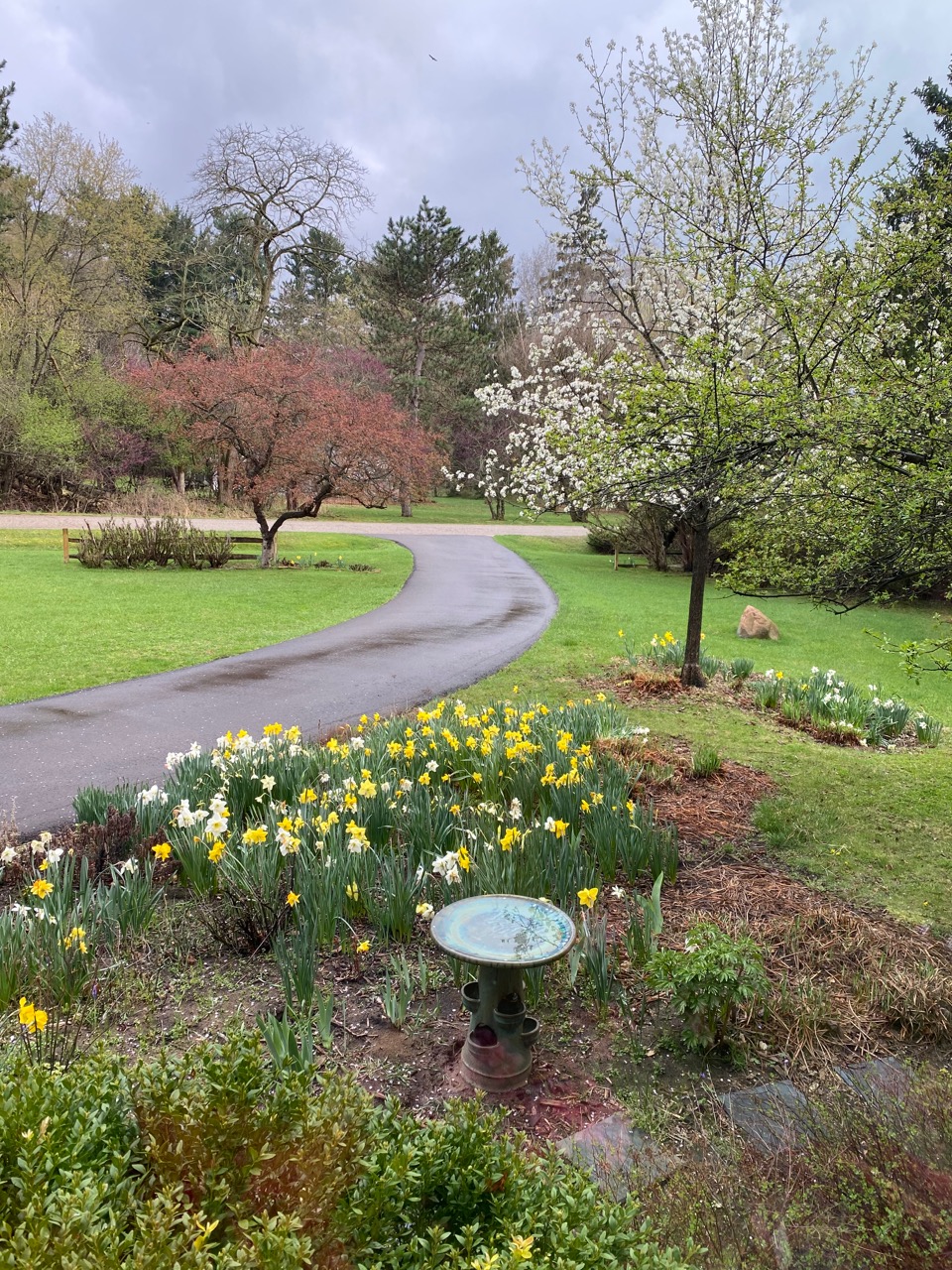 I was sitting in my chair by the window admiring the view, when a bright red blur streaked past, squawking, streaked past in the other direction squawking more, perched on a bare branch to squawk again, and flew off in what I perceived as a huff. The cardinal is impatient with me for slacking off when I should have been getting the birdbath out of the garage. He was right. No more ice, no more danger to garden ceramics, so birdbath time was here. I rolled it out, set it up, dumped in a bucket of water, leveled it, and while I was out there took a few photos. The sweep of April is glorious, from the daffodils at the birdbath’s foot, to the pear tree just starting to fill out, and down by the road a crabapple tree only barely beginning. A grand succession.
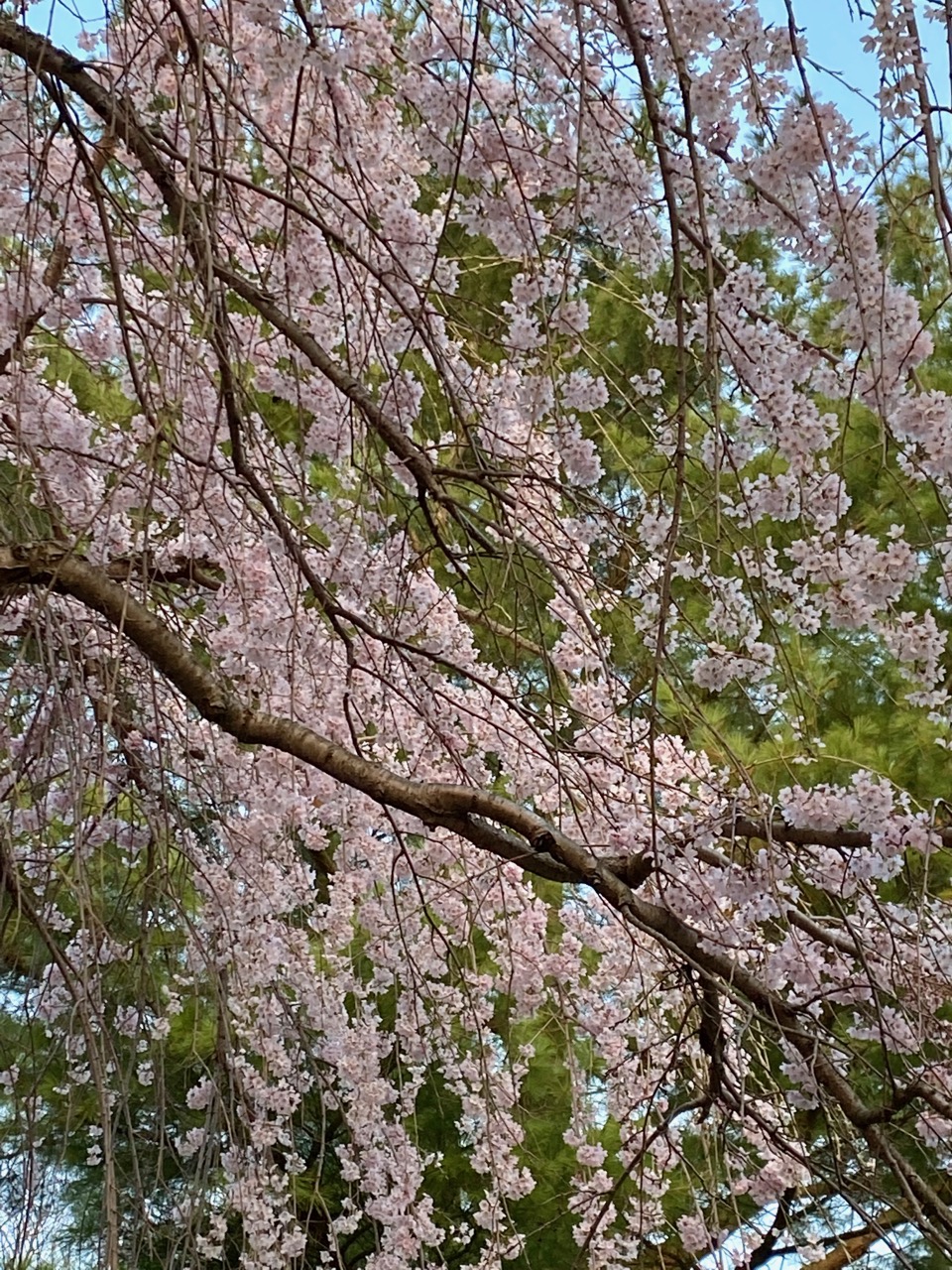 Look how happy the weeping cherry is this year. I’ve also been following the little blue chionodoxa since that last post, and it does indeed subside in time for the first lawn mow.
 Some of the same view shows up from the upstairs window where the seedlings are sprouting. I had seeds for Supersteak tomatoes left from last year and, thinking few would germinate, I put several in each pot. They all sprouted. I thinned them by snipping off the extra ones, since they were too close to risk pulling. I had some Millionaire Eggplant seeds from three years ago, and planted those. The germination rate was less, but not bad considering their elderly condition (for seeds).
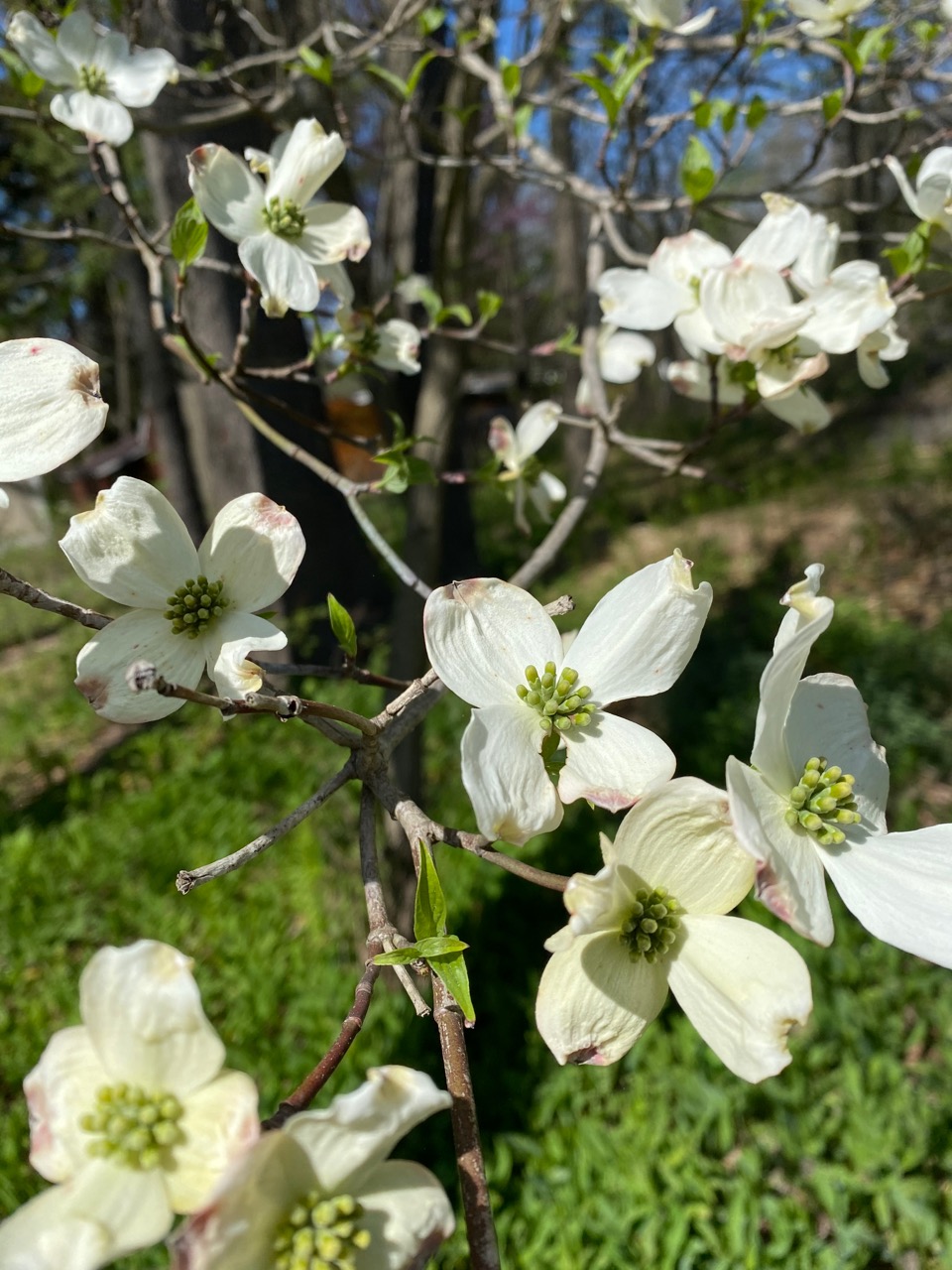
 Meanwhile out in the garden, where it’s still far too cold for the tropical likes of tomato plants, my tulips are coming up in the erstwhile tomato beds. They’re behind the fence to keep the deer from eating them; as they start to bloom, I cut them and bring them indoors for bouquets. Next time I’ll have pictures of the redbuds and dogwoods, which are trembling on the brink of gorgeousness.
 Full-on Michigan spring is not subtle – it hits you over the head with sheer, steep, moonrocketing glory. A little snow is falling this morning, mixed with rain, but it melts before it even hits the ground. The water in the birdbath trembles a little. The cardinal has noticed. Too quick for my camera, but I’m sure he’ll be back.
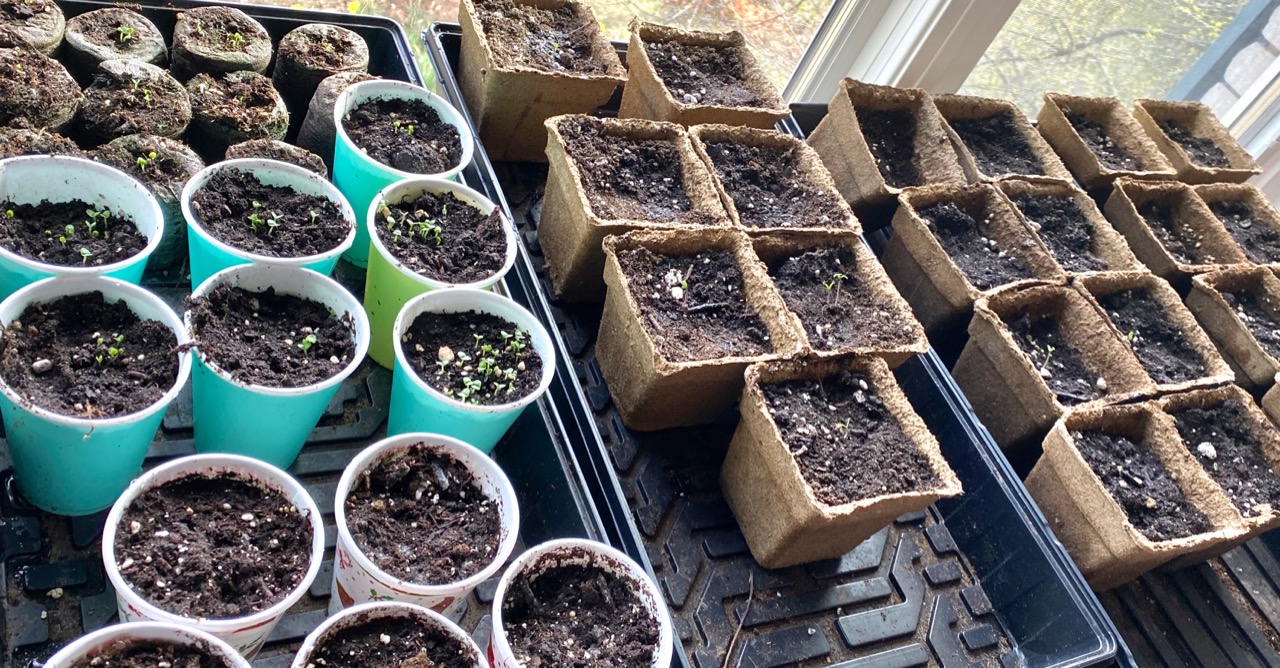 A year ago at the start of the pandemic, which was also the start of the lockdown, we arranged to have our milk delivered. It came in glass bottles. This was delightful, but it meant no more empty milk cartons to start my seeds. So I ordered some peat pots, gathered leftover paper cups from picnics past, scrounged up a handful of unused peat pellets, and proceeded. Here they are at the sunny upstairs window, only a few days in and already a few sprouts. The lobelia seeds were so tiny and so determined to stay in the seed envelope, I couldn’t tell if I got any of them planted, or if they blew away with the house dust. But little green bits are coming up pretty thick in those blobby pellets at the back there, so either I managed to plant the lobelia, or something colonized the pellets as they sat all year in the garage. We will find out.
 The sprouts in the blue cups, though, are basil. I recognize them. No surprise there. Basil’s very nice because when you thin out the seedlings, you can use the discards. They’re recognizably basil, in scent, in taste. Throwing them into the spaghetti sauce is way more fun than tossing every second tomato seedling in the compost pile, after going to all that trouble to start them.
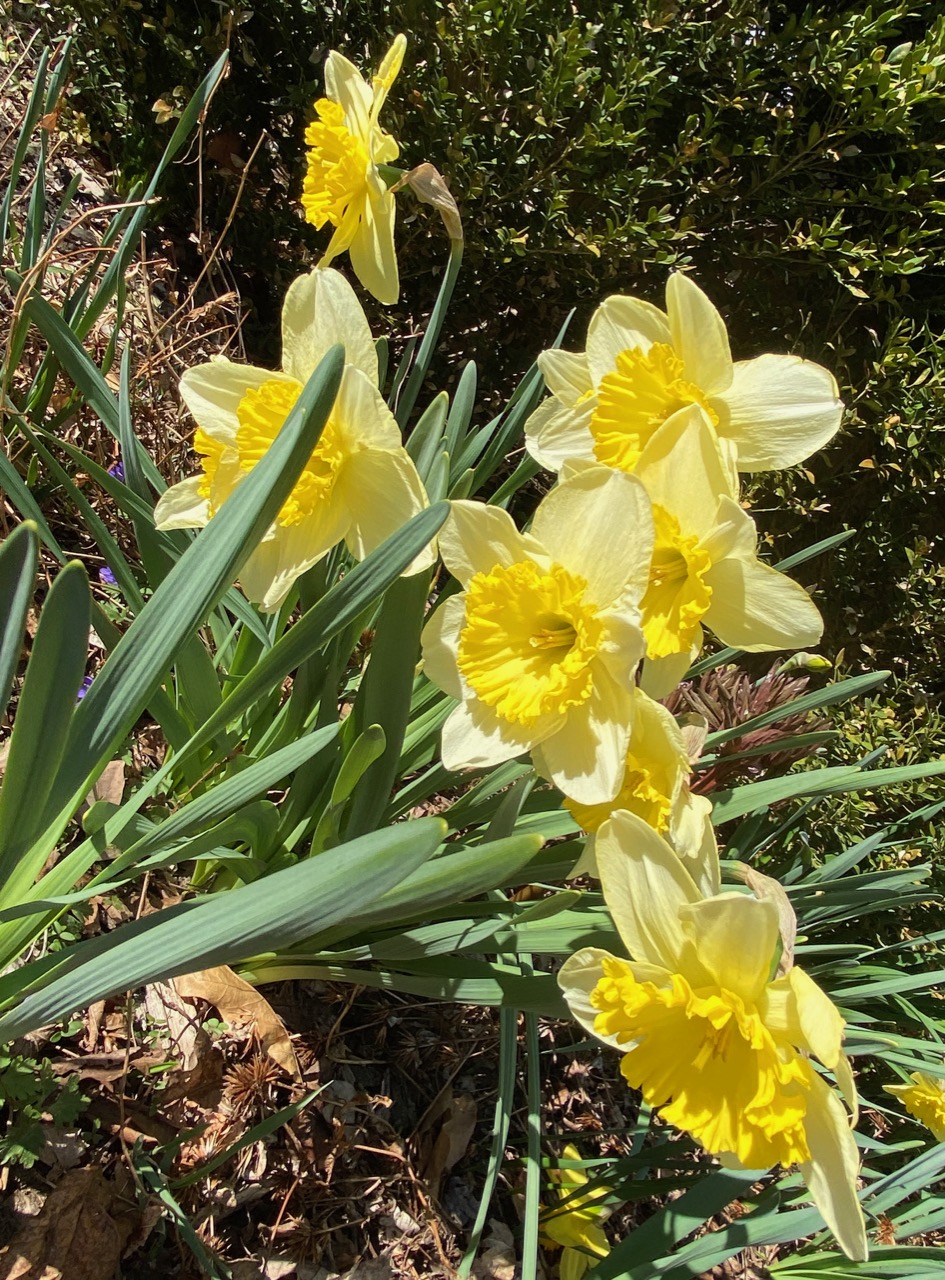
 Meanwhile on the other side of the window, the narcissus are far enough along that neighbors out walking their dogs stop to admire them. Last fall I put a lot of chionodoxa in among them – the small blue things. They were easy to interplant because they’re so small, I barely had to lift a little soil on the point of my shovel to slip them in. I’m hoping they will naturalize, that is, spread and thicken up. The lawn’s started to go green but is not growing yet. I’m keeping an eye on the relative progress of chionodoxa and grass. If the chionodoxa die back before the grass needs mowing, I’ll put a whole bunch of them into the lawn next fall. A blue lawn – even just a swath of blue lawn – will really give the dog walkers something to stop and look at.
 Robin Richstone