
photo by stephen marrinan
When I was growing up, Memorial Day meant a parade down the main street of our small town. People’s fathers appeared mysteriously in uniform, accompanied by the high school marching band, scout troops, local service clubs, and fire engines. My sister Lorna and I walked into town to see it, and followed the end of it to the VFW post, where speeches were made, ice cream in dixie cups was given out free, and a softball game was organized in the weedy next-door lot.
We had pictures at home of my father wearing the Army Air Force uniform that hung in our hall closet, but he did not put it on or join the parade. He was raised a city boy, but he hated crowds. Lorna and I weren’t big on crowds either, but we were very big on ice cream. Still in our single digits, we didn’t understand what memorials, or veterans, or foreign wars were, or what they had to do with the official start of summer, permission to wear white shoes, or free ice cream. But we gleaned from the speeches and the surroundings that the point was to be grateful: for the veterans who fed us, expecting nothing in return; for the musicians carrying their shiny instruments in the gleaming sun just to play for us; for the watchfulness of the firemen; for the warm light of summer; for the softball game that might last until dark; for all these things we licked our sticky fingers with gratitude.
 Sometime later I found out what war was, all loss, terror, and heartbreak, and then I was truly grateful for anyone able to pitch in and stop one. This meant the World War veterans, of course, but I had also heard of Victory Gardens. Now I thought I knew what they were – a way to stop war by getting people to garden. It made sense to me: if people put in the effort needed to grow things, to care for them patiently and see how beautiful they were, why would they want to blow them up?
It was later still that I found, sadly, that people could think of other people the way I thought of, say, the woodchuck. His needs opposed to mine, he becomes The Enemy. It’s a word that has momentum.
 Here they are with tomato towers from two manufacturers: the galvanized ones from Burpee are heavier gauge, so they stand up to windstorms better; the green ones from Gardener’s Supply, which they call tomato ladders and which stack, are taller and support the tops of the vines better. I don’t have a favorite between them, and never having been one for matched sets of things, I like mixing both kinds. I have a third type of stake, too – the spiral kind – which I will deploy for the other tomatoes. I don’t use tomato cages. They make it too hard to weed, and anyhow, I like to claim I have free-range tomatoes.
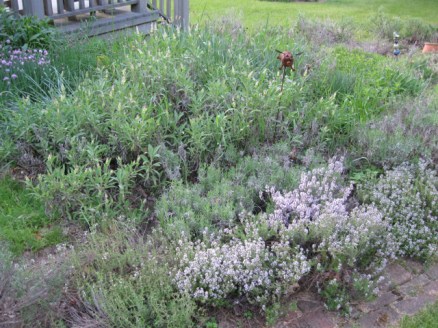 now and then, it really fends for itself. It has a long season, providing sage for Thanksgiving dinner and thyme whenever not covered with snow. The lavender, garlic chives, and chamomile are self-supporting, and it also boasts monarda, russian sage, and shasta daisies. The only annual is – or, will be – basil, various kinds, colors, and sizes. As soon as I get the aforementioned weeds out of the way.
 The lovely tall flowers blooming all around my chair here are dame’s rocket – not phlox, as I thought when I first saw them. Many people put them on an equal footing with garlic mustard and react to them with horror, but they are way less trouble, much easier to keep out of places they’re not wanted. And the deer don’t eat them, which is not true of phlox.
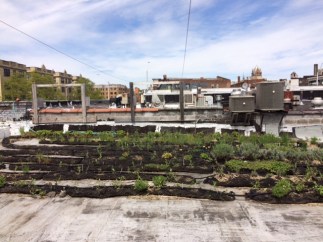
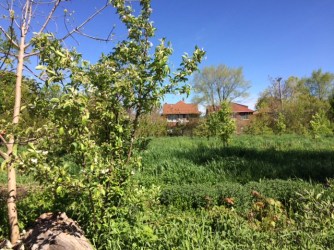 This combination would seem to make urban farming an obvious win, but as we learned on our tour, there are many complications. The soil is poor, and full of debris; the city still has many restrictions in place that limit farm options; and then there’s the human factor. For every group happy to have the tomatoes, there’s a group that wants its city back. What is the best use of this land? What is the possible use of this land?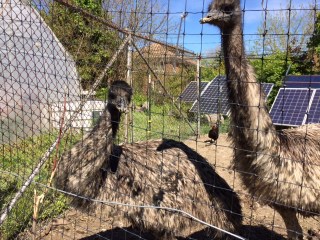

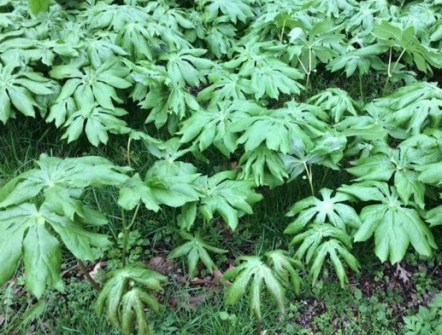 I had no idea what they were, so I posted a photo to Ann Arbor’s Natural Area Preservation facebook page and they identified it for me, along with their compliments on the garlic mustard removal. Mayapple. On further inspection each leaf had a dainty white flower under it, sort of like a lonely apple blossom; but the entire plant was poisonous. So my initial impression was correct: sinister. It’s interesting to think that we have some kind of inborn recognition system for dangerous plants, and intriguing to wonder who decided to undercut that native wisdom with a perhaps cynically chosen name.
 The year before last I planted two small dogwoods and the deer nearly killed them, stripping off bark as they used the trees to scratch the so-called “velvet” from their new antlers. Seems like they could at least have dropped the old antlers in my woods, in exchange. But in the fall I wrapped some protective material around the trunks and they are now recovering, even blooming a little.
 Robin Richstone