
When I told Doug I was heading out to the pumpkin farm, he said “don’t overdo it.” Which made me smile, because there’s a huge gap between my idea of overdoing it and his idea of overdoing it. Wells Pumpkin Farm is far too rich a resource to be denied. I had a base of Baby Boos and Jack Be Littles raised in my own garden, but they needed company. Wells Farm came through, with two little gourds that looked a lot like figs.

A big flat Cinderella white pumpkin was completely irresistible, but would have looked lonely sitting on the hearth all by itself. I gave it some friends: a Royal Blue, which looks green, and a Warty Gnome, which looks like a warty gnome. The Cinderella was satisfyingly heavy to pick up, and rather gloriously sloshed with bits of mud and hay, adding to its autumn aura. I didn’t even have to wipe it down when I got it home, because the dirt and hay rubbed off on my flannel shirt.

But Cinderella is hardly the only story this time of year. The hall table tells a different one every time I look at it, but definitely more Halloween than happily ever after. It’s pretty dark in that hallway, but another nice warty little orange guy and a green one with white stripes brightened it right up.

Then I put out a skeletal creature with a toothy grin to darken things back down. All the pumpkins in his photo are fake, so no overdoing of the pumpkin farm was involved. Overdoing of craft shops and Halloween pop-up stores, maybe yes.

This American Tondo had great color shifts, and a super-beefy stem amusingly out of proportion to its snug round shape. It seemed dignified and comical, both at once. Its name, too – and being into words as I am, I had to look that up. Its formal name is Tonda Padania, tonda being Italian for round, and Padania a valley in Italy. All pumpkins originate in the Americas, but this variety is said to have been developed in Italy. American Tondo could be a compromise, or an argument.

But for truly wild shapes, a Turk’s Head, a Crown of Thorns, and an Autumn Wings are a lovely tableau. It makes me happy to see them there on the kitchen counter, bringing in some autumn to compensate for the fading out of the tomatoes. Goodbye BLT sandwiches; hello pumpkin pie.


 Thanksgiving marks the pivot point between fall and winter. The leaves are all down, Christmas lights have begun going up, and a bit of snow has joined in the decorating trend. One of my surprises moving to Michigan from California, was still having fresh sage in the garden for the Thanksgiving turkey platter. I did have to brush the snow off of it, but it looked great and smelled wonderful.
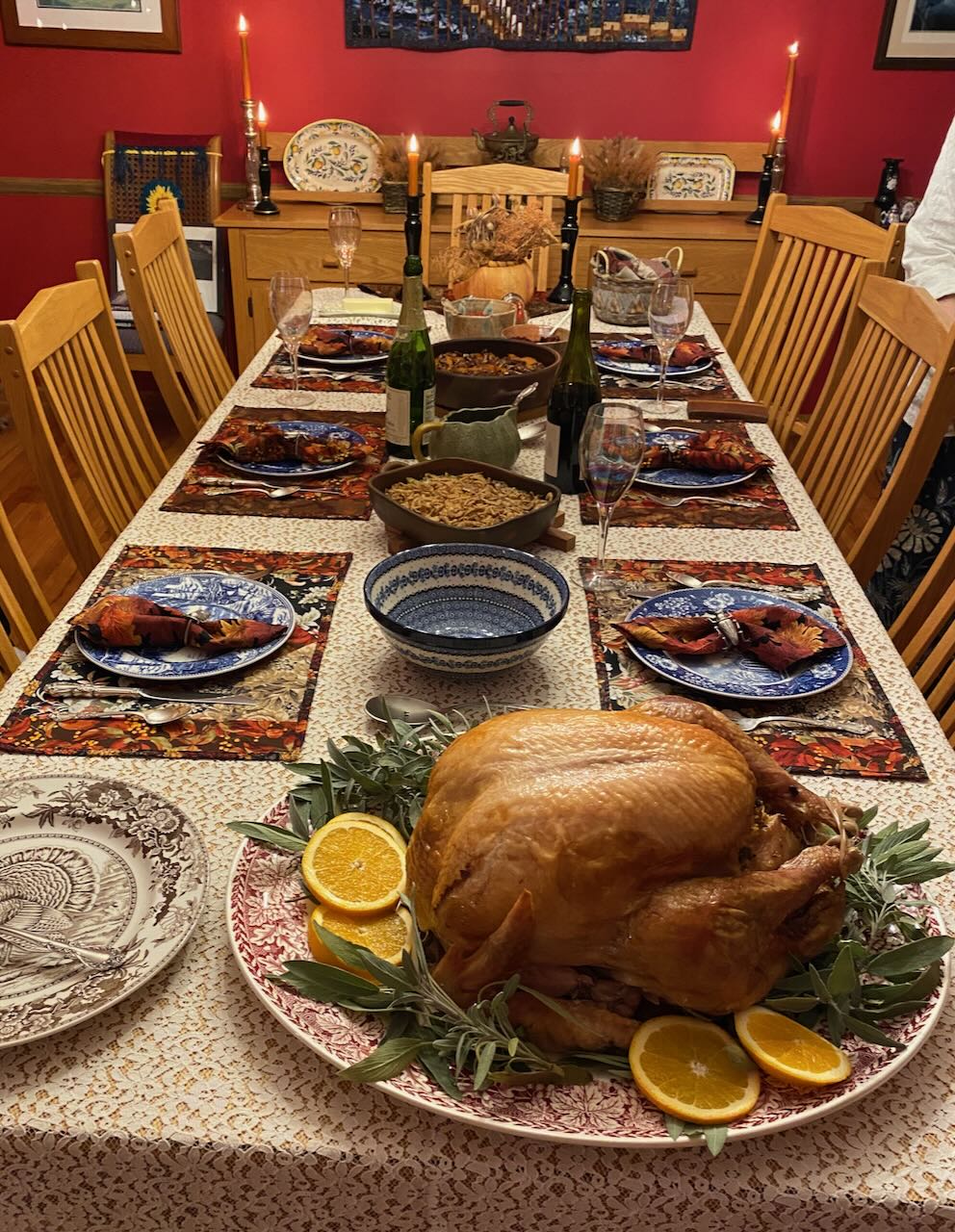 The turkey platter is a family heirloom. I didn’t have the best relationship with my mother growing up, but as I set the table it meant a lot to me to have her silver, her black glass candlesticks, her blue Staffordshire souvenir plates, her turkey platter. I lifted and placed these things and thought about what her life was like, what she might have wanted to do with it and what she did. She used to tell me stories that changed as she told them, that differed from time to time. That was how it seemed to me then. Now I think it was all the same story, just seen from different perspectives.
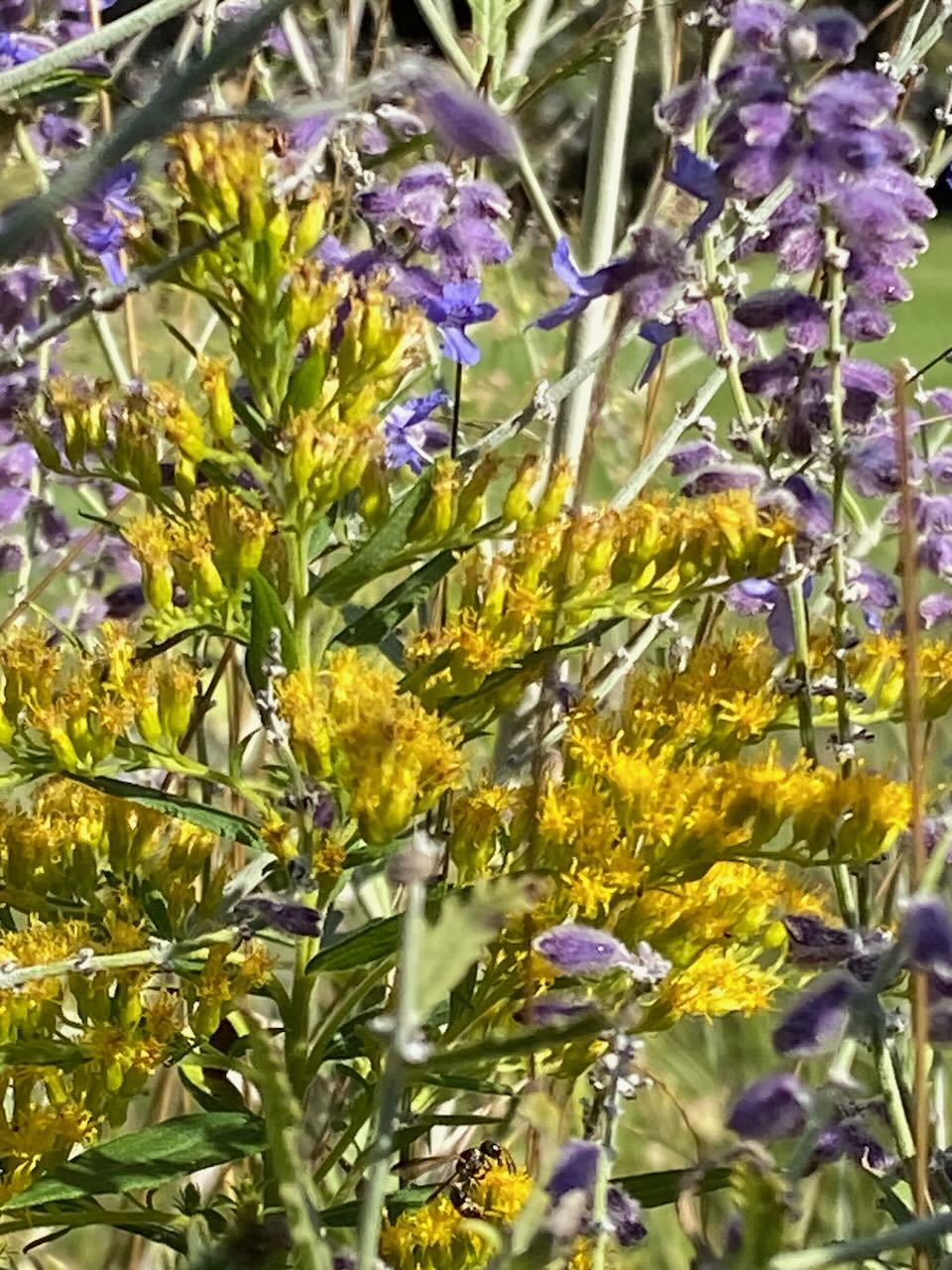
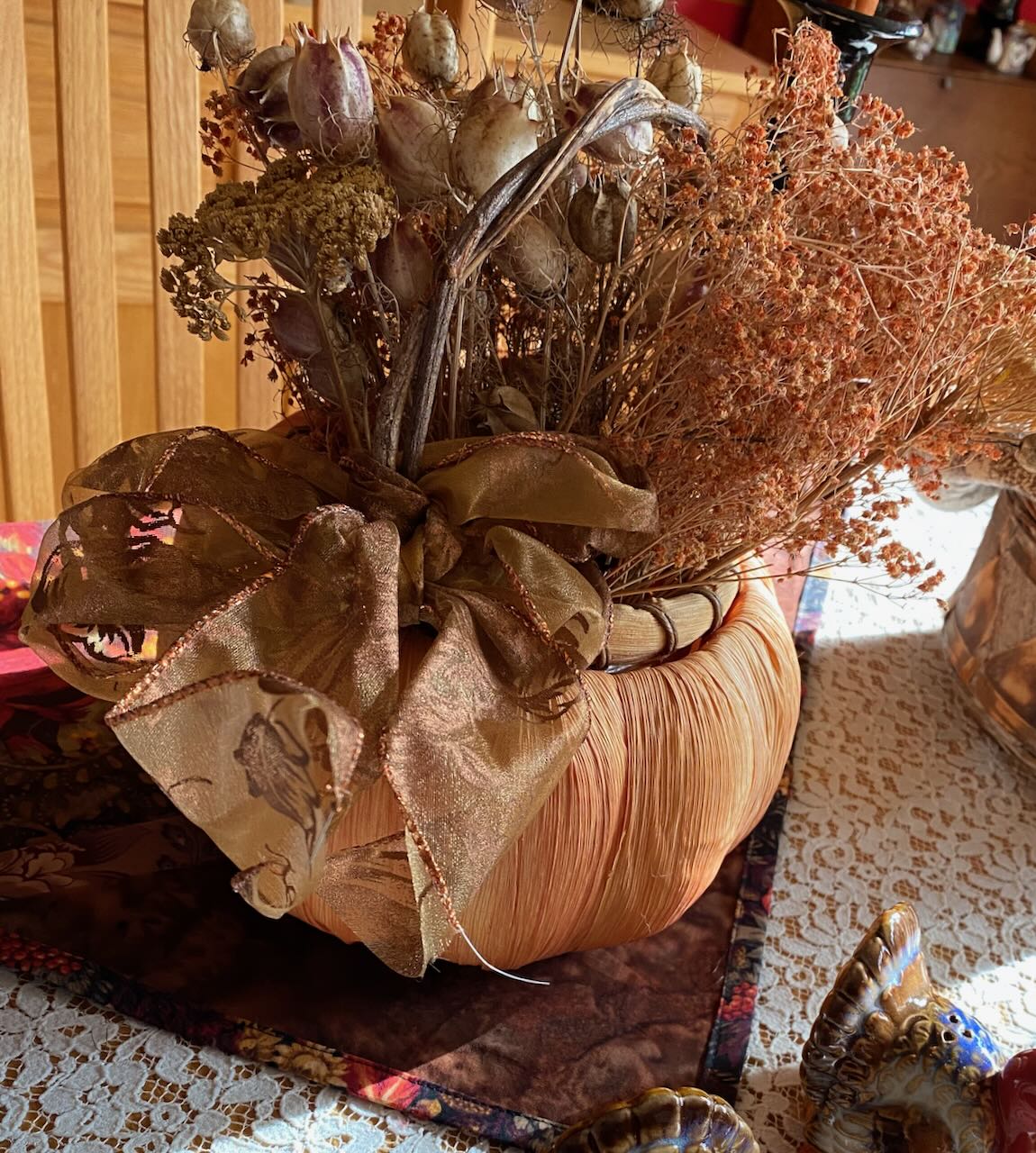 Thanksgiving is a good time for appreciating what you have. No more zinnias or cosmos in the garden, but the nigella and goldenrod, standing tall and dry outside in the cold, make a lovely arrangement.
 There’s leftover pumpkin pie for breakfast, while on the front porch the frost is definitely on the pumpkin.
 Snow outlines the trees, blows off, comes back, blows off. The sky’s not the same twice in ten minutes.
 On my windowsill another transition is happening: the poinsettias, so lush and green when I brought them in form the deck, are starting to turn red. The next season is coming along.
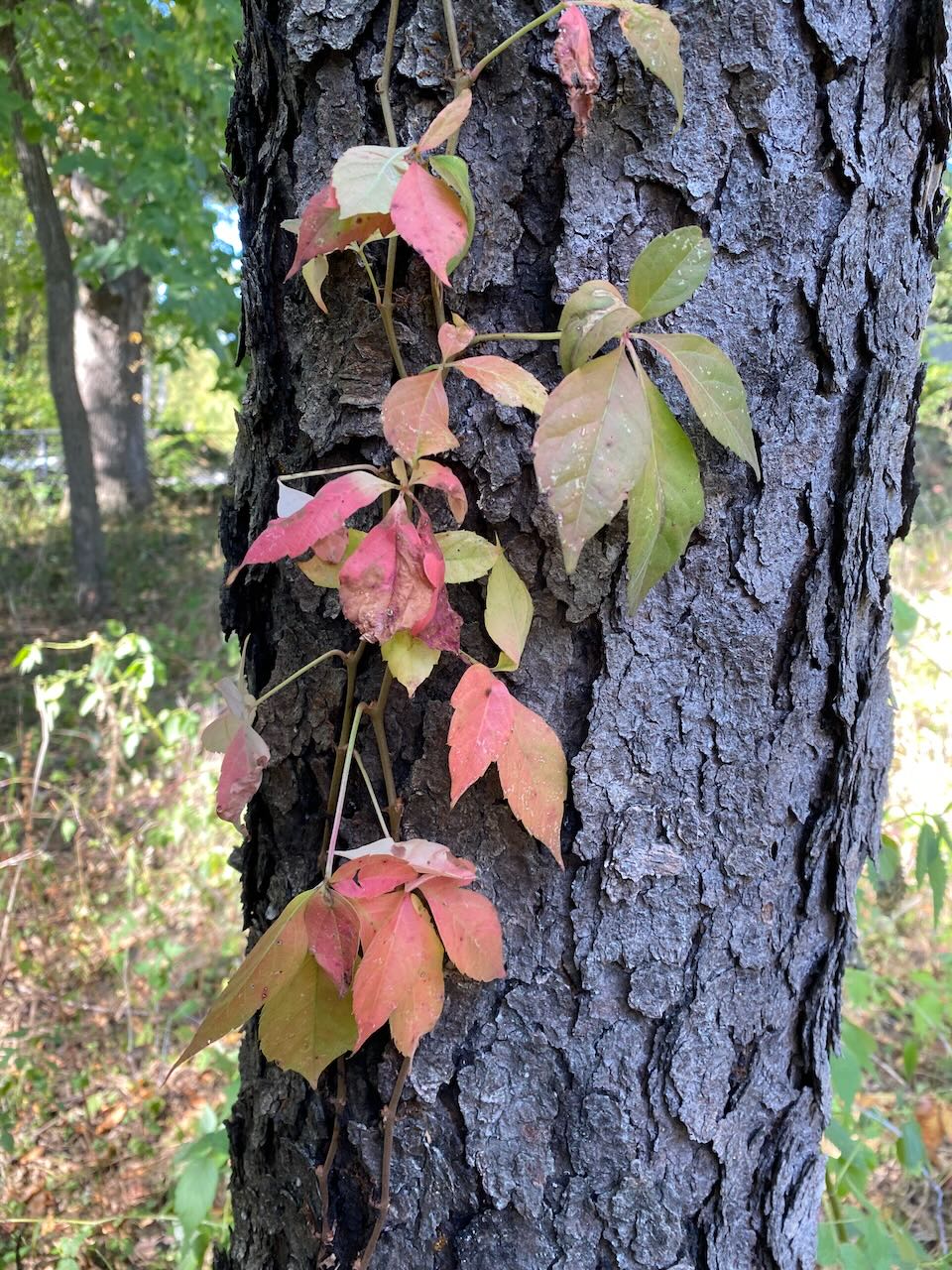
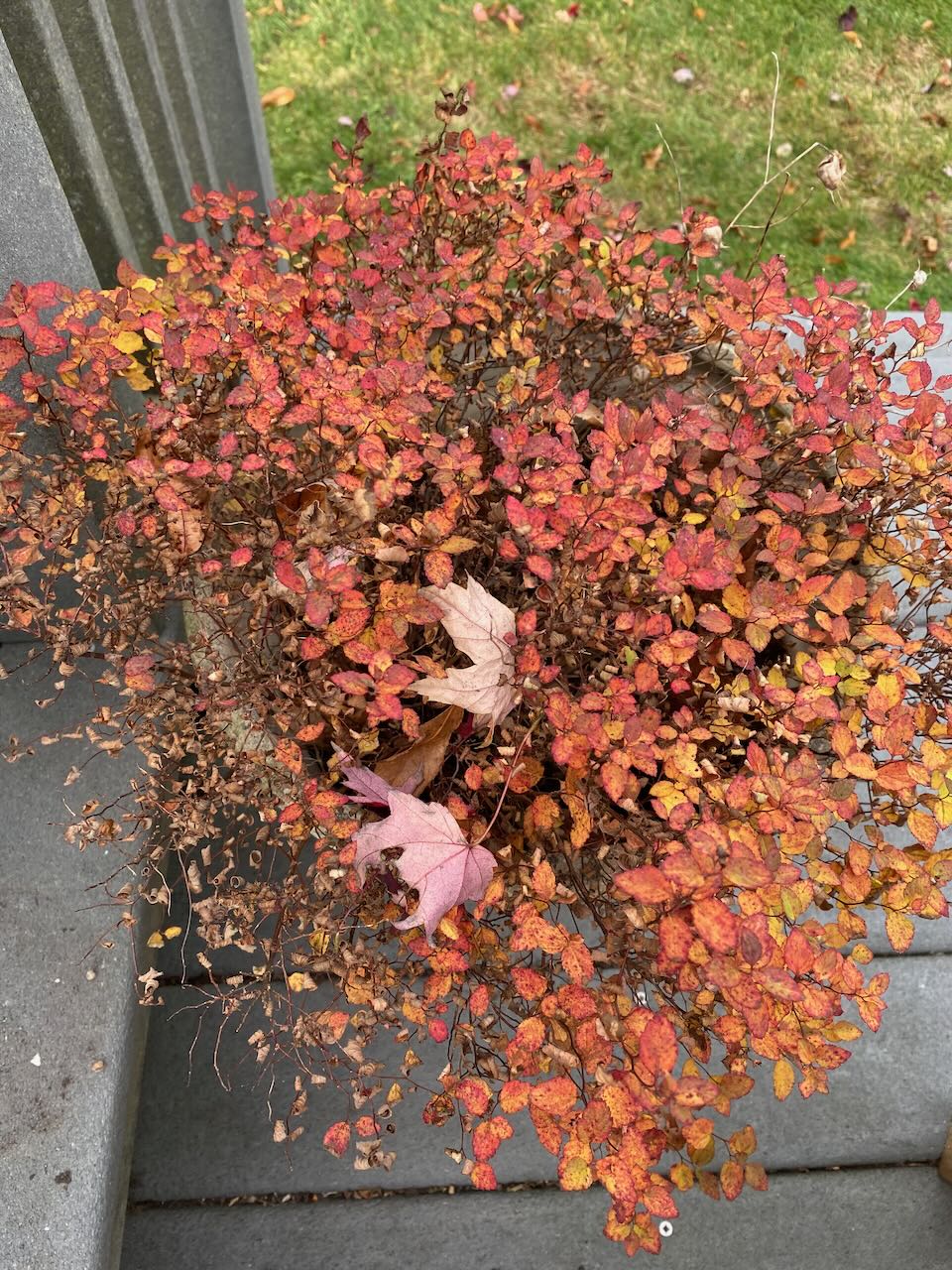 The late warm season continues. Most of the flowers are gone, but there’s still a lot of autumn color. The spirea planted in front is mostly down to bare branches, but this one in a pot on the deck is still in glory. This is odd, first because the front yard gets more sunshine, facing south, and the deck faces north; but also because roots in the ground get more protection from weather than roots in pots do. Nature surprises us whenever she wishes. The potted spirea is a volunteer – a pot of nigella was colonized by free-range spirea seed, and quickly became too lovely to remove. Here it is garnished by a couple of immigrant maple leaves, likely carried by whatever forces brought the spirea seed.
 Here’s the donor tree for those maple leaves, with just a little left in its branches to continue decorating the yard.
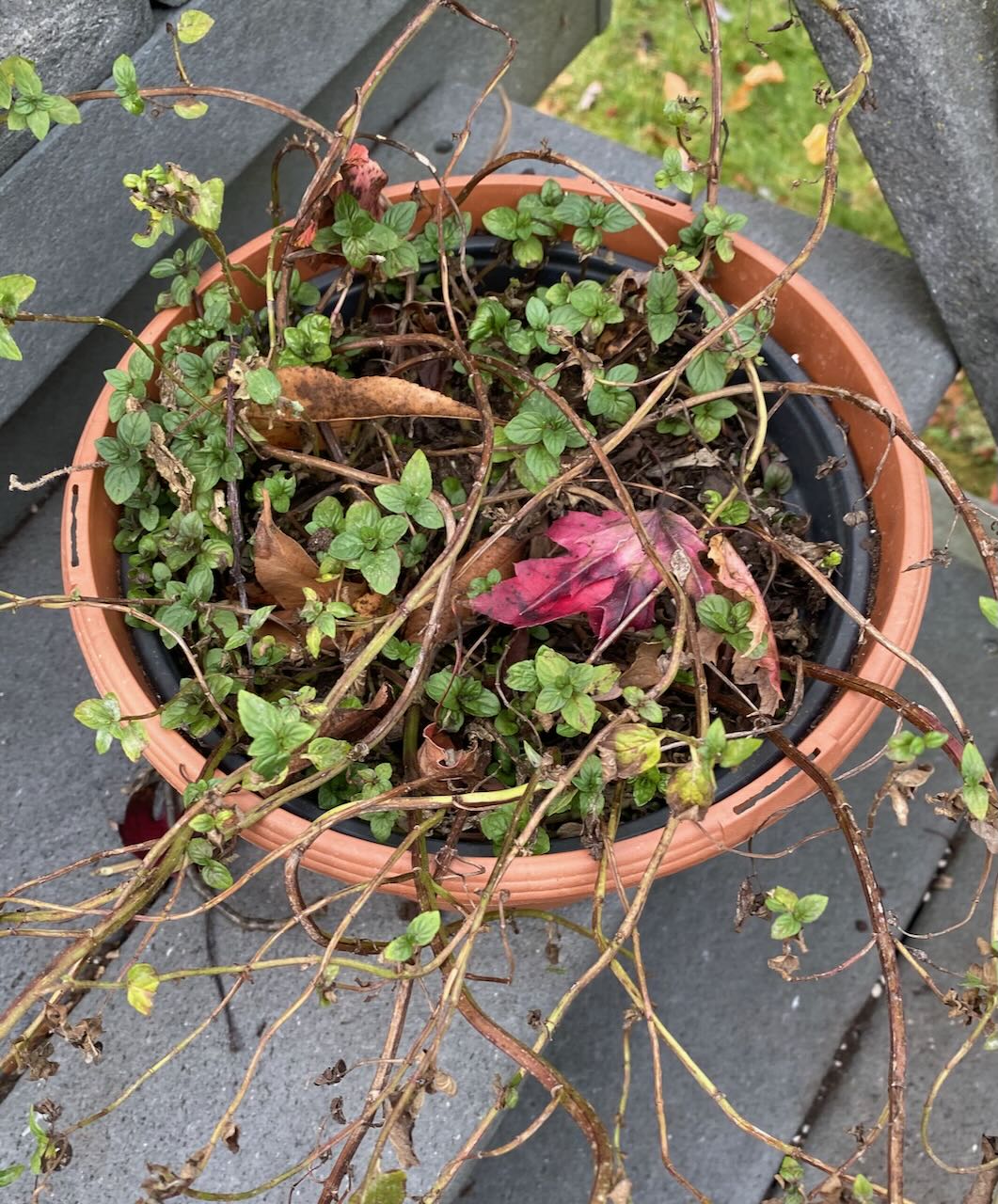 My herb collection has a mixed response to autumn. I had to bring the basil indoors, but thyme and sage will persevere outside all the way to Thanksgiving. The pot of mint may not last quite so long, but meanwhile has collected its own leaf embellishment.
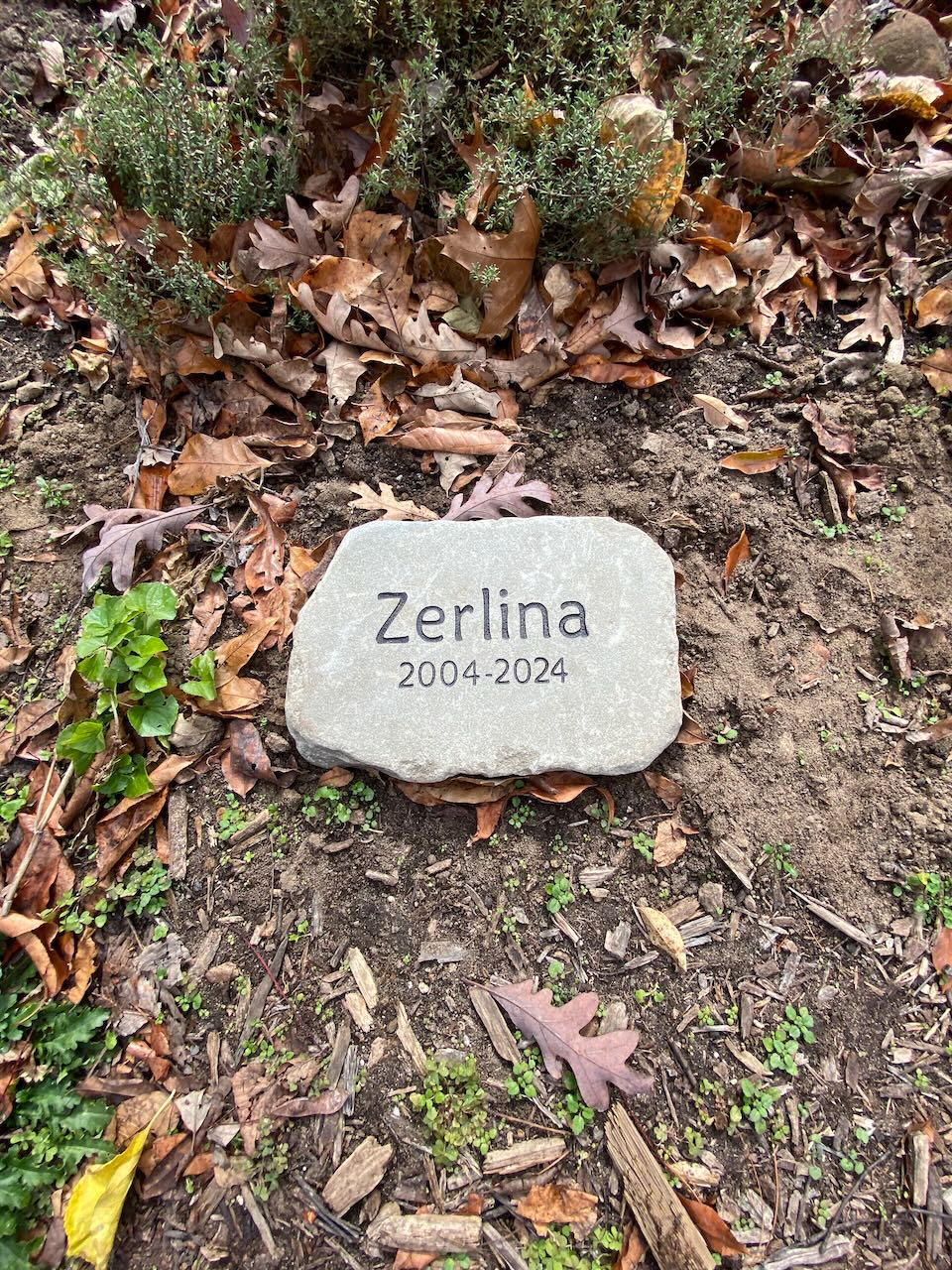 Meanwhile, after much inspection via the internet, I ordered a memorial stone for my wonderful cat, Zerlina. Many of those offered had elaborate decorations and extensive text, but none came up to Zerlina’s level of elegance. I chose one in her colors, with a soft shape. Not that a stone will be puffy, but hard angled edges seemed wrong. Doug came out to the garden with me while I buried her ashes in the center of the garden next to the thyme, and placed the stone on top. I needed the hugs. Then I sat for a while on my glider bench, thinking about her. The thyme will spread, and maybe I’ll encourage it to surround the whole stone. I haven’t decided yet, but thyme sounds like it belongs with memorials.
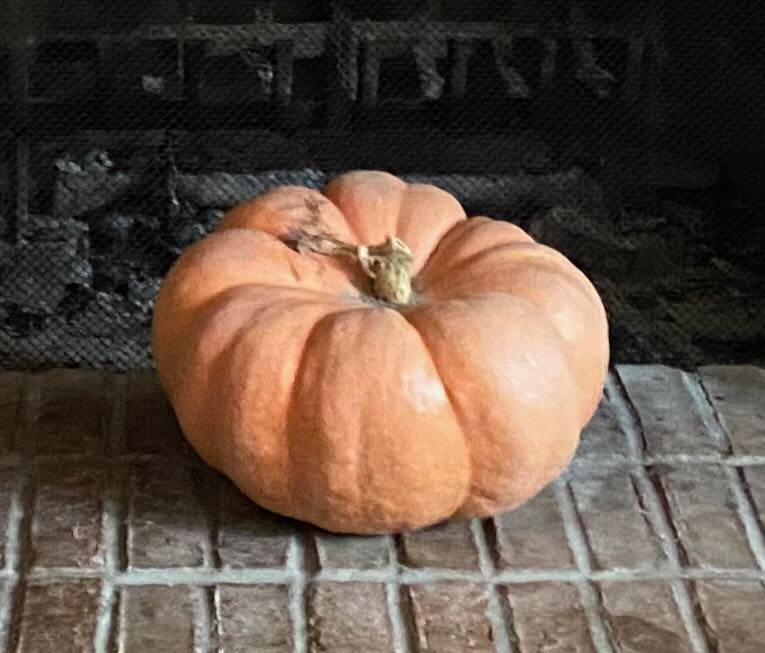 Then I went back into the house, where I picked up all the pumpkins and put them back in different places. I had to remember that things can change. And I found a sort of puffy one for the hearth.
 This morning my sprinkler guy, Craig, came and winterized the system. It’s pretty exciting to watch – he hooks up his air compressor, and it blows the water out of all the pipes at once, like an inverted thunderstorm. All over the yard, clouds rise out of the ground as if the woodchuck is popping open a lot of champagne.
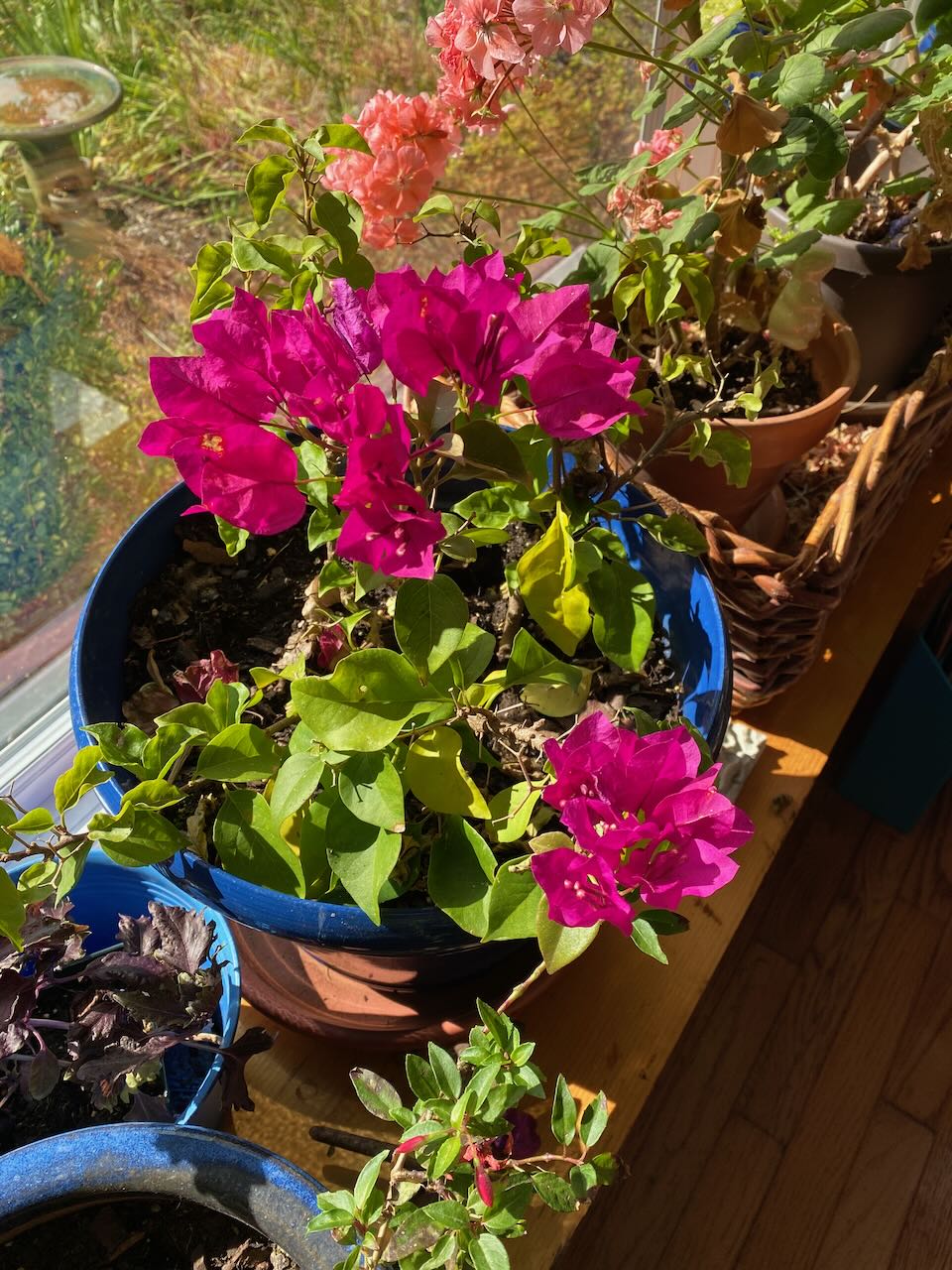 We haven’t had a frost yet, but with the cooler temperatures and shorter hours of daylight, what flowers remain won’t need me to water them. When I moved here fifteen years ago, Labor Day was the time to bring in your tender plants before the frost. Now, Columbus Day is in plenty of time. My bougainvillea gets a spot the sunniest window.
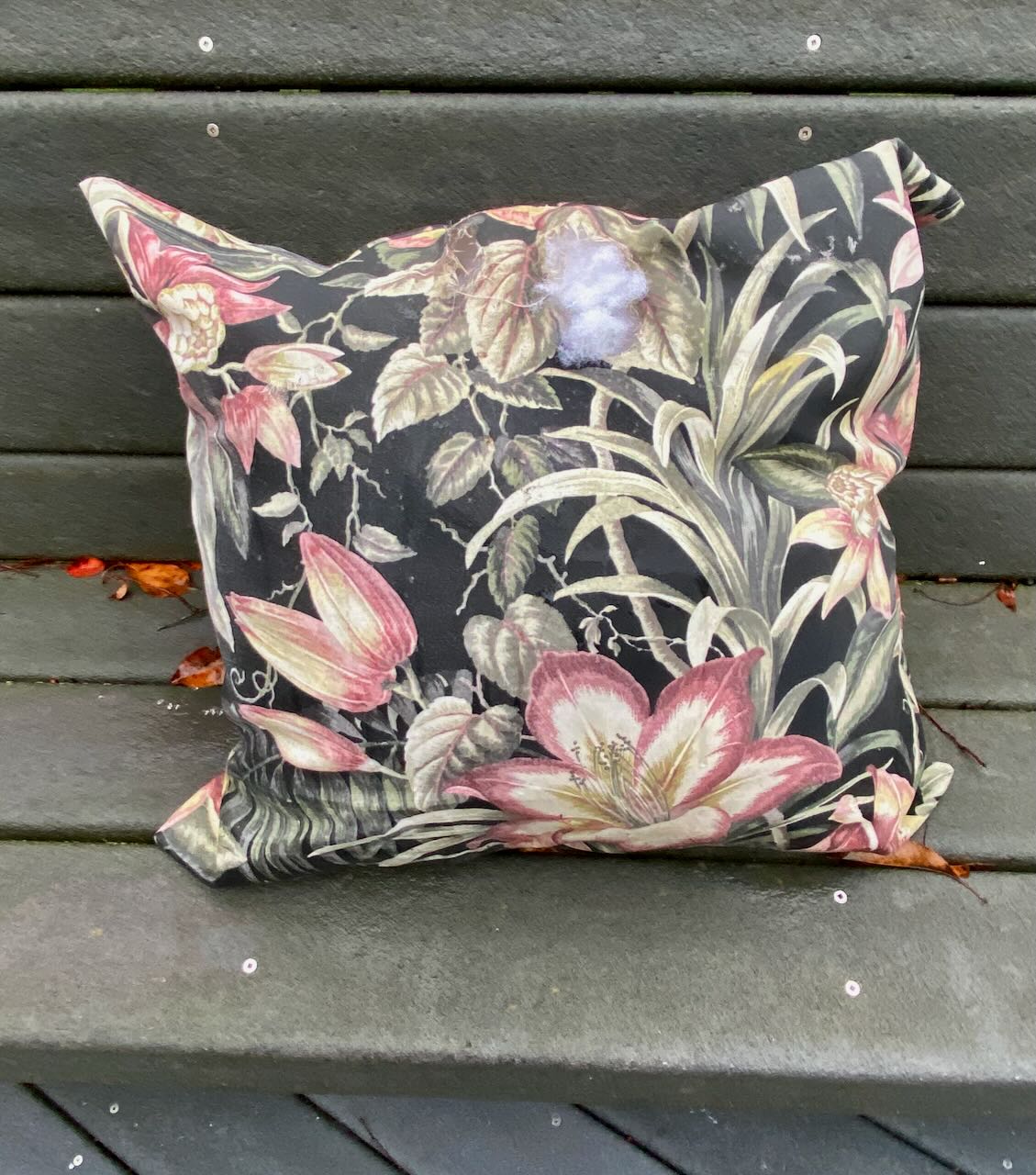 Next up will be bringing the pillows in from the deck. You see the white puff on this one – that’s the spot where the little red squirrel has been pulling stuffing out and carrying it away. I tried to take a picture of him at it, but he was way too fast for me. I also tried to see where he was taking it, but he was too fast for that, too. My first impulse when I saw this marauder, was to save the pillow by bringing it in. Two considerations made me leave it out there: one, that taking it away would encourage him to break into another pillow, whereas leaving it might mean only this one pillow was damaged; and two, it was very entertaining to watch him pack improbable amounts of fluff into his mouth for each trip. Squirrels don’t hibernate, but build nests for warmth in the winter.
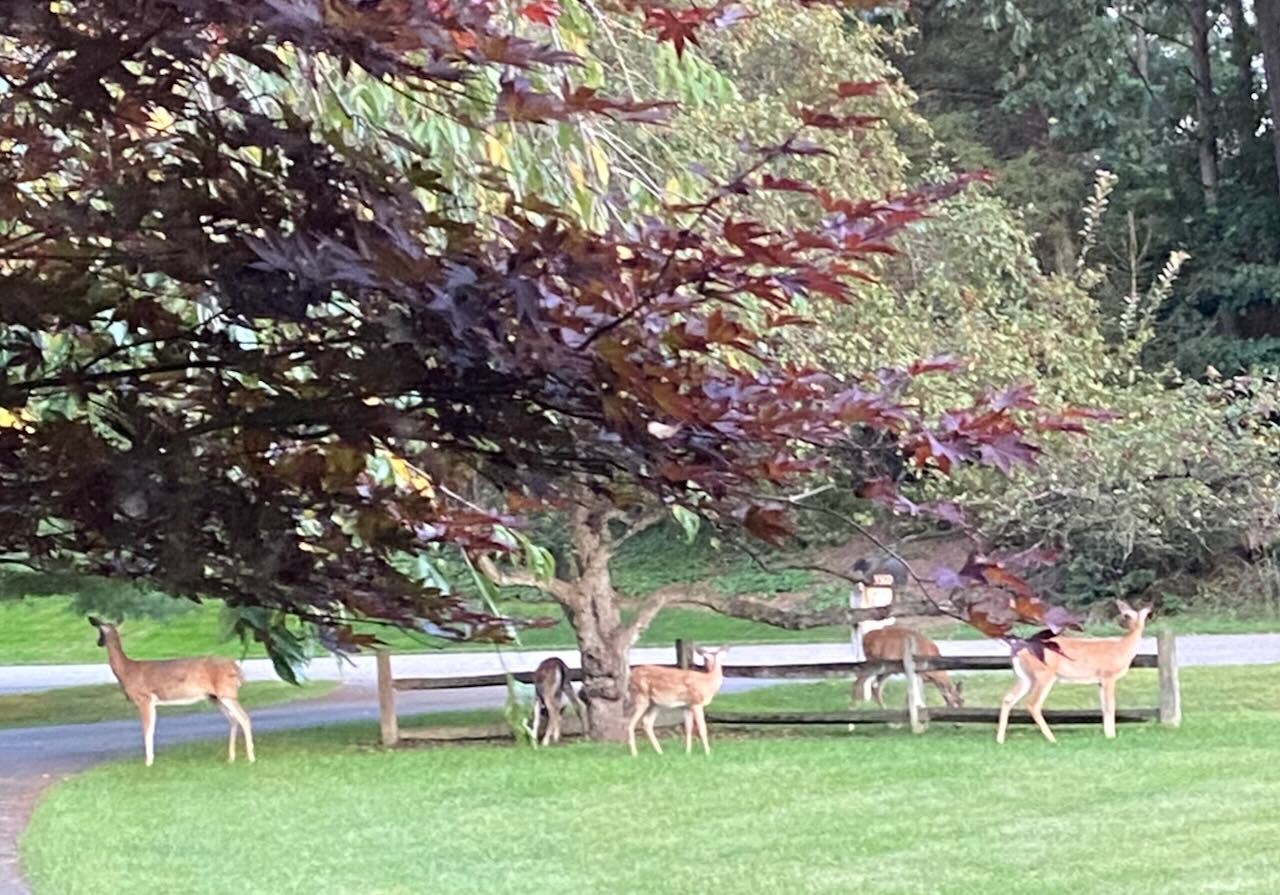
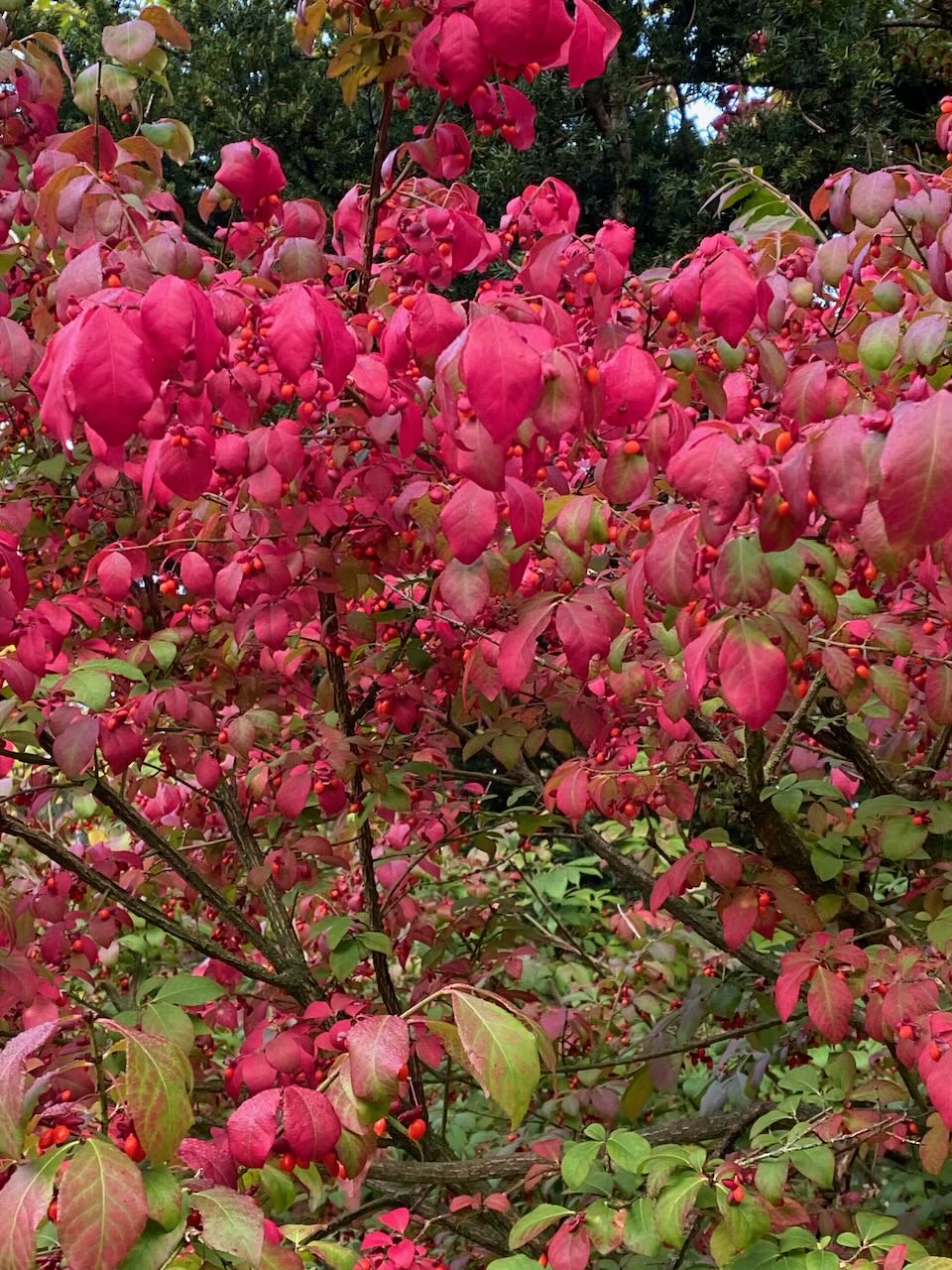 It doesn’t take a frost for the burning bushes to live up to their name. The color is glorious, and it’s very generous with its seeds, a benefit to the birds and small mammals that stay for the winter. Burning bush is not native, and in many areas is considered an invasive pest with no natural predators. Around here, though, the deer are happy to step up.
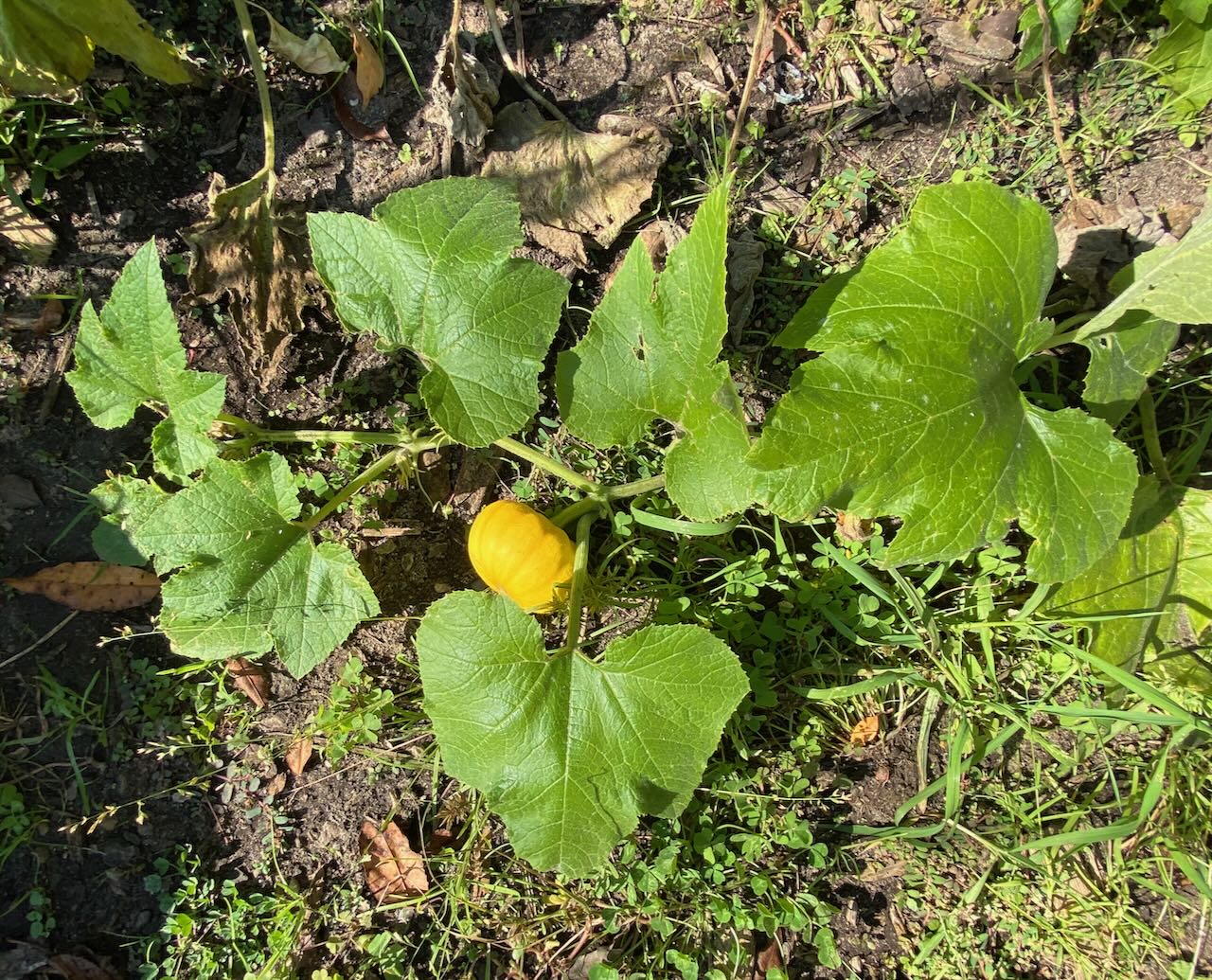
 Out in the garden I still have a few zinnias, but mostly I have miniature pumpkins. I love growing them myself because they’re small enough not to overrun the garden, and I get to cut them with long stems and curlicues still attached. Here they are perched on the hearth of my fireplace, on normal size bricks for a sense of scale. I’ll go down to one of the farms this week to buy some big pumpkins – some for the house, and some to set out on the porch where, when they’re finished building nests out of my pillow, the squirrels will have a handy pumpkin snack.
 Robin Richstone