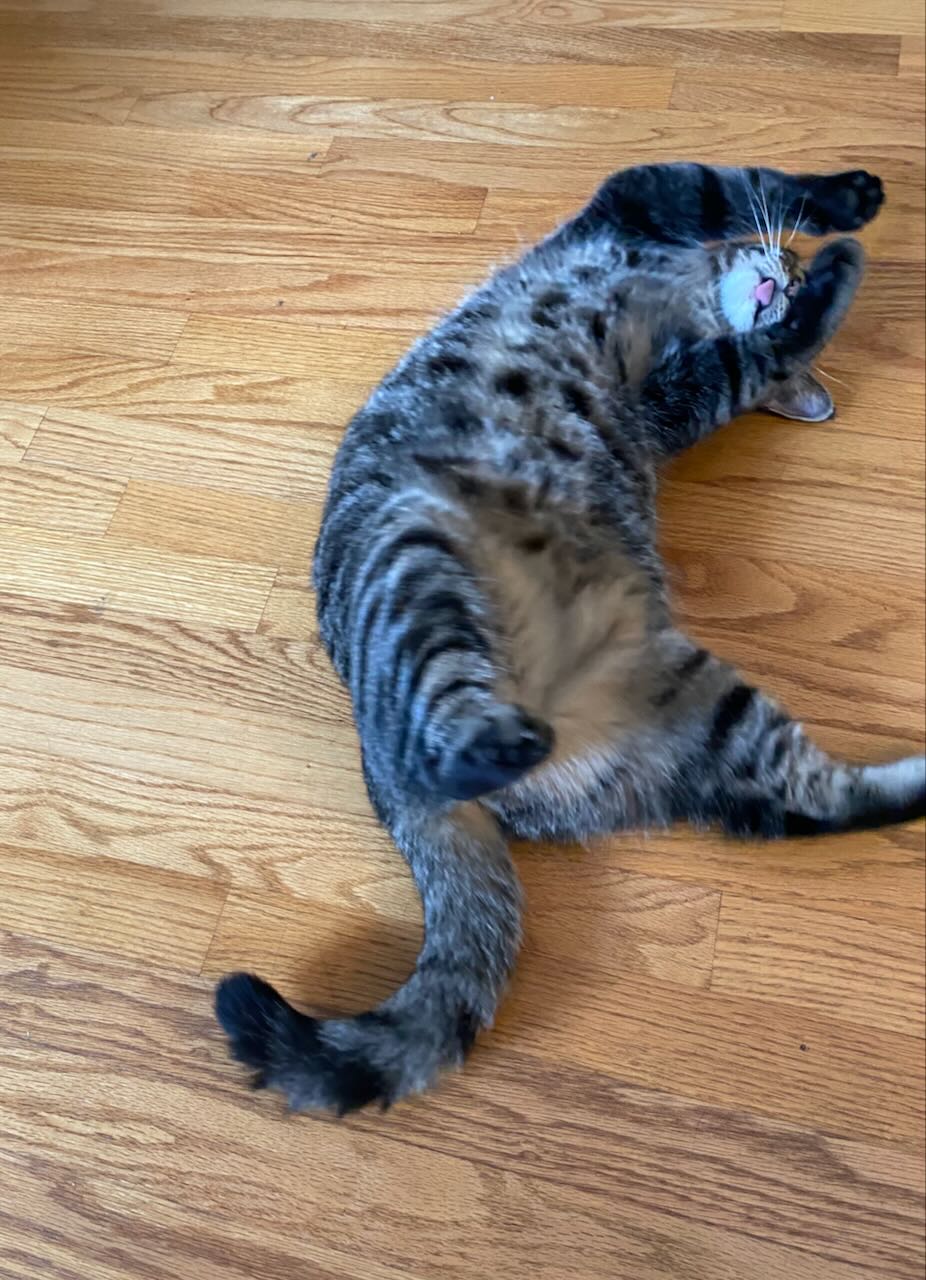
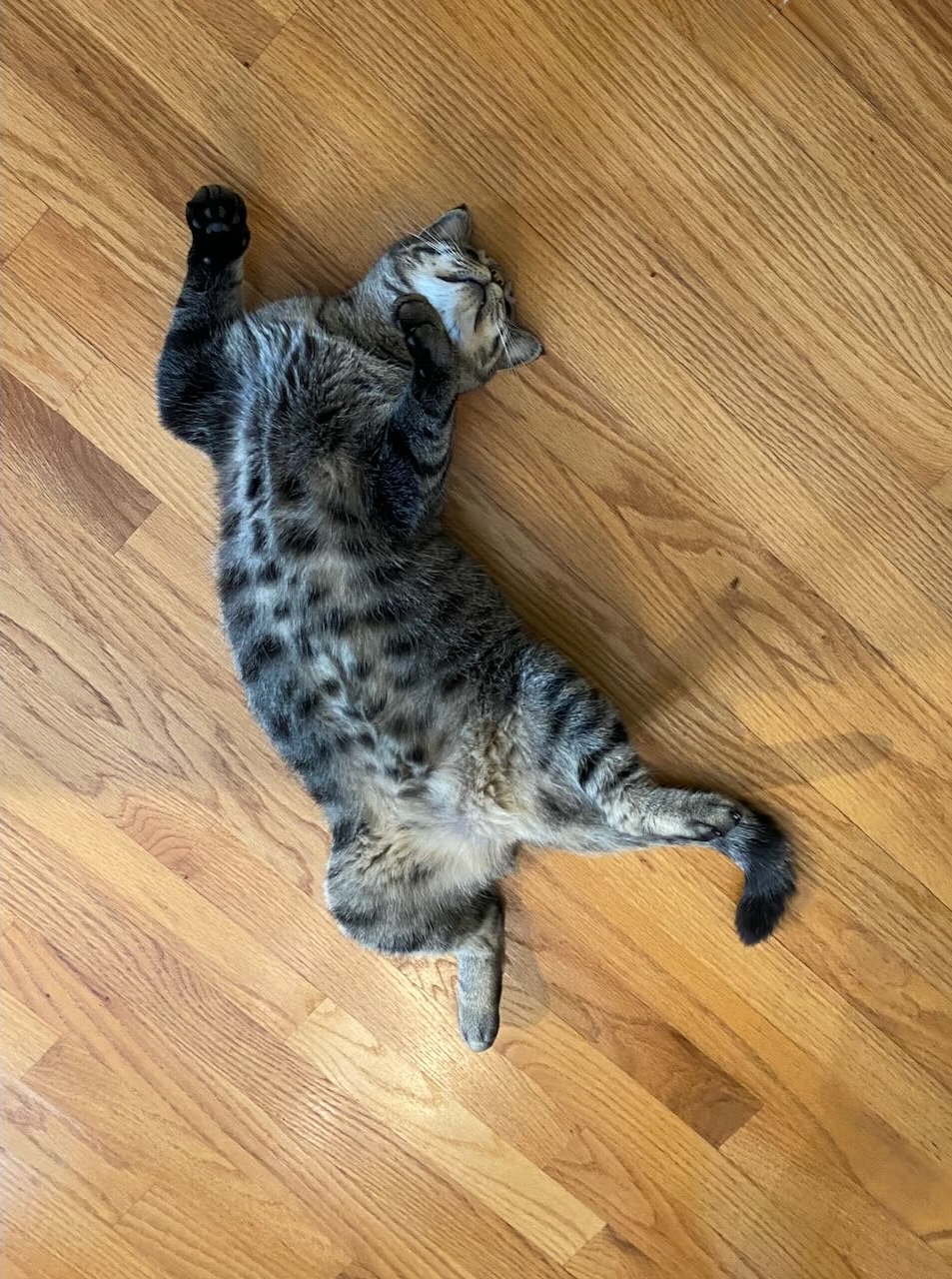
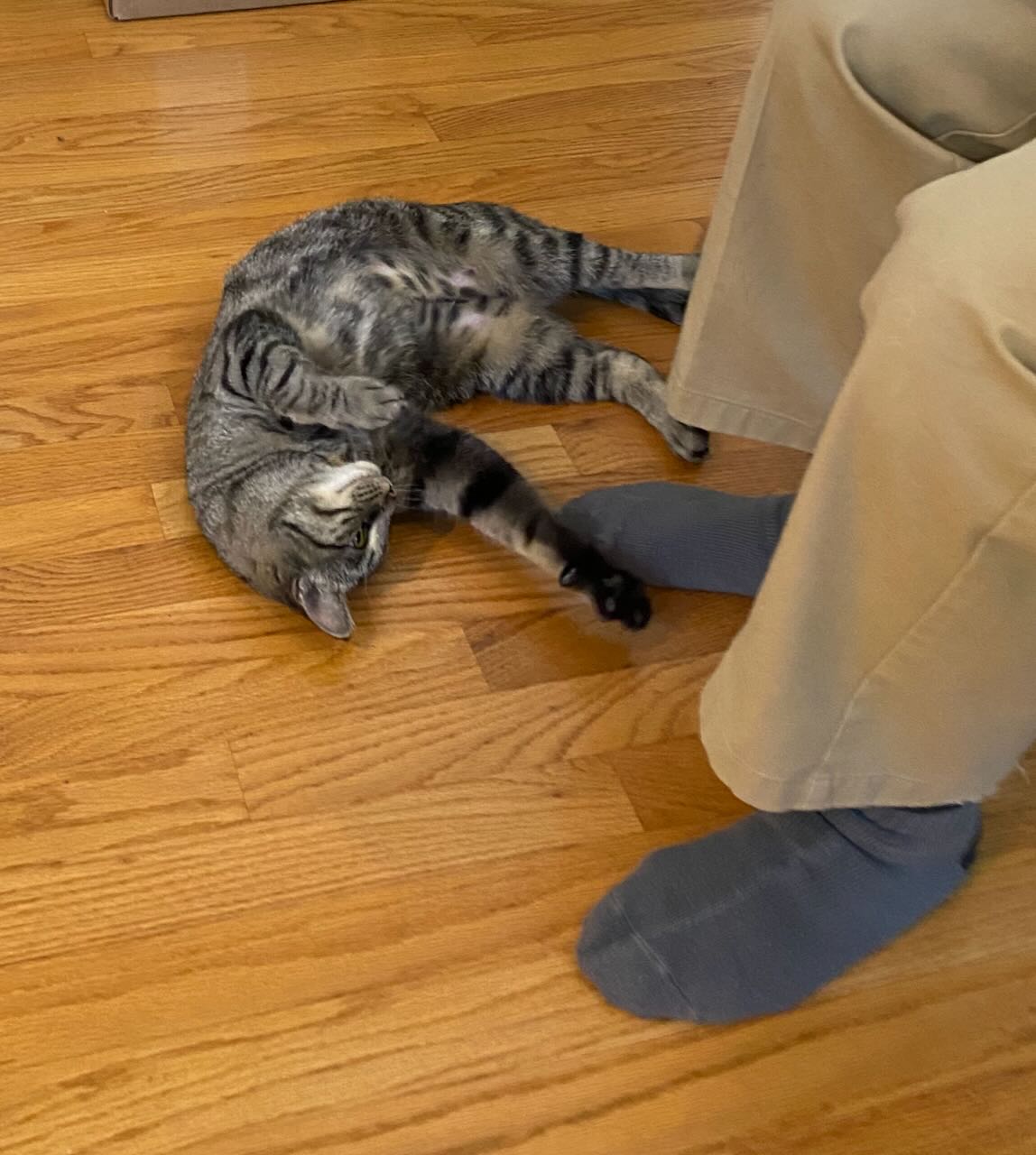
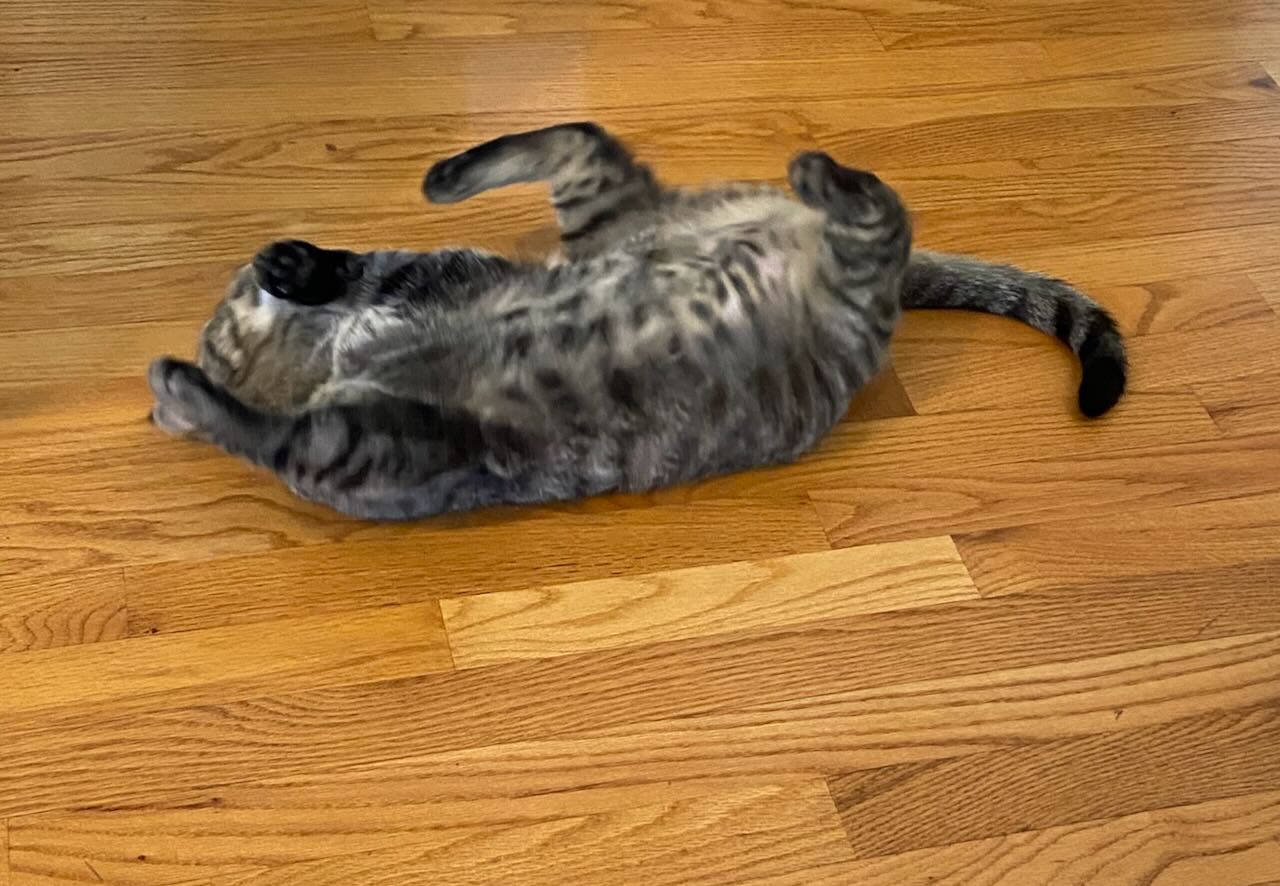
I’ve never had a cat who liked to lie on her back as much as Frassy does. It’s not just in hot weather – she does this no matter the temperature in the house.
Ballet?
Calisthenics?
When she also turns her head upside down, it reminds me of how much I enjoyed that as a child – lying on my back looking at the ceiling, pretending it was the floor, picturing myself walking around on it, stepping up over the doorways.
But what’s in Frassy’s mind when she looks at the world this way?
I put words in her mouth all the time, but my thoughts are unlikely to be hers. It’s hard enough to know what another human being is thinking – and yet we imagine we know the thoughts of our pets.
We especially imagine we know what our relationship to them is, what we mean to them, when all we can know is what they mean to us.
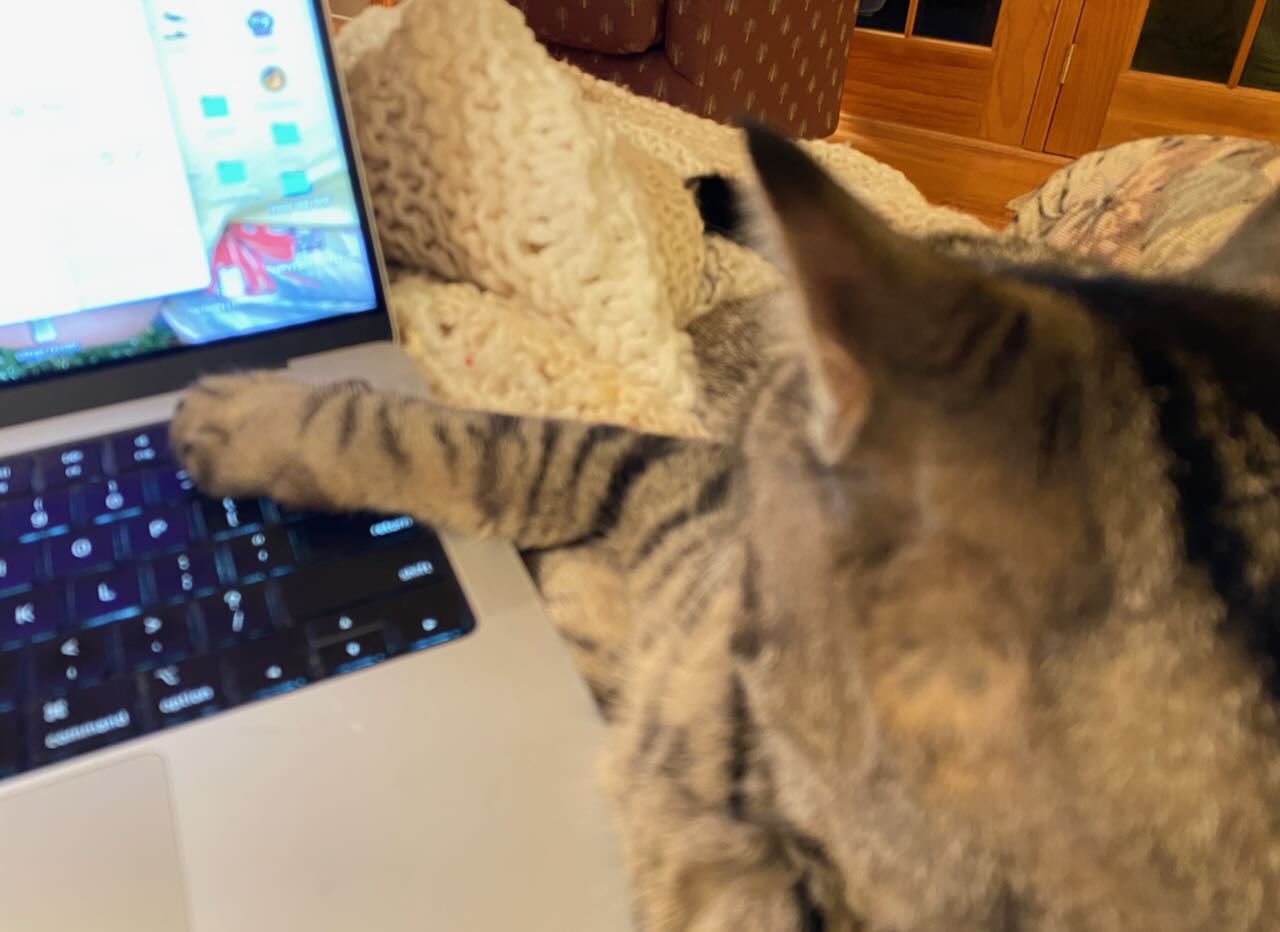
Frassy came up on my lap as I was writing this, and helped out. Or so I like to say.
I was scratching Frassy behind her ears today, when it occurred to me to wonder how it is that people have pets. Dogs may have been adopted as hunting helpers and cats for rodent control, following our habit of bribing wild creatures to live alongside us by feeding them in exchange for milk, wool, eggs, or service. But today people who don’t hunt and have never seen a mouse still have dogs and cats in their homes. And what about gerbils, hamsters, parakeets – all manner of animate beings with no useful task to perform for us.
How did this happen? I see domestication as something carried out by little girls, about seven to ten years old. Girls this age fall in love with baby animals, no matter how wild, and want to bring them home. Suppose the hunt has been successful, and while the grown-ups are busy drying meat and stretching hides, a little calf stands bleating at the edge of the firelight. Oh look, says Small Daughter, he’s so cute, can I keep him, please? Negotiations ensue, promises of care-taking are extracted, and the calf comes along home. The cultural attitude Small Daughter has to deal with today – maybe with an injured bird or abandoned baby squirrel – is different from what it was in a hunting camp 12,000 years ago, but it’s likely the emotional pull she feels from a small, vulnerable creature is the same, as much as our two legs, two arms, and large brains are the same. We’re built that way.
The remains of dogs and cats have been found in human graves from 12,000 years ago, valued and honored perhaps for their usefulness, perhaps for their companionship. We’re made for inter-relationships – we’ll even reach across species for them – we have pets because we have a need for interdependence. Frassy is very rewarding when I scratch behind her ears, leaning into it with the appearance of gratitude, and purring. Humans are more complex, harder to figure out, and most of us are not trying very hard right now. Emotional investment in our pets is lovely, but maybe we could look harder for things to value and honor in each other.


 Robin Richstone