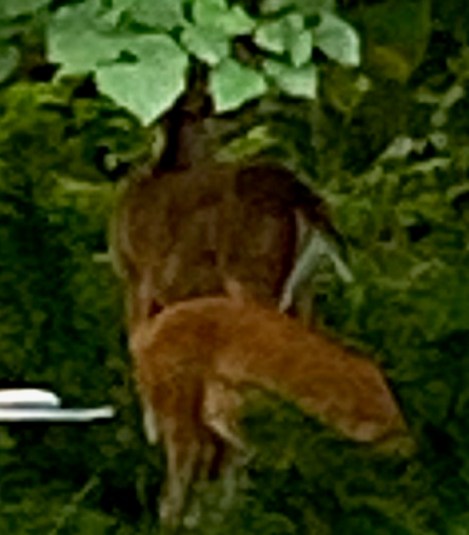
 Actually, he’s probably a buck. A stag, I find out, is older and grander than an eight-point buck, which is what I’m talking about here. But “Mystery Buck” sounds like a tv game show, so I’m sticking with my title. This time of year the deer stop traveling in twos and threes and start bunching up into herds for the winter. I was watching several does and fawns in the back yard when I spotted the buck, moving among the trees. He had a lovely set of antlers, so I reached for my camera, meaning my phone, which, rare for me, was in my pocket. Most everyone else smiled for the camera, but the buck kept his head in the canopy. Bet he was training that little guy beside him.
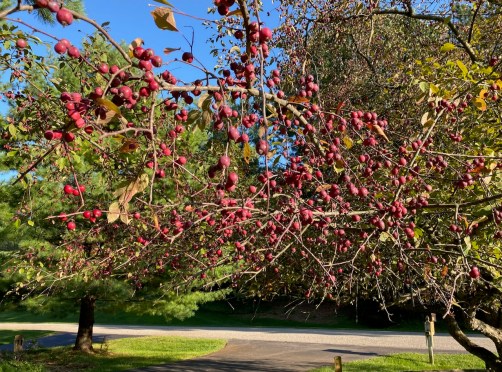 I went back inside, and a little later here they all came, munching their way through the huge crop of fallen crabapples on my front lawn. The buck, in the manner of bucks, was standing a little way behind them – anything that wanted to chase the herd would have to deal with him first – so I went to get my camera, meaning my phone, no longer in my pocket. By the time I had it in hand the buck had once again positioned himself in full view except for his antlers. This went on for some time – I moved, he moved, and always the leaves came between us.
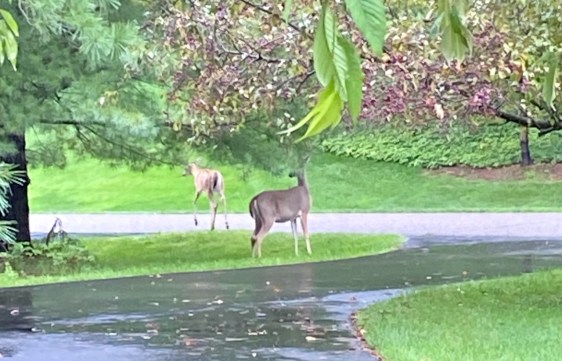 So what was going on? Was this really random motion, or did this guy have some reason why he didn’t want me to see his rack? Did he have an exclusive deal with Shutterstock? An instinct to avoid trophy hunters? Had he heard that cameras “shoot”? I began to see how easy it was to fall prey to conspiracy theories: surely the buck had no interest in whether I got a great photo or not, but after several thwarted efforts it began to feel deliberate on his part.
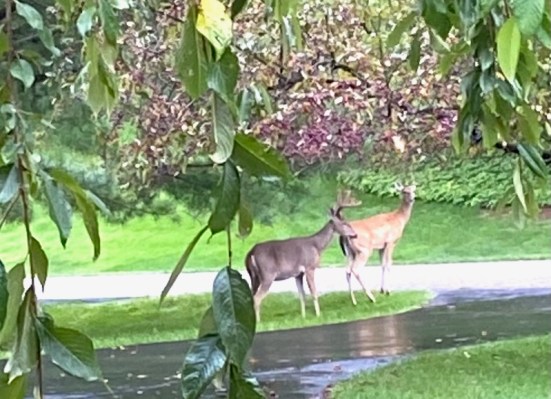 I kept taking pictures anyway hoping he’d miscalculate, and backed away to try for a better angle around the foliage. This was the best I managed: out of the trees, just barely; further away so having to be cropped to within an inch of its life, sacrificing resolution; and only a profile, not a full head-on shot. You’ll have to take my word that in addition to the four antler points you can see, there are four more on the other side. And yes, they are sort of fuzzy right now – still covered with “velvet” until he destroys some of my saplings, using them to scrape it off. Seems like the least he could do is drop those antlers in my yard come antler-dropping season. It hasn’t happened yet, but I’ll keep you posted.


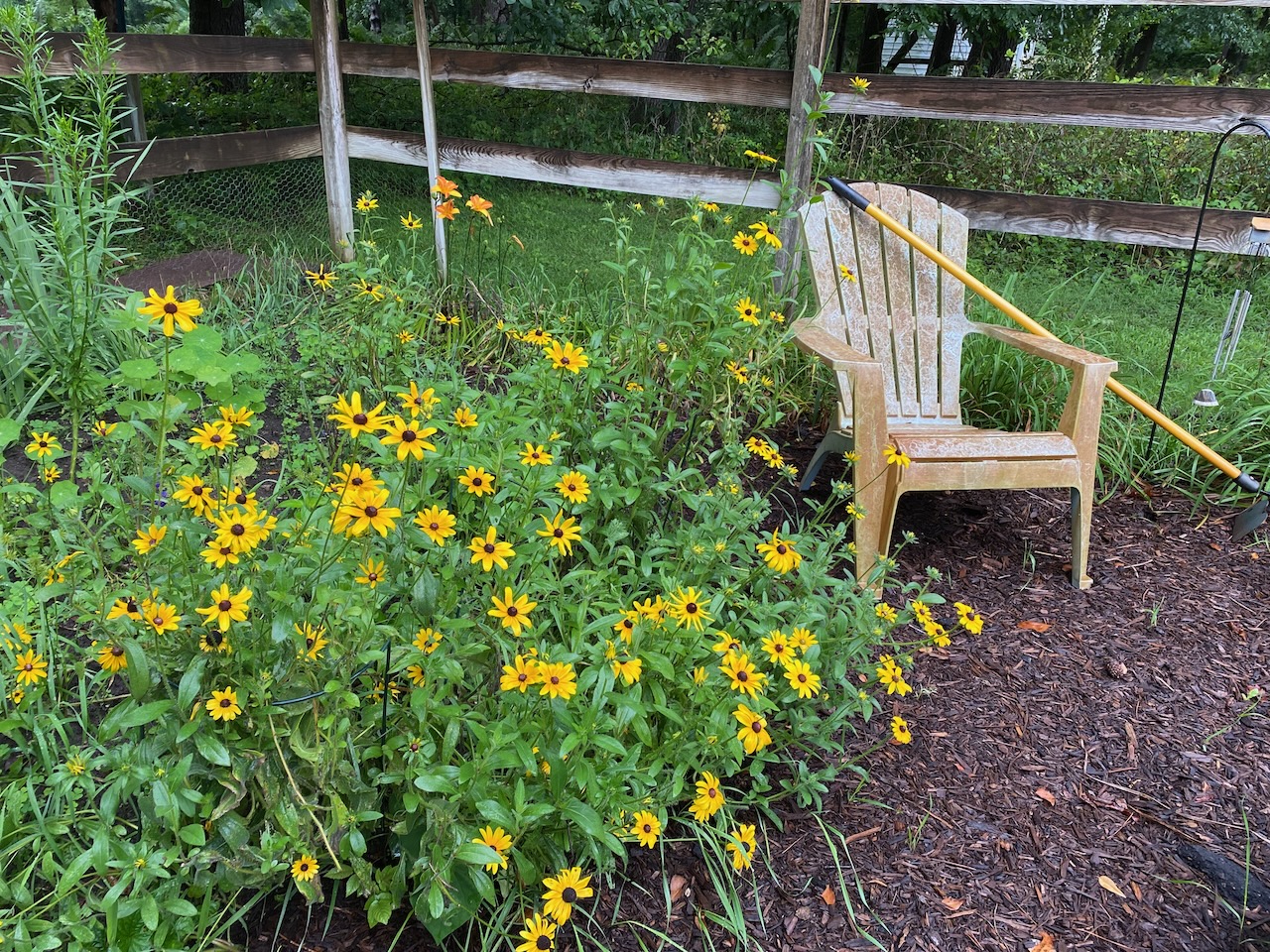
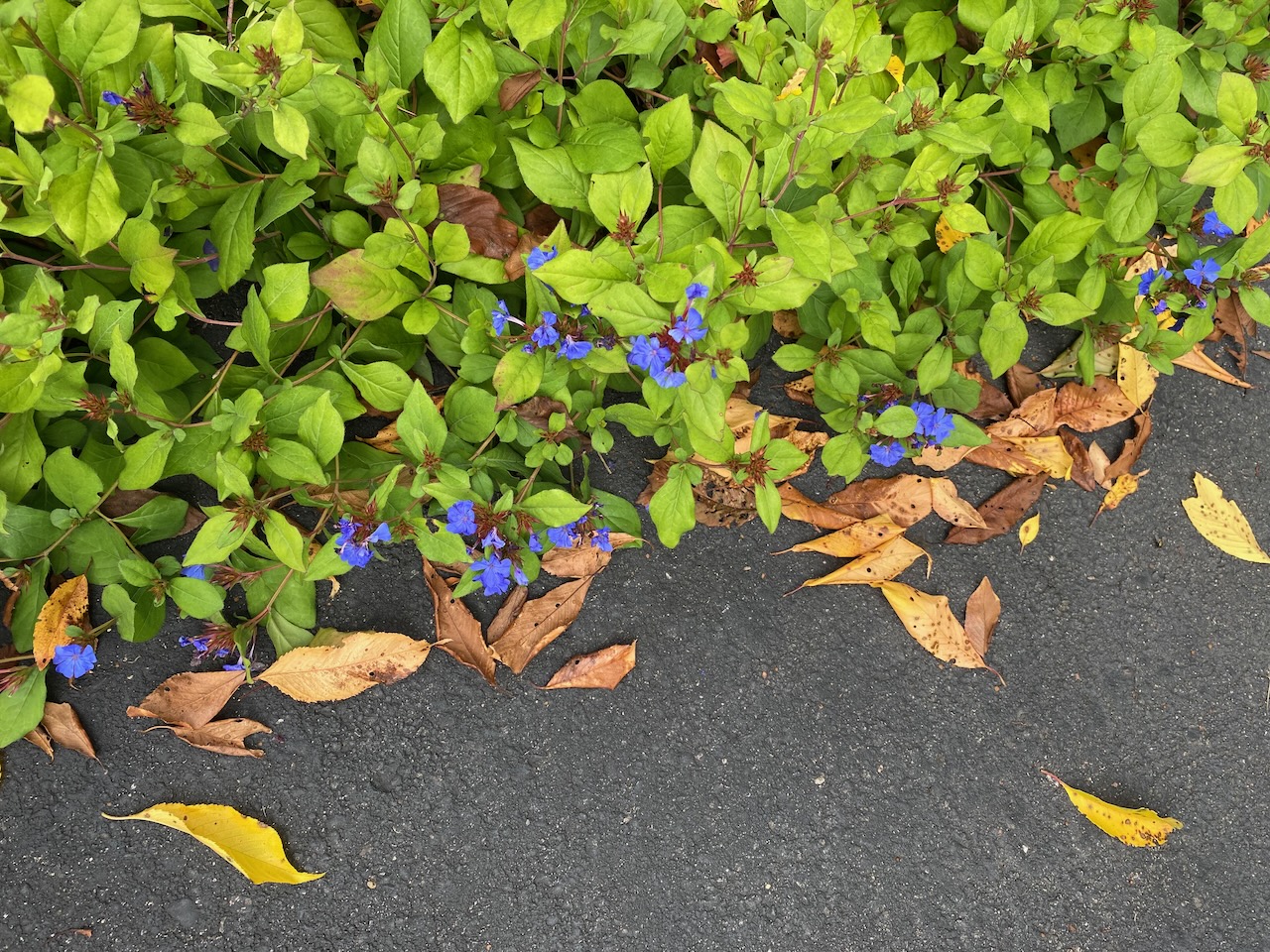
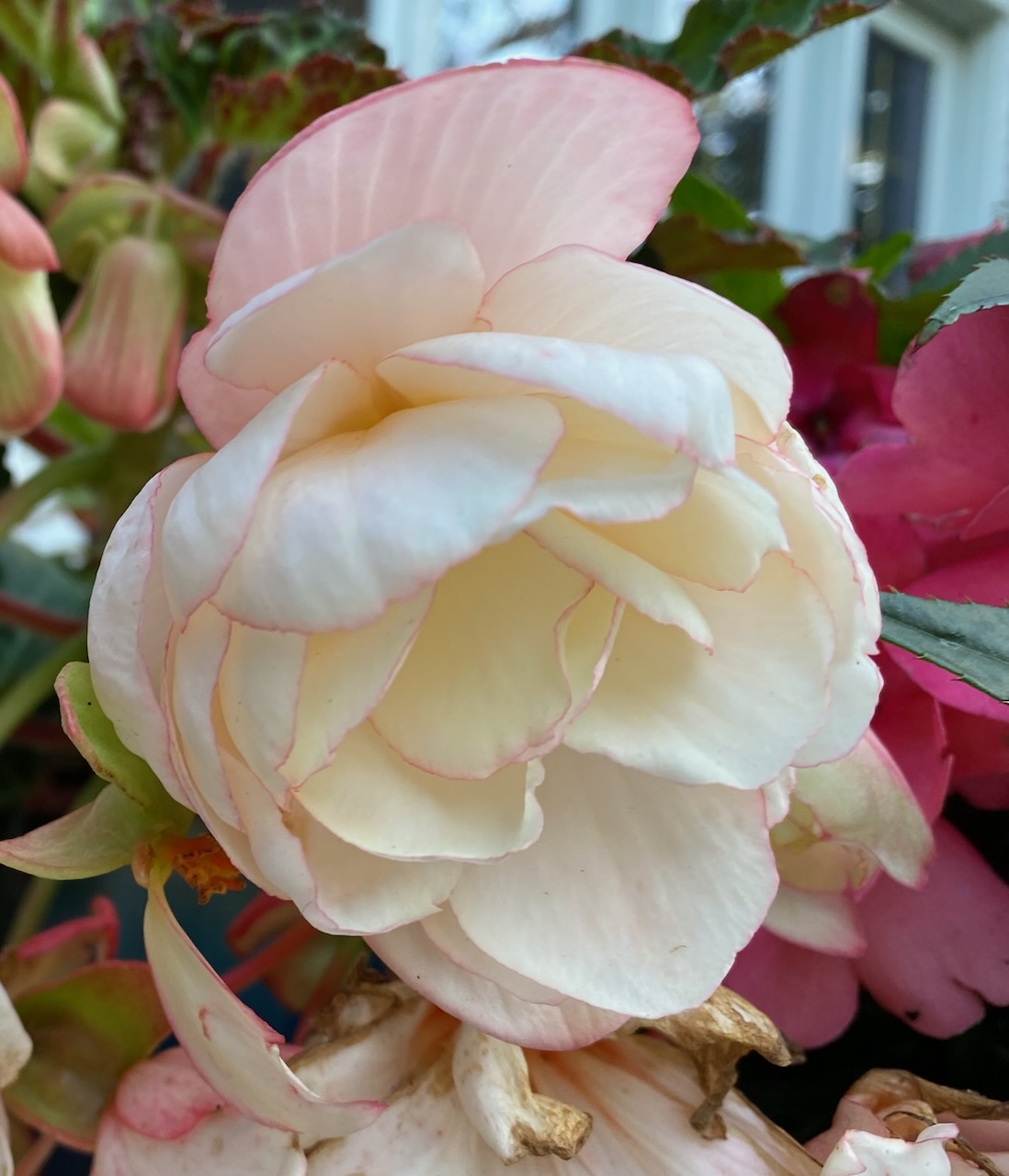 A gardener is always happy to see the flowers on blueberry bushes, tomato vines, and squash plants that will grow into good things to eat. It’s a joy, but mainly a practical consideration.
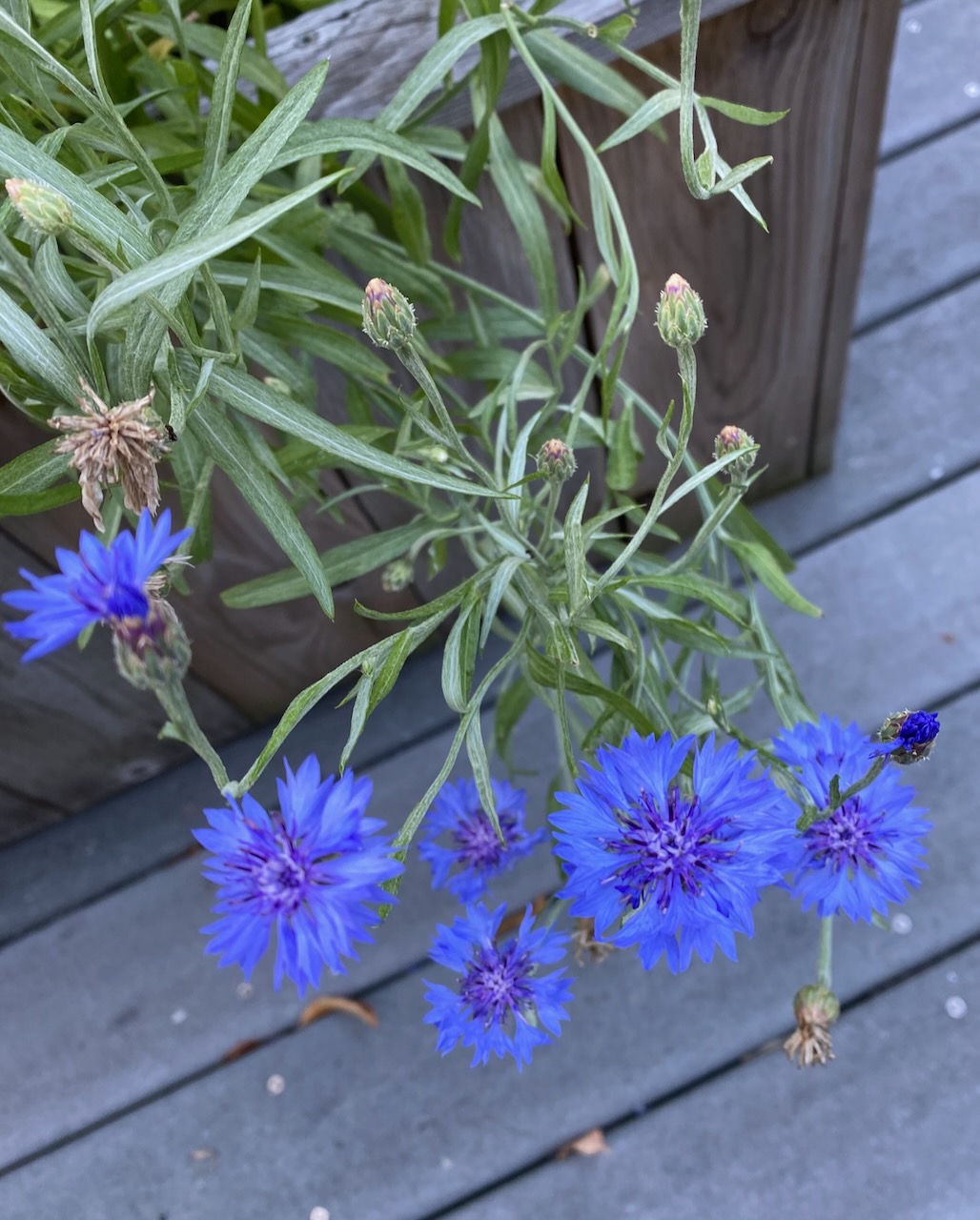 Up here on my deck where I will see them all the time, I’ve planted flowers whose whole point is to be beautiful. They are attractive to bees, hummingbirds, and butterflies, yes, but more modest flowers would please those pollinators just as well.
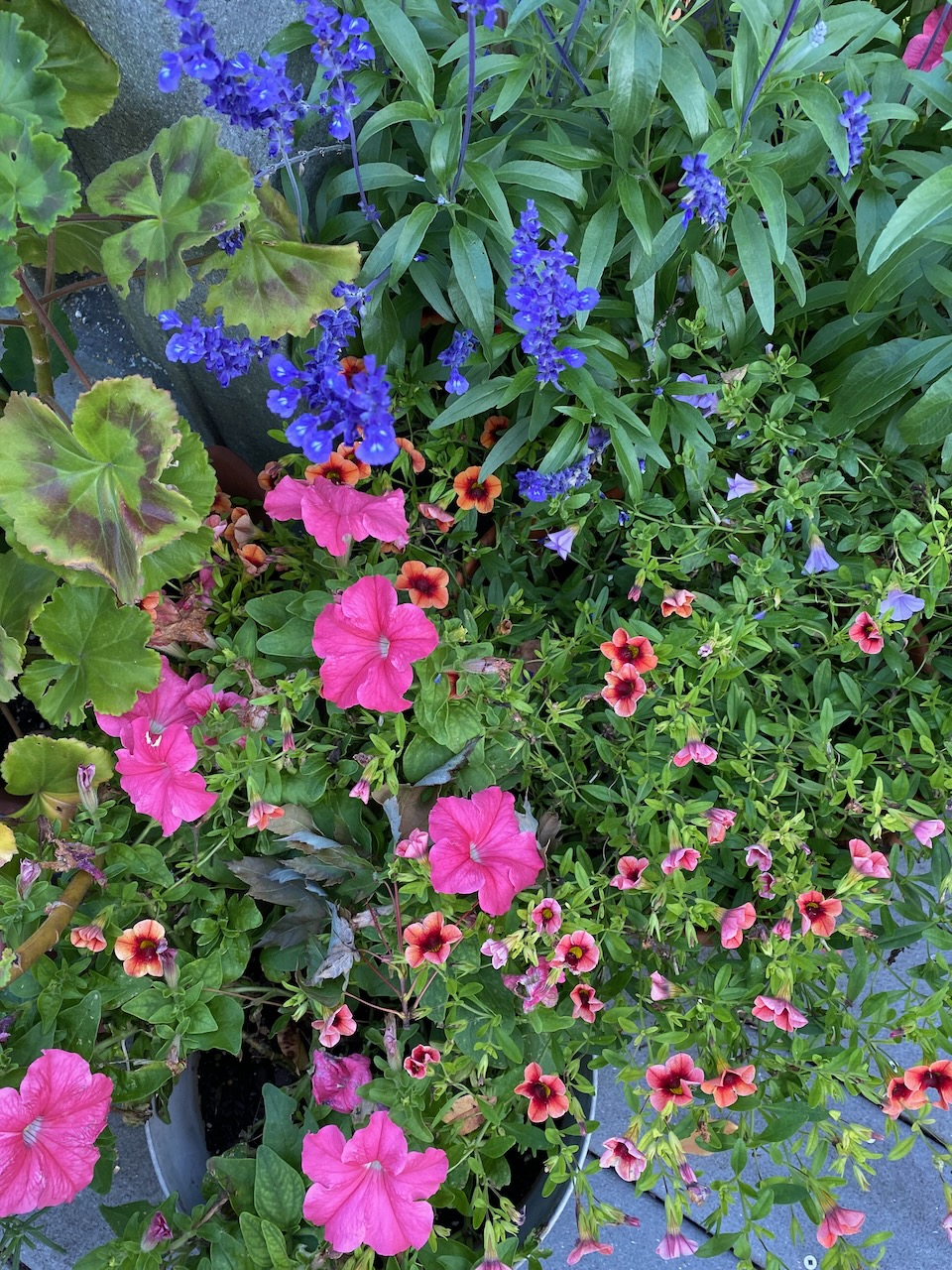 There’s evidence that people have valued flowers for more than producing food, for thousands of years. Traces of flowers have been found in paleolithic tombs. There are very few drawings of flowers in cave art, but once we get to the age of agriculture flowers are everywhere: in murals, reliefs, jewelry designs, pottery, and then in our oldest, most sacred texts. “I am the Rose of Sharon and the Lily of the Valley” says one Testament; “Behold the lilies of the field,” says the other, “not Solomon in all his glory was arrayed as one of these.”
 They’re not talking about useful date palms or parables of vineyards here. They’re talking about beauty, specifically useless beauty, in the expectation that readers will agree. Did early hunter-gatherers have no time to stop, while searching for food, to pay attention to the inedible? It takes time, as Georgia O’Keefe said, to see something small like a flower. Or maybe they did see, love, and gather them, but being flowers no trace of them stayed behind.
 I love the way Maria Newman set this poem of mine to music. You can listen to it
 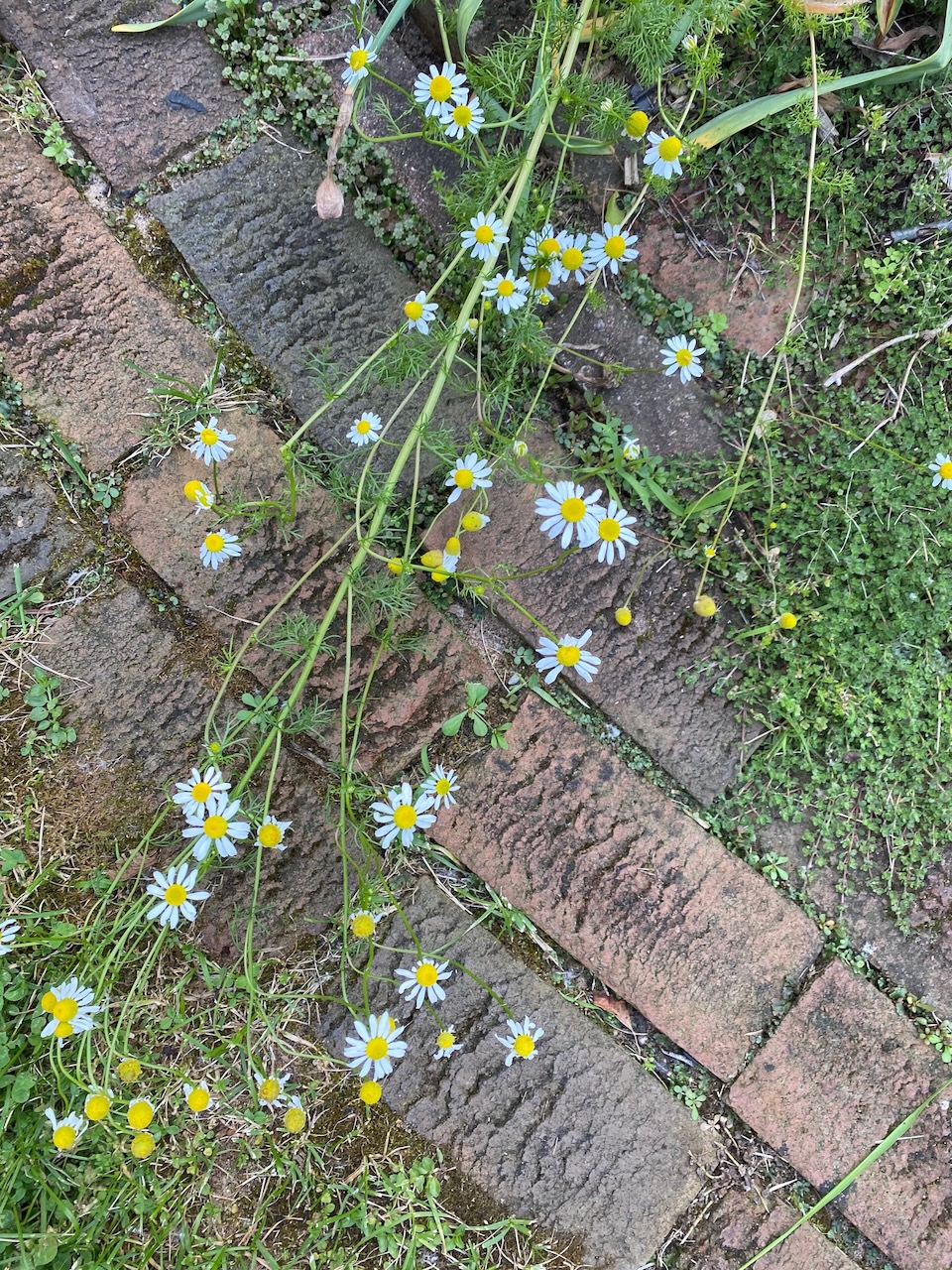 Of course there are more weeds. They come back, sometimes with a vengeance. Many sources claim that weeds tell you about conditions in your soil, but there’s a lot of confusion around what they’re trying to say. Goldenrod and ox-eyed daisies are supposed to grow in wet, poorly drained soil, but they love my sandy, dry, fast-draining yard. I do like these two, but do they know that? Goldenrod lights up the end of summer, and ox-eyed daisies make excellent bouquets. The daisies get very happy standing in a vase of water all week, soggy at last.
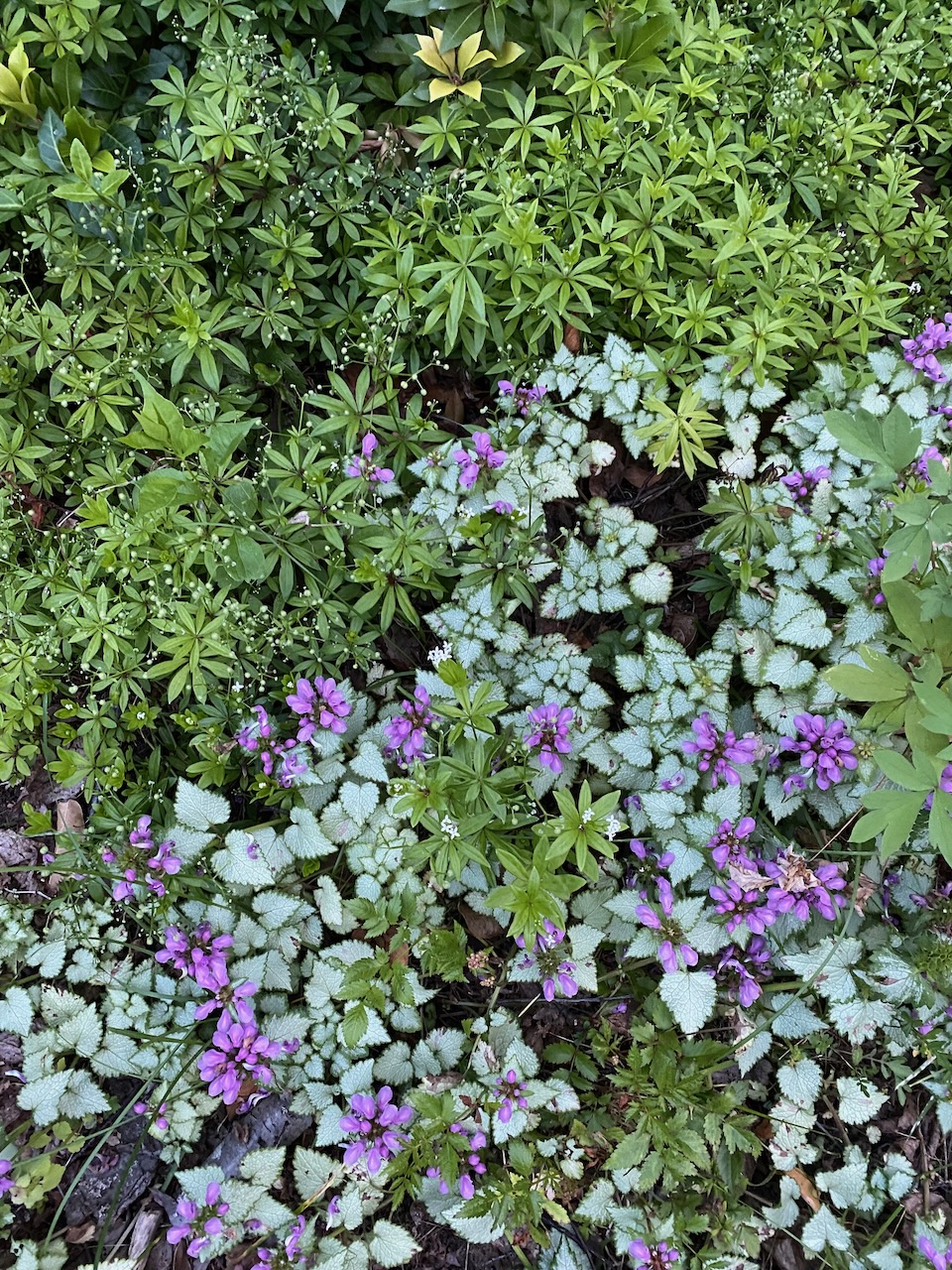 I’ve always pulled and tossed purslane, but having recently come across a trove of new purslane recipes
 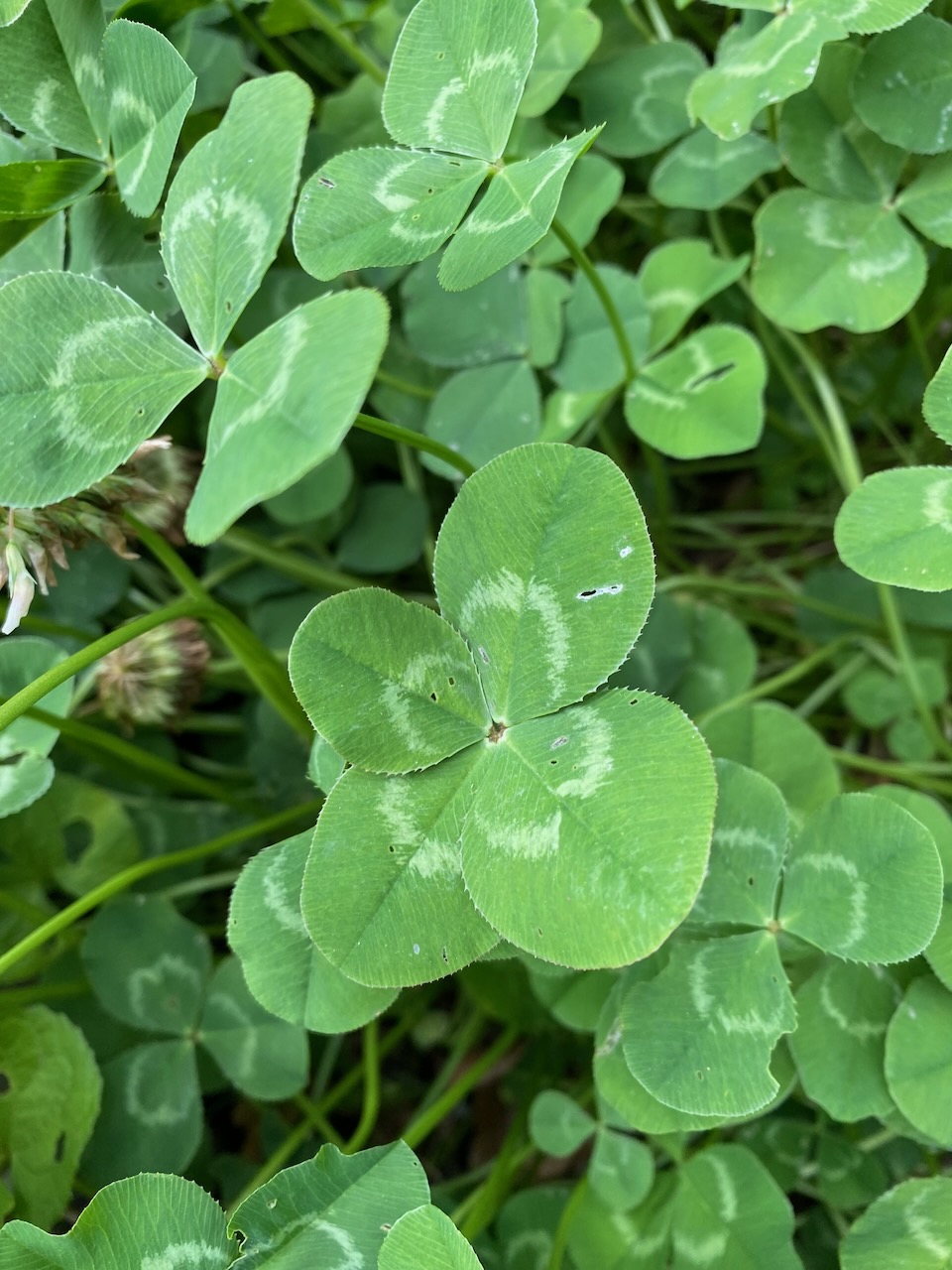 The lawns of my suburban childhood were planted with a mix of grass and white clover. I remember being told this was because clover “fixes nitrogen,” which made me wonder what was wrong with it. You had to be very careful walking through the clover because it was full of bees, and since bees were said to be busy, I figured they were busy helping the clover fix nitrogen.
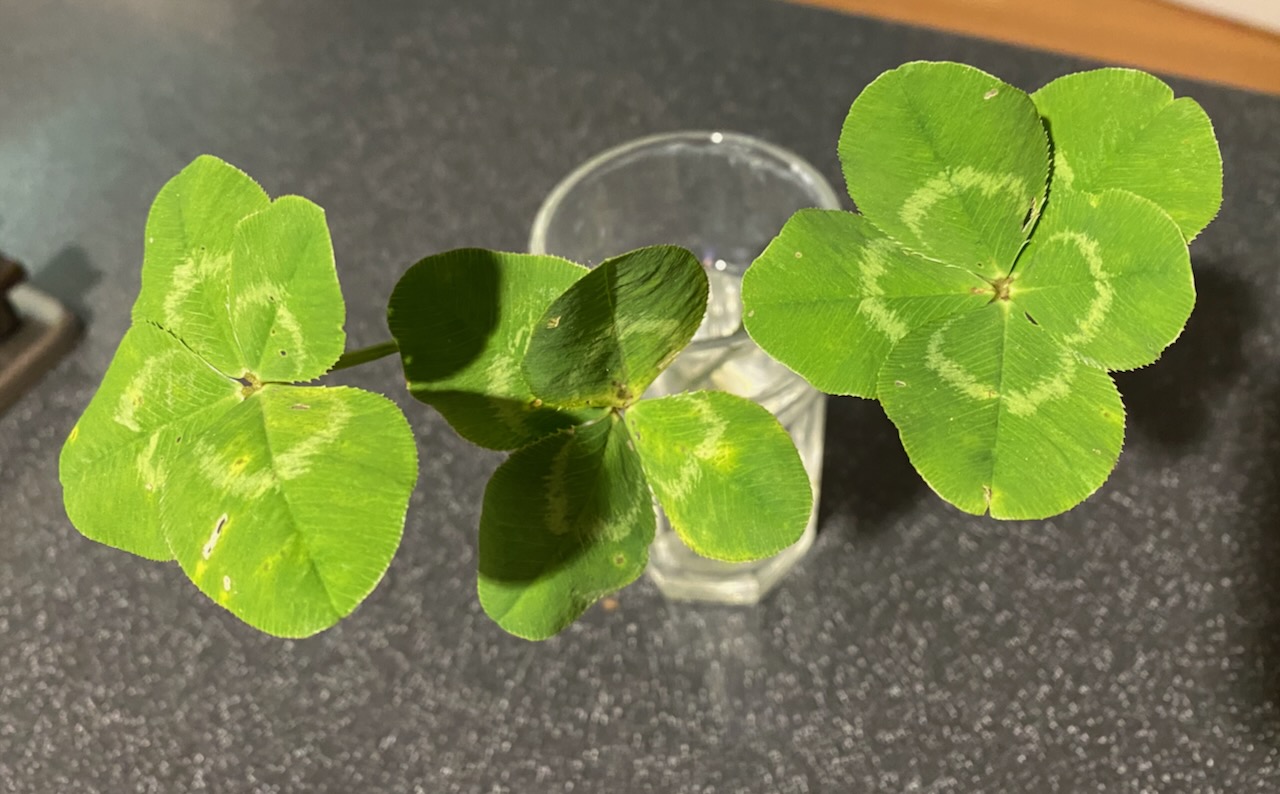 Bees or not, the best thing about clover was spending long afternoons looking through it for four-leafers. If you found a four leaf clover you had good luck and – in our neighborhood’s culture – you got to make a wish.
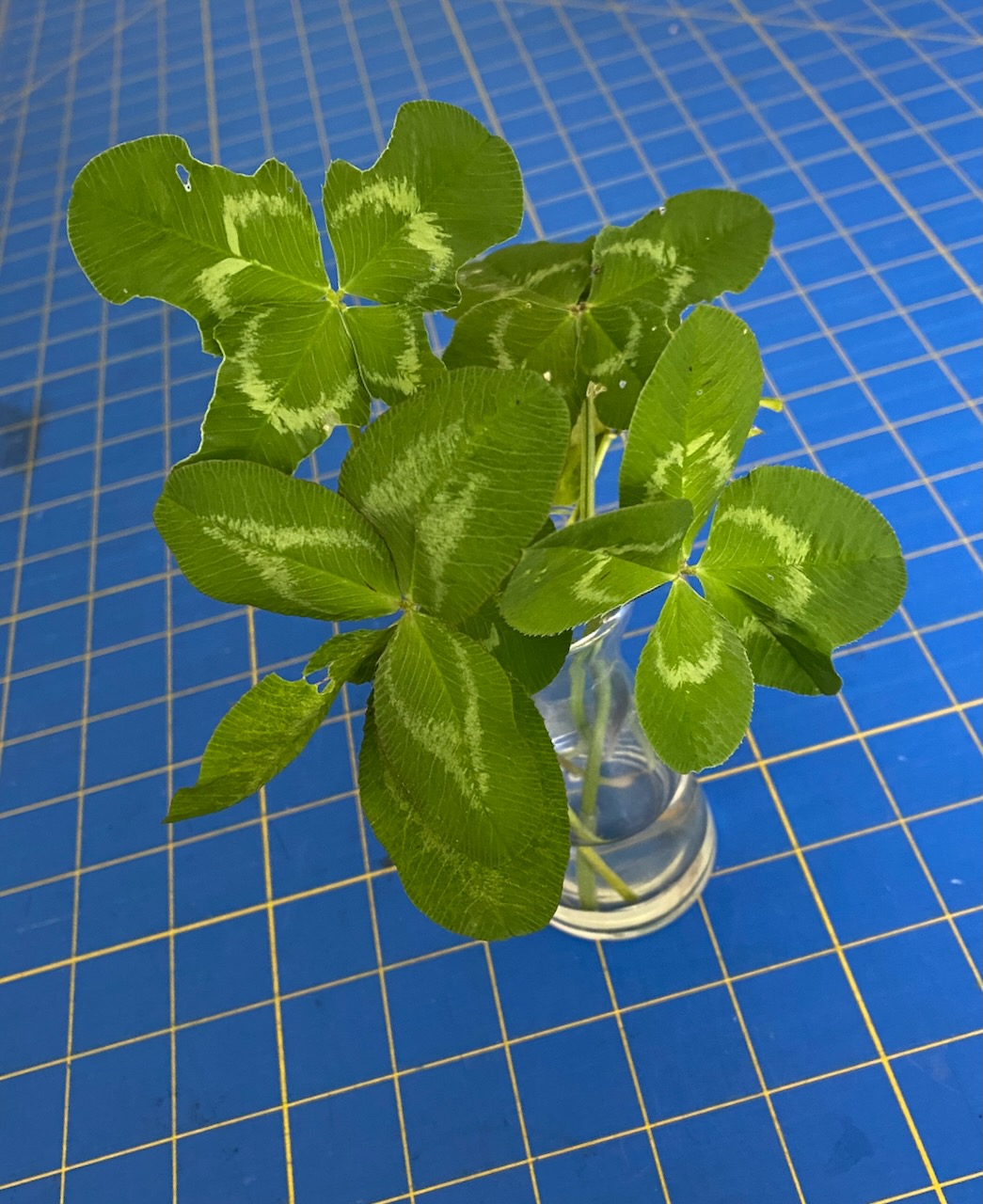 Having the internet right handy as I write, I looked this up: the probability of finding a four leaf clover is one in 5,000 or 1 in 10,000. Lucky me! In the last couple of years since I spread clover seed in the yard and garden, I have found dozens of four leaf clovers, possibly a hundred of them, plus many five-leafers and the occasional six leafer. They come from the same two clumps every time, so I’m assuming this is genetic rather than something weird going on in my garden. The tomatoes seem normal.
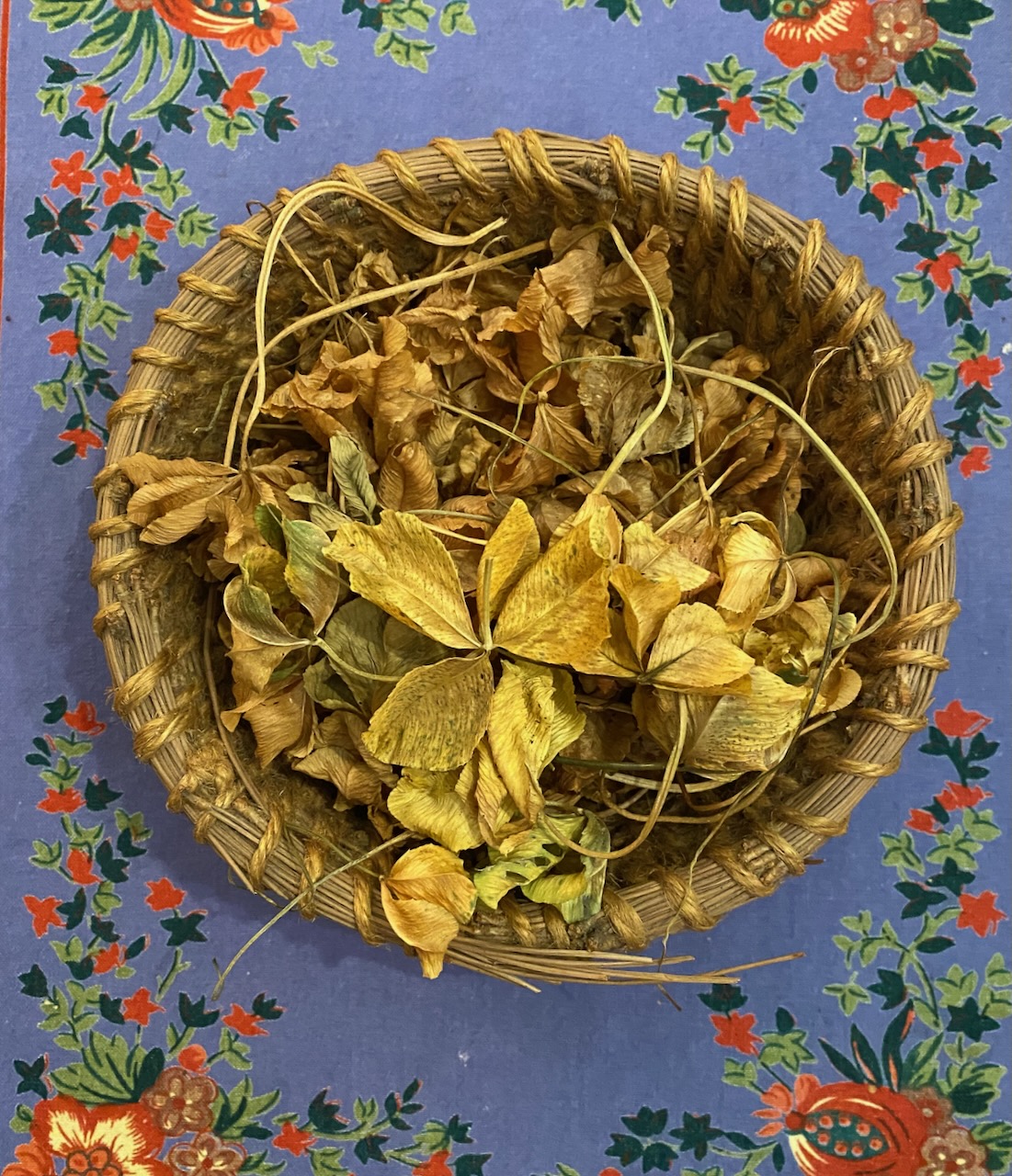 I bring the lucky clovers indoors, make my wishes (one per stem), and put them in small vases. When they fade and dry I collect them in this basket. I can’t tell you what I wish for, because naturally if you tell anyone, your wish will not come true. But I will say it’s ambitious, it’s in the public interest, and so far it’s making headway.
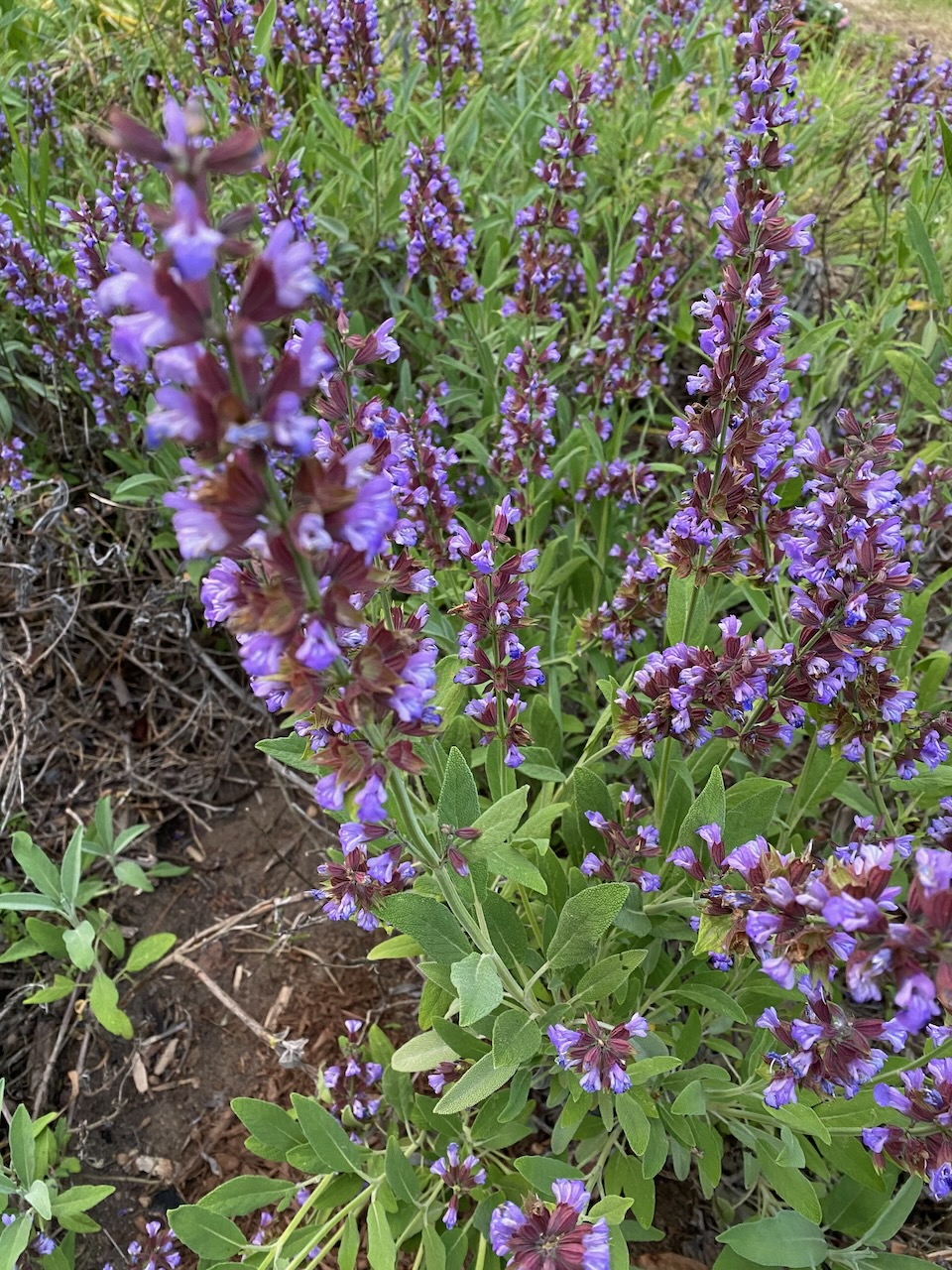 Green, everywhere green. All the plants that held back in the Michigan winter have come barreling out of the ground, pushing bricks aside, enthused by sunlight, encouraged by rain. It’s exhilarating to see the peonies and iris returning to bloom, sage flowering blue, chives purple, rudbeckia and coneflowers that will bloom later beginning to leaf up, and stalwart groundcovers holding their own. But then there are the weeds.
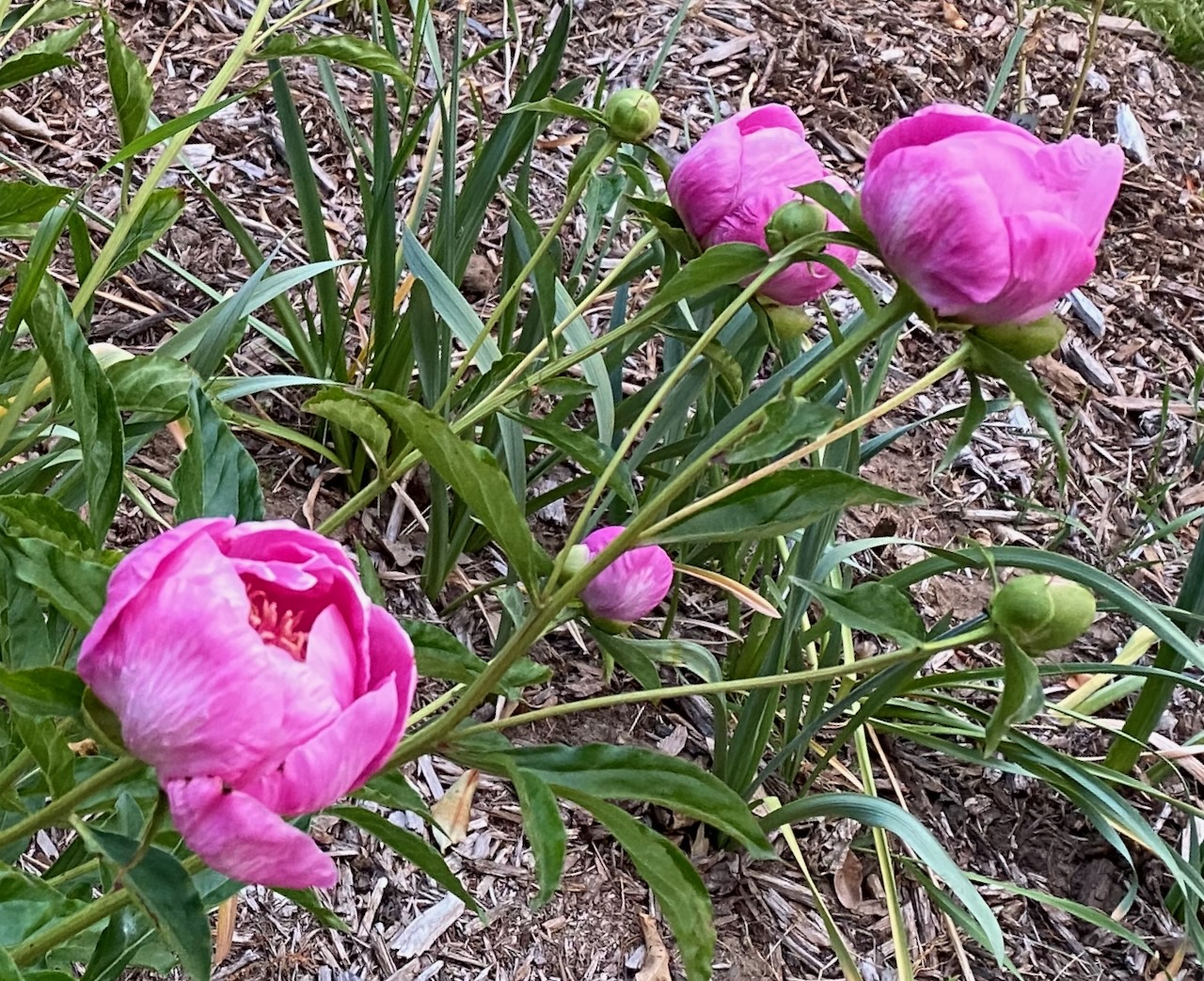 It takes some knowledge and much attention, to weed a bed of perennials. The first year I gardened in Michigan I pulled up all the monarda shoots, because we don’t have monarda in California and I didn’t know what it was. I had put in a couple as bedding plants, and though I was told they would self-seed I didn’t know it when I saw it. Many perennials, as they emerge in June, give little clue to their identities, leading to confusion and chagrin. I’ve started noting their positions with plant markers, metal ones with long legs so they go deep into the ground and don’t get frost-heaved out of place.
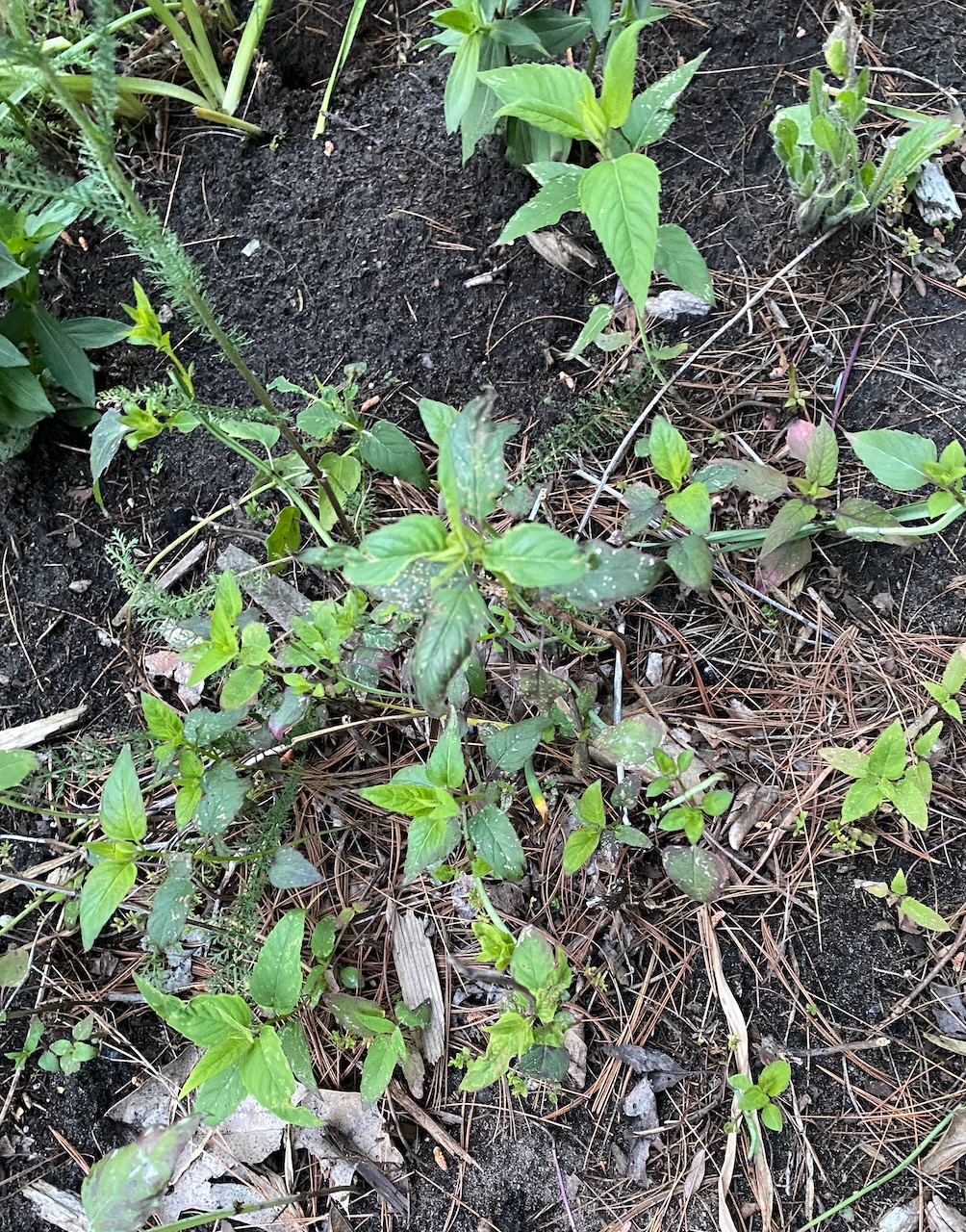 A weed, it has been said, is any plant growing where you don’t want it. I understand that chickweed can be used to feed chickens; that plantain makes a good poultice; and that purslane is human-edible. I did once try to make pesto from garlic mustard, but concluded that the colonists who brought it to these shores on purpose were unfamiliar with Italian cuisine. Weeds all; out they go.
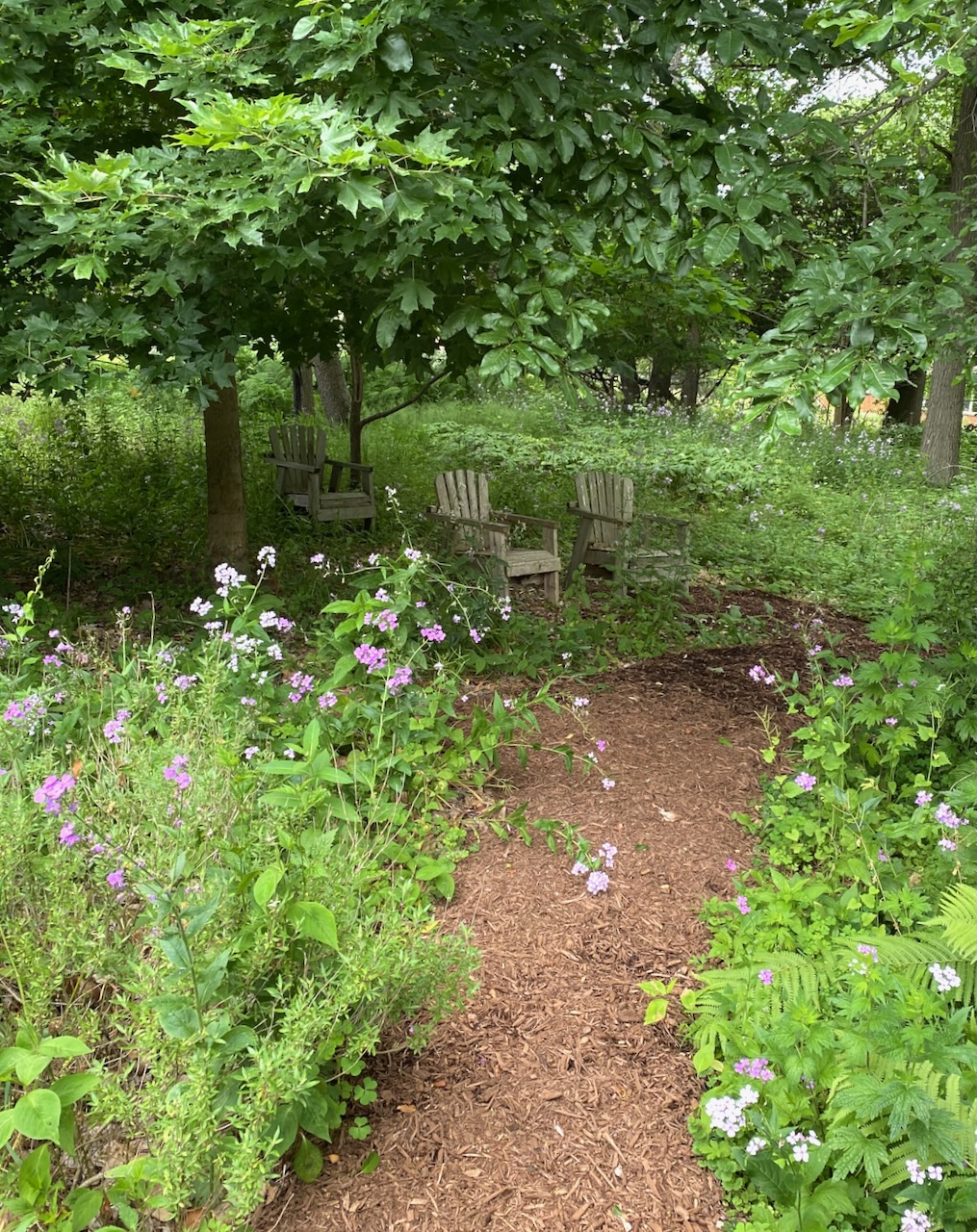 But I actively encourage the milkweed and goldenrod, and I let the Dame’s Rocket stand and bloom. It looks like its common name, wild phlox, but unlike tame phlox the deer don’t eat it.
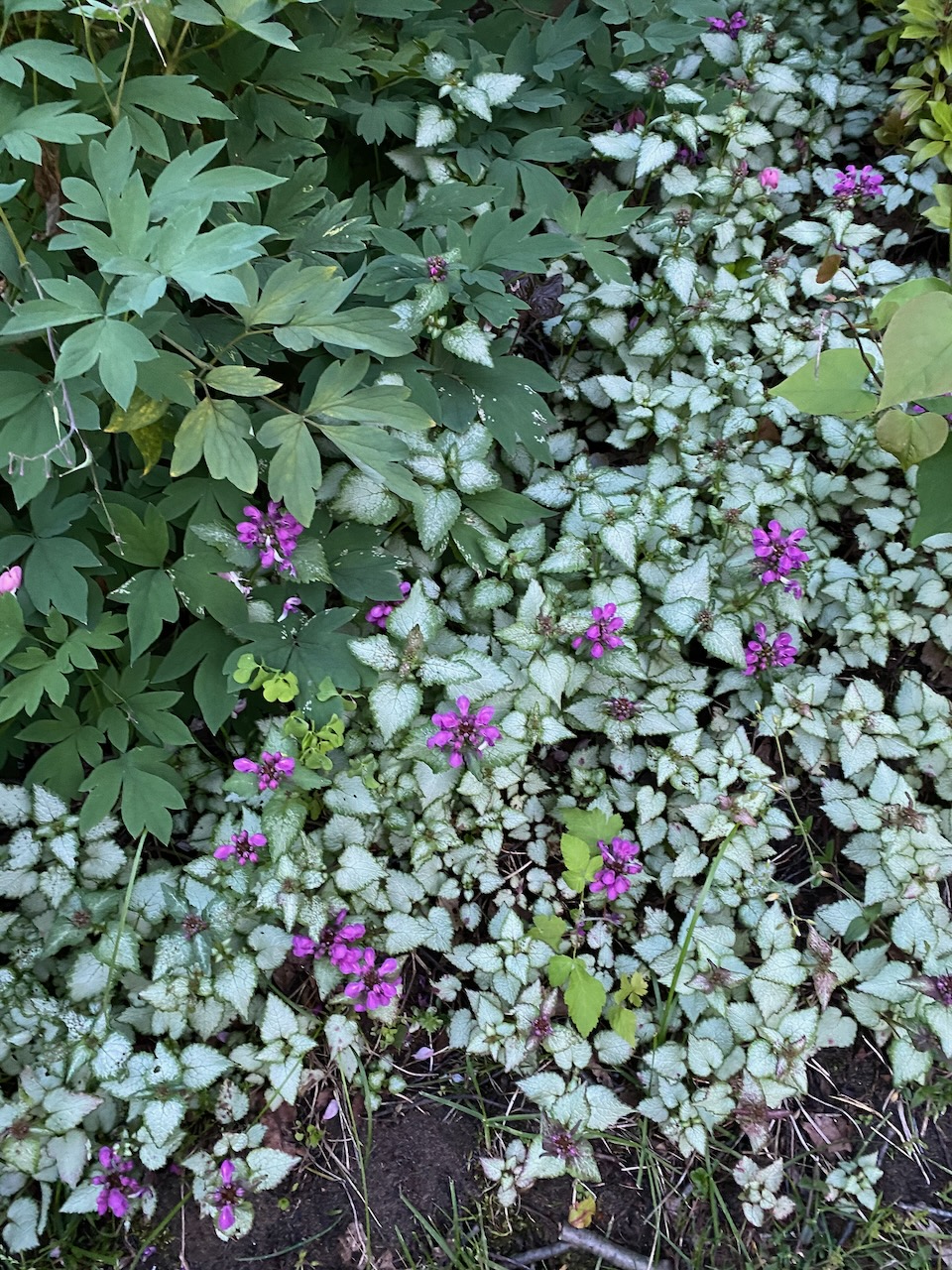 This is my concept of a garden, layering my sense of order and beauty onto the dirt, sun, rain, and seeds that have a sense of their own. When I move them, feed them, water them, they respond, often by trying to get back to what they were doing before I interfered. Unsure I speak their language, I try to listen to the plants. They’re the experts on what they need.
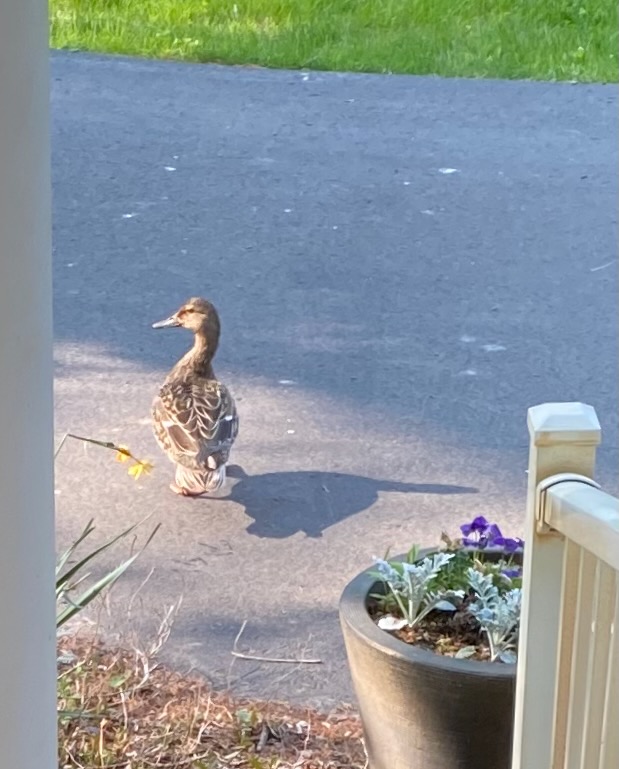 It was a good nesting site when she built it, but a little over a week after the duck settled beside our front steps, a fox moved into the backyard next door and had four kits. One morning shortly thereafter I came downstairs to find the nest abandoned uncovered, and this time I did not see Mama Duck lurking twenty or thirty feet away. When she wasn’t back in a couple of hours I went out with a stick and gently nudged the leafy-downy edges of the nest back over the eggs, hoping to help keep them warm, or at least camouflaged, till Mama Duck returned. But Mama Duck did not come back.
 One of my tree trimmers was standing in the driveway looking startled. I went out to ask what was wrong.
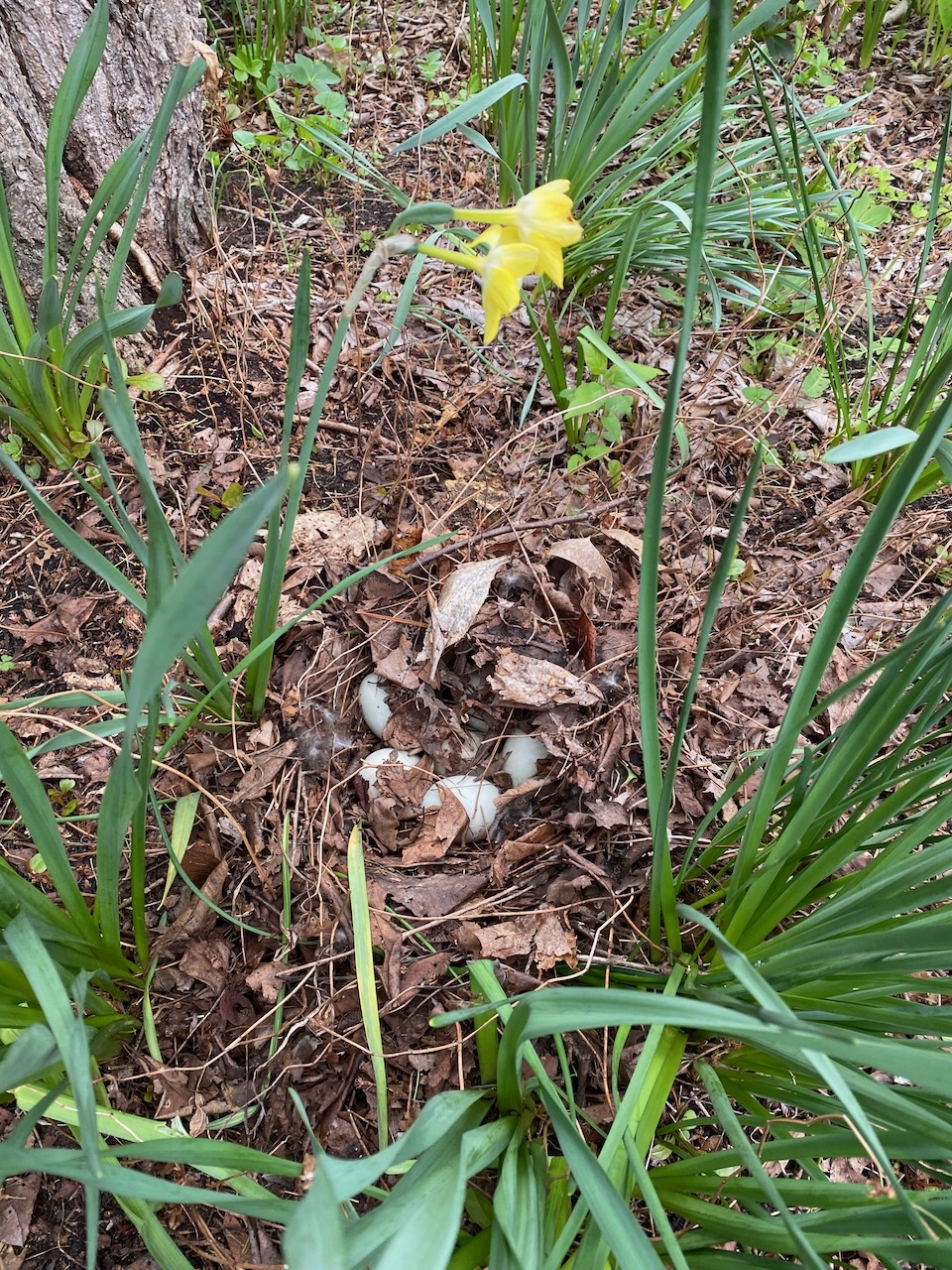
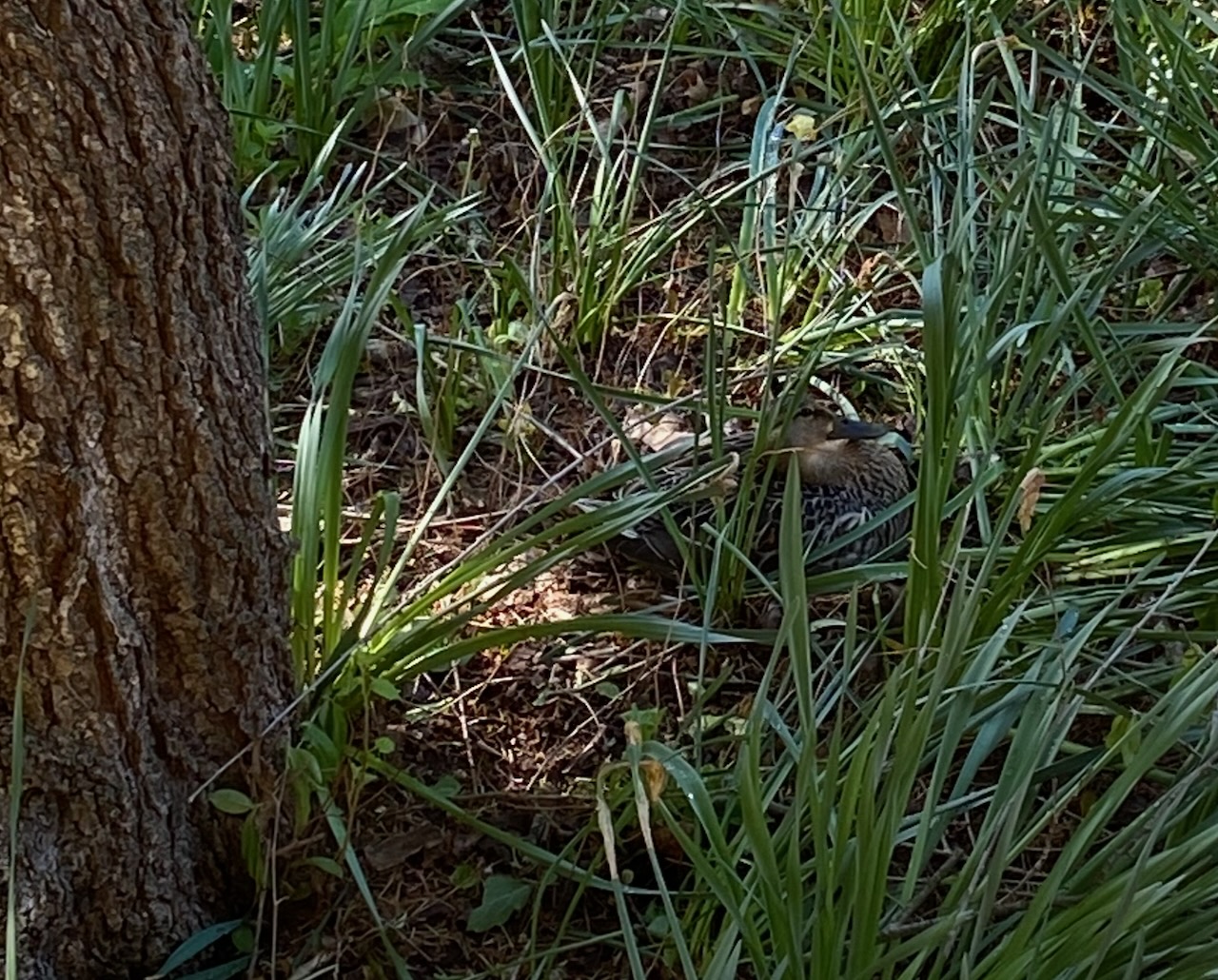
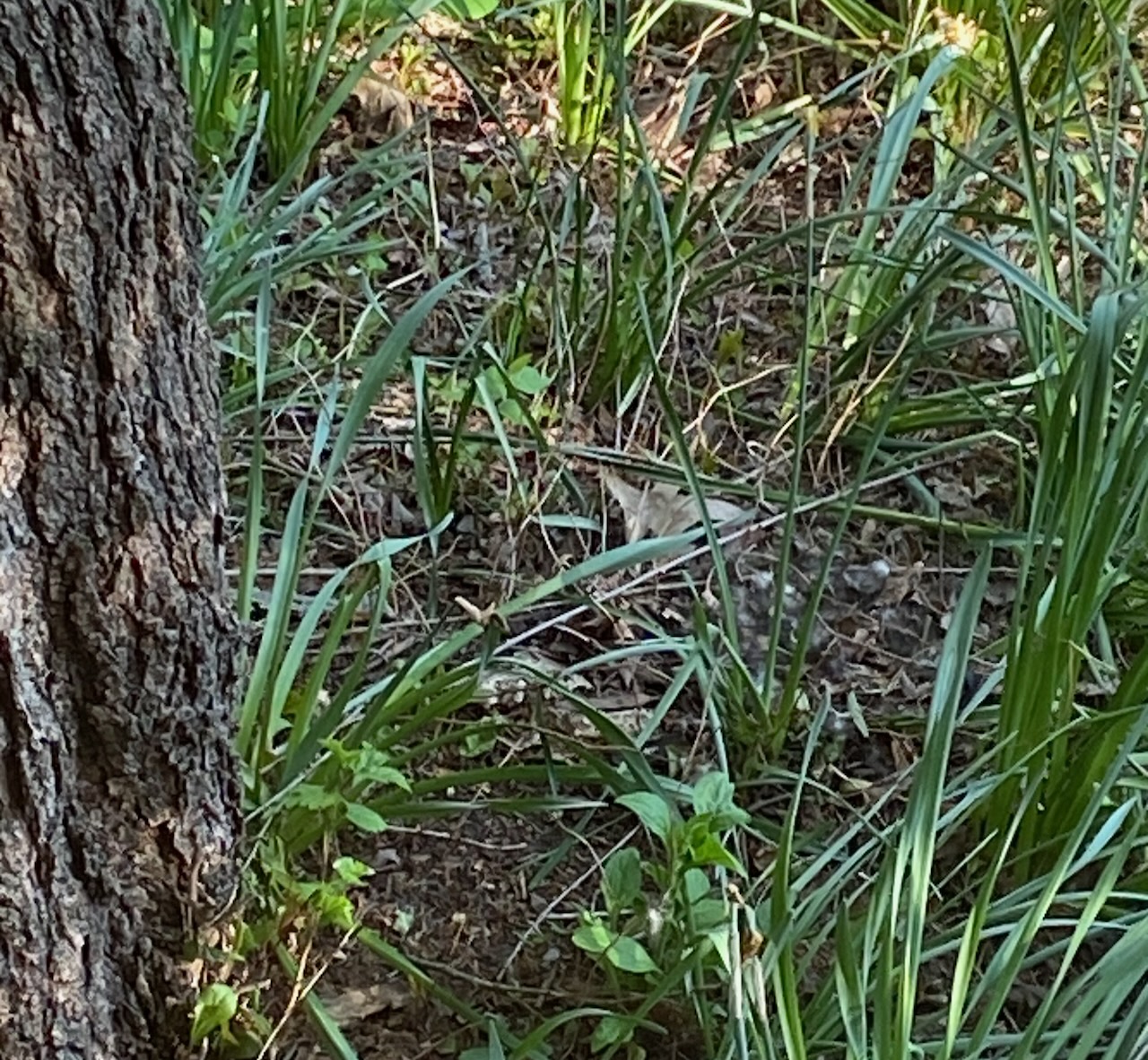 A day or two later she flew up to scare a random solicitor away – thank you, Duck – and I saw there were more eggs in the nest. Every evening before dusk she covered the nest carefully with leaf litter and down, and left for a while to feed, the nest so well camouflaged I sometimes wasn’t sure I was really looking at it (second photo). It was hard to see when she was on it, too, unless you saw her head move (third photo). The internet informed me that it was going to take a month for the eggs to hatch.
 Why did she build her nest so close to the house? Because the duck knew what she was doing. Predators were unlikely to come so near the house, and people, charmed by the cuteness factor of potential baby ducklings, were willing to concede a little space for a little while. I would give up using my front door for a month. Mama Duck had taken the habitat-trashing, ecological catastrophe of the human race, and promoted us to the role of Duck Protectors.
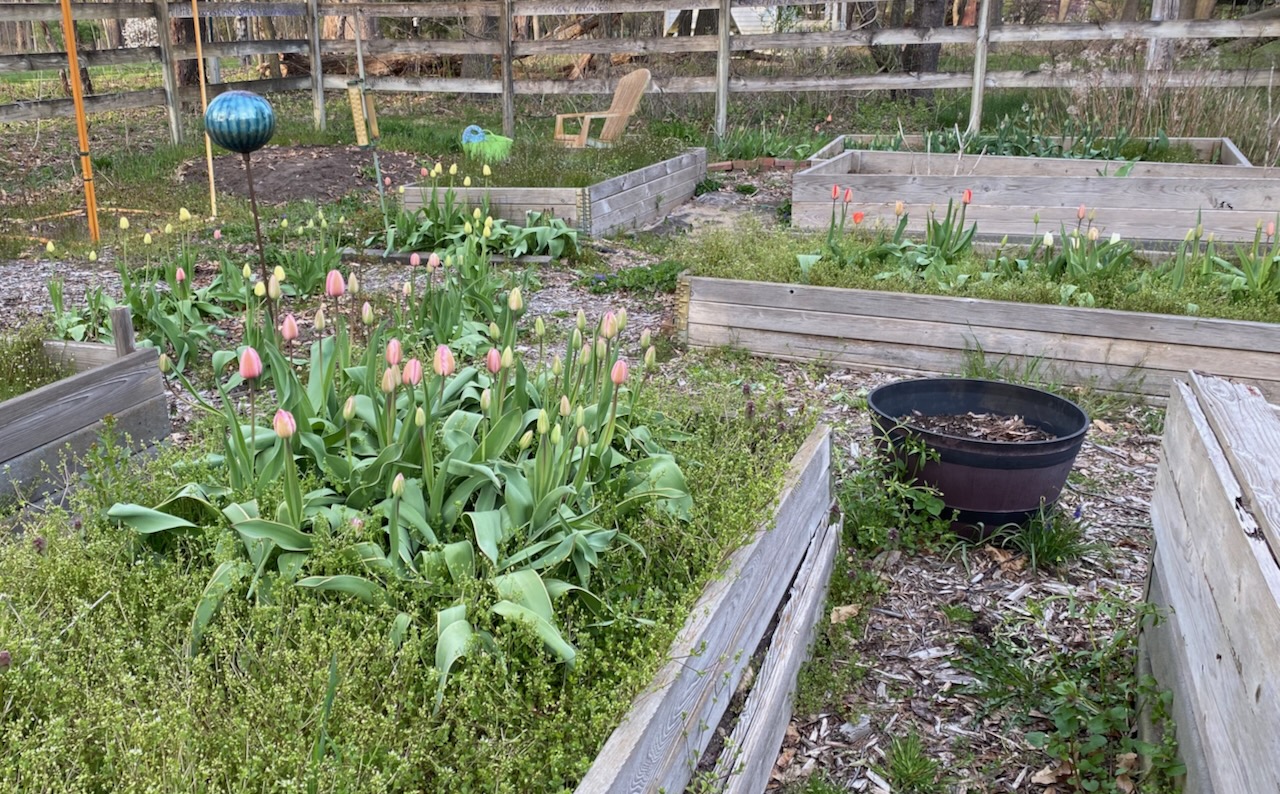 When the last of the deceased tomato vines came out of the garden in November, I put my tulip bulbs in. Come April and early May the result is what Doug calls The Tulip Farm. It’s a convenient arrangement because the fence keeps the deer and rabbits out of the flowers, which are all done blooming by time to use the raised beds for tomato plants.
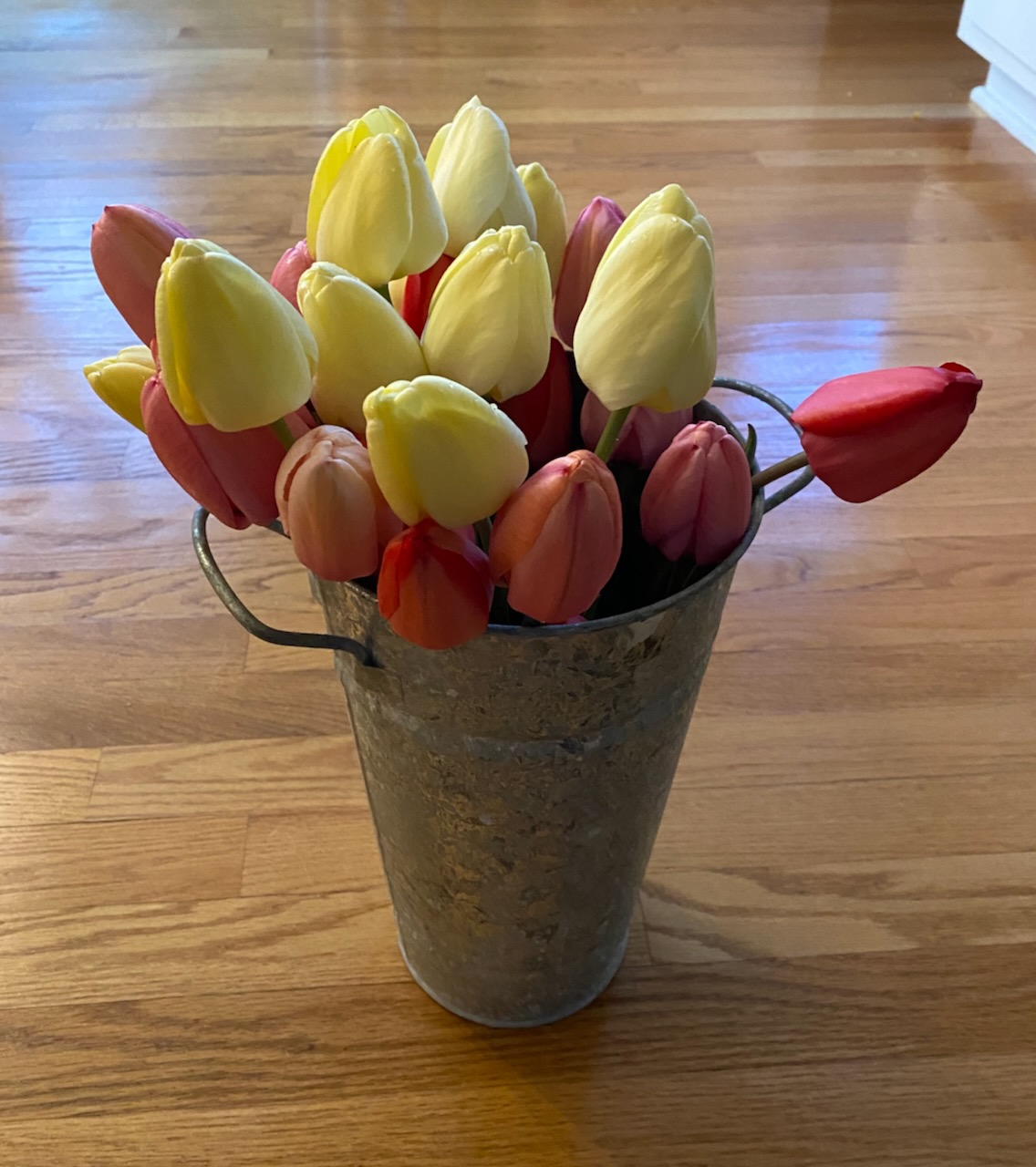 Every few days I go out with my flower bucket and cut a slew of Pink Impressions, Apricot Beauties, Salmon Pearls, and Darwin Whites from the garden’s largesse, and move Spring into the house.
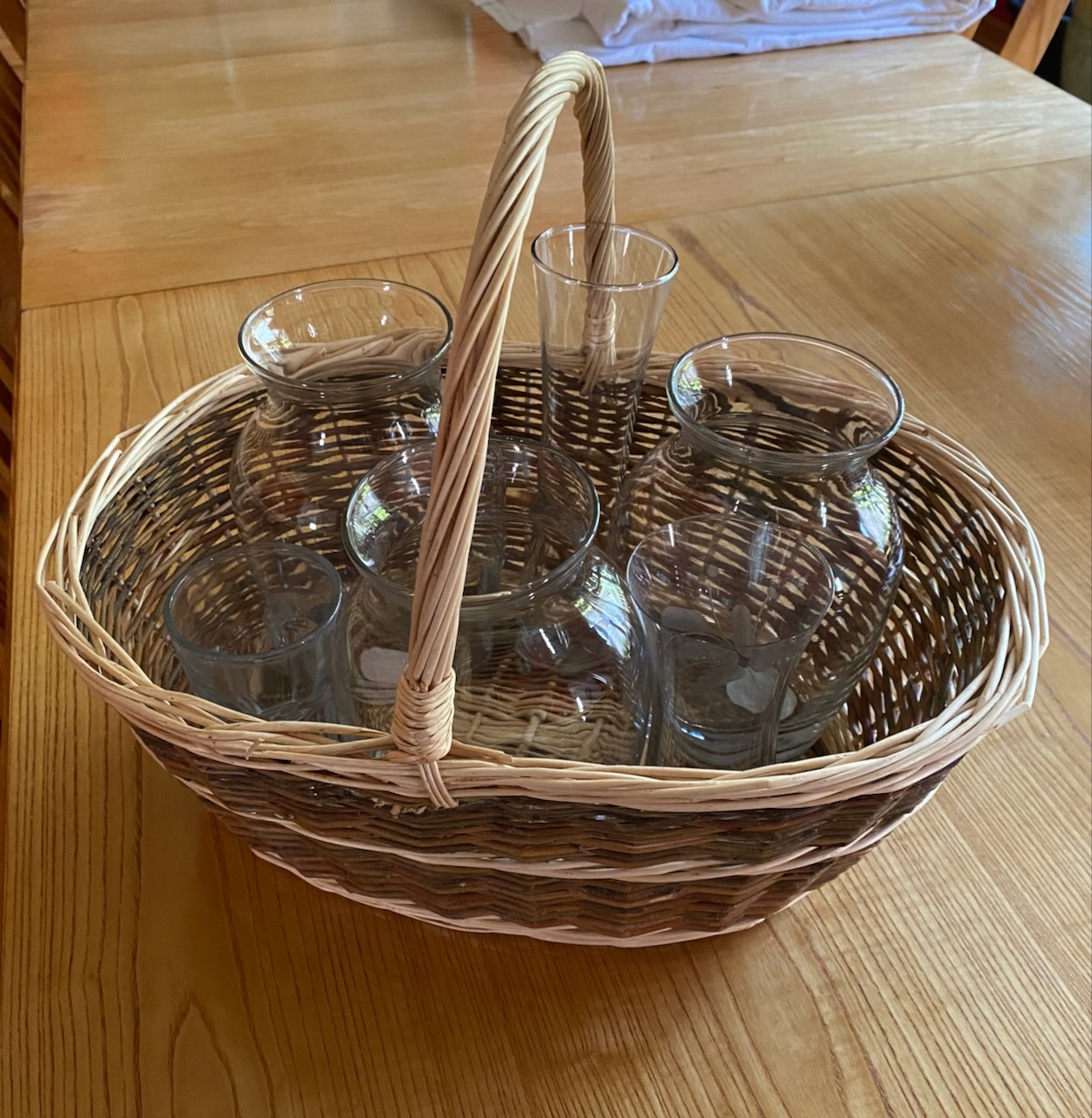 I’ve already been picking daffodils since late March, but the thing about daffodils is, if you put them in a vase with other flowers the other flowers will die. The culprit is said to be daffodil sap, which protects them from being eaten by critters and allows me to plant them anywhere at all in the whole yard. Fierce stuff. Cut daffodils have to be sequestered in their own vase for an amount of time that depends on how fresh the daffs are and how sensitive the other flowers. Some people give them just a couple of hours, but I haven’t had such luck. To get around the timing problem and still have mixed bouquets, I use several small vases set next to each other, for example like this basket containing three medium and three small vases.
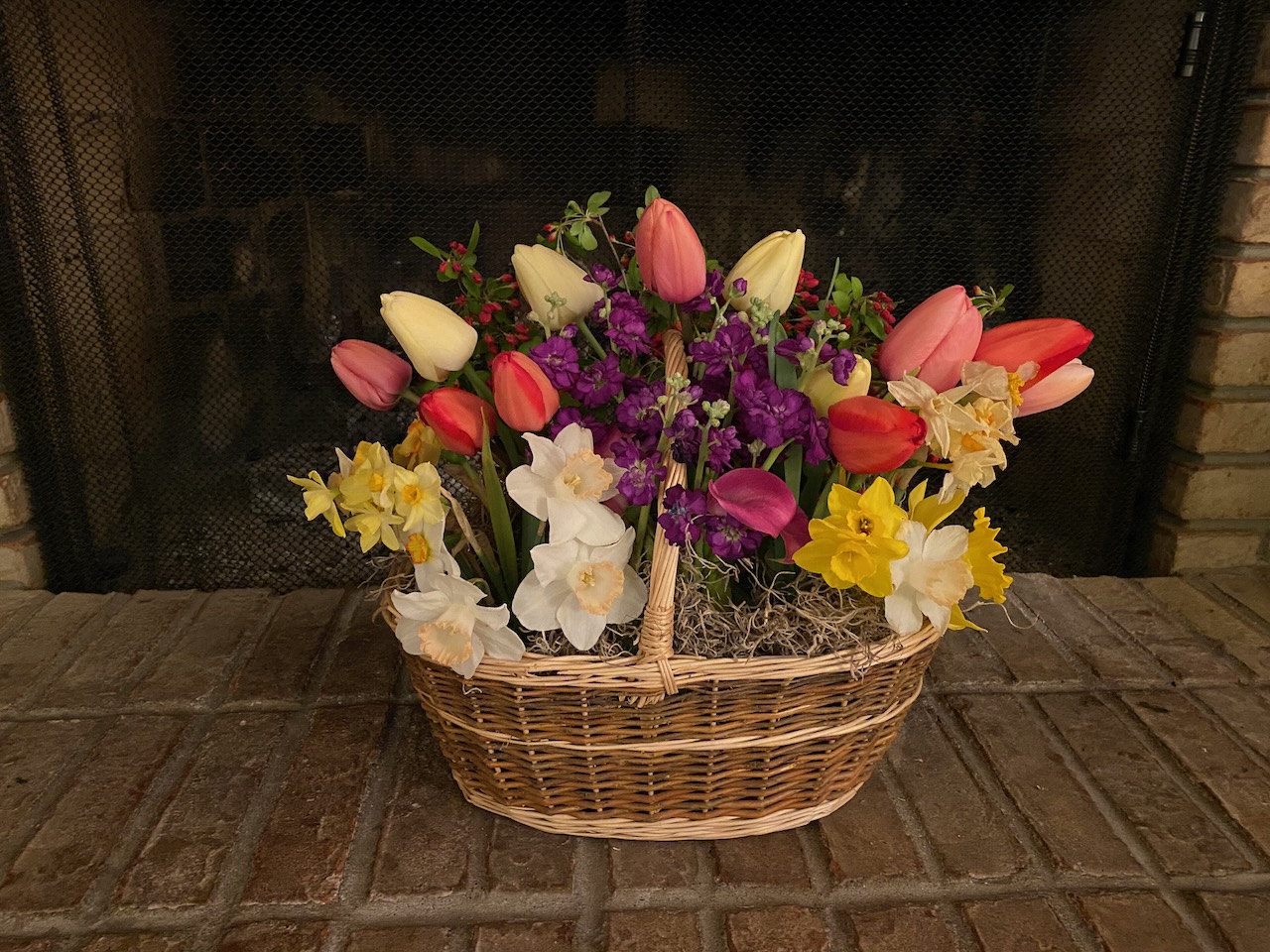 When I put my current arrangement together the two small outer vases got only daffodils, leaving the tulips and other flora in peace. A little moss covers the vase edges, and the basket pulls it all into a nice, tidy, well-balanced array for the living room.
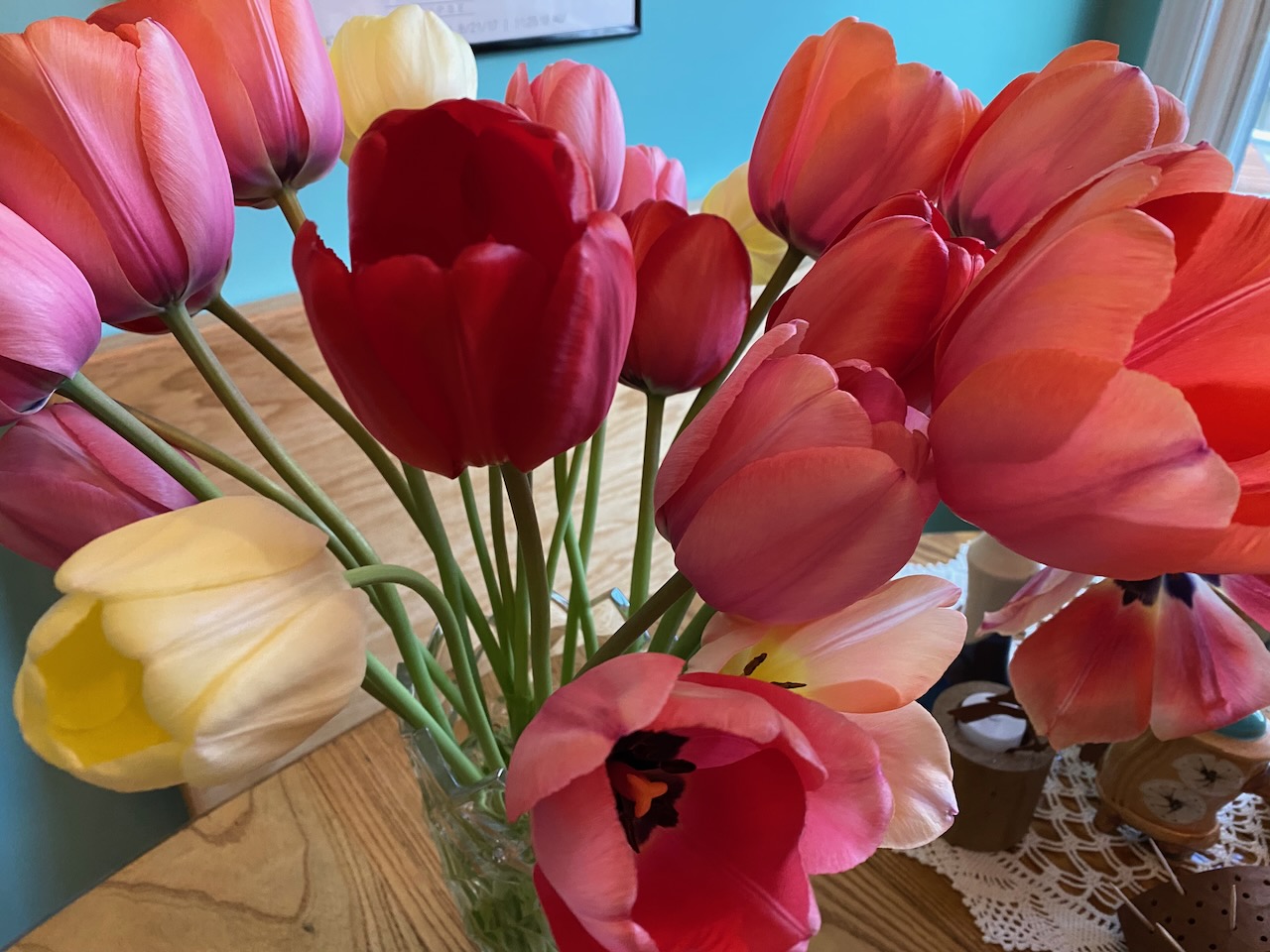 But sometimes nice and tidy just doesn’t cut it. For those times, I get out my big crystal vase and let the tulips go wild.
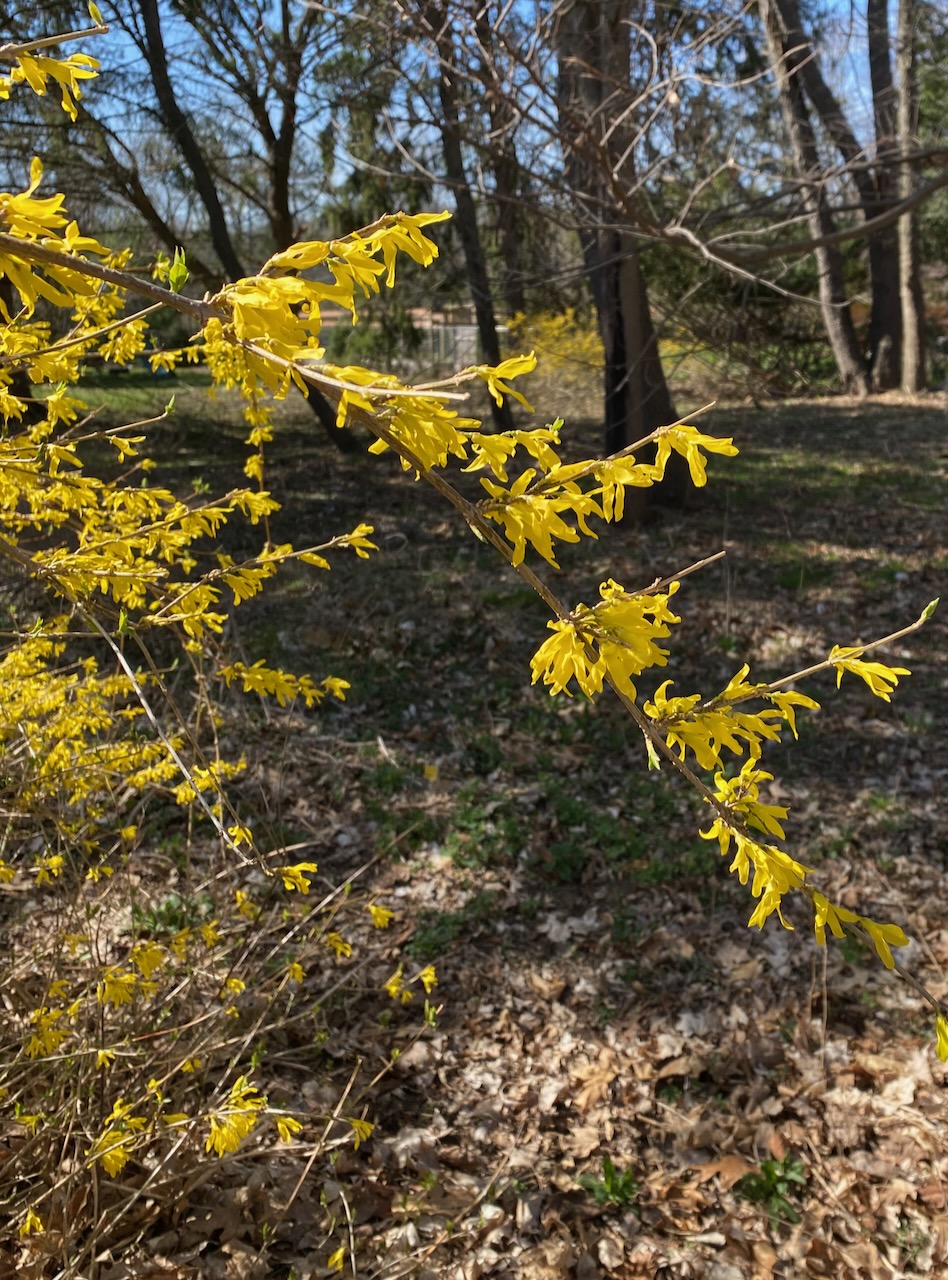
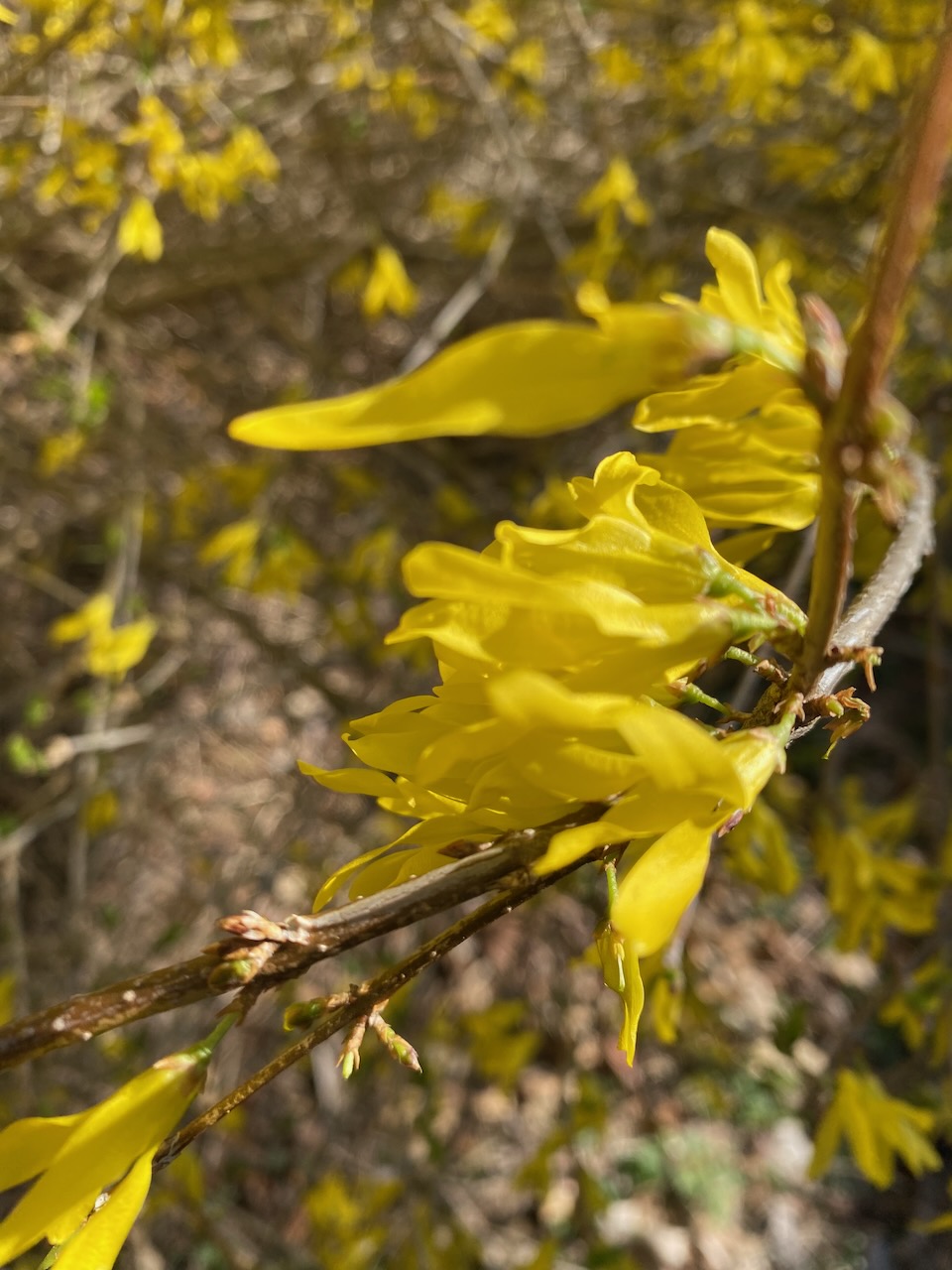
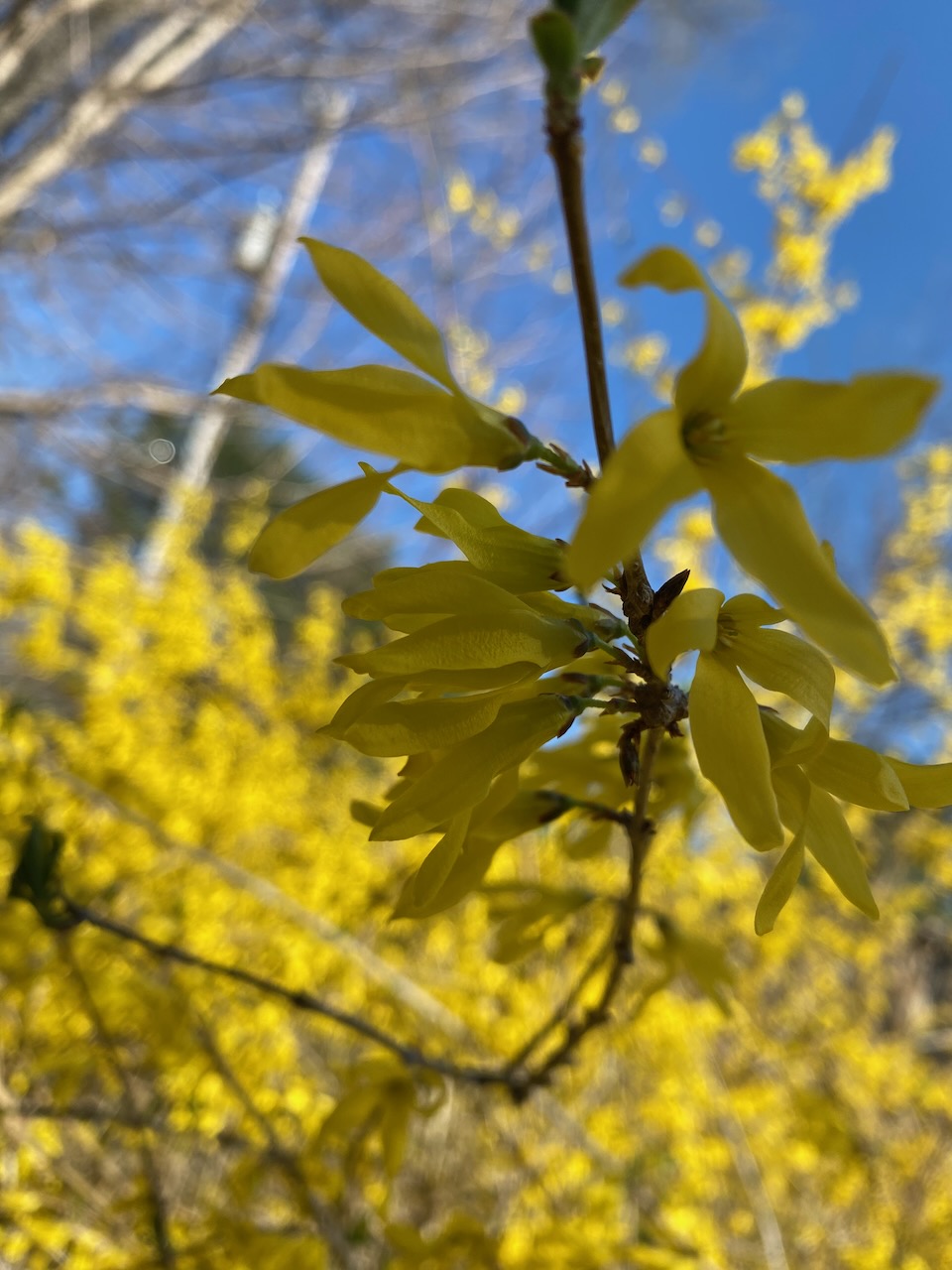 My niece Cynthia once told me that when she was a small child, her mother told her these bright yellow flowering branches were named in her honor: For Cynthia. I can just hear my sister saying it, and I must add it’s an improvement on the truth. How much lovelier to have a brilliant source of cheer and hope named for a little girl, rather than for a Scottish botanist. But of course, it was the Scottish botanist who earned the privilege of horticultural immortality, through having introduced the Chinese plant to Britain. In China the fruit of forsythia was used in traditional herbal medicine to treat colds, fevers, bronchitis, and allergies, though in Britain the shrub was purely ornamental. You may be surprised to hear that forsythia has fruit. After putting all that gold into its flowers, the fruits are small, dry, and brownish, and look rather like husks of leftover sepals. Forsythia is also a member of the olive family, and doesn’t look like that either.
 Naturally, it has inspired many poets. Mary Ellen Solt’s
  Nothing Gold Can Stay
 Robin Richstone