I was just settling in to weed the shade garden under the wild black cherry tree, when I noticed an errant overhanging lilac branch and raised my clippers into it. Suddenly, out of nowhere, a robin – a robin! – dive-bombed me, bopping me on the head and pooping on my cheek as it flew away. I had an extraordinarily close-up view of a wing and a red breast for probably half a second, and was so startled I dropped the clippers.
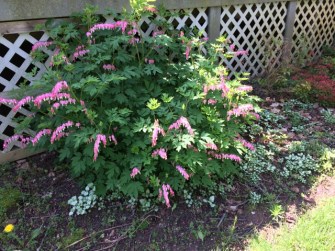
the shade garden
And then I started laughing. Here I was with my large size (compared to a bird) and my sharp pointed tools, but the robin easily won. When you’re been pooped on by a bird you absolutely have to stop what you’re doing and go wash it off. It might not be effective against other predators, but it was an adaptation well tailored to human-bearing suburbs.
Once I was cleaned up, I went back out to see where the nest was; because the only thing that could motivate a small bird to attack something like me, was danger to its offspring. The nest was about ten feet from where I raised my clippers. I wanted to be sure so I could stay clear of it, and not upset such a devoted parent again.
I’ve watched robins dive-bomb the eagle when he sat too near a nest, and I thought they were very brave. Knowing my own intentions, I don’t think of myself as a potential threat – but how would the robins know my intentions? How would any creature? They guess, and they err on the side of safety. It’s so easy to be wrong.
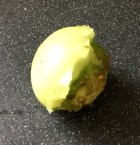 Though the garden is bunny-proofed and deer-proofed, there is no proofing against squirrels. They leap around in the treetops as a feint, then parachute into the garden. Though they mostly confine themselves to planting and digging up acorns and walnuts, this is the second year in a row that I’ve had them marauding among my tomatoes.
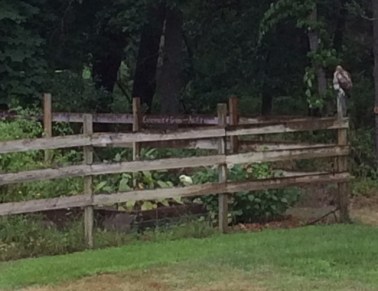 So I was pleased to go out the other morning and find Juvie Eagle sitting on one of the fenceposts, peering into the garden. I didn’t see him make any squirrel strikes, but I didn’t see any squirrels, either. Not anywhere in the whole yard. There were only the usual jays and robins making a racket and dive-bombing Juvie, who shrugged them off. After a while he spread his glorious wings and flew up onto the roof of the house, out of sight from where I stood.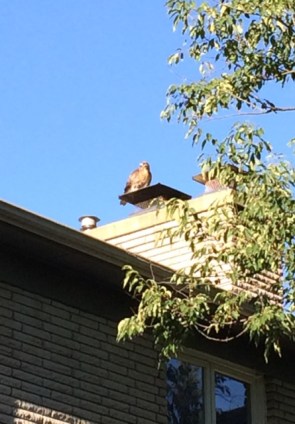
 McGovern smiled innocently. “It’s my flag,” he said.
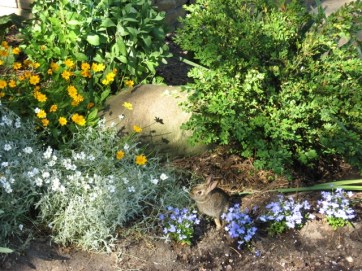
 Memorial Day used to mark the start of the gardening season in Ann Arbor, the date after which you could be reasonably certain your new plants would not be killed by frost. Then the garden catalogs began to arrive with new information. This, they said up front, was not a political statement and they did not want to get into any political arguments. It was just their duty, as provider of my seeds and plants, to notify me that my Ann Arbor garden was no longer in Zone 5. It was now Zone 6a. I could start planting on Mother’s Day.
 Flowers carry so many associations. They fill the bride’s hand, grace the table on Mother’s Day, wreathe headstones on Memorial Day, and have done these jobs for a long time. Fossil pollen has been found in burials from thousands of years ago; if we had wedding fossils I’d bet there would be flower remnants there, too. Flowers, fragile and short-lived, do a lot of emotional heavy lifting for us. Speaking for us in difficult situations, they are also traditionally used in apologies and fence-mending, activities that always seem to be in short supply right when we need them most. So, grow some flowers. Give them to someone you’ve had a disagreement with. Start a dialogue.
 a fescue. We took out a flowering shrub that needed more space than it could have. We put in some compact lavenders. We nestled a few succulents around the stepping stones. Julius handled the watering, pulling the curly hose along, pointing its spray nozzle at the new plants, and bending down to them with a big smile.
 Daffodils are the clear choice for spring bulbs here, because we have lots of deer. Deer eat tulips, not daffodils. You could plant tulips anyway, curse the deer as the tulips are beheaded and trampled, and join the vast army of trolls contributing only negative comments to the social enterprise. Catastrophizing. Getting so pumped from your own outrage that you lose sight of any flowers, at all.
 I expected to be outside weeding and planting perennials by now, but the ground is too cold and too wet and not good to stomp around on in its current, compactible state. We’ve had some little lost snowfalls – forlorn flakes blowing around with a what-am-I-doing-here look to them.
 through personal connection – someone who taught at the reservation told her friends, who told their friends. The people shivering in the cold were no longer “them.” They became “us.” Small-scale solutions are often criticized as being a patchwork, but whole big, bed-covering, life-warming quilts are made that way. Patch by patch. Piece by piece.
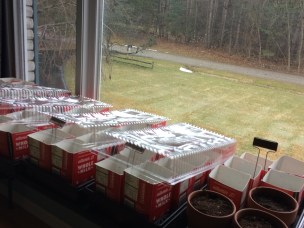 full of dirt. In went the seeds: Black Pearl and Supersteak tomatoes as usual, and a new bush variety I decided to try; Japanese eggplant; and cucumbers for my niece who likes to work in the garden with me. And lots of white Profusion zinnias. Seeds for the big zinnias will go directly in the ground, but I like to give these little ones a head start to help them stand up to marauding woodchucks. My neighbor tells me that when she sees the cartons lined up in that big front window, she knows spring is really on the way.
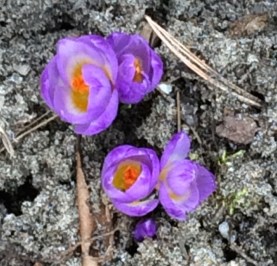
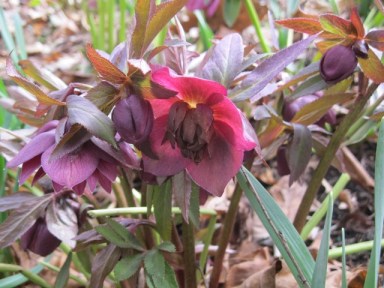 know they are because Facebook, helpfully, keeps sending me images marked “last year” and “two years ago today,” and what’s out there now is pathetic by comparison. But the hellebores and crocuses are holding down the fort, and I think there will be daffodils tomorrow. They’re that close to bursting out of their sheaths.
 Robin Richstone