When Goats and Rowers Are Not Enough

I hadn’t lived in Michigan very long before I discovered that the lovely, nodding plants with the delicate white flowers filling the woods in the backyard, were an invasive plague: garlic mustard, a classic example of a right thing in a wrong place. It was brought here from Europe as a beloved garden herb, but whatever kept it in check in that hemisphere is missing from this one. It grows from inch-high to knee-high seemingly overnight, choking out other plants both wild and domestic. It seeds like a maniac, and has to be pulled up by the roots or it regroups with a vengeance. Mowing makes it worse.

I turned to my local sources for ideas on eradicating it. Burning down the entire back yard didn’t seem like a great plan. Chemicals lacked appeal. Renting a herd of goats was a much more charming option, or alternatively one could rent members of the university’s rowing club, which being a club instead of a team sport didn’t get a share of the football gate and had to raise its own money. The goats ate the garlic mustard, but I assume the rowers pulled it. I did try eating it myself, but I was not impressed.

The trouble with these methods was, they were perpetual. The garlic mustard always came back, and you had to cope with it all over again. I was thinking this over while inspecting some damage deer had caused in my yard. The deer herd has reached numbers that cannot be sustained by their usual eating habits and they are now nipping the buds off of flowers they never cared for in the past, and gnawing native shrubs down to the ground. But they never eat the garlic mustard. This means they are helping the garlic mustard compete for space and resources.

And so I advance my modest proposal. We need deer genetically engineered to eat garlic mustard. I promise I would make them welcome.
Growing a Poem

Though all kinds of lines and phrases for poems will occur to me while I’m working in the garden, I can’t do much with them until I write them down. I need the feedback of seeing the letters on the page. For prose – like the text of this post – the keyboard and computer screen fill that requirement perfectly. But for poems I must have pen and paper. This is not so much a mystical connection with ancient methods of communication as it is a matter of topography. What starts out as a line of a poem will inevitably develop branches, arrows, circles, and various degrees of cross-outs that must nevertheless remain legible for future reference. If you looked over my shoulder (but I never let anyone look over my shoulder so early in a poem’s life), you would see a rather smudgy doodle. Every doodly smudge of it carries information for me.

When I write a poem I spend a lot of time mentally flexing it in and out: how does it feel from this angle? What if I look at it this way? Does it look inward, or outward? What does it see, and what does it show? What about the line breaks? What would happen to them if I read this aloud? Words have undertones and overtones – do I want the ones that are sneaking in here? Can I nudge them in another direction? While I am writing this, can I picture you reading it? And should I be writing, like this, about poems, or should I be reading and writing poems themselves? Is this like looking at seed catalogs instead of weeding the garden? Any number of gardening metaphors could certainly apply. Or, I could go outside, and think about whether I’m weeding the garden to put off working on a poem, or working on a poem to put off weeding the garden.

The Season Here

In Pasadena, spring was a subtle presence: a difference of which things were blooming, a change in the quality of the light. It came in on tiptoe and was easy to miss if you didn’t pay close attention. It took me years to learn to recognize it, and I was proud when I did. It seemed a kind of secret knowledge, something newcomers to California didn’t get.

No such obliviousness can be sustained against the spring in Michigan. One minute the edges of all the streets are humped with a sulky rind of snow. The next, there’s a cannonade of bird, flower, leaf, and green, while the daylight once in such poor supply suddenly stretches improbably beyond the dinner hour, the dessert hour, even the coffee hour. Snow boots and down coats break open like chrysalises, and arms and legs emerge, waving tenderly in the sun. If a late chill sneaks back in, we are too dazed by glory to care.

spring

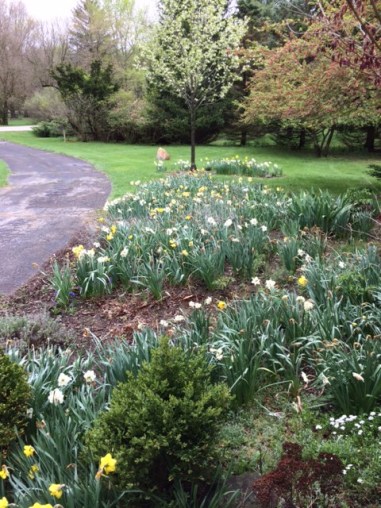
Under my windows hundreds of daffodils celebrate their inedibility, heart-shaped hoofprints showing where the deer stepped among them, prospecting, finding nothing they could eat. My daffodils’ triumph is the deer’s loss, but spring is generous. By now the deer are far away, eating someone’s tulips. I’ve seen it, walking around the neighborhood. It’s how I learned to plant daffodils.


Seedlings

Behind the double glass in my south-facing windows, rows of cut-down milk cartons sit in trays on folding tables, full of dirt and small green sprouts, luxuriating in the indoor warmth, encouraged by increasing hours of light, already a garden in my mind. All leg and a few leaves, they lean toward the light and I turn the trays around every day, trying to keep them straight. There are far more tomato plants coming than I can use, but I couldn’t deny every seed in a packet its chance for growth and glory. Also, I am greedy for tomatoes.

And they have good names. Is that a career path, thinking up names for new plant varieties? There is Black Pearl, a dark and early cherry tomato that begs my fingers to steal it from the vine; Supersteak, bursting out of its big red cape to leak all over the bacon and lettuce in a sandwich; Mortgage Lifter, enormous, prolific, cash crop leader; Black Krim, out of Ukraine and suited to a short growing season. An entire sonnet cycle, or maybe a biography, lurks in the pages of the Burpee catalog, with so many more that I had no room for. Pablo Neruda has already written them an ode: the tomato, he says, “sheds its own light.”

Notes From a Transplant

I’m a poet, a painter, and a gardener. Gardeners say a weed is a right thing in a wrong place, and getting things in their right places is at the center of making a rewarding poem, a good painting, or a satisfying garden.

When I moved to Michigan from Southern California a few years ago, I was certain everything I knew about gardening would be wrong. This confidence turned out to be misplaced. It was true I would no longer be planting sweet peas in October (we had no frost most years in Pasadena), but it was not true that all gardening came to a halt with the first Michigan frost. A nursery in Ann Arbor had a sale on perennials in October and I was suspicious; but, surprise, perennials like to spend their dormant time roots down in the dirt, in Zone Six or in Zone Ten. You still have to find the ones suited to your zone, and you still have to figure out how much sun and how much water each plant needs whether your drip irrigation comes from a hose or falls out of the sky. People will still tell you the special cures they swear by, and you will still have to find out which ones work in your garden.

What poets as well as gardeners do, is dig something out of one place and use it in another. If you think carefully about what you know, it’s not ever necessary to scrap it all and start over. It’s not even possible, since past knowledge clings. Some things, maybe not the ones you thought, will be useless, but some, maybe not the ones you expected, will carry through.

So welcome to my website and my blog, a collection of work I have done and work I am doing. There may be weeds, but I hope you’ll see the beauty I find among them.