It wasn’t until I moved to Ann Arbor that I went to a football game. Growing up, my experience of football was to walk through the room where my father was watching it on tv, see two lines of guys in helmets crash into each other, and hear my father yell “Idiots! Idiots!” This was not a compelling reason to sit down and watch the game. Eventually I learned to sit and watch it with Doug, who explained it much better than my Dad did.
But football permeates the air in Ann Arbor. Swaths of blue printed with large yellow block M’s are everywhere, including on people’s heads and chests. Streets downtown become suddenly deserted on autumn Saturday afternoons. You can go to a concert of Beethoven or Mozart and at intermission find half the women in the ladies room checking another kind of score on their smart phones. So when a neighbor offered us tickets to a real live game, I was curious and wanted to go.
It turned out to be a lot like attending the opera: a large stage; an engaged audience intent on letting the players know what they thought of the performance; fans who cared about it more than seemed sane; divas throwing tantrums over actions that were open to interpretation. I thought it was pretty wonderful and, like opera, completely different being in the same building with it, compared to watching a broadcast.
But a few days ago we went to the best football game ever. After struggling in the first two acts, our heroes came back after intermission, um, halftime, to overcome all difficulties in the third. Then in the fourth the magic happened: as it began to get dark, the first snow of the year came swirling down, backlit by tall racks of lights. The big stadium turned into a snowglobe. Snow feathered the teams, the fans; offense and defense threw up rooster tails of glitter while the disembodied voice of officialdom said, “the ball is somewhere near the middle of the field” and cheerleaders lay down to make snow angels. We won; it ended; players sledded, laughing, on their stomachs, threw snowballs, and made snow angels too. The whole sky had opened up in an ovation, crazy, generous. Just like opera.
And just what we needed. We were aching and sore from the difficult, muddy election we all dragged ourselves through, the one where the polls were unanimous that what everyone really wanted was for it to be over, but for the majority of us the end was a heartbreak. Like opera, the game and the snow remind us that setbacks exist to be overcome, that what looks like darkness can brighten in unexpected ways. There’s always possibility, and that’s something to be grateful for.
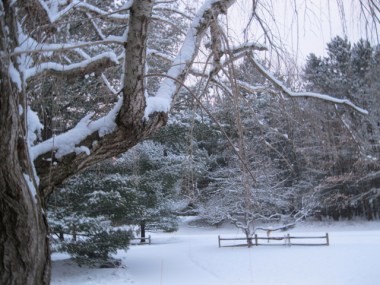 Something like that is going on outside right now – hard to say whether what’s falling is rain or snow. I saw footprints that looked suspiciously like the woodchuck, who should be asleep in her burrow until next month. She would not have seen her shadow this morning, but there’s nothing for her to eat so she’d be wise to go back to sleep. I wonder if she knows about Punxsutawney Phil. How did he end up getting all the woodchuck glory? Do you have to be a male woodchuck to get the job, and if so, how do we know Punxsutawney Phil qualifies? Did some foreign agency help him out? Are the deer behind this? I wouldn’t put anything past the deer.
 This name is most agreeable to a writer; and maybe that’s what makes me put so many of them into saucers full of pebbles or pots of dirt, set them near my desk, water them, and hope. Other narcissi – big yellow jonquils, white, yellow, and even pink daffodils – are waiting patiently in their beds in the yard and garden, for spring. Because I nudge the paperwhites into bloom in January, they represent winter to me, not spring: winter as pure beauty. Winter to be appreciated for itself, not as a way-station to somewhere else. This is how I look at them, as a kind of indoor snow, but the paperwhites themselves lean against the window glass. They grow toward the slowly increasing hours of light.
 This holiday means many things to many people, and nothing annoys one group like being told what it means to another. The Christian, the Secular, the Druidical, all sides have made arguments for ownership. The central factor in everybody’s story is light overcoming darkness, yet there are partisans unwilling to concede even that their stories have a central factor, let alone what it is. Trying to convince each other of the truth of your faith is difficult, because religious feeling is like love. When you love someone, you know it – it has perhaps hit you over the head with great insistence – but when you try to explain it to somebody else, well, you sound like a babbling idiot. Why do you love him? Because he’s wonderful. This is woefully lacking in detail. The only way anyone will understand it is, if they have been or are in love themselves, and recognize the futility of explanation. Emotional truth is not susceptible to logical argument.
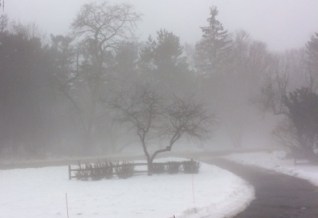 We woke up on the 26th to a warm rain and a world of fog. A row of deer stood in the backyard, silhouettes barely visible in the mist, like Santa’s off shift taking a well-earned break. It will be cold and snowy again, and soon, but today the grass stands up for the deer to graze, and no wind blows. Life is good.
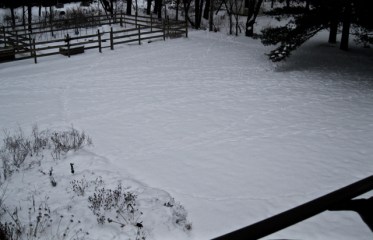 Winter dark comes so early and lasts so long, I don’t see much of the actual deer in late December. I see evidence of them written in the snow, a perfect map to the Deer Highway System, its on-ramps, and its rest stops. These are color photos, but look black and white because I took them at dusk, standing on my balcony looking down. No people walked across this yard. Some other animal tracks are mixed in there, but it’s mainly the deer, high-stepping when they leap with hurry, slow-dragging when they take their time. They prospect in the herb garden, but are disappointed in what they find.
 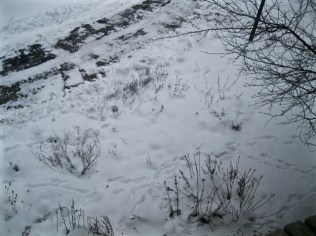 This is why the plants there are still standing. But the herd increases every year, so the deer know what they’re doing.
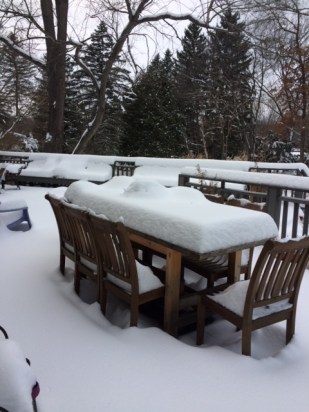 We heard the plow scraping in the night as it passed under the second-story bedroom window, and woke to find every twig of each tree made bold with a thick white brushstroke. Monday morning dawned to ten inches of stacked and powdery snow altering shapes and altering perception: a forgotten cushion, an upturned tub, a sledding hill for hardy squirrels, all these were potential to every windblown drift. School, we heard, would be cancelled. Is there such a thing as a child who does not root for the snow?
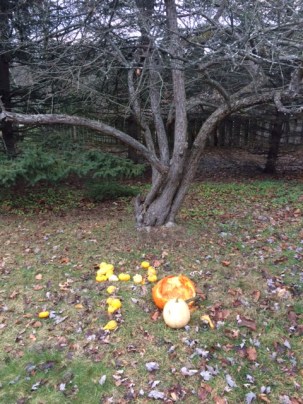 But so far this year snow has been a casual visitor, stopping in for tea and gone again in a matter of hours. Fall temperatures linger, but as hours of daylight continue their decline the garden drifts deeper and deeper into sleep.
 Robin Richstone