
herb garden in august
There are many positive interactions between a newspaper and a garden. Stressful current events come at you more slowly when you read them on paper in natural daylight, while the peace and calm of the garden provide another focus when you need to stop and regain composure, so often the case these days. Raise your eyes from the paper, look out across the garden, admire your handiwork, and muse on what to do next. The garden is a place you can always do something about.
Sunday is the best day for this, actual news being confined to one section. Among the other sections you can read about gardens to visit, find reviews of gardening books, see photos of garden parties in rich people’s back yards, and maybe find a few ads for useful things to wear or use while gardening. Apart from all that, you can read the Sunday Times for the quality of the writing. Felicitous phrases abound. How can you not love reading that morning people are “firing up coffeepots at an hour usually reserved for mating fruit bats.”
And then you get to the prize at the bottom of the Crackerjack box: the crossword puzzle. In especially lucky weeks you get the acrostic, too.
When you finish extracting information from the paper, you can put it to one more use. Take the paper, a bucket of water, and a wheelbarrow full of mulch out to the next area where you’d like to kill a swath of weeds or grass, lay the paper three or
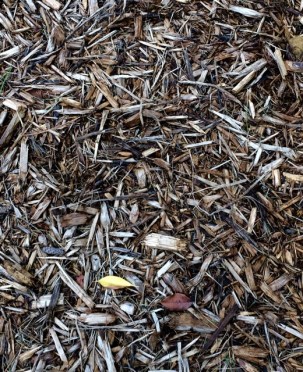
mulch with nyt
four sheets thick right over the weedy grassy whatever, water it from the bucket so it doesn’t blow around, and spread the mulch on top about three inches thick. With a nice big paper like the Sunday New York Times you can cover a lot of ground. Nothing will grow up through it. It’s satisfying to see facts stamping out chaos.
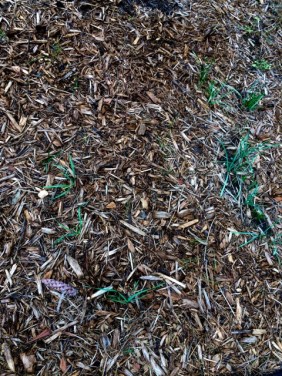
mulch without nyt
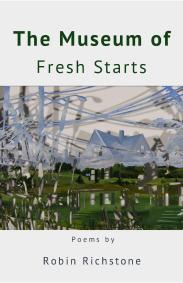 My chapbook of poems, The Museum of Fresh Starts, is being published by Finishing Line Press. The book is 18 poems connected by a theme of migration, change, and the need for refuge. It will be published on March 29 but you can pre-order it here to help determine the press run.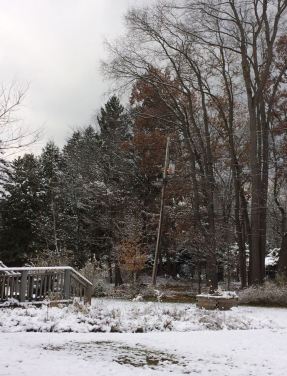


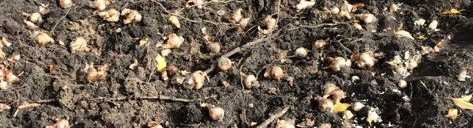
 It takes a lot of walking in autumn leaves, planting bulbs, and puttering in the garden to get some peace these days amid the slogans and shouting. Nature, at least, is ready for change: leaves turn bright and fall away, juvie eagles are gone to fish in open water somewhere else. We’ve had a rainy October and the colors were late in coming, but here they are, lighting up trees before drifting down to mulch the winter ground, the end of one growing season and preparation for another.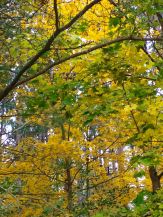
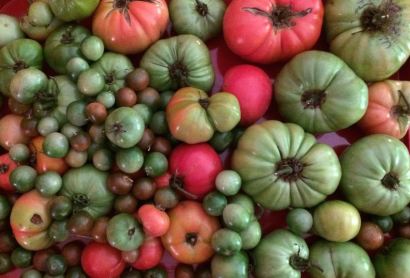 For something with such a material result, gardening is mysteriously satisfying to the spirit. Tomatoes can be beautiful, but I grow them to eat. I grow them for a material benefit to my physical body. But I buy most of the food I eat and could easily buy all of it; why do I garden? The transformation of dirt, water, seed, and sunlight into a substance nourishing to cell and sinew, supplying the gardener with the power to move, think, and write blog posts, is the most ordinary fact of existence on earth; still, the ripe tomato in my hand seems miraculous.
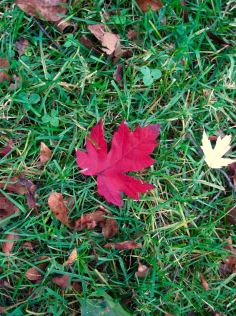 predicted overnight. Ripening is what tomatoes do, and they will continue to do it indoors, slowly, without leaf or vine. It is in them to do it; they participate directly in that large universal scheme. The vines spent the night open to the cold sky and this morning they are withered, the blackened leaves of tomato plants sifted over by red leaves falling from the nearby maples. I stand in this wide sweep of time, lifted into the flow of seasons, and for the moment not even needing to make plans.
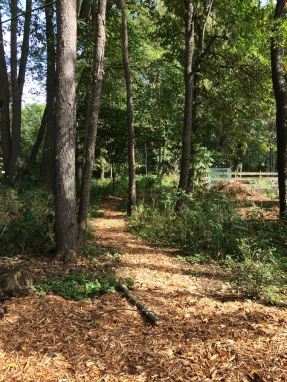 This is what some of that ambition led to. We ran out of New York Times and had to use packing paper, brown paper grocery bags, and random pieces of cardboard for the base. Many barrowloads of mulch later we had a lovely winding path with places to stop and look, or sketch, or sit. My idea was to mark out areas where certain plants could be encouraged or yanked out – confining (good luck) raspberry brambles here; spreading a fern bed (more likely) there. It also made it possible to visit the redbud and the kousa dogwood we’d planted back deep. If I can find more shrubby perennials this late I will plant them in the bends of the path, but it may have to wait for spring.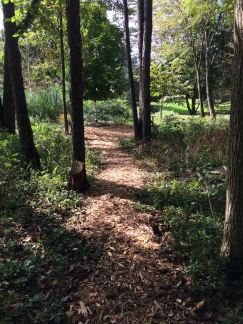
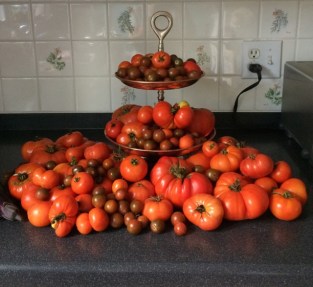 The garden right now is Easy Street. Weeds and bugs have slowed down with the cooler nights and shorter days, while the tomatoes keep rolling in like it’s still mid-August. Mostly all I have to do is go out there with a gathering basket and let the gorgeous ripe delectable tomatoes fall into my open hands.
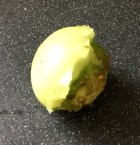 Though the garden is bunny-proofed and deer-proofed, there is no proofing against squirrels. They leap around in the treetops as a feint, then parachute into the garden. Though they mostly confine themselves to planting and digging up acorns and walnuts, this is the second year in a row that I’ve had them marauding among my tomatoes.
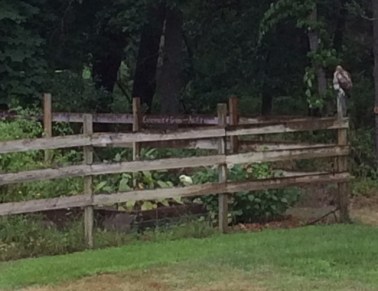 So I was pleased to go out the other morning and find Juvie Eagle sitting on one of the fenceposts, peering into the garden. I didn’t see him make any squirrel strikes, but I didn’t see any squirrels, either. Not anywhere in the whole yard. There were only the usual jays and robins making a racket and dive-bombing Juvie, who shrugged them off. After a while he spread his glorious wings and flew up onto the roof of the house, out of sight from where I stood.
 Robin Richstone