 The seeds I ordered have begun to arrive, with more of those wonderful names, some descriptive and some aspirational. Pumpkins are Baby Boo and Jack Be Little; cosmos are Snowpuff, Double Click, Apricotta, Cupcakes, Rosetta, Psyche White, Rose Bourbon, Versailles, and Sensation; zinnias are White Wedding, Forecast, State Fair, Zinderella, Peppermint Stick, Art Deco, Benary’s Giant, and Cut-and-Come-Again. I think I got too many flower seeds.
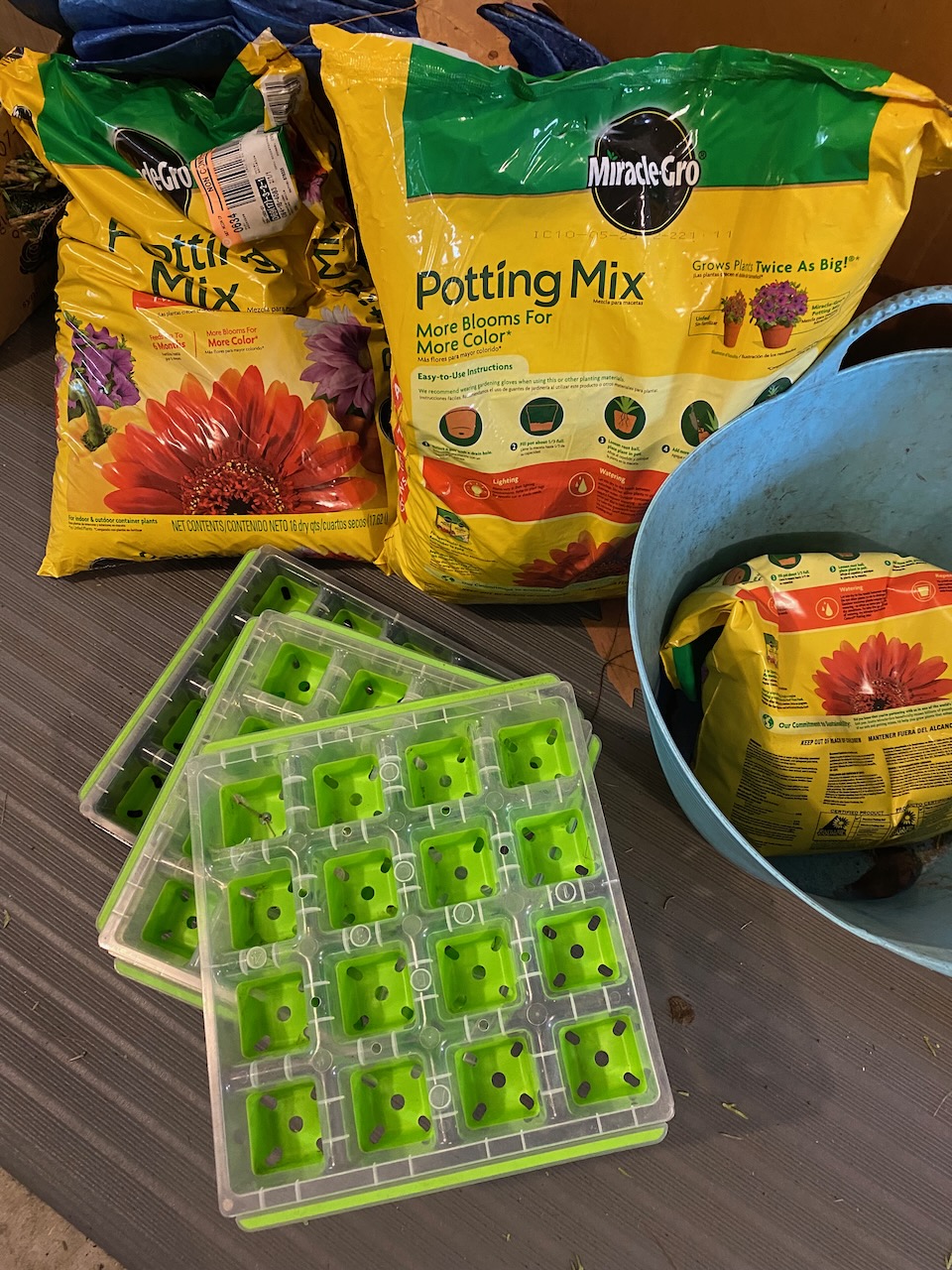 And that’s not counting the other flowers, the tomatoes, and a few veggies. How can I resist those names, those pictures, those catalog descriptions. Do other gardeners have this problem? Some seeds will go directly into the dirt outdoors; some need to be started inside. I used to cut down milk cartons for seed-starting pots, but now I get milk in glass bottles so I use an assortment: re-used plastic nursery pots, random containers found floating around the garage, and these spiffy pop-out-cell trays from Burpee. I use an assortment of potting soils, too, though only this brand was available to pose for its picture. At the moment I’m not convinced any one of them has an advantage for starting seeds.
 My winter flowers are currently prospering in one of my nice big south facing windows. Last time I took their photo there was snow on the other side of the glass, as there should be in February. Peeking past the amaryllis, you can see the snow is gone. This too-warm-for-February weather worries me – if the fruit trees bloom and then the freeze comes back it will knock all the blossoms down, and there goes the cherry crop.
 I’m not worried for the daffodils, though. They can take it. They’re making their way pretty much on schedule, green noses plumping up now with furled flowers. By the time my indoor flowers fade, the daffs should be coming into glory. My flower succession in summer plants is not as well regulated yet, but I’m working on it.

 Still February, the trees still hung with snow, but the bulbs on my windowsill are talking spring. They’re cozy enough on the plant stand Doug made for them, at a sunny, south-facing window with a heat register on the floor below. You can see Zerlina down there on her cushion, showing her appreciation with a nap.
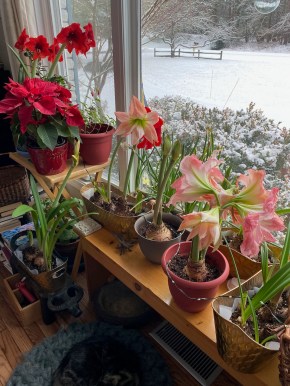 I mostly keep the amaryllis going from year to year, setting them outdoors when the weather warms up, lifting and storing the bulbs indoors in the fall, and potting them up again after Christmas. But every year I lose one or two, so every year I buy one or two new ones.
 This is a close-up of my new bulb this year, an Amadeus. Is it named for Mozart, or is it Beloved of God? Amaryllis is named for a shepherdess Virgil wrote about, in Latin, but the name apparently comes from Greek amarysso, to sparkle. And it’s native to South Africa. I would love to know its indigenous name, but the internet has not been forthcoming. There’s an International Association for Plant Taxonomy that oversees official plant names, but any seed catalog will reveal that common names are a mix of history and marketing. The names of tomato varieties are always fun, and frequently informative. Early Girl and Longkeeper are useful to know, while Mortgage Lifter and Supersteak evoke the plump and sizeable. Tomato is pretty close to its indigenous Nahuatl name, Tomatl. Far preferable to solanum lycopersicum.
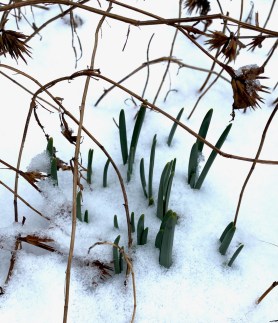 Meanwhile, the narcissus is starting to nose up through the snow. Narcissus should have a name joyfully recognizing how the flower announces spring, instead of being named for the fellow who fell in love with his own reflection. Is some kind of warning implied here, like not getting carried away by spring? Maybe Greeks, with their Mediterranean climate, didn’t understand the impact of spring on the rest of us. Our common name, daffodil, is a corruption of Asphodel, also Greek but a totally unrelated flower. It was good to corrupt it, since asphodel is associated with the underworld, but daffodil sounds like happy fun.
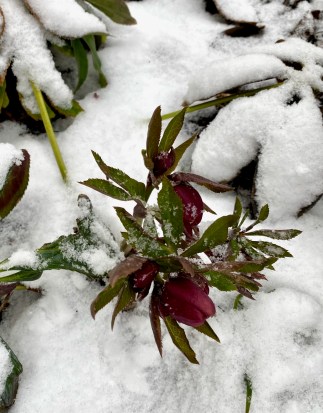 Hellebore is also a Greek name, possibly having to do with it being toxic, but it’s starting to bloom here in my yard, pushing the snow out of its way, right on time for its common name, Lenten Rose. It’s not a rose at all, but when you finally see a flower, even one that isn’t sweet, where no flower has dared go for months, let us call it a rose.
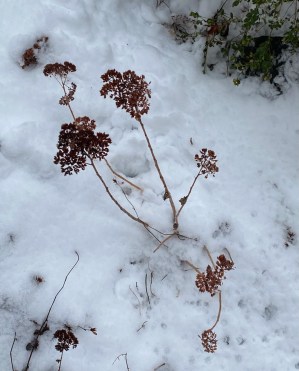 February second is Groundhog Day, when the groundhog and her shadow predict either six more weeks of winter or an early spring. Six weeks from February second only gets you to mid-March. How were they defining early spring? Mid-March is not spring in Michigan, and in California, where I used to live, February is not winter.
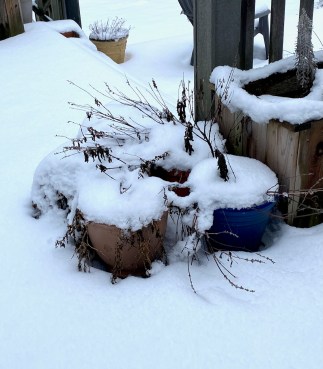 So where did the story come from? Ages ago in Ireland, February first was Imbolc, holiday of Brigid, the Gaelic goddess of spring and fertility. It was about as early in the year as you could tell the days were getting longer. Candles were lit in celebration of that and the possibility, in Ireland, of winter ending in fewer than six weeks. When Christianity came to Ireland Brigid became a saint, and her holiday Candlemass. Gaelic holidays ran from sunset of one day to sunset of the next, which I’m guessing is how it moved to February second.
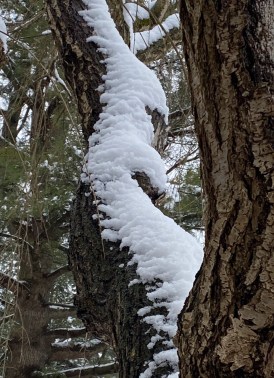 Animal behavior was often used in the past to predict weather, from hedgehogs to badgers to bears to groundhogs. There’s even a cat in Ohio who makes spring weather predictions by how he eats pierogi. The hope was that animals in their ancestral innocence and closeness to nature could tell, in ways we no longer could, whether conditions were ripe for moving out into the world. Punxsatawny Phil has been the one to watch since the 1880’s. He’s never been very accurate, but he completes the evolutionary cycle of many Western holidays (Halloween, for instance): from pagan religion, through Christianity, to secular. So we have Groundhog Day. Sadly, according to Wikipedia, “the observed behavior of groundhogs… was that they mostly come out of their burrows in mid-March, regardless of Groundhog Day weather.”
 Daylight grows but winter persists in February – it’s not a coincidence that Groundhog Day was a movie about being stuck in an endless time loop. But it was also a movie about taking advantage of endless time loops, making good use of the present. As A.E. Housman wrote:
 “And since to look at things in bloom
 Robin Richstone