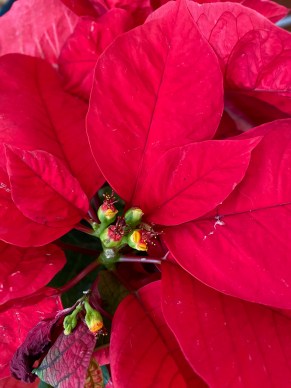
 It’s the time of year for poinsettias. I knew better than to put them out on my porch in the Michigan winter, but I hadn’t considered how to get them home from the store. When the checker at Arbor Farms pulled out florists’ tall paper bags for them and stapled the tops shut, I understood. Poinsettias are native to Mexico and Guatemala.
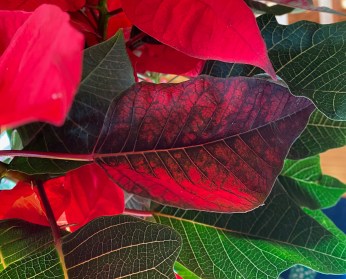 The Aztecs called them cuetlaxochitl, meaning “brilliant flower,” and the Maya called them k’alul wits, or “ember flower.” They acquired their English name, poinsettia, when Joel Robert Poinsett, the first U.S. ambassador to Mexico, brought them back with him in the early 1800’s. As a kid it never occurred to me that the plants were named for a person. I thought they were “pointsettas” because their leaves were pointy.
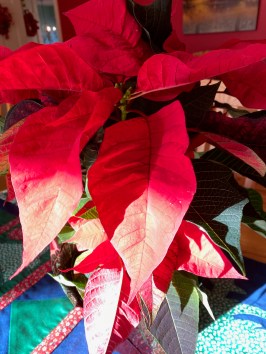 I looked up Poinsett’s biography, wondering what kind of character this beautiful plant got named for, and found he was quite a complex fellow. He had inherited an estate in South Carolina where people were enslaved, but became a leader of the Unionist Party, and opposed secession. He meddled in the affairs of Central and South American countries, annoying them with good intentions that were ill-conceived. As Martin Van Buren’s Secretary of War he took a scientific interest in mapping surveys of U.S. territories, but oversaw the Trail of Tears. And he was an enthusiastic world traveler and amateur botanist, which leads us back to why he brought this gorgeous plant home with him.
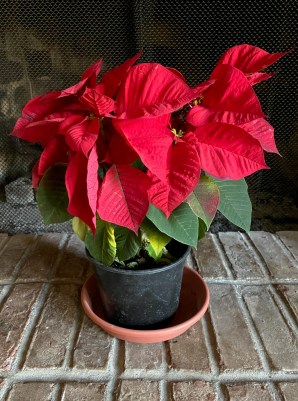 Poinsettias are a Christmas plant, so since Christmas is all about the possibility of redemption from sin, maybe it’s not so bad to name them for someone who generally meant well, according to the standards of the time and place in which he lived, but did badly by the standards of ours. Which of the things we commonly accept today will be considered heinous in the future?
 Robin Richstone