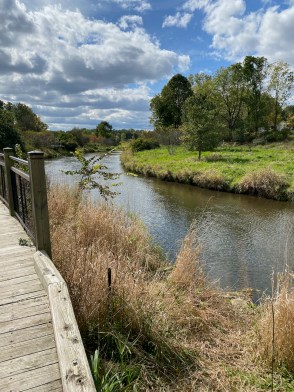
 How does it happen that in a country, any country, where most people want to live their lives in peace, they are carried into war? Some days ago I went for a walk with friends on a path along a creek, a new path but with friends I often walk with. There I was, putting one foot in front of the other, when it struck me how amazing it is to walk, temporarily balancing on one leg, then shifting to the other, without falling over. Standing on one leg is not easy at all, yet this constant switching from one to the other is so easy small children learn to do it. A rainstorm had gone, leaving bright, gorgeous clouds behind it. It was an ordinary walk on an ordinary day, and it was breathtakingly beautiful.
 Then I went home and read the news. Imagine the friends you walk with and the landscape you love most, grew up with, or live in now, destroyed by someone who thought that was a good idea. It’s hard to see how he could have believed this would make life better for his own people. Anger breeds more anger. Peace is hard for us.
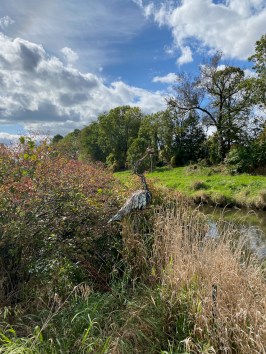 The path and the park along Mill Creek look peaceful, but nature is full of conflict. Fish come to the surface of the creek to eat insects. Herons and egrets spear the fish. Territorial disputes break out between birds. Territorial disputes, in fact, break out among many of our fellow creatures. We fit right in.
 But we do all sorts of things that other species don’t. We’re mammals but walk on two legs. We communicate, but at light speed all around the world. We believe we’re pretty smart. We should be able to think up a better way to deal with each other. William Butler Yeats said, “The best lack all conviction, while the worst/ Are full of passionate intensity.” Yeats wrote that over a hundred years ago, in a place thousands of miles from the current conflict. I like to believe that poetry expresses universal truths, things true not just in the moment but for all time. I hope this isn’t one of them.
 Robin Richstone