 Of course there are more weeds. They come back, sometimes with a vengeance. Many sources claim that weeds tell you about conditions in your soil, but there’s a lot of confusion around what they’re trying to say. Goldenrod and ox-eyed daisies are supposed to grow in wet, poorly drained soil, but they love my sandy, dry, fast-draining yard. I do like these two, but do they know that? Goldenrod lights up the end of summer, and ox-eyed daisies make excellent bouquets. The daisies get very happy standing in a vase of water all week, soggy at last.
Plantain, said to indicate clay soils, grows in the sandy stuff right next to the ox-eyed daisies; Queen Anne’s lace is supposed to like poor soil, but out along the road edges here it grows mixed in with chicory, which is supposed to indicate rich soil. More interesting is the claim for dandelions, which grow in compacted soil but get right to work loosening it up.
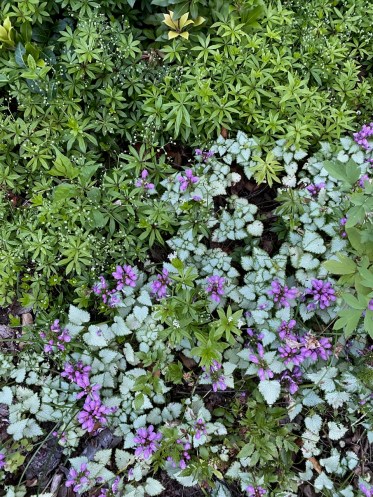 I’ve always pulled and tossed purslane, but having recently come across a trove of new purslane recipes here I may bring some of it into the kitchen and give it a try. And I was surprised to learn that woodruff is sometimes considered a weed. I like it as a groundcover, twining with the lamium.
So, for weeding, first you have to decide which are the weeds, retaining the right to reclassify as you go along. Then, remember weeding is an ongoing practice, not an event with a beginning and an end. It’s lovely to sit and enjoy a garden at the end of the day, but the real pleasure is in the gardening.
 Robin Richstone