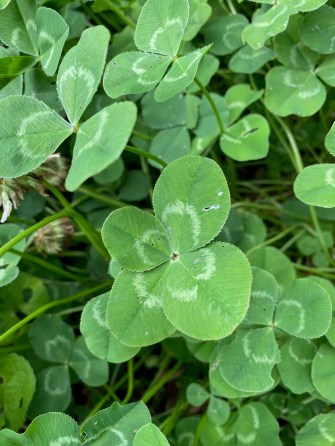
 The lawns of my suburban childhood were planted with a mix of grass and white clover. I remember being told this was because clover “fixes nitrogen,” which made me wonder what was wrong with it. You had to be very careful walking through the clover because it was full of bees, and since bees were said to be busy, I figured they were busy helping the clover fix nitrogen.
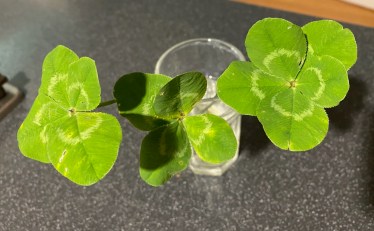 Bees or not, the best thing about clover was spending long afternoons looking through it for four-leafers. If you found a four leaf clover you had good luck and – in our neighborhood’s culture – you got to make a wish.
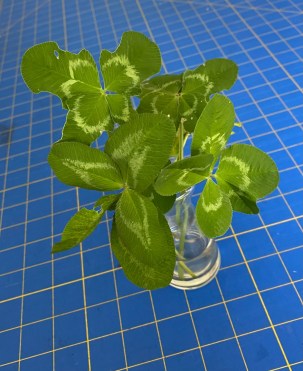 Having the internet right handy as I write, I looked this up: the probability of finding a four leaf clover is one in 5,000 or 1 in 10,000. Lucky me! In the last couple of years since I spread clover seed in the yard and garden, I have found dozens of four leaf clovers, possibly a hundred of them, plus many five-leafers and the occasional six leafer. They come from the same two clumps every time, so I’m assuming this is genetic rather than something weird going on in my garden. The tomatoes seem normal.
 I bring the lucky clovers indoors, make my wishes (one per stem), and put them in small vases. When they fade and dry I collect them in this basket. I can’t tell you what I wish for, because naturally if you tell anyone, your wish will not come true. But I will say it’s ambitious, it’s in the public interest, and so far it’s making headway.
 Robin Richstone