 Last Wednesday night we had three thunderstorms in a row between one and four a.m. About three o’clock the thunder was continuous, which means the lightning was. For some reason this inspired the local (electronic) paper to run an article on how good lightning is for your garden. Assuming it doesn’t knock over any trees that smash all your plants, that is. Lightning, it turns out, fixes nitrogen. This is the job that peas and clover famously do in the soil, but lightning does it right in the air. Nitrogen, of which our atmosphere is mostly composed, is a crucial requirement for plant growth but needs to be broken out of its sturdy molecular form, or “fixed,” so plants can use it. Lightning, you know, can kill people, so it’s pretty strong stuff.
So these thunderstorms, in addition to knocking out power to thousands of people in southeastern Michigan, were feeding my tomatoes. My tomatoes seemed grateful, but their main problem was still getting enough sunlight. Lightning didn’t help with that, but at least stormclouds in the middle of the night didn’t interfere.
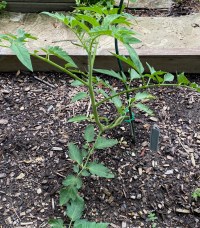 This is where the tomato house comes in. Here you see photographic evidence: on the left, your tomato plants in the garden, on four and a half hours of sunlight.
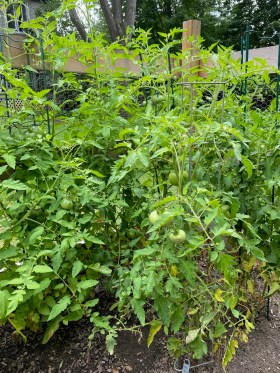 On the right, your tomato plants in the tomato house, on nine hours of sunlight.
The bouquet above shows that cosmos and zinnias can still manage in the somewhat shady garden, since they don’t have to go as far as producing fruit. I also found I could put in vines for baby pumpkins, because they will leap out of the bed and find sunlight for themselves. But except for the cold frame which inhabits a fortunate spot, the garden doesn’t do right by tomatoes any more. I’ll have to put more flowers, more gourds, or something else out there for the lightning to feed. For tomatoes, the tomato house rules.
 Saturday was a perfect summer day: lightly warm, little breezes pushing puffy clouds around, giving intermittent shade. With the blueberries harvested and the tomatoes not ready, I took my fishtail weeder in hand and went out to weed the garden.
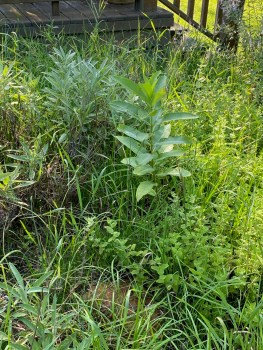 growing where you don’t want it, and one person’s weed is another’s treasure. Community values, current fashion, material needs, individual taste, and no doubt many other things factor into the decision: to pull or not to pull.
 Then here’s a raised bed full of nascent zinnias, edged by violets that have colonized the mulch on the garden path. They’re invasive but I love the scent of violets in spring, so I pull them back just enough to keep the path open.
 After I cleared out the excess violets, I discovered they were hiding a perfect example of right thing, wrong place: a baby redbud tree has sprung up inside the garden, exactly where no tree should be. I’m going to scout around the yard for a good spot for it, and it will be transplanted.
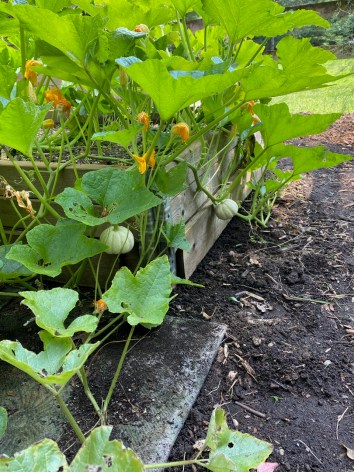 So I knelt happily on my foam pad, hands in the dirt, making order of chaos, and in a short time found another lovely surprise: Baby Boo pumpkins dangling like a string of Christmas lights. Mixed holiday metaphors, I know, but they did seem like a gift. I planted the seed, true, but dirt, rain, and sunlight did the rest.
 Robin Richstone